Act I
The elevator doors were closing when Daniel Brooks decided that a man in a wheelchair had wasted enough of his time.
“Come on!” the businessman snapped, checking the luxury watch on his wrist. “Some of us have actual meetings to get to.”
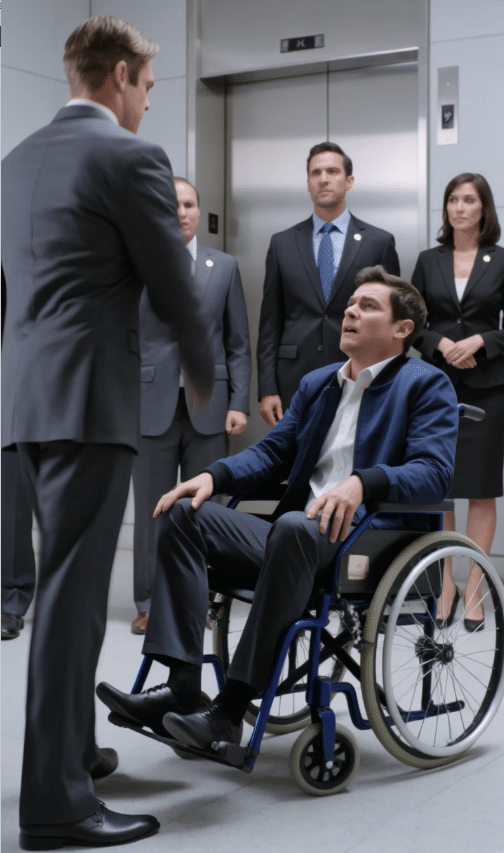
Mr. Hayes was fifty-two, dressed in a simple navy jacket and white shirt, with a thin folder of documents balanced across his lap. He was trying to angle his wheelchair through the narrowing elevator entrance without catching a wheel against the doorframe.
He needed only a few seconds.
Daniel had already decided those seconds were an insult.
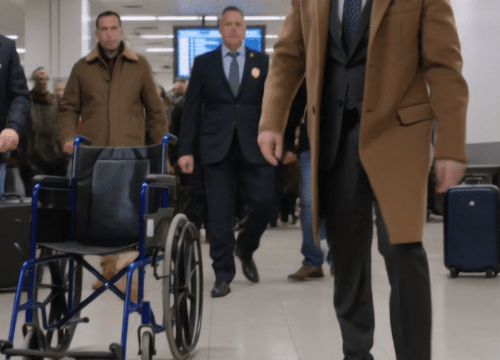
The elevator doors slid apart again as the sensor detected movement. A suited employee stepped back to make room, while another glanced nervously at the floor indicator above the doors. The lobby was filling with people heading toward morning meetings, and Daniel’s impatience seemed to grow with every passing second.
“Can you move any slower?” he demanded.
Mr. Hayes adjusted one wheel and tried again. His chair was almost aligned with the entrance, but the angle was wrong, and forcing it forward risked striking the door.
“I only needed a few seconds…” he said.
Daniel looked down at him with open contempt.
“Trash. You just wasted my meeting time.”
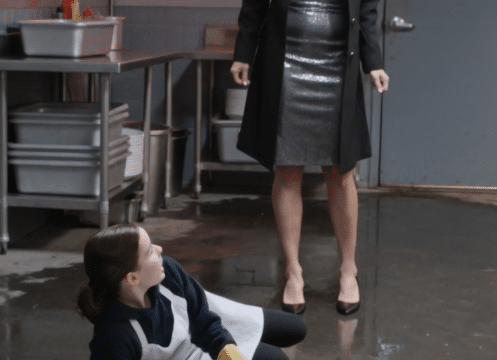
Before anyone could react, Daniel rushed forward and drove a brutal kick into Mr. Hayes’s chest.
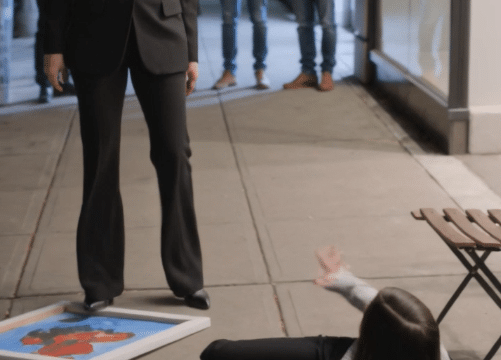
The impact threw him out of the wheelchair. He crashed onto the polished stone floor as his document folder flew open, papers scattering beneath the feet of startled employees. The wheelchair skidded sideways, one wheel spinning uselessly near the elevator threshold.
A thin trace of blood appeared on Mr. Hayes’s elbow where it struck the floor.
For a moment, the lobby seemed to stop breathing.
Mr. Hayes grimaced and tried to gather himself. His chest hurt, his arm burned, and the scattered pages that had been secured neatly in his folder now lay across the stone tiles.
Still, he reached for them.
Daniel stepped closer.
“Next time, wait where you belong.”
Then he kicked Mr. Hayes twice more while he lay on the floor, striking his back and side before stepping away as though he had merely cleared an obstacle from his path.
A woman near the reception desk covered her mouth. Two employees backed toward the wall. Someone dropped a coffee cup, and the sharp crack of porcelain seemed impossibly loud.
Nobody had expected a disagreement over an elevator to become an assault.
Nobody had expected the man in the wheelchair to be left reaching for his own papers while the businessman adjusted his suit.
Then the private executive elevator behind them opened sharply.
A woman in a dark formal suit strode into the lobby, accompanied by her senior assistant, two corporate security officers, and the building manager. Her expression was composed until she saw the wheelchair lying on its side and Mr. Hayes on the floor.
She moved toward him immediately.
“Get medical assistance,” she ordered.
Her assistant dropped to one knee and began gathering the scattered documents. The security officers positioned themselves between Daniel and the injured man.
The woman crouched beside Mr. Hayes, careful not to move him unnecessarily.
Then she looked at him with unmistakable concern.
“Mr. Hayes, the board is waiting for you.”
Daniel’s expression changed.
The confidence vanished from his face so quickly that it looked as if someone had switched off a light.
He stared at the woman, then at the man he had kicked, then back at the documents being gathered by the board chair’s assistant.
“The board?” he whispered.
For the first time that morning, Daniel Brooks understood that he might have made a mistake he could not talk his way out of.
But he still had no idea how much of his own future was sitting in that scattered folder.
Act II
Daniel Brooks had built his career around one simple belief: time belonged to important people, and everyone else was expected to accommodate them.
At forty-three, he was a senior vice president at Meridian Crest Holdings, a large investment and commercial property company with offices across the United States. He wore expensive suits, drove a luxury car, and had learned to speak in the confident, clipped tone of someone accustomed to having the last word.
He was ambitious, polished, and good at making executives believe that every success had been his idea.
He was also late that morning.
At nine o’clock, Meridian Crest’s board was scheduled to begin a special meeting concerning the future of one of its most important divisions. Daniel had spent weeks preparing for the presentation, convinced that the meeting would determine whether he became the company’s next chief operating officer.
He had told colleagues that the promotion was practically guaranteed.
He had even begun discussing the role with his wife as though the decision had already been made.
So when Mr. Hayes took a few extra seconds to enter the elevator, Daniel saw more than a delay. He saw a threat to the image he had constructed of himself: the decisive executive whose time mattered more than anyone else’s.
The man in the wheelchair had become, in Daniel’s mind, an inconvenience that needed to be corrected.
What Daniel did not know was that Mr. Hayes had not come to Meridian Crest to attend an ordinary meeting.
His full name was Samuel Hayes, and he had spent nearly twenty-five years helping the company become something more than a collection of buildings, investment accounts, and quarterly reports.
Before his accident, Samuel had been a senior operations executive who traveled constantly between regional offices. He was known for walking construction sites before sunrise, remembering employees’ names, and asking questions that made managers uncomfortable because they required honest answers.
He had never been the loudest person in a room.
He had never needed to be.
Seven years earlier, a serious spinal injury had changed his life. Rehabilitation was long, frustrating, and filled with small victories that other people rarely noticed. Learning to navigate unfamiliar buildings in a wheelchair had become a daily exercise in patience.
Samuel had returned to work gradually, first as an adviser and later as a member of the company’s governance committee. His experience had made him especially attentive to accessibility, employee safety, and the gap between a company’s public promises and the way people were treated when no senior executive was watching.
He had also helped establish the Hayes Access Initiative, a program that funded workplace accommodations, accessible transportation, and employment opportunities for people with disabilities.
The program was not named after him because he wanted recognition. The board had insisted after his initial funding helped save several promising projects that the company had considered too expensive to support.
Samuel had accepted the name reluctantly.
He preferred the work itself.
During the previous year, he had become increasingly concerned about how Meridian Crest treated employees and visitors who lacked influence. Internal complaints described inaccessible meeting spaces, managers who dismissed accommodation requests, and contractors who had been pressured to meet deadlines by ignoring safety procedures.
Samuel believed those complaints reflected a deeper problem.
The company had begun rewarding people for producing impressive numbers without asking enough questions about how those numbers were achieved.
Daniel was one of the executives whose division had attracted scrutiny.
His quarterly reports were exceptional. His projects were delivered on time, his presentations were persuasive, and he knew exactly which metrics would attract the board’s attention.
But beneath the polished results were troubling inconsistencies.
Several employees had reported that Daniel’s team discouraged them from documenting delays caused by accessibility failures. Others alleged that managers had been told to classify accommodation expenses as avoidable overhead so that project budgets would appear more efficient.
Those allegations had not yet been resolved. Samuel had insisted that they be examined carefully, with an independent review and an opportunity for everyone involved to respond.
The board had scheduled its special meeting to discuss the findings and determine the next steps.
Samuel had arrived that morning carrying a folder containing his recommendations, supporting documents, and a summary of the questions he believed the directors needed to answer.
He had planned to take the regular elevator because the main lobby was crowded and the private executive elevator was reserved for board members and authorized personnel.
He had not expected a confrontation.
He certainly had not expected Daniel Brooks to attack him.
Now, as the board chair knelt beside him, the meeting Daniel had spent weeks trying to control was about to begin under circumstances nobody could have anticipated.
And the papers scattered across the floor were no longer merely meeting documents.
They were the beginning of a reckoning.
Act III
The board chair was Eleanor Whitmore, a sixty-year-old executive who had led Meridian Crest’s board through acquisitions, financial crises, and several difficult leadership transitions.
Eleanor had a reputation for listening longer than most people expected and speaking only when she had reached a decision. She disliked public displays of authority, and she was especially suspicious of executives who used intimidation to make themselves appear strong.
When she saw Samuel on the floor, she did not ask who he was.
She knew.
She had worked beside him for more than a decade and had been one of the people who persuaded him to return to the company after his injury. She knew the effort it had taken for him to rebuild his professional life and the quiet determination behind his insistence that the company become more accessible.
She also knew why he was carrying that folder.
“Samuel,” she said softly, “don’t try to get up yet. We’re getting someone to examine you.”
“I can hear you,” he replied, wincing as he shifted his arm. “Just don’t let those pages disappear.”
Eleanor glanced toward her assistant.
“Keep everything together. Don’t discard anything.”
Then she turned to the building manager.
“Call the medical team and preserve the lobby security footage. I want the incident documented properly.”
Daniel took a step forward.
“Eleanor, this is being blown out of proportion.”
The board chair slowly stood.
“Do not come any closer.”
He stopped.
“It was an accident,” Daniel said quickly. “He was blocking the elevator, I was trying to get past, and—”
“An accident?” Eleanor repeated.
Daniel glanced around at the employees who had witnessed the attack.
No one supported his version.
He tried another approach.
“I have an important meeting. I was under pressure. You know how these mornings can get.”
Eleanor’s expression did not change.
“I know exactly how mornings can get. I also know the difference between being delayed and deliberately hurting someone.”
Daniel looked toward Samuel.
The man he had dismissed as an inconvenience was now surrounded by people who treated him with quiet respect. The building manager stood nearby, waiting for instructions. Eleanor’s assistant was collecting his documents with both hands, keeping them separate from the papers that had been scattered beneath the elevator.
Daniel suddenly noticed the first page.
At the top was the Meridian Crest emblem, followed by the heading Independent Governance Review: Executive Conduct and Accessibility Compliance.
He recognized the document.
He had received a notice about the review two weeks earlier. His legal team had advised him to cooperate and provide any requested records. Daniel had assumed the process was a routine exercise that would end with a few recommendations and no meaningful consequences.
He had not expected Samuel Hayes to be presenting the board’s final recommendations.
And he had certainly not expected to attack him before the meeting.
“Samuel,” Daniel began, forcing a smile, “I didn’t recognize you.”
Samuel looked up at him.
“That doesn’t explain what you did.”
Daniel’s smile faltered.
“I wasn’t thinking clearly.”
“You were thinking clearly enough to tell me where I belonged.”
The words were quiet, but they landed harder than a shout.
Daniel’s jaw tightened.
“I didn’t mean it that way.”
Samuel glanced toward the wheelchair lying on its side.
“Then what did you mean?”
Daniel had no answer that did not make him sound worse.
A member of the building’s medical response team arrived, followed by security staff who helped create space around Samuel. The medical professional asked him questions and checked his condition before arranging further assessment.
Eleanor remained close enough to hear the instructions but did not interfere.
When Samuel was ready to be moved, the team handled the transfer carefully and secured his wheelchair. His documents were placed in a separate folder, and a security officer recorded the names of the employees who had witnessed the incident.
Daniel watched it all with growing alarm.
He had spent years believing that his title would protect him from uncomfortable consequences. When a project failed, he blamed a department. When a deadline slipped, he blamed a contractor. When an employee complained, he described the person as difficult or resistant to change.
Now there was no spreadsheet he could adjust, no subordinate he could pressure into accepting responsibility, and no meeting-room presentation that could make the scene disappear.
Eleanor turned toward him.
“You will not attend the board meeting until the board has determined how to proceed. Security will accompany you while the incident is documented.”
“You can’t do this to me,” Daniel said.
“I can require that this matter be handled appropriately within the company’s procedures. The police will determine whether any law was broken, and the board will address your conduct as an executive.”
Daniel’s eyes darted toward the elevators.
He seemed to be calculating his options.
Then Eleanor said something that made him stop.
“The review you were worried about this morning is still going ahead.”
For the first time, Daniel looked genuinely frightened.
Because the assault was no longer an isolated incident in a crowded lobby.
It had happened just as the board was preparing to examine the culture he had helped create.
And the man he had kicked was the person who had insisted that the board look beyond Daniel’s impressive numbers.
Act IV
By late morning, the incident had become the most urgent matter at Meridian Crest’s headquarters.
The company did not announce a verdict or pretend that the lobby assault automatically proved every allegation in the governance review. Instead, its legal and security teams preserved the relevant records, cooperated with the appropriate authorities, and initiated the internal procedures that applied to alleged serious misconduct by an executive.
Daniel was placed on administrative leave while the company assessed the incident and the existing concerns about his division.
He was not allowed to contact employees who might be witnesses, and the review team continued its work independently of the criminal investigation.
For once, Daniel could not simply call a meeting and decide which version of events everyone would repeat.
The lobby footage showed the confrontation from multiple angles. It documented Samuel’s attempt to enter the elevator, Daniel’s aggressive approach, and the assault that followed. Witness statements provided additional context, while the scattered documents were retained as part of the record of the meeting Samuel had been preparing to attend.
The evidence did not need dramatic embellishment.
What had happened was already serious enough.
As the board convened later that day, Eleanor opened the meeting by making two things clear. First, Samuel’s medical care and the investigation into the assault would proceed separately from corporate decisions. Second, the board would not use the incident as an excuse to bypass its established process or reach conclusions unsupported by the evidence.
Samuel joined the discussion after receiving medical attention and when he was able to participate. He insisted that the directors focus on the broader review, not simply on what had happened to him.
“It’s easy to condemn someone after you’ve watched them do something indefensible,” he told the board. “The harder question is why our system allowed people to believe that this behavior was acceptable in the first place.”
The directors listened.
The independent review had identified several weaknesses in how accessibility concerns were handled across Daniel’s division. Some complaints had been closed without meaningful consultation with the people affected. Certain cost-saving measures had been approved without adequate review of their impact on employees and visitors with disabilities.
The review also raised questions about how performance targets were set and how managers were rewarded for meeting them.
Not every allegation had been substantiated. Some decisions had legitimate business explanations, and several employees had acted in good faith. But the pattern was concerning enough that the board could no longer treat the complaints as unrelated administrative problems.
Samuel presented his recommendations.
He proposed an independent accessibility audit, a confidential reporting process for employees, and clearer accountability for managers who failed to address accommodation requests. He also recommended that senior leaders be evaluated not only on financial performance but on whether their teams followed company policies and treated people with dignity.
A director asked whether the proposals would slow down projects.
Samuel did not pretend they would have no cost.
“Some changes will take time,” he replied. “But a system that works only when nobody needs an accommodation isn’t an efficient system. It’s a fragile one.”
Eleanor nodded.
The board agreed to implement the immediate safety and compliance measures while continuing to examine the unresolved findings. It also authorized a broader review of executive incentives, including whether managers had been rewarded for savings achieved by transferring hidden costs onto employees or contractors.
Daniel’s position was now uncertain for reasons far larger than the assault.
The company had to determine whether he had violated its conduct standards, whether his management decisions had contributed to the problems identified in the review, and what response was warranted under the applicable policies.
He would have an opportunity to respond to the allegations.
But he would not be permitted to control the investigation.
Outside the boardroom, Daniel sat in a private conference room with a company representative and his legal counsel. His phone had been set aside under the company’s procedures, and he had been instructed not to contact potential witnesses about the incident.
For the first time in his professional life, he was waiting for other people to decide what happened next.
He kept replaying Eleanor’s words.
Mr. Hayes, the board is waiting for you.
He had imagined the board waiting for him.
He had spent months believing that his results made him indispensable. He had assumed that a title, an expensive suit, and the right relationships would allow him to recover from almost any mistake.
He had never considered that the person he treated as an obstacle might be the person who understood the company better than he did.
When he finally requested a meeting with Eleanor, she agreed only after consulting the appropriate company representatives.
Daniel entered the room looking older than he had that morning.
“I need you to understand something,” he began. “I was under extraordinary pressure.”
Eleanor folded her hands on the table.
“I understand that you were under pressure.”
“I had a meeting that could determine my future.”
“And Mr. Hayes was trying to enter an elevator.”
Daniel looked down.
“I lost my temper.”
“You chose to assault someone.”
He flinched at the word.
“I know how it looked.”
Eleanor leaned forward slightly.
“Daniel, this is not about how it looked. It’s about what happened.”
For a moment, he seemed ready to argue. Then his shoulders dropped.
He had no explanation that could turn the assault into a scheduling problem.
Eleanor continued.
“The board will consider the evidence and the review findings. Those are separate matters, and you will have the opportunity to respond through the appropriate process. But I will not promise you a particular outcome, and I will not ask anyone to overlook what happened because you have delivered strong financial results.”
Daniel stared at the table.
He had spent years telling other people that professionalism meant putting business first.
Now he was discovering that professionalism also meant accepting limits on his own behavior.
And the man he had tried to push out of his way had become the clearest example of the values Daniel had failed to practice.
Act V
The consequences unfolded over the following months, not in a single dramatic announcement but through a series of decisions grounded in evidence.
The police investigation proceeded independently. The company completed its internal review under established procedures, and Daniel was given an opportunity to respond to the findings concerning both the assault and his leadership.
Ultimately, Meridian Crest determined that Daniel’s conduct was incompatible with the responsibilities of his position. The board removed him from his executive role, following the company’s governance process and review of the substantiated findings.
Any legal consequences arising from the assault were handled separately by the relevant authorities.
Daniel’s career did not end because Samuel Hayes possessed a powerful title. It ended at Meridian Crest because his behavior, examined alongside the evidence, demonstrated that he could not be trusted to exercise executive authority in accordance with the company’s standards.
The distinction mattered.
Eleanor made sure the board’s response did not become a public spectacle designed to humiliate him. There was no campaign to destroy his reputation beyond the legitimate consequences of the investigation. The company communicated what it needed to communicate, protected confidential information, and focused on correcting the weaknesses that had allowed the broader problems to persist.
For Samuel, the most important outcome was not Daniel’s departure.
It was what happened afterward.
The board approved an accessibility initiative that required every major office location to undergo an independent assessment. Elevator access, meeting rooms, emergency routes, and shared facilities were examined not only for technical compliance but for practical usability.
Employees and visitors with disabilities were invited to report barriers without having to persuade a manager that the problem mattered. Requests for accommodations were tracked, assigned to responsible teams, and reviewed to ensure they were not dismissed without explanation.
The company also changed how managers were evaluated.
Financial results remained important, but they were no longer the only measure of leadership. Executives were expected to demonstrate that their teams met safety standards, responded appropriately to complaints, and treated people with dignity.
Samuel chaired the first oversight meeting.
He arrived in his wheelchair, carrying a folder almost identical to the one that had scattered across the lobby floor. This time, the elevator doors remained open long enough for him to enter without rushing, and an employee stepped aside to give him the space he needed.
Nobody applauded.
Nobody announced his arrival.
He simply entered the meeting room and began the work.
That was how Samuel preferred it.
He knew that one incident could become a symbol, but symbols alone did not make buildings accessible or workplaces fair. Real change required budgets, clear responsibilities, honest reporting, and people willing to challenge decisions that looked efficient on paper but failed in practice.
Eleanor understood that, too.
At the next board meeting, she thanked Samuel for keeping the focus on the company’s responsibilities rather than allowing the assault to consume the entire discussion.
“You could have made this about what happened to you,” she said privately.
Samuel considered that.
“It was about what happened to me. But it shouldn’t end there.”
He looked toward the glass wall overlooking the city.
“Someone else will need those few seconds at an elevator. Someone else will need a door held open, a meeting room adjusted, or a manager willing to listen. If the only lesson we learn is that Daniel picked the wrong person to attack, we haven’t learned enough.”
Eleanor nodded.
That sentence became the guiding principle of the new initiative—not as a slogan on a wall, but as a test for decisions the company made every day.
Months later, Samuel returned to the lobby where the assault had occurred.
The polished stone floor had been cleaned long ago. The elevators opened and closed with their usual quiet precision. Employees hurried past reception carrying laptops, coffee cups, and the concerns of another busy morning.
For a moment, Samuel remembered the impact, the sudden pain, and the humiliation of lying on the floor while people watched.
He remembered the papers scattered around him.
He remembered Daniel’s voice telling him to wait where he belonged.
The memory still hurt.
But it no longer defined the place.
A young employee approached the elevator and noticed Samuel waiting near the entrance. She moved aside, checked that the doorway was clear, and gave him room to position his wheelchair.
“Take your time,” she said.
Samuel smiled.
“Thank you.”
The doors remained open as he entered.
There was no grand reveal this time. No board chair emerging from a private elevator. No security team rushing across the lobby. No businessman discovering too late that the person he had mistreated was connected to someone more powerful.
There was only an ordinary moment in which one person recognized that another person deserved the same consideration as anyone else.
And that, Samuel realized, was the change worth fighting for.
Daniel had believed that importance was measured by how quickly other people moved when he demanded it. He had mistaken impatience for authority and cruelty for strength.
He had kicked a man in a wheelchair because he believed the man could not possibly matter as much as his meeting.
Then the board chair stepped out of the elevator and called Samuel by name.
Daniel’s expression changed because he finally understood that Samuel was important.
But the deeper truth was that Samuel had never needed to be important to deserve respect.
He had needed a few seconds.
That was all.
And the company was finally learning that no person’s dignity should depend on whether someone powerful is watching.