Act I
“Please… I’m trying to get my papers.”
The woman on crutches was bent over the airport check-in counter, struggling to place her small suitcase on the luggage scale without losing her balance. Her beige coat had slipped off one shoulder, and several flight documents were trapped awkwardly between her fingers as she tried to keep one crutch from sliding across the polished floor.
Behind her, a businessman in a black suit checked his luxury watch for the fourth time in less than a minute.
He was forty-one, impeccably groomed, and visibly furious that the line had stopped moving.
“Come on,” he muttered, loud enough for everyone nearby to hear. “Some of us have flights to catch.”
The woman tried to straighten her papers.
The airline agent was waiting to scan her documents, but the suitcase had to be positioned correctly first. With only a limited amount of weight on one leg, every small movement required concentration. She shifted her crutch, reached toward the scale, and nearly lost her grip on the boarding documents.
“I’m sorry,” she whispered.
The businessman glanced at the departure board.
His flight was approaching its boarding deadline. He had spent the morning rushing through traffic, answering calls, and blaming everyone else for the schedule he had failed to manage. Now, he had found someone who could not move as quickly as he wanted.
He stepped closer.
“Trash. I’m about to miss my flight.”
The woman flinched at the insult but kept trying to finish checking in.
Then the businessman made a choice that stunned everyone around him.
As she leaned forward to place her suitcase properly on the scale, he drove a forceful kick into her back.
She fell face-down onto the airport floor.
Her crutch skidded away, her flight papers scattered across the tiles, and the suitcase slid off the scale with a heavy clatter. Her forearm struck the ground, leaving a thin trace of blood.
For a moment, the long passenger line went completely still.
The woman winced, shaking with pain. She tried to lift herself, but without her crutch, even sitting up was difficult. Somehow, she managed to keep a tight grip on the documents that had not slipped from her hand.
“Please…” she said again, her voice trembling. “I’m trying to get my papers.”
The businessman stood over her.
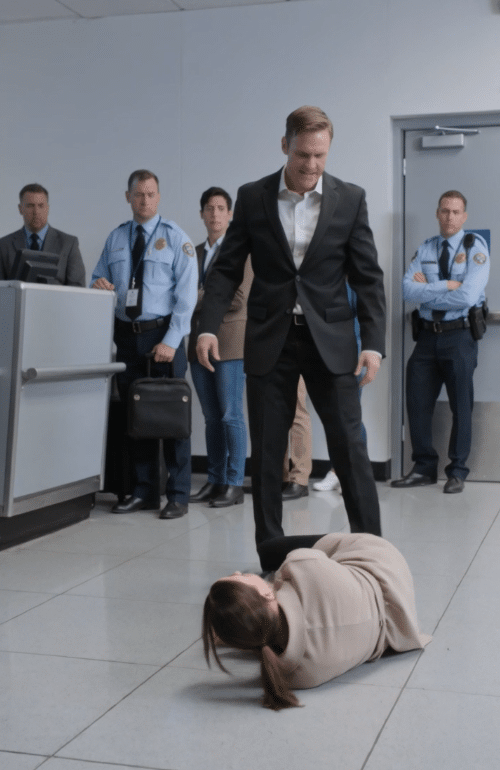
Instead of offering help, he stepped closer and delivered two more forceful kicks into her back and side.
A passenger gasped. Another covered her mouth and backed away. Several people stared in disbelief, but no one moved toward the injured woman before airport security arrived.
The businessman adjusted his jacket.
“Board from the floor.”
He said it as if he had delivered a clever punchline.
Then a restricted-area door behind the check-in counters burst open.
A woman in a navy suit strode into the terminal with an airline manager and two airport security officers. She was fifty-eight, carried herself with the confidence of someone accustomed to making decisions under pressure, and wore the security credentials of the airport’s operations director.
She saw the woman on the floor.
Her expression changed.
“Get medical assistance,” she ordered.
The security officers moved between the businessman and the injured passenger while the airline manager hurried to gather the scattered papers.
The director turned toward the check-in counter.
“Hold his boarding pass. Escort her first.”
The businessman blinked.
His boarding information disappeared from the agent’s immediate workflow as the incident was escalated for review. Security remained beside him while another staff member attended to the injured woman.
He looked from the director to the officers, then toward the counter where his check-in had suddenly stopped.
“My boarding pass?” he said.
For the first time that morning, he seemed to understand that he was no longer the person controlling the situation.
But he had no idea who the woman on the floor really was—or why the director’s decision would reach far beyond a delayed flight.
Act II
Her name was Claire Bennett.
She was thirty-six years old, an architect who specialized in public infrastructure and accessible building design. For nearly a decade, she had worked on transportation projects, helping turn complicated accessibility standards into spaces that people could actually use.
Airports were among her most familiar environments.
She knew how much effort could be hidden inside an ordinary task: lifting a suitcase onto a scale, navigating a narrow queue, opening a heavy door, or reaching a counter designed without enough room for a wheelchair or crutches.
She also knew how quickly a stranger could mistake difficulty for incompetence.
Three months earlier, Claire had suffered a serious injury in a road accident. Her doctors expected her to recover, but the process had been slow. She was learning to manage pain, conserve her strength, and plan movements that had once required no thought at all.
She had been frustrated by the changes, though she rarely admitted it.
Before the accident, she could carry two bags, walk across a terminal, and read documents while moving. Now, even a short journey required preparation. She had to consider where to place her crutches, how to keep her balance, and whether a crowded doorway would leave enough room for her to turn safely.
She hated asking for help.
Not because she believed help was beneath her, but because she missed the independence she had once taken for granted.
That morning, she was traveling to Chicago for a meeting with a national transportation accessibility committee. The committee was reviewing a set of design recommendations for major transit hubs, including airport check-in areas, security queues, and boarding routes.
Claire had spent months preparing the presentation.
Her work focused on the practical failures that were easy to overlook in architectural plans. A doorway might technically meet a requirement yet remain difficult to navigate in a crowd. A counter might be accessible on paper but leave too little room for a passenger using crutches to manage luggage safely.
She believed accessibility was not a favor granted to people who needed extra time.
It was part of the design of a public space.
The meeting mattered to her personally as well as professionally. Since her injury, she had experienced many of the obstacles she had previously studied from drawings and reports. She had discovered how much patience a person could need just to complete a task that everyone else performed without noticing.
She had also discovered that some people considered patience an unreasonable demand.
The businessman behind her had introduced himself to the airport staff as Michael Grant, a regional sales executive for a technology company. His morning had gone badly, but not entirely through circumstances beyond his control.
He had left his hotel later than planned, taken a call while driving to the airport, and arrived with less time than he had intended. He had convinced himself that the flight delay was everyone else’s fault: traffic, the rideshare driver, the slow-moving queue.
He was scheduled to meet a potential client in Chicago, and he had spent weeks insisting that the trip would secure a major contract.
His career had been built around urgency.
He sent emails late at night and expected immediate replies. He treated colleagues who questioned his deadlines as obstacles. When a junior employee once asked for an extension after a family emergency, Michael had reminded him that clients did not care about personal problems.
He believed he was simply demanding.
In reality, he had become accustomed to using pressure as a substitute for planning—and contempt as a way to make other people move faster.
Claire’s difficulty at the check-in counter exposed that habit in its ugliest form.
Michael had looked at her crutches and seen a delay. He had looked at her papers and seen a mess. He had looked at her struggle to balance her suitcase and decided that her problem mattered less than his schedule.
He had not asked whether she needed assistance.
He had not considered that the counter setup might be difficult to navigate.
He had simply decided she was in his way.
When airport staff approached Claire after the assault, they did not ask her to prove that she deserved their attention. A trained responder assessed her condition, while security ensured that the area remained clear and the incident was documented.
The airline manager carefully collected her documents and placed them together.
Claire watched, still shaken, as her boarding papers were retrieved one by one.
Her first thought was not about Michael.
It was about the meeting she might miss.
“I need those papers,” she murmured. “My presentation is in there.”
The manager crouched beside the documents.
“We have them. We’ll keep everything together.”
Claire closed her eyes for a moment.
She had prepared for a difficult journey. She had packed carefully, arranged assistance where appropriate, and allowed extra time because she knew that traveling with crutches could be unpredictable.
She had not prepared for someone to attack her because she needed a few seconds at a counter.
Across the check-in area, Michael was being kept away from the scene while airport security began establishing what had happened.
He still looked more offended than frightened.
He had no idea that the person he had attacked was traveling to discuss precisely the kind of public-space failures he had just exposed.
And the woman who had arrived with the authority to manage airport operations was not about to let the incident be dismissed as an unfortunate argument in a queue.
Act III
Airport Operations Director Patricia Lawson had spent twenty years managing crowded terminals, flight disruptions, security incidents, and the difficult decisions that came with keeping thousands of people moving safely.
She had seen passengers shout at airline staff over missed connections. She had watched exhausted parents argue with gate agents and business travelers demand exceptions to rules they had ignored until the last minute.
She understood that airports could bring out the worst in people.
But she had little patience for anyone who used inconvenience as an excuse to threaten or harm another person.
When the security alert reached her office, she had been reviewing a morning operations report with an airline manager. The initial message was brief: an assault had occurred at a check-in counter, and the injured passenger was using crutches.
Patricia had immediately left the restricted area.
Now, standing beside the counter, she watched a responder speak with Claire while security officers maintained a safe distance between her and Michael.
“Has the incident been documented?” Patricia asked.
“Yes, ma’am,” one officer replied. “We’re identifying witnesses and preserving the relevant camera footage.”
“Good. Make sure the airline’s records are retained as well. No one should alter anything connected to this incident.”
Michael heard her.
“Excuse me,” he said, stepping forward before a security officer stopped him. “This is ridiculous. I have a flight to catch.”
Patricia turned toward him.
“Your boarding status is being reviewed while security documents what happened.”
“I didn’t ask for a review. I asked to get on my flight.”
“And I asked that an injured passenger receive assistance.”
Michael glanced toward Claire.
“She was holding up the entire line.”
Patricia’s expression remained controlled.
“That does not give you permission to assault her.”
“I barely—”
A witness near the queue spoke up, describing how Michael had kicked Claire while she was bent over the luggage scale. Another passenger confirmed that he had struck her again after she fell.
Michael’s face tightened.
“You don’t know what happened before that.”
Patricia looked toward the security officer.
“Please make sure all witness accounts are recorded independently.”
The officer nodded.
Michael suddenly realized that no one was interested in accepting his description of events without checking it against the evidence.
He tried to regain control by changing the subject.
“Do you know who I am? I’m meeting a client who could bring my company millions of dollars.”
Patricia did not react to the number.
“Your business commitments will not determine how this incident is handled.”
He stared at her as though she had deliberately misunderstood him.
“I’m about to miss boarding.”
“You may have to wait while the incident is addressed. The airline will handle your travel status under its procedures, and security will determine the appropriate next steps.”
Michael glanced at the check-in screen.
The airline manager had placed his booking into a review process while the staff coordinated with airport security. That did not mean Patricia could arbitrarily cancel his ticket or decide his legal fate, but it did mean that his immediate demand for routine processing was no longer the priority.
He pointed toward Claire.
“And she’s getting special treatment?”
Patricia looked back at the injured woman.
“She is receiving assistance because she has been assaulted and may be injured.”
The simplicity of the answer left him with nothing to argue against.
Claire was moved to a safer area for assessment. Her crutches were brought over, and staff arranged for her luggage and documents to remain secure. She was not hurried to stand, and no one pressured her to decide whether she could continue traveling before the medical assessment was complete.
Patricia followed at a respectful distance.
“Ms. Bennett,” she said, “I’m Patricia Lawson, the airport operations director. I’m sorry this happened to you. We’ll make sure the incident is documented and that you have assistance with your belongings and travel arrangements.”
Claire looked up.
“Thank you.”
Her voice was quiet, but she held Patricia’s gaze.
“I don’t want anyone to lose their job just because I needed a little more time.”
Patricia paused.
“Your concern is noted. But you are not responsible for deciding what consequences are appropriate. We’ll follow the evidence and the procedures that apply.”
Claire looked down at the papers in her hands.
“I was just trying to get to my meeting.”
“I understand.”
Patricia did not promise that Claire would make her flight. She knew that medical care, airline policies, and the circumstances of the incident would determine what happened next.
But she could make sure that Claire was not treated as an inconvenience simply because she had been hurt.
When Patricia returned to the counter, Michael was still arguing with the security officer.
He had begun to understand that the airport would not simply wave him through.
What he did not understand was that the incident had revealed a second problem: the way he treated people when he believed they had no power over him.
And that habit was about to follow him onto a much larger stage.
Act IV
By the time the first wave of passengers had moved through the check-in area, the incident had become a formal security matter.
Airport personnel preserved the available footage, recorded witness information, and documented the condition of the scene. The airline manager retained the relevant booking information and followed the airline’s procedures for handling a passenger whose conduct was under review.
Michael was not simply told that he could never fly again. Patricia had no authority to invent such a punishment on the spot, and she made no attempt to do so.
Instead, she made sure the immediate situation was handled safely and that the incident was referred through the appropriate channels.
The distinction infuriated Michael.
He wanted someone to blame. He wanted to be told that the delay was over, that his ticket was valid, and that he could hurry to his gate without answering further questions.
Instead, security asked him to remain available while officers documented the allegations and established what had occurred.
He called his company’s travel coordinator.
Then he called his assistant.
Then he attempted to reach the client waiting for him in Chicago.
Every conversation made him sound more agitated.
He described the airport as incompetent. He complained that staff were making an example of him. He insisted that a minor altercation had become an absurd bureaucratic ordeal.
But he never mentioned that he had kicked a woman on crutches.
Not until his assistant asked him directly.
“Michael, what actually happened?”
He fell silent.
“I was under pressure,” he said at last.
“That isn’t what I asked.”
Michael ended the call.
For years, he had managed difficult situations by controlling the first version of the story. If a deadline was missed, he described the circumstances as impossible. If an employee complained, he characterized the person as emotional. If a colleague challenged him, he suggested that the colleague did not understand the commercial stakes.
He had rarely needed to confront what happened when someone else had evidence.
Now there was footage, a growing list of witnesses, and an injured passenger who had done nothing more than try to check in.
Patricia, meanwhile, received an update that made the situation more complicated than she had first understood.
Claire’s travel documents identified her as a consultant working with a national transportation accessibility committee. Her meeting in Chicago was part of a broader review of passenger access and service design across several major transportation hubs.
Patricia knew the committee.
The airport had been preparing to participate in its review, and Claire’s team had been invited to evaluate how accessibility policies worked in real-world conditions—not merely how they appeared in planning documents.
Patricia did not treat this as a reason to give Claire special consideration. Claire’s injury was already enough to justify assistance.
But the coincidence was difficult to ignore.
A woman traveling to help improve access for passengers with disabilities had been attacked because she needed additional time to handle her luggage.
The incident had become an example of the very problem her work was meant to address.
Patricia spoke with the airline manager and the appropriate airport representatives. They arranged for Claire to receive medical assessment and assistance with her travel options. If she was fit to travel and chose to continue, staff would help her navigate the remaining steps without requiring her to rush.
Her original flight was no longer a certainty.
Claire was disappointed, but she did not argue.
“I can make another connection,” she said. “I just need to know what my options are.”
The airline manager explained the available arrangements and began checking alternatives.
Claire listened carefully, asked a few practical questions, and chose to wait until the medical responder had finished assessing her.
She was not going to risk worsening her injury simply to preserve a schedule.
That decision was small, but it marked a change in her thinking. Before the assault, she had been determined to prove that she could manage everything independently. Now she recognized that accepting help did not mean surrendering control.
Across the terminal, Michael learned that the airline’s review of his immediate travel arrangements would continue while the incident was addressed. He was also informed that the matter could be referred to law enforcement and that he should follow all instructions from the responding personnel.
He looked toward Patricia.
“You can’t let her ruin my career.”
Patricia’s answer was immediate.
“She did not make the choices that brought us here.”
Michael’s face flushed.
“You’re treating me like a criminal.”
“I am treating an allegation of assault seriously. The authorities will determine the legal questions, and the airline will make its own decisions under its policies.”
He shook his head.
“This is because she’s connected to some committee, isn’t it?”
“No,” Patricia replied. “The response would be the same if she had been traveling for a vacation, visiting family, or going nowhere beyond the next city.”
That answer unsettled him because it removed the excuse he wanted most.
He could no longer pretend that the incident mattered only because Claire had professional connections.
The evidence was what mattered.
The harm was what mattered.
And the fact that he had believed a stranger’s physical safety was less important than his own schedule was becoming impossible to hide.
As the morning continued, the airport returned to its normal rhythm. Flights were called, passengers moved through the terminal, and staff continued assisting people whose journeys had nothing to do with the incident.
Michael’s immediate crisis remained unresolved.
Claire’s next steps were being arranged.
And Patricia made one final request of her team: ensure that the incident was reviewed not only as an individual act of violence but also as a test of how the airport responded when a passenger needed help.
Because the true measure of an accessible airport was not whether it looked efficient on a quiet morning.
It was whether it protected a vulnerable passenger when the terminal was crowded, the line was long, and someone powerful enough to make a scene demanded that everyone else get out of his way.
Act V
Claire did not make her original flight.
After being assessed, she decided that continuing through the terminal immediately would not be wise. The airline helped arrange an alternative itinerary, and airport staff ensured that her luggage and documents remained accounted for.
She was frustrated about missing the meeting’s opening session, but her colleagues were able to adjust the schedule and include her remotely for part of the discussion. Later arrangements allowed her to travel when she was ready.
It was not the smooth journey she had planned.
But it was no longer a journey she had to manage entirely alone.
In the days that followed, the assault was handled through the appropriate investigative and airline processes. Witness accounts and available footage were reviewed, and Michael was given the opportunity to respond through the channels available to him.
The airline assessed the incident under its policies, while any potential legal consequences remained a matter for the relevant authorities.
Patricia did not make promises about the outcome.
She made sure the evidence was preserved and that Claire’s account was taken seriously.
The airport also conducted a review of the incident response. Staff examined whether the check-in area provided adequate space for passengers using mobility aids, whether the process for obtaining assistance was clear, and whether employees knew how to respond when a passenger became aggressive.
The review did not suggest that better design could excuse an assault. It recognized that accessible facilities and effective safety procedures were both essential.
Claire later participated in a follow-up meeting with airport representatives.
She arrived with her crutches, a new folder of documents, and the same careful attention to detail she had brought to her original trip. She described what had happened at the counter and explained how a crowded space could turn a routine task into a difficult maneuver.
She did not ask for Michael to be publicly humiliated.
She did not demand that the airport make an example of him.
She asked for something more practical.
“Please make sure the next person doesn’t have to choose between rushing and staying safe.”
Patricia listened.
The airport committed to reviewing the layout around selected check-in counters, including the space available for passengers using crutches, walkers, and wheelchairs. Staff also examined how passengers could request assistance without feeling that they were disrupting the line.
The changes would take time, and not every suggestion could be implemented immediately. But the airport established clear responsibilities for assessing the problems and reporting progress.
For Claire, that mattered more than a dramatic announcement.
She knew what it felt like to be treated as a delay rather than a person. She knew how quickly a stranger could turn an ordinary difficulty into a public humiliation.
If the airport learned something useful from what happened, perhaps the incident would lead to fewer passengers experiencing the same thing.
Michael’s professional life also changed.
His company learned of the incident through the investigation and its own internal review. It examined the conduct he had displayed in a public setting and considered whether it reflected broader concerns about his judgment and treatment of others.
The company did not assume that one incident automatically proved every criticism made about him. It reviewed the available facts and gave him an opportunity to respond.
Ultimately, his behavior led to formal consequences at work. His responsibilities were reduced while the company assessed his future, and the trust he had spent years building with clients and colleagues was badly damaged.
The contract he had been desperate to secure did not arrive as the triumphant career milestone he had imagined. His client postponed its decision, citing concerns about continuity and leadership. Other professional relationships became more cautious.
Michael could no longer rely on the old explanation that everyone else was simply too slow, too sensitive, or too difficult.
He had to confront the fact that the way he treated people when he was frustrated was part of his professional character.
And the world had finally seen it.
Months later, Claire returned to the airport for another trip.
She arrived early, checked her documents, and approached the counter with her suitcase balanced carefully between her crutches. The process still took longer than it once had. Her recovery was progressing, but she had not regained all the ease of movement she remembered from before the accident.
This time, the agent offered to help position the suitcase on the scale.
“Would you like a hand with that?”
Claire smiled.
“Yes, thank you.”
The agent waited until Claire was ready, then helped with the bag while she kept her balance. The line continued moving, and no one treated those extra seconds as an offense.
At the next counter, a passenger glanced at his watch and shifted his weight impatiently. For a moment, Claire recognized the old feeling—the instinct to apologize for taking up space, to hurry even when hurrying was unsafe.
Then she let the feeling pass.
She had a right to check in.
She had a right to use the time required to do so safely.
And no one else’s schedule made her dignity negotiable.
As she moved toward security, Patricia happened to cross the terminal. She recognized Claire and greeted her briefly, asking whether the assistance arrangements had been useful.
“They made a difference,” Claire said. “Not because everything became effortless. Because I didn’t have to be afraid of asking for help.”
Patricia nodded.
“That is what we want.”
They parted without ceremony.
The airport carried on around them: departures called overhead, suitcases rolled across the floor, and passengers hurried toward gates that would soon close.
Somewhere in the terminal, someone was late.
Someone else needed a little more time.
And this time, those two facts did not have to become a conflict.
Michael Grant had kicked Claire because he believed his boarding deadline made him more important than the woman in front of him. He had assumed that her crutches made her an obstacle and that his impatience gave him permission to punish her.
Then the airport operations director stepped out, ordered his boarding pass held for review, and made sure Claire received assistance first.
He had thought the revelation would be that she mattered to someone powerful.
But the deeper truth was simpler.
She mattered before Patricia arrived.
She mattered before the witnesses spoke.
She mattered before the footage was reviewed or the airline made its decision.
She mattered while she was struggling to balance her suitcase, while her papers lay scattered on the floor, and while she asked for a few seconds to finish checking in.
The airport did not need to discover that she was important in order to protect her.
It only needed to remember that she was a person.
And in a crowded terminal where every minute seemed precious, that was the one rule no departure board could ever make obsolete.