Act I
“I just need to count the change.”
Mrs. Walker stood at the supermarket checkout with one hand resting on her white cane and the other carefully separating the coins in her palm. Her groceries were still on the conveyor belt, her reusable bag hung open beside her, and the cashier waited patiently while she confirmed the amount she had received.
Behind her, a man in a gray office jacket checked his watch and let out an exaggerated sigh.
The line stretched almost to the next aisle. The scanner beeped, the receipt printer rattled, and fluorescent lights reflected off the polished floor. To everyone else, it was an ordinary night at an ordinary supermarket.
To Mrs. Walker, it was a small exercise in independence.
She was thirty-eight, blind, and accustomed to navigating a world that often seemed designed for people who never had to think about where they placed their hands or how they found their way through a crowded room. She knew how to organize her money by touch, how to recognize familiar packaging, and how to ask for assistance when she needed it.
She also knew that mistakes happened.
A coin could slip between her fingers. A receipt could be placed somewhere she did not expect. A cashier could hand her the change before she had finished putting her groceries away.
She had learned to take a few extra seconds rather than pretend she could see something she could not.
The man behind her had no interest in understanding any of that.
“Seriously?” he muttered. “One person is holding up the entire line.”
Mrs. Walker turned slightly toward his voice.
“I’m sorry. I’m almost finished.”
He gave a short, humorless laugh.
She heard it, but she did not answer. Instead, she continued counting the coins, feeling their edges and placing them carefully into the small compartment of her purse.
Then the man stepped closer.
“Trash. You’re holding up everyone.”
The insult landed harder than she expected. She froze for a moment, her fingers tightening around the coins.
“I just need to make sure the change is right,” she explained.
He looked toward the cashier, as if demanding that someone else take responsibility for the delay. No one did. The cashier remained focused on the transaction, and the people farther back in line shifted impatiently.
The man decided he had waited long enough.
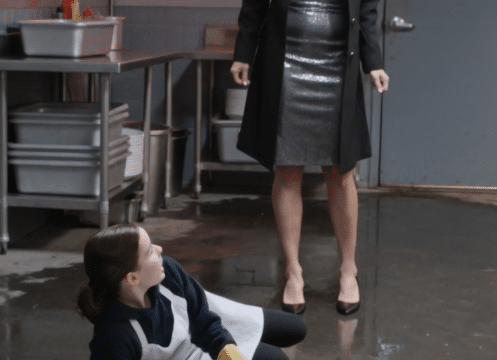
Standing directly behind Mrs. Walker, he drove a forceful kick into her back.
She fell face-down beside the checkout counter.
Her white cane flew away across the tile. The grocery bag tipped over, sending a carton and several packaged items tumbling onto the floor. Coins and bills scattered beneath the counter, and her forearm struck the hard base of the register, leaving a thin trace of blood.
For a moment, the only sound was the clatter of loose change spinning across the tiles.
Mrs. Walker gasped.
She tried to lift herself, but pain caught her before she could get her knees underneath her. Without her cane, she had no immediate way to orient herself. Her hands moved uncertainly over the floor, searching for the familiar handle.
“I just need to count the change,” she whispered again, her voice trembling.
The man stood over her.
“Trash. You’re holding up everyone.”
He stepped closer and kicked her twice more, striking her back and side as shoppers recoiled. A woman near the end of the line covered her mouth. A teenager stared at the floor. Several customers backed away, frightened by the sudden violence.
The man adjusted his jacket as though he had merely pushed a shopping cart out of his path.
“Shop when you can move faster.”
Mrs. Walker reached blindly across the floor.
Her fingers brushed a receipt, then a fallen coin. Neither was her cane.
She could hear people moving around her, but the voices seemed distant, blurred by the shock and pain. She was aware of the open grocery bag, the scattered money, and the fact that the man who had attacked her was still standing nearby.
Then a black SUV braked sharply outside the glass entrance.
The doors opened, and a woman in a black suit entered with the store manager and two security employees. She moved quickly through the checkout area, her eyes fixed on the scene.
She saw Mrs. Walker on the floor.
She saw the cane lying several feet away.
And she saw the man standing over the woman he had just attacked.
The regional director crossed the remaining distance and knelt beside Mrs. Walker before addressing anyone else.
“Mrs. Walker, I’m sorry your audit started like this.”
The store manager stopped dead.
The man in the gray jacket stared at the director.
“Your audit?”
His anger disappeared so quickly that his face seemed to change shape.
He had believed he was humiliating an ordinary customer who could not defend herself.
He had no idea that the woman on the floor had come to the store for a reason that could affect the entire chain.
And he had just made sure that the first thing she would remember about her visit was his face.
Act II
Mrs. Walker’s full name was Eleanor Walker, although almost everyone who knew her well called her Ellie.
She had been blind since the age of twenty-four, when a rare medical complication caused the rapid loss of her remaining sight. The change had arrived with devastating speed. One year, she was driving herself to work and reading restaurant menus in dim lighting. The next, she was learning to distinguish the rooms of her own apartment by sound, touch, and memory.
The adjustment was not graceful.
At first, she refused help even when accepting it would have made her life easier. She memorized routes, practiced crossing streets with a cane, and repeated everyday tasks until her hands could perform them with confidence.
Over time, she built a life that was not smaller than the one she had lost—only different.
She became an accessibility consultant, working with public-facing businesses to identify obstacles that customers with disabilities encountered in ordinary settings. Her projects included improving store layouts, training employees to offer assistance respectfully, and examining whether company policies worked in real situations.
Her work was practical rather than glamorous.
She wanted a blind shopper to be able to find the checkout without having to ask three strangers for directions. She wanted employees to understand that offering help was different from taking control. She wanted someone who used a cane to be able to move through a crowded store without being treated as an inconvenience.
And she believed that the small moments mattered most.
A company could spend millions on advertising that claimed it cared about every customer. But its true values were revealed when a customer needed extra time, asked an unfamiliar question, or required an employee to do something that fell outside the usual routine.
That was why Eleanor had agreed to conduct an independent accessibility audit for a regional supermarket chain.
The chain had been expanding rapidly, purchasing older stores and renovating them under a new corporate identity. Its leadership wanted an external review of customer access, employee training, and the practical experience of shoppers with disabilities.
Eleanor had been hired because she was thorough, experienced, and unwilling to accept a polished presentation as proof that a system worked.
Her assignment was confidential in the ordinary sense that the company did not announce the exact timing of every assessment. The purpose was not to trap employees. It was to observe how the store functioned without special preparation, then compare those observations with its written policies.
She had visited several locations already.
Some employees had impressed her with their patience. Others had been kind but poorly trained. A few stores had accessibility procedures that looked excellent on paper but broke down whenever the checkout lanes became crowded.
The store she entered that night had appeared promising.
The aisles were clear, the product labels were reasonably organized, and the entrance offered enough space for customers using mobility aids. She had spoken with no one about the audit because she wanted to experience the checkout process as an ordinary customer would.
She had purchased a few groceries, paid in cash, and begun organizing her change.
Then the man behind her had attacked her.
His name was Richard Cole, a forty-two-year-old regional insurance manager who had stopped at the supermarket on his way home. He carried a small basket containing a few convenience items and had spent most of the evening thinking about a report he still needed to finish.
He was not in danger of losing his job that night. His meeting had not been canceled. No emergency was unfolding.
He was simply impatient.
Richard had always considered himself a practical man. He believed that efficiency mattered, that people should know how to manage their own problems, and that everyone benefited when things moved quickly.
But his idea of efficiency had one consistent flaw: it required everyone else to accommodate him.
At work, he interrupted colleagues who took too long to explain a concern. In restaurants, he complained when service slowed during busy hours. When someone made a mistake, he rarely asked what had caused it. He assumed the person had failed to do something obvious.
He had mistaken his own convenience for a universal standard.
When he saw Eleanor counting coins, he did not think about how a blind person might distinguish different denominations. He did not notice that she was trying to keep her cane within reach while packing her groceries.
He saw only a line that was not moving at the speed he wanted.
And when his irritation grew, he gave himself permission to punish the person he blamed.
The attack was not the result of a misunderstanding. Eleanor had not threatened him, struck him, or deliberately obstructed him.
She had been counting her change.
After the regional director arrived, the store manager hurried toward the injured woman, visibly shaken by the director’s presence and by what had happened in front of the checkout lanes.
The director, Margaret Ellis, ignored the manager for the moment.
She gently retrieved Eleanor’s white cane and placed it within reach of her hand. Security positioned themselves between Eleanor and Richard while staff arranged for medical assistance.
“Can you hear me clearly?” Margaret asked.
Eleanor nodded faintly.
“Yes.”
“Please stay where you are until someone has assessed you. We’ll take care of your belongings.”
Eleanor’s fingers closed around the cane.
The familiar handle gave her something solid to hold on to. She took a shaky breath and tried to gather herself.
“I didn’t mean to cause trouble,” she said.
Margaret’s expression tightened.
“You didn’t cause this.”
The words were simple, but Eleanor felt something inside her loosen.
She had spent years trying to make her needs as unobtrusive as possible. She arrived early, practiced routes in advance, and apologized when she needed extra time. Even after becoming an experienced professional, she sometimes caught herself treating ordinary assistance as a favor she had to earn.
Now she was on the floor of a supermarket, hurt because a stranger had decided that her disability made her less deserving of patience.
And she had apologized.
Margaret remained beside her until the responding staff were ready to assist.
Only then did she stand and turn toward the store manager.
“Tell me exactly what happened.”
The manager opened his mouth, then closed it again.
Because the answer was already visible all around them.
Scattered groceries. Loose coins. A fallen cane. A frightened checkout line.
And a man who had thought no one important would ever care what he did to a woman who could not see him coming.
Act III
Margaret Ellis had spent twenty-seven years working in supermarket operations.
She had started as an assistant manager in a small neighborhood store, where she learned that customers rarely experienced a business the way executives imagined it. A corporate policy might look clear in a training manual and become confusing at a busy checkout. A store could advertise welcoming service while allowing its employees to treat people with disabilities as problems to be managed.
Margaret had worked her way through district management and regional operations before becoming the chain’s regional director.
She knew the numbers behind the business: labor costs, shrinkage, inventory, sales targets, and customer retention. But she also knew that no spreadsheet could fully capture what it felt like to stand at a counter and realize that the people responsible for serving you considered your presence an inconvenience.
When she received the first call about the incident, she had been on her way to another location. She changed direction immediately and arrived with the store manager and security personnel.
Now she was standing in the checkout area, watching staff preserve the scene and collect witness information.
“Has anyone contacted emergency services?” she asked.
“Yes,” the manager replied. “They’re on their way.”
“Good. Make sure the footage is preserved and that witnesses can speak separately if they choose to.”
Richard interrupted.
“This is getting out of hand.”
Margaret turned toward him.
“An injured customer is receiving assistance. That is exactly what should be happening.”
“She was holding up the whole line.”
Margaret studied him for a moment.
“And that justified what you did?”
Richard shifted his weight.
“She was taking forever.”
“That still doesn’t answer the question.”
He looked around, searching for someone who might agree with him. The customers who had watched the attack avoided his gaze. The cashier stood beside the register, pale and silent.
Richard pointed toward the scattered money.
“She couldn’t even count her own change.”
Margaret’s expression became colder.
“She was confirming a transaction. That is a normal thing for a customer to do.”
“Come on. You can’t expect everyone to wait all night.”
“No one asked you to wait all night.”
The exchange drew the attention of the people at the neighboring checkout lanes. Several customers had heard enough to understand what was happening, and their expressions had changed from shock to disbelief.
Richard noticed.
He lowered his voice.
“Look, I was frustrated. I didn’t mean for it to become this big thing.”
Margaret glanced toward Eleanor, who was still being assessed.
“You had several opportunities to stop.”
He said nothing.
“You insulted her. You kicked her after she fell. And you continued after it was clear she was hurt.”
Richard’s jaw tightened.
“You don’t know what happened.”
“That’s why we’re preserving the evidence and speaking with witnesses.”
He stared at her.
For the first time, he seemed to realize that Margaret was not going to settle the matter by deciding which person sounded more confident.
She was going to establish what happened.
A security employee approached and informed Margaret that the store’s cameras had captured the checkout area. The footage would be retained for the investigation, and witnesses were being identified.
Margaret nodded.
“Thank you. Please make sure nothing is overwritten or altered.”
Then she turned toward the manager.
“Where is the incident-response procedure?”
The manager hesitated.
“In the office.”
“Bring it here.”
He hurried away.
Richard gave a short, nervous laugh.
“Are you seriously doing an audit right now?”
Margaret looked at him.
“Mrs. Walker was conducting an accessibility audit when you attacked her.”
The manager returned holding a folder.
He had gone pale.
The audit had been authorized by corporate leadership several weeks earlier, and the store had been informed that its customer-access practices would be reviewed during the current evaluation period. The manager knew the assessment was underway, but he had not known which customer was conducting it or exactly when she would arrive.
He had assumed the visit would be routine.
Margaret opened the folder and checked the relevant section.
The store’s written policy stated that employees should allow customers with disabilities the time they needed to complete transactions, offer assistance when appropriate, and never assume that a customer wanted someone else to handle their money or belongings.
The policy also required employees to report threatening behavior and summon assistance when a customer was at risk.
The document was clear.
The reality at the checkout had been different.
No employee had intervened before the attack. The cashier had not caused the violence, but the scene raised questions about whether staff understood how to respond when impatience escalated into intimidation.
Margaret did not accuse the employees of endorsing Richard’s behavior. Fear could freeze people, especially when an incident unfolded without warning.
But the store needed to examine what training and safeguards were missing.
She closed the folder.
“This review will continue,” she said. “The incident will be documented separately, and the accessibility findings will be based on evidence, not assumptions.”
Richard stared at her.
He had expected to be scolded, perhaps asked to leave.
He had not expected his actions to become part of a formal review of how the store treated customers.
Then Margaret added one more sentence.
“And Mrs. Walker will decide whether she is able to continue participating after she receives medical care. No one is going to pressure her to finish an audit while injured.”
For the first time, the manager seemed to understand the full seriousness of the situation.
The audit was not an executive performance.
It was not a trap.
It was a chance to discover whether the store’s promises matched the experience of its customers.
Richard had turned that opportunity into something far more revealing than any checklist could have been.
Act IV
The responding medical team arrived and assessed Eleanor before helping her move to a safer area. She was shaken and in pain, and the injury to her forearm needed attention. The staff did not rush her or insist that she continue shopping, and Margaret made sure her belongings were gathered and kept secure.
Eleanor was concerned about her cane.
A staff member retrieved it, checked that it had not been damaged, and placed it beside her.
“Thank you,” she said quietly.
Margaret crouched near her chair.
“You don’t have to worry about the groceries or the audit right now.”
Eleanor’s face tightened.
“I know. I just wanted to finish what I came here to do.”
“And you still can, if and when you’re ready. But not at the expense of your health.”
Eleanor nodded, though her thoughts were already moving ahead. She had taken the assignment seriously, and she worried that leaving before completing the assessment would weaken the findings.
Margaret seemed to understand.
“Your observations from before the incident are still valid,” she said. “The incident itself will be documented through the appropriate process. No one expects you to prove anything by staying.”
Eleanor finally allowed herself to lean back.
Across the store, Richard was speaking with security personnel. The incident was being documented, and the relevant footage and witness accounts would be made available to the appropriate authorities.
He kept insisting that he had been provoked by the delay.
But every time he repeated the explanation, the facts remained the same.
Eleanor had been paying for groceries.
She had been counting change.
He had kicked her.
His frustration did not change the sequence of events, and neither did his repeated claim that the line had been moving too slowly.
When a security officer asked him to provide his account, Richard tried to make the incident sound accidental.
“I was trying to get past her,” he said.
The officer asked him to explain that statement.
Richard looked away.
He knew what the cameras showed. He knew what the witnesses had seen. He could not plausibly claim that he had stumbled into Eleanor while trying to reach a shopping cart.
He had made a deliberate choice, and now he was searching for language that would make it sound like something else.
Margaret did not try to determine his legal guilt herself. That was not her role. She ensured that the store cooperated with the investigation, preserved its records, and followed its procedures for a serious customer-safety incident.
She also directed the store manager to begin a formal review of the checkout response.
The review included several questions.
Were employees trained to recognize when a customer with a disability needed time or assistance? Did they know how to summon security quickly? Were there clear procedures for protecting a customer without escalating a confrontation? Did the checkout area provide a practical way for a blind shopper to organize money, groceries, and a cane?
These questions mattered even before anyone considered Richard’s conduct.
But the assault made them impossible to postpone.
The manager admitted that employees received general customer-service training, but they had not recently practiced a scenario in which a customer became physically aggressive toward someone with a disability.
Margaret wrote that down.
“Then we need to address it.”
She also instructed the team to review how cash transactions were handled when customers needed additional time. The goal was not to make blind customers prove that they required patience. It was to make sure employees could offer assistance without taking away a customer’s independence.
When Eleanor was ready to speak, Margaret asked whether she wished to share her observations.
Eleanor agreed.
Her voice was steadier now.
“The cashier was polite,” she explained. “I don’t want the report to suggest otherwise. My difficulty wasn’t with the person scanning my groceries. It was the lack of any clear response when the customer behind me began making threats.”
Margaret listened carefully.
“Did you feel you could ask for assistance?”
“Yes. But I shouldn’t have to anticipate that someone might attack me because I’m taking longer than they want.”
“No,” Margaret said. “You shouldn’t.”
Eleanor continued.
“The important thing isn’t that a blind customer can count coins perfectly. The important thing is that a customer can complete a normal transaction without being humiliated for needing a different amount of time.”
Margaret wrote down the statement.
It was the clearest summary of the issue she had heard all evening.
By the following week, the store had begun implementing immediate training changes while the wider audit continued. Employees reviewed how to respond to threatening behavior, how to offer assistance respectfully, and how to avoid leaving a vulnerable customer isolated during a confrontation.
The chain also began reviewing accessibility practices across nearby locations rather than treating the incident as a problem unique to one checkout lane.
The review did not assume that every store had failed. It required each location to demonstrate that its procedures worked in practice.
Richard’s case proceeded separately.
The evidence was referred through the appropriate channels, and the company did not promise an outcome before the investigation was complete. But the consequences of his conduct had already reached beyond the supermarket.
A customer had been injured.
Witnesses had seen what he did.
And a business that had previously been able to discuss accessibility in abstract terms now had to confront the human cost of allowing contempt to go unchallenged.
Richard had wanted everyone to move faster.
Instead, he had forced an entire organization to stop and look at what had happened.
Act V
Eleanor returned to the supermarket several weeks later.
She did not come because she needed to buy anything. She came to complete a follow-up discussion with Margaret and review the changes the chain had begun making after the incident.
Her forearm had healed, though the memory of falling beside the checkout counter remained sharper than she wanted to admit.
She still remembered the coins scattering across the tile.
She remembered reaching for her cane and finding only a receipt.
Most of all, she remembered the strange loneliness of hearing people gasp around her without knowing who was standing where or whether anyone would come close enough to help.
That memory did not disappear simply because the store had apologized.
But Eleanor had never believed that an apology alone was enough.
Margaret met her in a quiet office near the customer-service area. On the table lay a revised training plan, a summary of the initial accessibility findings, and a schedule for further reviews.
The company had begun retraining checkout employees on how to respond to harassment and threats. Store managers were required to confirm that employees knew how to request security assistance. The chain was also reviewing the layout and procedures at its cash registers to make it easier for customers with disabilities to complete transactions at their own pace.
The changes were not dramatic from the outside.
There was no grand ceremony, no banner across the entrance, and no announcement that the company had solved every accessibility problem.
Instead, the work involved practical adjustments, employee training, clearer reporting procedures, and follow-up checks to determine whether the changes were actually being used.
Eleanor appreciated that approach.
“It’s easy to write a policy,” she said, running her fingers along the edge of the document. “The difficult part is making sure people know what to do when something goes wrong.”
Margaret agreed.
“We’ve started the work. We’ll have to keep checking whether it makes a difference.”
Eleanor paused.
“I also want to make sure the staff aren’t taught to panic whenever a customer needs extra time.”
“They won’t be. The goal is to help customers complete their transactions safely and independently. Assistance should be offered, not forced.”
That mattered to Eleanor.
She had spent years fighting the assumption that disability meant helplessness. She did not want the answer to one man’s cruelty to be a new system that treated every blind customer as incapable.
She wanted a store where she could count her change, organize her groceries, and leave without having to defend her right to do either.
Margaret handed her the latest summary.
“Your findings have helped us identify things we need to improve. I wish the circumstances had been different.”
“So do I,” Eleanor replied.
Neither woman pretended that the changes could erase the assault. But they could make it harder for the same failures to go unnoticed the next time a customer needed help.
Richard’s life did not collapse in a single cinematic moment.
There was no instant public verdict, no miraculous executive decree that determined every aspect of his future. The incident was investigated through the appropriate process, and any legal consequences depended on the evidence and the decisions of the relevant authorities.
His employer also reviewed the conduct that had come to its attention. The company considered the seriousness of the incident and the concerns it raised about his judgment and behavior.
The experience damaged his professional standing and strained relationships he had previously taken for granted.
People who had once described him as demanding began asking whether they had overlooked something more troubling. Colleagues remembered the way he spoke about people who made mistakes. His explanation that he had simply been in a hurry became harder to accept after witnesses described what he had done.
He could argue that the line was slow.
He could complain that he had been frustrated.
He could insist that his evening had been ruined.
None of those things answered the question that mattered.
Why had he believed his impatience gave him the right to hurt someone?
He never found an explanation that made the answer acceptable.
For Eleanor, the most meaningful result came on an ordinary evening months later.
She stood at a checkout counter with a few groceries in her bag. The store was busy, the scanner was beeping, and a customer behind her shifted impatiently while she organized her change.
For a moment, her hands tightened.
The old fear returned: the expectation that someone might sigh, complain, or decide that her presence was a problem.
Then the cashier asked whether she would like help placing her groceries into the bag.
Eleanor considered the offer.
“Yes, please. Thank you.”
The cashier helped without taking over. Eleanor counted her change, confirmed the amount, and put the coins away.
The customer behind her remained quiet.
The transaction took the time it took.
When Eleanor finished, she collected her cane and moved away from the counter. No one applauded. No one announced that a lesson had been learned.
It was simply an ordinary checkout.
And that was exactly what she had wanted.
As she reached the exit, Eleanor thought about how easily the entire evening could have been reduced to a story about a blind woman who was attacked by an impatient man—and how much would have been missed if the story ended there.
The assault had revealed the cruelty of one person.
The response had revealed something else: the responsibility of everyone who ran the place, wrote its policies, trained its staff, or watched a vulnerable customer struggle.
A welcoming sign could not guarantee respect.
A training manual could not guarantee courage.
A corporate promise could not guarantee that every customer would be treated with dignity.
Those things had to be demonstrated in the moment when patience was difficult, when the line was long, and when someone decided another person’s needs were less important than his own convenience.
Eleanor had not needed to be an auditor to deserve protection.
She had not needed Margaret Ellis to arrive in a black SUV.
She had not needed witnesses, security footage, or a corporate review to establish that counting her change was a reasonable thing to do.
She had deserved respect from the beginning.
The audit simply made the store confront what happened when that basic truth was forgotten.
And the man who had kicked her because she moved too slowly had learned, far too late, that the most revealing moment in any business was not when everything went according to plan.
It was when someone needed a little more time—and everyone else had to decide whether that person was worth waiting for.