Act I
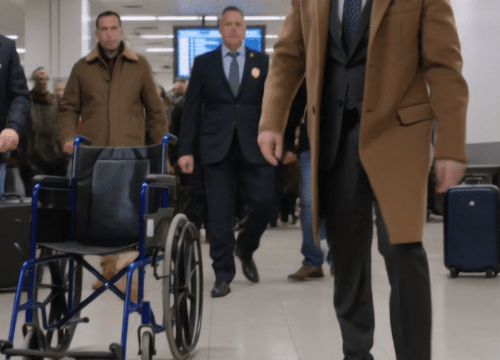
The escalator was closed, the corridor was packed, and a businessman in a black suit had already decided that the blind man in front of him was a problem.
Mr. Bennett stood beside a maintenance rope with his white cane in one hand and his guide dog’s harness in the other. The escalator beyond the barrier was silent, its steps frozen beneath a bright orange warning sign. Shoppers streamed around the obstruction, following temporary signs toward the elevators.
His guide dog paused, searching for a clear route through the moving crowd.
Mr. Bennett waited a few seconds, listening for the elevator chime and orienting himself to the sounds around him. He knew the mall well enough to understand where he needed to go, but the unexpected closure had changed the route. He wasn’t lost. He was making sure he could move safely.
Behind him, a man in an expensive black suit dragged a rolling carry-on across the glossy stone floor.
He checked his watch.
Then he checked it again.
The businessman was thirty-nine-year-old Andrew Pierce, a corporate consultant whose calendar was divided into meetings, calls, and deadlines he considered more important than anything happening around him. He had spent the morning telling colleagues how valuable his time was. Now, with a meeting approaching, he was furious that a stranger had forced him to slow down.
“Come on,” he muttered. “Some of us have places to be.”
Mr. Bennett heard him but kept his attention on his dog.
The animal shifted slightly, guiding him away from the maintenance barrier and toward the wider section of the corridor. A family passed on their left. A couple stopped near a directory. The route was crowded, and Mr. Bennett wanted to avoid stepping into someone’s path.
“My guide dog is finding the elevator,” he explained.
Andrew gave a contemptuous laugh.
“Trash. Find it faster.”
Mr. Bennett turned his head toward the voice, startled by the insult.
“I’m trying to get out of everyone’s way,” he said.
Andrew’s hand tightened around the handle of his carry-on. He had spent the last several minutes treating his own schedule as an emergency, and now he saw the man in front of him as the obstacle standing between him and the rest of his day.
He stepped closer.
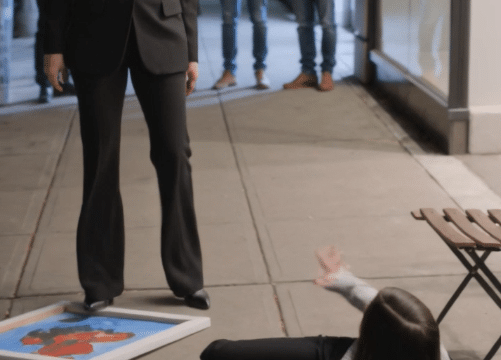
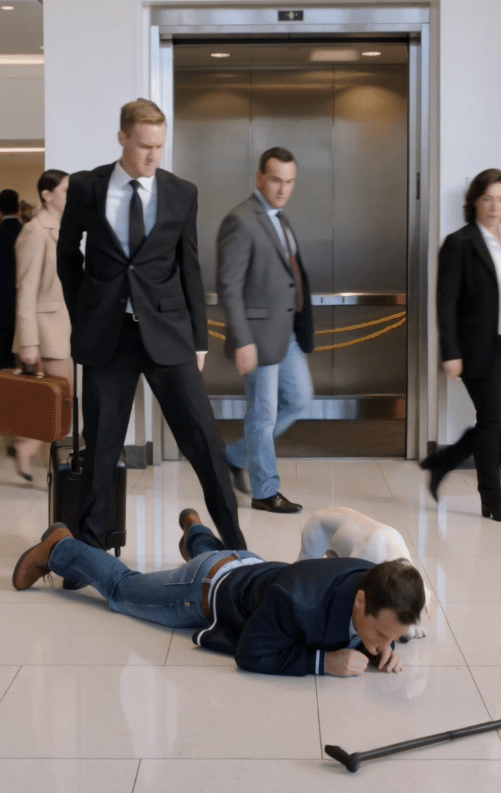
Then he drove a forceful kick into Mr. Bennett’s back.
The impact sent him sprawling face-down onto the stone floor beside the maintenance rope. His cane fell away, skidding across the polished surface. His guide dog remained beside him, unharmed but visibly alarmed, shifting its paws as its handler struggled to move.
Mr. Bennett grimaced and drew a sharp breath.
His forearm struck the floor, leaving a thin trace of blood near the point of impact. He reached instinctively toward the dog’s harness, trying to reassure the animal even as pain tightened his own body.
“Easy,” he whispered, his hand searching for the familiar strap.
Andrew stood over him.
“Trash. Find it faster.”
Mr. Bennett tried to gather himself, but before he could rise, Andrew stepped in and kicked him twice more, striking his back and side.
A woman gasped. A father pulled his young daughter away from the scene. Several shoppers stepped back, covering their mouths, while others stared in stunned silence.
Andrew’s carry-on rested beside his leg.
He looked down at the man on the floor as though the assault had been a reasonable response to an inconvenience.
“Your delay is not my problem.”
Mr. Bennett’s breathing grew uneven. He kept one hand near the guide dog’s harness, more concerned with keeping the animal calm than with the cane lying out of reach.
Then a sharp chime sounded behind Andrew.
The VIP elevator doors opened.
A tall, silver-haired man in a dark gray suit stepped out, followed by security management and members of the mall’s maintenance team. He had been reviewing the escalator closure upstairs when security alerted him to an incident in the corridor.
The moment he saw Mr. Bennett on the floor, his expression changed.
He crossed the distance quickly, signaling for security to protect the injured man and his guide dog. Only after ensuring that Andrew could not approach them again did he turn toward Mr. Bennett.
“Mr. Bennett, your accessibility review starts right now.”
The maintenance supervisor froze.
The mall’s security manager stopped mid-step.
Andrew stared at the man who had just emerged from the VIP elevator.
“Accessibility review?”
His voice had lost its certainty.
He had believed he was punishing a stranger for wasting his time.
Instead, he had attacked the very person whose findings might expose how the entire mall treated people who needed accessible routes.
And the owner had witnessed the consequences before the review had even begun.
Act II
Mr. Bennett’s full name was Thomas Bennett.
He was forty-five, blind, and accustomed to the complicated negotiations that came with navigating places designed primarily for people who could see. He had learned to recognize intersections by sound, identify familiar buildings through subtle changes in acoustics, and work with his guide dog to move confidently through crowds.
His blindness had not erased his independence.
It had made preparation more important.
Thomas had lost his sight gradually in his late twenties after a progressive eye condition worsened beyond what treatment could manage. At first, he tried to continue living exactly as he had before. He relied on memory, resisted asking for help, and became frustrated whenever familiar routines stopped working.
His guide dog changed much of that.
The partnership gave him a safer, more flexible way to navigate busy streets and crowded public spaces. The dog learned his routes, responded to obstacles, and helped him move through environments that could change without warning.
But the dog did not magically make every building accessible.
A closed walkway could still force Thomas to find another entrance. A poorly placed sign could still be useless to someone who could not read it. An elevator could be available but difficult to locate, especially when the usual route was blocked and the corridor was full of people moving in different directions.
Thomas had learned that accessibility was not simply about installing equipment.
It was about making sure people could actually use it.
That realization had shaped his career. He became a consultant specializing in accessibility planning for public spaces, working with shopping centers, transportation hubs, office buildings, and cultural venues.
His assessments examined the details that many property owners overlooked: whether alternate routes were clearly marked, whether maintenance barriers left enough room for people using mobility aids, whether staff knew how to give useful directions, and whether emergency changes were communicated in ways that people with different disabilities could understand.
He did not believe every inconvenience could be eliminated.
Buildings needed repairs. Elevators sometimes failed. Escalators required maintenance. Crowds could become difficult to navigate during peak hours.
What mattered was whether a property had planned for those realities.
A closed escalator should not leave a blind visitor guessing which direction to take. A maintenance crew should understand that its barriers could change the movement of the entire corridor. And security staff should be prepared to respond when someone became threatening toward a customer who needed more time to find a safe route.
Thomas had been invited to review the mall’s accessibility systems after its owner announced a major renovation program.
The property was one of the region’s busiest shopping destinations, known for its luxury stores, restaurants, entertainment complex, and private event spaces. Its public image emphasized comfort and convenience, and management had invested heavily in polished floors, striking architecture, and premium services.
But Thomas’s assignment was to look beyond appearances.
The mall had promised to improve access throughout the property. Before approving the next stage of renovations, the owner wanted an independent assessment of how visitors with disabilities experienced the building in real conditions.
Thomas had agreed to conduct an unannounced review during a normal operating day.
He would examine entrances, routes, elevators, customer-service procedures, and the way staff responded when an accessible route was temporarily unavailable.
He had deliberately chosen a busy period.
Accessibility was easy to demonstrate when corridors were empty and every employee knew a reviewer was coming. The real test came when shoppers filled the walkways, maintenance crews blocked a route, and staff had to help visitors without disrupting the entire building.
Thomas had expected to encounter problems.
He had not expected to be kicked to the floor.
The mall’s owner, Richard Lawson, had spent nearly four decades building the property from a modest regional shopping center into a major commercial destination. He understood the financial stakes of a renovation program and the importance of maintaining public trust.
He had also learned that executive assurances could conceal uncomfortable realities.
Before approving the accessibility review, Richard had received reports describing the mall as largely compliant with its internal standards. But the reports relied heavily on scheduled inspections and management checklists. They offered limited evidence of how the building functioned during unexpected disruptions.
Richard wanted a more honest picture.
That was why he had asked Thomas to conduct the assessment independently.
He had not expected the first major finding to arrive in the form of an assault.
As security moved Andrew away from the immediate scene, Richard remained beside Thomas and waited for medical assistance.
Thomas’s guide dog stayed close, its body angled toward its handler. Thomas reached toward the harness again, speaking softly to calm the animal.
Richard lowered himself nearby without crowding him.
“Medical help is on the way,” he said.
Thomas nodded, breathing carefully.
“My cane,” he managed.
A security employee retrieved it from beside the maintenance barrier and placed it within reach. Richard made sure the dog remained with Thomas rather than allowing the growing crowd to surround them.
Only then did he look toward the maintenance supervisor.
“Why was this route closed without someone directing visitors to the elevator?”
The supervisor looked at the orange sign and the ropes.
“We posted the closure.”
“Where is the accessible route marked?”
The supervisor hesitated.
Richard followed his gaze toward a temporary directional sign several yards away. It pointed toward the elevators, but the sign had been positioned at an angle, partially obscured by a promotional display.
It was visible to someone who happened to be looking in the right direction.
That was not the same as being useful to everyone.
Richard’s expression hardened.
The review had begun with a simple question: could a visitor safely find an alternative when the normal route was unavailable?
Now the owner had a second question.
Why had no one thought to make that alternative obvious?
Act III
Andrew Pierce had built his professional identity around one central belief: important people should not have to wait.
He was successful by conventional measures. His firm advised businesses on operations and restructuring, and he had developed a reputation for demanding schedules and blunt opinions. Clients praised his decisiveness. Colleagues admired his ability to move quickly through complicated decisions.
But people who worked closely with him knew another side of that efficiency.
Andrew had little patience for anything that disrupted his plans. He treated delays as personal insults, especially when he believed the person causing them had less status than he did.
A junior employee asking for clarification could expect a cutting remark. A service worker who made a mistake might be subjected to a lecture in front of customers. If a colleague needed extra time to complete a task, Andrew often assumed the person was incompetent rather than considering whether the process itself was flawed.
He called this high standards.
Other people had begun to call it something else.
The mall was a place where Andrew felt particularly entitled. He visited regularly for business lunches and private events, and he had become accustomed to the privileges associated with premium parking, reserved entrances, and executive access.
Those conveniences had gradually blurred into an assumption that the building should rearrange itself around him.
When the escalator was closed, he did not see a maintenance issue that required a different route.
He saw a disruption to his schedule.
When Thomas paused, he did not see a blind man navigating a crowded corridor with a guide dog.
He saw someone who should move faster.
And when his frustration peaked, he acted as though his own inconvenience justified violence.
The security manager took Andrew to a separate area while the responding medical team assessed Thomas. Mall personnel preserved the relevant security footage and began collecting witness accounts.
Andrew’s first instinct was to complain.
“This is ridiculous,” he said. “He was blocking the entire corridor.”
The security manager did not argue with him. He asked for Andrew’s account of the incident and recorded his response.
Andrew insisted that he had been trying to get around Thomas. But the available camera angles showed him standing behind the blind man before the attack, then kicking him and delivering the two follow-up blows after he had fallen.
The footage was not a complete investigation by itself, but it gave investigators an important record of the sequence of events.
Witnesses were also asked to describe what they had seen. Several confirmed that Thomas had paused only briefly near the maintenance barrier and that Andrew had verbally abused him before the assault.
The mall’s staff were instructed not to alter, delete, or circulate the footage. Any further determination of criminal responsibility would be left to the appropriate authorities.
Richard Lawson watched the initial review from a monitor in the security office.
He had seen customers become impatient. He had seen arguments over parking spaces, restaurant reservations, and store policies. But watching a man attack someone who was trying to find an accessible route made the situation painfully clear.
The mall’s policies could not control every visitor’s behavior.
They could, however, determine how quickly staff recognized a threat, how safely they protected an injured person, and whether their design made a difficult situation even worse.
Richard called the maintenance supervisor and the head of security into the office.
“I want a complete timeline,” he said. “When the escalator was closed, where the signs were placed, who was assigned to the corridor, and what the emergency response procedure required.”
The supervisor began explaining the maintenance schedule.
Richard raised a hand.
“Start with what happened. We can discuss why later.”
The head of security confirmed that the cameras had captured the assault. Staff had contacted emergency services and separated Andrew from Thomas. The initial response was underway, but the review raised questions about how quickly employees had recognized the danger and whether anyone had been assigned to direct visitors around the closure.
Richard wrote down each point.
Then he asked for the mall’s accessibility documentation.
The reports were neatly formatted and full of reassuring phrases. They described clear circulation routes, accessible vertical transportation, and established procedures for maintenance closures.
But the incident had exposed a gap between those statements and the experience of an actual visitor.
The elevator existed.
The route existed.
The signs existed.
Yet Thomas had still needed to pause and orient himself because the alternative route was not sufficiently clear in the crowded corridor.
That pause had been brief. It had harmed no one. But the building had offered little help in making the transition straightforward.
Andrew had responded to that ordinary difficulty with extraordinary cruelty.
Richard could not claim the mall was responsible for Andrew’s decision to attack someone. But he could not ignore the environment in which the incident unfolded, either.
A well-designed public space should anticipate that people move at different speeds, use different mobility aids, and sometimes need time to make safe decisions.
It should not depend on every visitor being patient and every situation remaining calm.
Richard returned to the corridor with the accessibility team.
The maintenance crew was examining the barrier placement. A new sign was being positioned at the approach to the closed escalator, with a clear direction toward the elevator and enough room for visitors to stop without blocking the main flow.
Thomas was still receiving care, so Richard did not ask him to continue the assessment. The review could wait until he had recovered.
But the initial observations were already significant.
Richard looked at the supervisor.
“From now on, every temporary closure gets an accessibility check before the barrier goes up.”
The supervisor nodded.
“And the route must be clear enough to find without guessing,” Richard added. “If we can’t make it clear, someone needs to be there to help direct people.”
The supervisor looked toward the VIP elevator, then back at the maintenance ropes.
The owner had arrived expecting to discuss a review.
Instead, he was discovering how much the building had assumed about the people who used it.
Act IV
By the time Thomas was ready to return to the mall, the assault had become the subject of a formal investigation, and the accessibility review had expanded beyond its original scope.
Richard Lawson did not want the incident reduced to a single employee mistake or a single maintenance error. He wanted the team to determine which problems were specific to that corridor and which reflected wider weaknesses in the mall’s procedures.
The review began with the closed escalator.
Maintenance records showed that the closure had been scheduled, and the crew had followed the standard procedure for placing barriers. The sign directing visitors toward the elevator had also been installed.
On paper, the process appeared complete.
In practice, the sign was partly obscured by a promotional display, and its placement required visitors to notice it before reaching the barrier. During peak hours, the corridor became crowded enough that people often followed the movement of the crowd rather than searching for directional information.
For a visitor who could not see the sign, the problem was even more significant.
The review team tested several routes using different mobility aids and navigation methods. They discovered that some temporary closures forced visitors to make quick decisions at points where the available information was incomplete or difficult to access.
The mall had not deliberately excluded anyone.
It had simply mistaken the existence of an alternative route for proof that the route was accessible.
That distinction changed the work ahead.
The team began reviewing signage placement, audible information, staff positioning, and procedures for directing visitors during unexpected closures. It also examined whether security personnel and maintenance employees knew how to respond when a person using a cane or guide dog needed additional space.
The recommendations were practical.
Temporary barriers had to leave sufficient room for safe passage. Directions toward elevators needed to be visible from the point where visitors first encountered a closure, with additional assistance available when the route was confusing. Staff had to know that a guide dog was working and that grabbing the animal or pulling its handler without permission could create additional danger.
The team also revised its response procedures for harassment and physical assaults.
Employees could not be expected to prevent every act of violence, but they needed a clear way to summon security, protect the person at risk, preserve evidence, and avoid crowding or separating a guide dog from its handler unnecessarily.
Richard insisted that the changes be tested rather than merely documented.
“Don’t tell me the procedure works because it’s in the manual,” he told the team. “Show me what happens when the corridor is full.”
The first live test took place during another busy shopping period. A section of the main route was temporarily closed, and staff observed how visitors moved toward the alternate elevator.
The team adjusted the signs after noticing that a display stand still obscured part of the approach. They changed the placement of a staff member so that visitors who needed directions could ask for help without being forced to stop in the middle of the flow.
The process was not dramatic.
It involved moving a sign, changing a routine, and asking people to notice details they had previously overlooked.
But those details were the difference between a route that technically existed and a route a visitor could actually use.
When Thomas returned, Richard met him near the corridor where the assault had occurred.
Thomas walked with his guide dog, his cane folded and secured as he moved through the familiar space. The dog paused at the newly positioned barrier, then followed the route toward the elevator.
This time, the directions were clear.
A staff member stood far enough away to offer help without blocking the path. The corridor remained busy, but Thomas did not have to stop and search for the next step.
Richard watched the route from a short distance.
“How does it feel?” he asked when Thomas was ready to speak.
Thomas considered the question.
“Better. The route is easier to understand. More importantly, I don’t have to guess where it begins.”
Richard nodded.
“That was what we missed.”
Thomas turned toward him.
“The closure wasn’t the problem by itself. Escalators need maintenance. Things happen. What matters is whether the person using the building can understand what to do next.”
Richard accepted the correction.
He had spent years measuring a mall by occupancy, sales, tenant satisfaction, and the smooth movement of crowds. Thomas was asking him to consider a different measure: whether the building remained usable when ordinary conditions changed.
The review continued across other areas of the property, including parking access, elevators, customer-service desks, and temporary construction zones.
Some findings required immediate fixes. Others would need to be included in the longer renovation program. The team recorded each recommendation, assigned responsibility, and scheduled follow-up inspections.
Andrew’s conduct remained a separate matter.
The mall provided the relevant footage and witness information to investigators and followed its established procedures regarding the incident. Any legal consequences would depend on the investigation and the applicable law, not on Richard’s personal anger.
But the mall also reviewed whether Andrew would continue to receive special access privileges at its properties. Any restrictions had to follow the property’s rules and be based on the documented incident rather than an improvised public punishment.
For Richard, that distinction mattered.
He wanted accountability, not a spectacle.
Andrew had made his choice, and the evidence needed to speak for itself.
Still, the consequences of the incident reached into his professional life. His employer became aware of the allegations and reviewed the available information under its own conduct policies. Colleagues who had previously dismissed his impatience as a personality trait began to reconsider what that impatience could become when he believed someone beneath him had no power to resist.
Andrew had spent years insisting that time was too valuable to waste.
Now he faced questions that could not be dismissed with a glance at his watch.
And the man he had attacked was helping the mall answer a question far more important than how quickly a corridor could move.
Act V
Three months later, the mall’s central corridor looked almost exactly as it had before.
The stone floor gleamed beneath the overhead lights. Stores opened their doors to the afternoon crowd. The escalators carried shoppers between levels, while elevators served visitors who could not or did not wish to use the moving steps.
To someone passing through, the changes might have seemed insignificant.
The signs were positioned more carefully. Temporary closures had clearer directions. Staff knew where to stand when a route changed, and managers were expected to verify that the alternate path worked for visitors with different access needs.
The emergency procedures had also changed.
Employees practiced how to summon help during a threatening incident and how to keep a safe space around an injured person. Security staff were instructed to preserve evidence promptly and coordinate with responding medical personnel. The guide-dog guidance was explicit: do not distract, grab, or separate a working dog from its handler without a genuine safety necessity.
The mall had not become perfect.
No building could eliminate every obstacle or guarantee that every visitor would behave well. But the review had given management a way to recognize problems before they became crises.
Thomas remained involved as an independent consultant, helping the team evaluate whether the changes were effective. He was careful not to let the assault become the only story told about the review.
“The point isn’t to build a mall that works only when everyone is kind,” he explained during a follow-up meeting. “The point is to build one that remains usable when people are in a hurry, when a route is closed, or when someone needs a little more time.”
Richard remembered those words.
He had initially viewed accessibility as a set of obligations that needed to be incorporated into a renovation plan. Thomas had helped him understand that it was also a test of how the organization responded to uncertainty.
A building could be beautiful and still be confusing.
A policy could be correct and still be useless if employees did not know how to apply it.
A company could claim to welcome everyone while leaving the most vulnerable visitors to solve unexpected problems alone.
The mall’s review forced management to confront those contradictions.
For Thomas, the process was not a victory over Andrew. He did not measure success by whether the businessman suffered embarrassment or lost professional opportunities.
He measured it by whether the next blind visitor could find the elevator without having to stop in a crowded corridor and wonder where to go.
He measured it by whether a maintenance worker understood that moving a barrier could change someone’s entire route.
He measured it by whether an employee who witnessed harassment knew how to respond instead of freezing in uncertainty.
Those were the changes that mattered.
The investigation into the assault continued through the appropriate channels, with the footage and witness accounts forming part of the available evidence. Thomas did not need to exaggerate what had happened or demand that the mall invent a punishment beyond its authority.
The truth was already serious enough.
He had paused for a few seconds because the escalator was closed. His guide dog was helping him locate an alternative route. Andrew had responded with insults and repeated kicks.
Nothing about Thomas’s behavior justified the attack.
Nothing about Andrew’s schedule changed that.
The incident also changed how some of the people who had witnessed it thought about their own silence. Several shoppers had stepped back in fear, uncertain how to intervene without making the situation more dangerous. During the mall’s later safety communications, management emphasized that witnesses should seek security or emergency assistance rather than place themselves recklessly in harm’s way.
The goal was not to shame frightened bystanders.
It was to make sure they knew what they could do.
One afternoon, Thomas returned to the corridor for a final route assessment. His guide dog moved steadily beside him, following the accessible path toward the elevator.
At the former closure point, he paused briefly—not because he was confused, but because he wanted to test the directional information one last time.
The route was clear.
The signs were positioned where they needed to be. The elevator was easy to locate, and the surrounding space gave him room to move without being forced against the crowd.
Richard stood nearby, watching the assessment.
Thomas finished the route and turned toward him.
“This works,” he said.
Richard let out a slow breath.
It was a small sentence, but it meant more than a stack of reports marked complete.
It meant the review had moved beyond promises.
Thomas’s guide dog nudged gently against his leg, ready to continue. He rested a hand on the harness, thanked the staff who had assisted with the assessment, and headed toward the elevator.
The mall carried on around him.
Shoppers hurried to appointments. Children tugged at their parents’ hands. Business travelers checked their watches and rolled their bags across the polished floor.
Somewhere in that crowd, someone would inevitably be delayed.
An elevator would take longer than expected. A route would close for repairs. A visitor would stop to orient themselves before moving safely through the building.
Those moments were not failures.
They were part of operating a public space used by thousands of different people.
The real failure was believing that one person’s convenience mattered so much that another person’s safety could be ignored.
Andrew Pierce had looked at Thomas Bennett and seen a delay.
Richard Lawson had looked at the same scene and finally seen a responsibility.
And Thomas, who had never needed to prove that he deserved patience, had helped an entire organization understand that accessibility was not a favor offered to people who moved differently.
It was part of what made a public place worthy of the public.
The escalator could close. The crowd could grow impatient. The schedule could slip by a few minutes.
But no one should ever have to earn the right to move through the world safely.
And no deadline, no matter how important someone believed it to be, could make that right less valuable.