Act I
“I’m trying to open my room.”
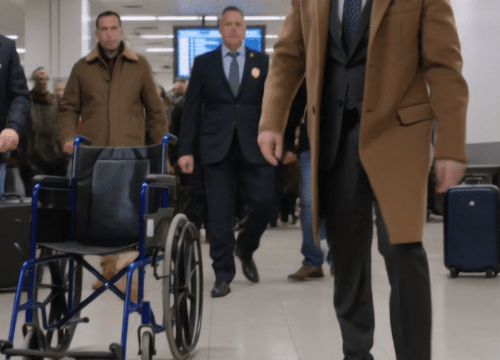
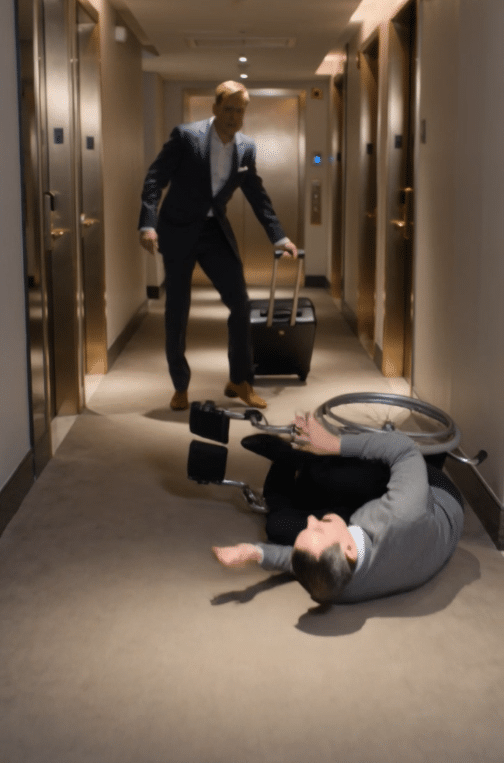
The elderly man struggled to position his wheelchair in front of the hotel door, holding a key card between trembling fingers. The hallway was narrow, its thick carpet swallowing the sounds of approaching footsteps, while warm wall lights illuminated a long row of polished doors.
Behind him, a businessman in a navy suit stopped abruptly.
His expensive suitcase bumped against the wheelchair.
The man checked his watch, pulled the suitcase back, and tried to squeeze past. There wasn’t enough room. The elderly guest needed only a few more seconds to line up his chair and swipe the key card, but the businessman behaved as though those seconds had been stolen from him.
“Come on,” he muttered, his face tightening with irritation.
The elderly man adjusted his position. His name was Arthur Whitmore, and at seventy-six, he had learned to be patient with the small difficulties that came with using a wheelchair. A door that opened too quickly, a narrow turn, or a key card that failed to register on the first attempt could turn a simple task into a frustrating one.
He wasn’t asking anyone to carry him.
He wasn’t demanding special treatment.
He was trying to enter his own room.
The businessman, however, had already decided that Arthur’s presence was costing him something valuable.
“I’m trying to open my room,” Arthur repeated, turning slightly toward the impatient voice behind him.
The man gave a contemptuous laugh.
“Trash. You’re costing me money.”
Arthur went still.
He had heard impatience before. He had encountered strangers who spoke too loudly, offered unwanted assistance, or treated his wheelchair as an inconvenience. But the man’s words carried a deliberate cruelty that made it difficult to believe he was simply having a bad evening.
“Please give me a moment,” Arthur said.
The businessman glanced at his watch again.
He was forty-four-year-old Daniel Cross, a corporate executive who had arrived at the luxury hotel after a long day of meetings. He had spent hours discussing deadlines, contracts, and the financial consequences of delays. Somewhere along the way, he had begun to believe that everyone around him should move according to his schedule.
Now he stood behind an elderly man whose wheelchair blocked the narrow passage.
Daniel’s expression hardened.
Instead of waiting, he stepped closer, planted his foot, and drove a forceful kick into the back of Arthur’s wheelchair.
The chair lurched forward.
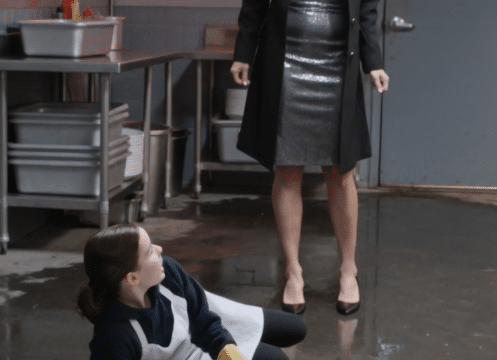
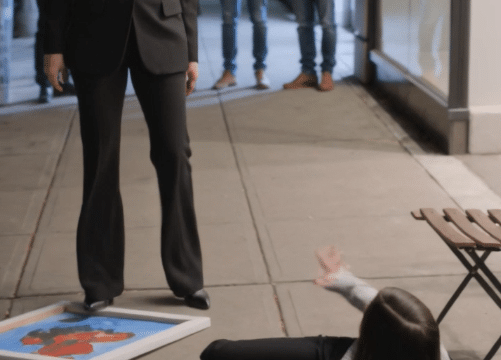
Arthur was thrown out of it and crashed onto the carpet. His wheelchair skidded across the hallway before tipping against the wall. The key card flew from his hand and slid beneath the light from a nearby doorway.
For one stunned second, Arthur couldn’t understand how he had ended up on the floor.
Then pain caught up with him.
He groaned and curled slightly, trying to protect himself as he reached weakly toward the place where he had last heard his key card land. His forearm had scraped against the floor, leaving a thin trace of blood.
Daniel stood over him.
“Trash. You’re costing me money.”
Arthur looked up, bewilderment and pain written across his face.
Before he could gather himself, Daniel stepped closer and delivered two more forceful kicks into his back and side.
A door opened down the hallway.
Someone gasped.
Another guest pulled back behind a partially opened door, one hand covering her mouth. Several people watched from a distance, frightened by the sudden violence and uncertain what would happen if they intervened.
Daniel straightened his jacket.
“Check in to the floor.”
Arthur lay on the carpet, breathing hard, his wheelchair tipped against the wall and his key card out of reach. The man who had attacked him showed no sign of regret.
Then the private elevator at the end of the hallway opened with a sharp chime.
A woman in a long black coat stepped out, accompanied by the hotel manager and two security employees.
She looked toward Arthur’s room.
Then she saw the wheelchair lying on its side.
She saw the elderly man on the floor.
And she ran.
“Dad!”
The word tore through the hallway.
The woman dropped to her knees beside Arthur, supporting him carefully while security moved between him and Daniel. Her face had gone pale, but when she looked up at the businessman, the shock in her eyes hardened into fury.
Daniel recognized her immediately.
Mrs. Whitmore was not merely another guest.
She owned the hotel.
And the elderly man he had kicked out of his wheelchair was her father.
“Mrs. Whitmore… your dad?”
Daniel’s voice cracked.
For the first time that evening, he seemed to understand the scale of what he had done.
But the most devastating consequence of his cruelty would not come from the identity of the man he had attacked.
It would come from discovering who Arthur Whitmore had been long before Daniel ever walked through the hotel’s doors.
Act II
Arthur Whitmore had never enjoyed being treated as fragile.
Before his mobility declined, he had spent decades working in commercial property development. He was the kind of man who arrived early to inspect a building, asked the maintenance crew questions no executive thought to ask, and remembered the name of the person who repaired a broken elevator months earlier.
He believed a building revealed its character through the details most people overlooked.
A beautiful lobby could hide an unreliable lift. An expensive room could have a bathroom that was difficult to use. A hotel might advertise exceptional service while leaving an elderly guest struggling alone with a door that should have been easy to open.
Arthur had spent his career noticing those things.
He and his wife, Margaret, had built a modest hospitality business before expanding into several properties across the country. Their daughter, Eleanor Whitmore, grew up around renovation plans, guest complaints, and conversations about the difference between looking successful and running a good business.
When Margaret died, Eleanor took over the family enterprise.
She expanded it into a respected luxury hotel group, known for elegant interiors, careful service, and a management culture that emphasized guest dignity. She was sixty-three, disciplined, and famously attentive to operational details.
Yet she had never tried to turn her father into a public symbol of the business.
Arthur had earned the right to live privately.
He still attended family events, reviewed occasional development proposals, and visited the hotels when he wanted to see how the properties were functioning. He no longer managed construction sites or traveled constantly, but his interest in buildings had never disappeared.
His wheelchair was a practical necessity, not a declaration that he had stopped participating in life.
The evening Daniel attacked him, Arthur had returned to the hotel after dinner with a longtime friend. He had chosen to go to his room independently rather than ask an employee to escort him.
The hallway was familiar. The door was not complicated. He simply needed a little extra room to align the chair with the card reader.
He had expected the process to take seconds.
Instead, it had become a confrontation with a man who treated patience as a debt other people owed him.
Eleanor had been attending a late meeting on the hotel’s upper floor when security received the first report of a disturbance in the guest corridor. She left the meeting and took the private elevator down with the hotel manager.
She had expected to find an argument, perhaps a guest complaining about noise or a misunderstanding over room access.
She had not expected to find her father on the floor.
When she reached him, she kept her attention on his immediate needs.
“Dad, can you hear me?”
Arthur nodded faintly.
She checked that he was conscious and avoided trying to lift him herself. Security kept Daniel away while hotel staff called for medical assistance and arranged for Arthur to be assessed.
“Don’t try to move yet,” Eleanor said, keeping one hand close to his shoulder. “Let’s make sure you’re all right first.”
Arthur drew a careful breath.
“My chair.”
“I know. We’ll take care of it.”
The hotel manager retrieved the key card and made sure the wheelchair was secured away from the immediate scene. Eleanor stayed beside her father until the medical team arrived.
Only then did she rise.
Daniel stood several feet away, his suitcase beside him. He had lost the impatient confidence that had carried him through the first seconds of the confrontation.
“Mrs. Whitmore,” he began, “I can explain.”
Eleanor looked at him.
“You can give your account to security.”
“He was blocking the hallway.”
“My father was opening his room.”
“I had an important meeting.”
Eleanor’s expression did not change.
“And that gave you the right to kick him out of his wheelchair?”
Daniel glanced toward the open guest-room doors. The people who had witnessed the assault were still watching.
“I didn’t mean for him to fall like that.”
“You kicked the chair.”
He had no answer.
Eleanor turned to the hotel manager.
“Preserve the camera footage. Get the witness information, and make sure the responding officers have everything they need. No one is to delete or alter any record of what happened.”
The manager nodded immediately.
Then Eleanor looked back at Daniel.
“You are not going anywhere with this treated as a private disagreement.”
For years, Eleanor had insisted that her hotel group should be judged not only by the comfort of its suites or the elegance of its restaurants, but by how it treated people when service became inconvenient.
Now that principle was being tested in the corridor outside her father’s room.
And as Arthur was taken for medical assessment, Eleanor realized that the incident had exposed something more serious than one guest’s appalling behavior.
It had forced her to ask whether the hotel had done enough to protect the dignity and safety of people who needed extra time, space, or assistance.
Act III
Daniel Cross had built his career around the language of efficiency.
He advised major companies on financial performance, restructuring, and operational decisions. He spoke confidently about wasted time, unnecessary costs, and the need to eliminate obstacles. In meetings, he could make impatience sound like discipline and intimidation sound like leadership.
He was good at making people feel that disagreeing with him was a sign of weakness.
Over time, he had begun to apply the same logic outside the office.
At restaurants, he expected staff to anticipate his preferences. In airports, he treated delays as personal affronts. When someone moved more slowly than he wanted, he rarely considered the possibility that the person had a reason.
Daniel believed his schedule mattered because his work mattered.
And because his work mattered, he had quietly decided that other people’s difficulties should never inconvenience him.
The hotel corridor had offered him a simple choice.
He could wait a few seconds.
He could ask Arthur whether he needed help.
He could turn around and use another route.
Instead, he chose violence.
Now he was facing security personnel who were recording the incident, preserving the evidence, and arranging for the appropriate authorities to review what had happened.
Daniel tried to regain control by explaining his circumstances.
He mentioned the meeting he was late for. He described the narrow hallway. He insisted that Arthur had prevented him from passing.
None of it changed the sequence of events.
Security footage showed Daniel approaching the wheelchair, kicking it, and then kicking Arthur after he had fallen. Witnesses described the insults. The physical evidence documented the injuries.
The hotel did not need to guess what had happened simply because Daniel spoke confidently.
Eleanor understood that distinction.
She was angry, but she would not allow anger to replace proper procedure. The hotel would cooperate with the investigation, and any legal outcome would be determined by the relevant authorities. The property’s own response would follow established rules rather than become an improvised act of revenge.
That did not mean Daniel would escape consequences.
The hotel manager reviewed the guest’s status and the terms under which the property could refuse continued accommodation or restrict access after a serious safety incident. Security was instructed to keep Daniel separated from Arthur while those decisions were handled.
Eleanor also asked for a complete review of the hotel’s accessible guest-room arrangements.
The manager looked surprised.
“Because of the door?”
“Because of the entire situation,” she replied.
Arthur had managed to align his wheelchair and use the key card, but the process had taken longer than he expected. The corridor was narrow enough that a guest with a large suitcase could not easily pass while he positioned himself.
That did not excuse the assault. Daniel had been responsible for his own behavior.
But the hotel still had a responsibility to ensure that guests could reach their rooms safely and independently.
Eleanor asked the team to examine the corridor dimensions, door access, placement of service equipment, and availability of assistance when guests needed it. They would also review whether the hotel offered a simple way for a guest to request help with a door without being forced to depend on a stranger’s goodwill.
She wanted the team to consider how a similar moment might unfold for someone who was alone, exhausted, or unable to call out for assistance.
The manager began taking notes.
Eleanor then visited her father.
Arthur was resting under medical supervision. His injuries needed attention, and the staff were monitoring him before deciding whether further evaluation was necessary.
Eleanor sat beside him.
“I should have come down with you,” she said quietly.
Arthur turned his head toward her.
“You couldn’t have known.”
“I should have made sure the hotel was safe enough that you didn’t need me.”
He was silent for a moment.
Then he reached for her hand.
“Eleanor, a hotel can’t control every person who walks through its doors.”
“No,” she admitted. “But it can decide what it does when someone becomes dangerous.”
That was the part she could not ignore.
Her father had been a guest in a hotel his family owned, yet the incident had shown how quickly a person could become vulnerable in a place that promised comfort and security. The corridor had been elegant, the carpet thick, the lighting warm. None of those details had protected him from a man who believed his own time was worth more than another person’s safety.
Eleanor returned to the manager with a clearer sense of what needed to happen.
The hotel would investigate the assault and cooperate with authorities. It would also examine whether its procedures made it easy for staff to intervene, how quickly security could respond, and whether accessible routes and room entrances worked as intended.
The two issues were connected by the setting, but they were not interchangeable.
Daniel was responsible for kicking Arthur.
The hotel was responsible for learning from what happened on its property.
And Eleanor intended to hold both truths in view.
Act IV
By morning, the hotel had begun a formal incident review.
Security had preserved the relevant recordings and collected the accounts of guests who had witnessed the attack. The hotel manager was coordinating with investigators and making sure that Arthur’s medical needs were addressed before anyone asked him to provide a detailed statement.
Daniel remained separated from the scene while the hotel reviewed its options under its guest-safety policies.
His first attempt to minimize the incident had failed.
He could not describe the attack as an accidental collision when the available evidence showed deliberate kicks. He could not claim that he had merely moved the wheelchair aside when Arthur had been thrown onto the carpet. And he could not explain away the follow-up blows as a momentary loss of balance.
The facts were becoming harder to avoid.
But Eleanor was not interested in making a show of him in the lobby.
She had the hotel manager arrange a meeting with the heads of security, guest services, maintenance, and accessibility operations. The purpose was to establish what had happened, identify any procedural weaknesses, and decide which changes were necessary.
The first issue was the narrow corridor.
The hotel had been designed to create an intimate, quiet atmosphere. Thick carpet reduced noise, and the guest-room doors were arranged along a long hallway with warm lighting and discreet service areas.
But the design left limited passing space in certain sections.
The hotel met its existing requirements, yet the team recognized that compliance alone did not answer every practical question. Guests using wheelchairs sometimes needed extra room to position themselves near their doors. Housekeeping carts or unattended luggage could narrow the path further.
The review team began examining whether furniture, service equipment, and temporary obstructions were being kept out of the accessible route. They also reviewed room-entry procedures to make sure guests could request assistance without having to explain themselves repeatedly.
The second issue was the response to violence.
The hotel had a security team, cameras, and procedures for serious incidents. But management wanted to confirm that employees knew how to summon help quickly, protect an injured guest, and preserve evidence without escalating the confrontation.
Training would include scenarios involving harassment of older guests and people with disabilities. Staff would practice how to offer assistance without moving someone who might be injured and how to keep a clear area for medical responders.
The third issue was more difficult to measure.
Eleanor wanted the hotel to examine its culture of service.
Luxury hospitality could encourage a dangerous misunderstanding: that the guest who spent the most money was the guest whose wishes mattered most. Staff were trained to anticipate needs, respond promptly, and make difficult situations feel effortless.
But that did not mean every demand was reasonable.
A guest who was impatient did not gain the right to threaten another guest. A business traveler with an expensive reservation did not outrank an elderly man trying to enter his room.
Eleanor made that principle explicit.
“We provide excellent service,” she told the management team. “We do not provide permission for one guest to abuse another.”
The manager nodded.
“And we don’t wait to see whether the victim is important before we respond.”
That sentence remained with the team long after the meeting ended.
It was the most uncomfortable lesson of the night.
Arthur was Eleanor’s father. The hotel belonged to their family. His identity had turned the incident into an immediate executive crisis.
But if the victim had been an unknown guest with no connection to ownership, the assault would have been just as serious.
The response should not depend on a family relationship, a prestigious title, or the amount of money in someone’s account.
The hotel began revising its staff guidance to make that standard clear.
Daniel’s situation proceeded on a separate track. The hotel documented the incident and handled his access and accommodation status according to its policies. Investigators would determine what charges or other legal steps were appropriate, while his employer could review the conduct under its own standards if it received reliable information.
Eleanor did not order a public campaign against him. She did not claim the power to decide his legal fate.
She simply ensured that the hotel would not conceal what had happened to protect its reputation.
That decision carried its own consequences.
The hotel’s internal review identified gaps that required correction, and management assigned responsibility for each change. Staff training was updated, corridor checks were made more systematic, and the accessible-room experience received additional attention during inspections.
The incident also prompted Eleanor to ask a question she had avoided for too long.
How many problems had gone unreported because guests assumed that complaining would be more difficult than enduring the inconvenience?
A guest who struggled with a door might simply ask a family member for help. Someone who encountered an obstructed route might take a longer path without mentioning it. A person who felt intimidated might leave rather than risk a confrontation.
Those experiences would never appear in a report unless someone made space for them to be heard.
Eleanor asked the hotel to review its feedback process so that guests could report accessibility problems privately and receive a clear response. The goal was not to promise that every issue could be fixed immediately. It was to make sure that concerns were recorded, investigated, and followed through.
The hotel’s reputation had been built on the promise that every guest mattered.
Now Eleanor intended to make that promise measurable.
Act V
Arthur returned to the hotel after his recovery, though Eleanor offered to arrange a different room if he preferred not to use the same corridor.
He considered the suggestion.
Then he shook his head.
“I don’t want the answer to be that I should stay somewhere else.”
Eleanor understood.
He was not trying to prove that he was fearless. He was asking not to have his life rearranged around someone else’s cruelty.
The hotel manager made sure the route to Arthur’s room was clear, and the team reviewed the door access with him. They examined the space needed to position a wheelchair, the placement of the card reader, and the way staff could offer assistance when a guest requested it.
Arthur participated in the review because he wanted the changes to work for people who did not have a family member on the ownership team.
He was direct about what helped and what did not.
He did not want employees rushing toward him whenever he approached a door. He did not want strangers touching his wheelchair without permission. He wanted enough space to maneuver, a reliable key-card reader, and a straightforward way to ask for help if something failed.
The team adjusted its procedures accordingly.
For Eleanor, those conversations were more valuable than a polished apology.
They forced the hotel to distinguish between treating a guest with dignity and treating that guest as helpless. Good service did not mean taking control of someone else’s choices. It meant removing unnecessary obstacles and allowing people to do what they could for themselves.
The assault investigation continued through the appropriate legal channels. The preserved footage and witness accounts provided evidence of what had happened, and the authorities handled the case according to the applicable process.
Daniel also faced scrutiny from his employer after the incident came to its attention. The review considered the seriousness of the allegations and the conduct documented by witnesses and security footage. His professional standing suffered as people reconsidered whether the behavior he had once described as high standards was something more troubling.
There was no single dramatic moment in which every consequence arrived at once.
Instead, Daniel discovered that his actions could not be separated from the person he had shown himself to be. The meeting he had been desperate to reach became a small detail in a much larger story about judgment, entitlement, and the way he treated someone he believed had less power than he did.
He had complained that Arthur was costing him money.
But it was Daniel who had chosen to turn a few seconds of waiting into a violent act.
The hotel did not need to exaggerate that fact. It only needed to preserve the truth.
Several weeks later, Eleanor stood with Arthur in the same hallway. The carpet had been cleaned, the wheelchair had been repaired, and the door’s card reader had been checked.
Nothing about the corridor looked dramatically different.
But the service carts were kept clear of the passing route, the staff had completed updated safety training, and the management team had begun regular checks of room access and accessibility procedures.
Arthur positioned his wheelchair beside the door.
He held the key card against the reader.
The lock flashed green.
The door opened.
He smiled faintly.
“That’s better.”
Eleanor watched him move forward, then stepped aside so he could enter without feeling that the moment belonged to anyone else.
She had spent years building a hotel where guests could expect comfort, privacy, and thoughtful service. The assault had shown her that those promises were meaningless if the hotel treated dignity as something reserved for people who could move quickly or avoid inconveniencing others.
Her father had not needed to be the owner’s parent to deserve safety.
He had deserved it because he was a guest, because he was an older man using a wheelchair, and because no one should have to fear being attacked while opening a hotel-room door.
Eleanor knew that no policy could prevent every cruel act. A hotel could not control every guest’s character or guarantee that every corridor would be free of conflict.
But it could decide what behavior it tolerated.
It could make its routes easier to use, train its staff to respond to danger, and ensure that evidence was preserved when something went wrong. It could refuse to let a guest’s wealth or status determine whose safety mattered.
Those changes would not erase what happened to Arthur.
They would, however, make the next guest less likely to face the same obstacles alone.
As Arthur settled into his room, Eleanor remained outside for a moment, looking down the quiet hallway.
She remembered the sound of the elevator opening, the sight of her father on the floor, and the expression on Daniel’s face when he realized who Arthur was.
His shock had been immediate because he understood the importance of the Whitmore name.
But Eleanor’s anger had never been about the name.
It was about the fact that Daniel had believed an elderly man’s body was an acceptable price for a few seconds of his time.
The revelation had changed the balance of power in that hallway. It had made Daniel realize that the person he had attacked was connected to the woman who owned the hotel.
Yet the deeper lesson was the one Eleanor insisted her staff remember.
The next person who needed a little more room might have no powerful family, no executive title, and no one waiting behind the private elevator.
That person would still deserve the same care.
Because a hotel’s true luxury was not the thickness of its carpet, the shine of its fixtures, or the speed with which a staff member answered a wealthy guest’s request.
It was whether someone could struggle with an ordinary task, take the time they needed, and remain safe while doing it.
Arthur had only been trying to open his room.
He should never have had to fight for the right to do so.