Act I
“My guide dog is leading me through.”
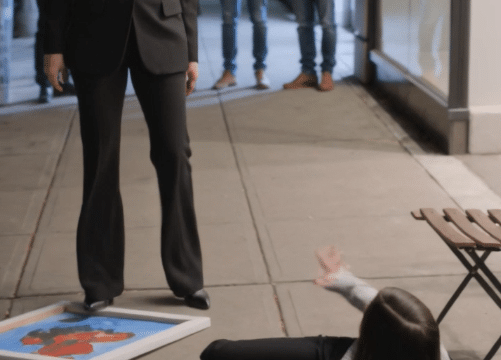
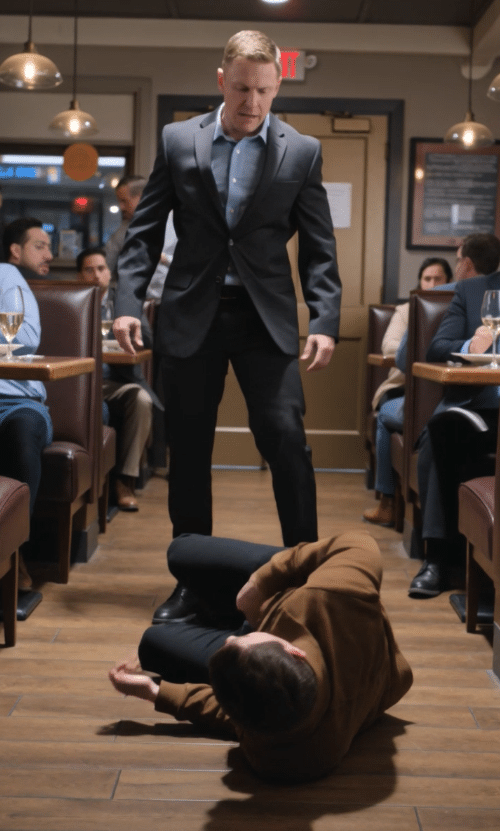
The blind man had barely finished speaking when the man behind him drove a vicious kick into his back.
He fell face-first onto the restaurant floor. His white cane clattered beneath a nearby table, a chair scraped sharply across the tile, and his guide dog stayed close to his side, startled but unharmed. Around them, diners froze with forks suspended above half-finished meals.
The man in the black blazer looked down at him as if he had dropped a piece of trash in the aisle.
“Trash. You’re blocking the whole restaurant.”
The victim was thirty-seven-year-old Daniel Bennett. He wore a brown jacket, black pants, and the harness of a trained guide dog named Cooper. He had been navigating the narrow aisle between crowded tables when a server passed in the opposite direction, forcing him to slow down and let Cooper find a safe route around the chairs.
It was an ordinary moment in a busy restaurant.
To the businessman behind him, it was an unforgivable inconvenience.
Daniel tried to steady his breathing. One hand remained on Cooper’s harness, a familiar point of contact that helped him understand where his dog was standing. His other hand searched for the white cane that had slipped away.
“Please,” Daniel said, wincing as he moved. “I’m trying to get through.”
The businessman stepped closer.
His name was Richard Voss, a forty-one-year-old investor who had spent years cultivating the appearance of a man whose time was more valuable than everyone else’s. He wore an expensive watch, carried his phone like a permanent extension of his hand, and had become accustomed to having staff move obstacles before he even asked.
Tonight, he had been expecting to meet an important client in the restaurant’s private dining room.
He was already irritated that his table wasn’t ready when he arrived. Then the crowded aisle slowed him down, and his frustration found a target.
Daniel’s disability was not something Richard tried to understand. He saw only a man moving more slowly than he wanted.
Richard delivered two more forceful kicks into Daniel’s back and side.
Diners gasped. A woman pulled her chair away from the aisle, while a father drew his young daughter closer to him. Several guests covered their mouths, watching in disbelief as Cooper stayed beside Daniel, alert and anxious, his trained instincts keeping him near the person he was supposed to guide.
Daniel curled slightly from the pain.
He could hear the dog’s breathing. He could hear plates rattling on a nearby table. He could hear the sudden silence of people who had been talking moments earlier.
What he could not understand was why a few seconds of delay had made someone decide that he deserved to be hurt.
Richard straightened his blazer.
“Move like everyone else.”
The words seemed to hang over the aisle.
No one rushed forward. No one challenged him. The diners had witnessed something terrible, but fear and disbelief held them in place.
Then a door opened sharply at the far end of the restaurant.
The entrance to the VIP room swung wide, and the restaurant’s owner stepped into the dining area with the floor manager and two security employees close behind him.
His name was Thomas Mercer. At fifty-nine, he had built one of the city’s most respected dining establishments by insisting that the experience of a restaurant should be measured by more than its menu, its prices, or the people who could afford its private rooms.
He took one look at Daniel on the floor.
Then he hurried toward him.
“Clear the VIP room for him.”
The floor manager immediately began opening a wider path. Security moved between Richard and the injured man while Thomas knelt beside Daniel, checking on him before giving a second glance to the businessman.
Richard’s face changed.
The owner had passed several wealthy guests without acknowledging them. He had ignored the commotion at the entrance and come straight to the blind man with the guide dog.
Richard stared, struggling to make sense of what he was seeing.
“For him?”
He had assumed Daniel was the least important person in the room.
He was about to discover how badly he had misunderstood the situation.
Act II
Daniel Bennett had never believed that being blind made him less capable of living independently.
He had lost his sight gradually during his twenties, after a medical condition damaged his vision beyond what treatment could restore. At first, the change had been devastating. He had been forced to relearn ordinary tasks that once required no thought: navigating unfamiliar streets, identifying the correct train platform, and finding the right doorway in a crowded building.
People often mistook his quiet concentration for uncertainty.
They saw the cane, the guide dog, and the extra seconds he sometimes needed to orient himself. They rarely noticed the planning, memory, and practiced judgment that allowed him to move through the world with confidence.
Daniel had worked hard to build a life that did not revolve around what he could no longer see.
He was a consultant specializing in accessible design and independent mobility. His work involved helping businesses understand how buildings, services, and public spaces could be made more usable for people with disabilities.
He had advised hotels on room access, worked with transportation providers on wayfinding, and helped restaurants reconsider layouts that looked elegant on paper but became difficult to navigate when every table was occupied.
He knew how to identify a poorly placed chair by the way sound traveled around it. He could recognize changes in flooring beneath his feet and understand Cooper’s movements through the harness in his hand.
He also knew that independence did not mean never needing time.
Sometimes a crowded aisle required patience. Sometimes a server carrying hot dishes needed the right of way. Sometimes the safest route was not the fastest one.
That evening, Daniel had come to the restaurant for a meeting of his own.
Thomas Mercer had invited him to advise on a planned redesign of the dining rooms. The restaurant had become popular enough that its narrow aisles were frequently congested during peak hours. Staff members were skilled and attentive, but the layout had not kept pace with the number of guests.
Thomas wanted an independent assessment before committing to expensive renovations.
He had heard about Daniel through a hospitality accessibility initiative and was impressed by his practical approach. Daniel did not arrive with a list of accusations. He arrived with questions, measurements, and an understanding that a business could be beautiful without making some of its customers feel as though they did not belong.
The two men had planned to discuss the initial findings over dinner.
Daniel had arrived a little earlier and asked to walk through the restaurant rather than be escorted directly to the private room. He wanted to experience the main dining area during a busy service, when the real challenges became apparent.
Cooper had guided him between tables, pausing whenever a server crossed their path.
Then Richard had appeared behind him.
Now, as Thomas knelt beside him, Daniel tried to focus on the familiar rhythm of his dog’s breathing.
“Stay with me, Cooper,” he murmured, keeping a hand on the harness.
Thomas’s expression tightened when he saw the pain Daniel was trying to suppress.
“Don’t try to stand yet,” he said, his voice controlled but urgent.
He signaled for the manager to arrange medical assistance and asked security to keep Richard away. The manager moved a group of chairs to open the aisle, allowing the responders to reach Daniel without crowding him.
Thomas did not attempt to pull Daniel upright. He remained close, making sure Cooper had room to stay beside his handler.
Only after the immediate arrangements were underway did Thomas turn toward Richard.
“What happened here?”
Richard glanced at the guests watching from nearby tables.
“He was blocking the aisle.”
Thomas stared at him.
“So you kicked him?”
Richard’s mouth opened, then closed.
“He wouldn’t move.”
“He told you his guide dog was leading him through.”
“I had somewhere to be.”
Thomas looked at the overturned chair and the cane lying beneath the table. His anger was visible now, but he did not raise his voice.
“Your plans do not give you the right to assault another guest.”
Richard tried to recover his confidence.
“Do you know who I am?”
It was the wrong question.
Thomas had spent years watching powerful customers use their names, money, and connections as shields against ordinary standards of behavior. Some expected a restaurant to accommodate every demand because they had paid for an expensive meal. Others believed a private room was a small kingdom where normal rules no longer applied.
He had no interest in playing that game.
“No,” Thomas replied. “And right now, that isn’t the issue.”
He turned to the floor manager.
“Preserve the security footage. Get the witnesses’ details, and make sure the police receive the information they need. Keep this area clear for the medical team.”
Then he looked back at Daniel.
“I’m sorry this happened in my restaurant.”
Daniel swallowed, still trying to steady his breathing.
He had expected to discuss accessible seating, clear routes, and the practical details of a renovation.
He had not expected to become the reason the entire dining room had fallen silent.
But Thomas had recognized something about the incident that Richard still did not understand.
The restaurant was not simply a place where the owner had to decide which guest deserved the best table.
It was a place where the owner’s values had just been tested in front of everyone.
And the decision Thomas made next would reveal whether those values were real.
Act III
Thomas Mercer had opened his first restaurant nearly thirty years earlier with a small dining room, a modest menu, and a loan he had spent years repaying.
He had learned the business from the ground up. He knew how quickly a kitchen could fall behind when one order was delayed, how a careless manager could turn a minor complaint into a lasting grievance, and how a room full of satisfied guests could become uneasy when someone was treated unfairly.
Over time, his restaurant had become a destination for executives, artists, visiting dignitaries, and families celebrating important milestones.
The VIP room was part of that success.
It offered privacy, dedicated service, and a quiet place for business dinners. Guests paid for the experience, and Thomas took the obligation seriously.
But he had never believed that the VIP room should symbolize a hierarchy of human worth.
It was a room with a door, a table, and a better measure of privacy. It was not a place where people became more deserving of respect simply because they could afford to enter.
When he ordered the room cleared for Daniel, he was not rewarding him for being important.
He was creating space for an injured guest who needed privacy, medical attention, and a safe place for his guide dog while the situation was handled.
The floor manager understood immediately.
The VIP room had been occupied by a small group finishing a business dinner. They were informed that an urgent incident required the space, and staff helped them move to another suitable area. No one argued.
Within minutes, the private room was ready.
Security kept a clear route open, while the medical responders assessed Daniel and determined the appropriate next steps. Cooper remained close to his handler, his harness still in Daniel’s grasp.
Thomas accompanied them to the room but left enough space for the medical team to work.
Richard watched from the main dining area.
His shock had begun to turn into resentment.
He could not understand why the restaurant’s owner was willing to disrupt a private dining arrangement for a man who, in his view, had caused the original delay. He had spent years measuring people through their usefulness, their influence, and the speed with which they responded to his demands.
Daniel had offered him none of those things.
Yet the entire restaurant now seemed to revolve around him.
Richard took out his phone and began composing a message to a business associate, trying to make the incident sound like an unreasonable overreaction by the restaurant.
Before he could send it, the floor manager approached him.
“Sir, security needs you to remain here while we document the incident.”
Richard frowned.
“I’m not being detained.”
“You’re being asked to remain available while the police are contacted. Our security team will explain the process.”
“I have a reservation in the VIP room.”
“Not anymore.”
The manager did not say it with triumph. He said it as a statement of the restaurant’s immediate decision to manage a serious safety incident.
Richard looked toward the private room.
The door was closed.
He had expected to be treated as a valued customer. Instead, he was being kept away from the person he had attacked while the restaurant preserved evidence and contacted the authorities.
For the first time, his money could not make the situation disappear.
Inside the room, Daniel was being cared for. Thomas waited until the medical team had finished its initial assessment before approaching him about the meeting they had planned.
“We can postpone everything,” Thomas said. “Your health comes first.”
Daniel took a breath.
“I may need to postpone the meeting,” he replied. “But I don’t want what happened to be the reason the accessibility review stops.”
Thomas was silent.
Even now, Daniel was thinking about the problem he had come to help solve.
That was what made his work different from a simple compliance checklist. He understood that a business could not build a welcoming environment by focusing only on measurements and regulations. The real test came when people had to share limited space, when the room was crowded, and when someone needed more time than others expected.
A clear aisle was not a luxury.
A guide dog was not an obstacle to be tolerated.
And a person who moved slowly was not a problem that needed to be pushed out of the way.
Thomas nodded.
“The review will continue. But you won’t have to do anything tonight.”
He then asked the manager to preserve Daniel’s original appointment notes and the plans they had prepared for the redesign. The work would resume when Daniel was ready, with the same scope and independence as before.
There would be no attempt to turn the assault into a publicity opportunity. Thomas did not want a staged apology, a photograph in the VIP room, or a speech about how much the restaurant cared.
He wanted the incident documented honestly, the injured guest cared for, and the underlying problems addressed.
That distinction mattered.
The restaurant’s immediate response was about safety and accountability. The redesign would require its own thoughtful process, including input from people who used mobility aids, guide dogs, and other accessibility tools.
Thomas knew he could not fix every barrier in a single night.
But he could make one thing clear: no customer would be allowed to use the restaurant’s reputation, wealth, or social standing as permission to hurt someone else.
Richard had come expecting the restaurant to bend around him.
Instead, the owner had made a decision that exposed the emptiness of his entitlement.
And when the security footage was reviewed, the truth would become impossible to disguise.
Act IV
The restaurant’s cameras had recorded the assault from two angles.
One view showed Richard approaching Daniel in the narrow aisle. Another captured the moment the businessman kicked him from behind and the subsequent blows after Daniel fell.
The footage was preserved and made available to the responding authorities through the proper process. Witnesses provided their accounts, and the restaurant documented the condition of the area, including the displaced chair and the cane that had fallen beneath the table.
There was no need for Thomas to invent a version of events that made his restaurant look heroic.
The evidence could speak for itself.
Richard’s first defense was that Daniel had blocked the aisle.
His second was that the restaurant had failed to keep the dining room moving.
Neither explained the decision to attack someone who had already told him why he was moving slowly.
The distinction was simple: an inconvenience might justify a complaint. It did not justify violence.
The restaurant followed its incident procedures, cooperated with the investigation, and made sure Richard could not approach Daniel while he was receiving care. Decisions about criminal charges or other legal consequences were left to the authorities, while the restaurant handled its own safety and guest-access decisions.
Thomas refused to make promises about outcomes he did not control.
But he did make one decision himself.
Richard would not be permitted to continue his evening as though nothing had happened. The restaurant ended his service for the night and addressed his access to the premises under its policies, taking into account the seriousness of the incident and the guidance of its security team.
The VIP room was no longer available to him.
In fact, the room had become a symbol of the exact opposite of what he had expected. The space he believed should be reserved for people like him had been opened to Daniel because Daniel needed it, not because he could purchase it.
That realization unsettled Richard more than the security guards did.
He tried to argue that the restaurant was humiliating him.
The floor manager remained professional.
“No one here is trying to humiliate you, sir. We’re responding to what happened.”
Richard looked around the dining room.
The guests who had witnessed the assault were no longer whispering as though they were unsure what they had seen. Some had provided statements. Others had simply returned to their tables, quieter than before, with a new awareness of how quickly an ordinary evening could change.
The silence that surrounded Richard was not the same as the fear that had held the room earlier.
It was judgment.
He had believed that everyone would instinctively side with the person who sounded confident, looked successful, and complained the loudest. Instead, the evidence had revealed what confidence concealed.
Inside the VIP room, Thomas sat with Daniel while they waited for the next stage of his care.
Cooper rested close to Daniel’s chair, still attentive to every movement. Daniel kept a hand near the dog’s harness, drawing comfort from the familiar presence.
Thomas apologized again.
Daniel accepted the sincerity but did not let the conversation drift toward sympathy alone.
“The aisle is too narrow when the restaurant is full,” he said. “That matters. But what happened to me isn’t a layout problem.”
Thomas nodded slowly.
“No. It isn’t.”
“We should fix the layout because people need to move safely. But we shouldn’t confuse that with what he chose to do.”
It was the clearest assessment of the evening.
A narrow aisle could create friction. A crowded restaurant could make navigation more complicated. Better design could reduce delays and make movement easier for guests and staff.
None of those things had forced Richard to kick Daniel.
That choice belonged to Richard.
Thomas asked the floor manager to schedule a full accessibility assessment of the dining room. The review would examine table spacing, chair placement, the route between the entrance and the main dining area, and whether servers had clear procedures for navigating around guests using mobility aids or guide dogs.
The team would also consider how staff could respond when a guest became verbally aggressive, including when to call security and how to keep an aisle clear for medical assistance.
The restaurant had always prided itself on attentive service.
Now it needed to demonstrate that attentiveness included people whose needs were not immediately obvious to every customer.
In the days that followed, Thomas commissioned practical changes based on the assessment. Furniture arrangements were revised to create more reliable passageways during peak hours. Staff were given clearer guidance on keeping accessible routes free of bags, chairs, and service equipment. Managers reviewed how complaints were handled so that impatience from one guest would not become pressure placed on another.
The changes were not presented as a favor to Daniel.
They were improvements the restaurant should have considered already.
Thomas also made sure the review would not stop at the VIP entrance. A private room could be spacious and quiet while the route leading to it remained difficult to navigate. Accessibility had to be considered across the entire guest experience, not just in the part of the building that looked best in photographs.
Daniel’s meeting would take place when he had recovered and was ready.
And when it did, the owner intended to listen.
Act V
Several weeks later, Daniel returned to the restaurant with Cooper.
The dining room was busy again. Glasses clinked, servers moved between tables, and the warm lights reflected off the polished surfaces. To a casual observer, the restaurant looked almost exactly as it had on the night of the assault.
But the aisle had changed.
The tables were arranged with more consistent space between them, and chairs were positioned so that they were less likely to block the route when guests stood up. Staff had been trained to notice when a pathway became obstructed and to correct the problem without waiting for a complaint.
Daniel walked through the main dining area at his own pace.
Cooper guided him around a table, paused as a server crossed ahead, and continued toward the private room. No one hurried him. No one treated the extra seconds as a failure of service.
At the entrance to the VIP room, Thomas was waiting.
“Good to have you back,” he said.
Daniel smiled.
“I’m glad we’re doing this.”
They sat down to review the assessment and discuss the changes. Daniel offered practical feedback on the revised layout, explaining where the space felt more natural and where additional adjustments might help.
Thomas listened without trying to turn every suggestion into an immediate promise.
The goal was not to make the restaurant perfect overnight. It was to establish a habit of noticing barriers, listening to guests, and making improvements based on real experience.
Cooper settled beside Daniel while they worked.
At one point, Thomas looked toward the open door.
“I keep thinking about that night,” he admitted. “About how quickly everyone froze.”
Daniel considered the question.
“People don’t always know what to do when something terrible happens in front of them.”
“I know. But I wish someone had stepped forward sooner.”
“So do I.”
Daniel did not excuse the bystanders. Their hesitation had left him alone in a frightening moment. But he also understood that people sometimes needed clear guidance to move past shock and take action safely.
Thomas decided to include that lesson in the restaurant’s staff training. Employees would be taught how to summon security, protect the person at risk, and create space for medical responders rather than crowding around an incident.
He also asked the team to make sure that a guest using a guide dog would never be treated as though the dog were a problem to be managed. Staff could offer assistance when appropriate, but they should not interfere with the dog’s work or assume that the handler needed someone to take control.
The changes were quiet, practical, and lasting.
They did not undo the violence Daniel had experienced. They did not guarantee that another entitled person would never enter the restaurant. But they made the staff better prepared to respond and the dining room easier to navigate.
Richard’s own consequences unfolded elsewhere.
The incident was investigated through the appropriate channels, with the preserved footage and witness accounts informing the process. His professional relationships were also affected as his conduct became known to people who had previously accepted his impatience as the price of dealing with a demanding executive.
He could explain a delayed dinner.
He could complain about a crowded aisle.
He could insist that his schedule had been important.
But none of those explanations changed what he had done after Daniel asked for a moment to move safely through the restaurant.
His reputation had been built on the belief that efficiency was a virtue and that people who slowed him down were the problem.
Now the question was no longer whether Richard could get people to move out of his way.
It was whether anyone could trust him with power over others.
At the restaurant, however, Daniel’s return was not treated as a victory over Richard. There was no public confrontation, no staged apology, and no announcement designed to make the restaurant look generous.
There was simply work to do.
Daniel reviewed the new layout, suggested further improvements, and helped the team understand the difference between an aisle that technically met a measurement and one that remained usable when a restaurant was full.
When the meeting ended, Thomas walked with him to the main entrance.
Cooper led Daniel past the tables and toward the exit, navigating the route with practiced confidence.
Thomas watched them go, remembering how the same crowded aisle had become the setting for one of the ugliest moments he had witnessed in his own restaurant.
He had ordered the VIP room cleared for Daniel that night because an injured man needed a safe place to receive care.
The decision had startled Richard because he believed the room belonged to people with status.
But the real lesson was not that Daniel deserved special treatment.
It was that he should never have needed the owner’s intervention to receive basic respect.
The VIP room had been opened for him, yet dignity should not have depended on a private door, a famous name, or a powerful person rushing in at exactly the right moment.
It should have been present from the beginning, in the space left between tables, in the patience shown to a guest, and in the willingness to recognize that another person’s needs were not an insult.
As Daniel and Cooper disappeared through the entrance, the restaurant returned to its usual rhythm.
Orders were taken. Plates were carried. Conversations rose and fell beneath the warm lights.
And the aisle remained clear.
Not because the restaurant expected every guest to move at the same speed, but because it had finally accepted a simple truth:
A person who needs a little more time is not taking something away from everyone else.
Sometimes, the measure of a room is not how quickly people can pass through it.
It is whether the people inside it are allowed to move through the world without being punished for who they are.