Act I
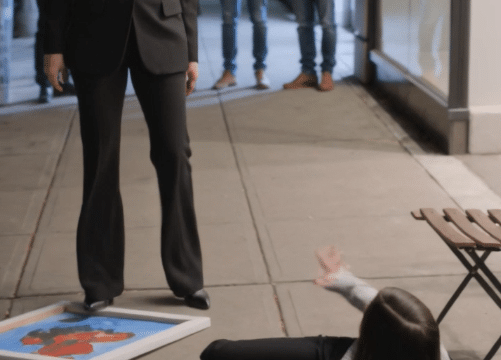
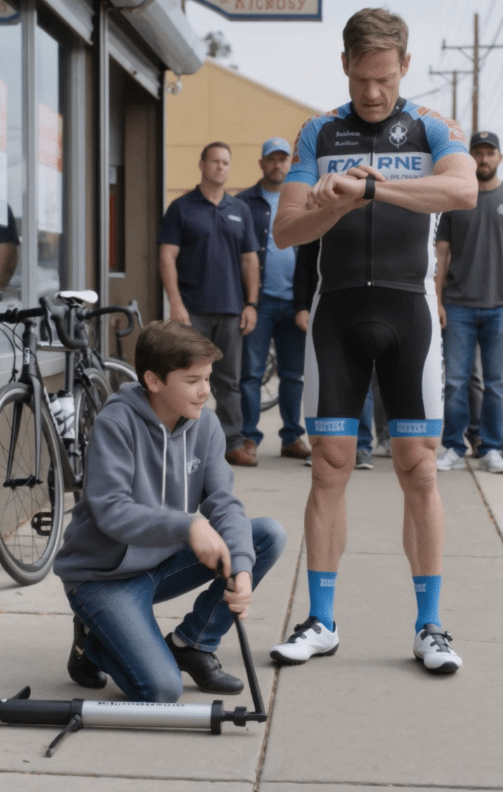
The boy was still holding the hand pump when the wealthy cyclist kicked him in the chest.
Thirteen-year-old Ethan Brooks crashed onto the narrow sidewalk beside the bicycle wheel, his gray hoodie twisting beneath him as the pump clattered across the pavement. The wheel wobbled violently, the metal spokes catching the afternoon sunlight, while the expensive racing bike tilted toward the boy lying beneath it.
For a split second, nobody moved.
The man standing over Ethan wore a sleek professional cycling outfit, carbon-fiber shoes, and a helmet worth more than everything inside the little repair shop combined. His racing bike was a machine built for speed, the kind of equipment serious amateurs admired and professional athletes treated with almost religious reverence.
Yet the man had just attacked a child because a tire was taking too long to inflate.
Ethan tried to sit up. His elbow stung where it had scraped the pavement, and his hand trembled as he reached toward the bicycle.
“The valve is stuck. I’m fixing it.”
He spoke quickly, hoping an explanation might calm the man down.
It had taken him less than a minute to discover the problem. The valve was resisting the pump connector, and every time Ethan tried to secure it, a little air escaped. He had been about to try a different fitting when the cyclist began complaining.
The man did not care.
“Trash. Don’t waste my time.”
Ethan stared at him, stunned by the insult.
The cyclist stepped closer.
He could have asked for another mechanic. He could have taken his bike somewhere else. He could even have demanded a refund for the delay.
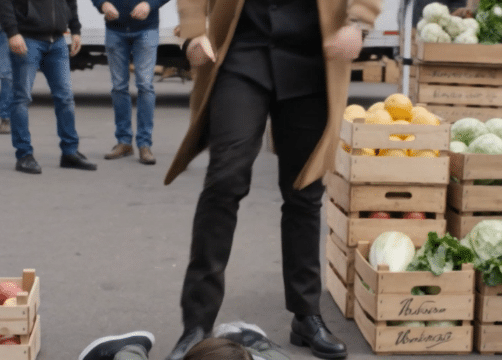
Instead, he kicked Ethan again, then delivered another forceful kick to the boy’s side.
Ethan curled inward, pulling his hand away from the spokes. The old pump lay several feet away, and a thin streak of blood appeared on his elbow.
A woman walking past the shop gasped.
A man near the curb stopped with his phone halfway out of his pocket. Two customers standing beside a row of bicycles backed away, their faces tense with disbelief.
Nobody had expected a routine repair to become a public assault.
The cyclist straightened his jersey and glanced at the bike as though the boy had inconvenienced the machine itself.
“Fix bikes from the dirt.”
The words hung in the air.
Ethan had heard people dismiss the shop before. He had watched customers glance at its weathered sign, the rust around the doorframe, and the mismatched bicycles parked outside before deciding they would rather spend their money somewhere more polished.
But he had never heard anyone speak about his uncle’s work with such contempt.
Then a black SUV stopped sharply beside the curb.
The rear door opened, and a man in a professional cycling team jacket stepped out. He looked toward the shop, saw Ethan on the ground, and broke into a run.
The cyclist barely had time to turn before the newcomer delivered a single sharp punch to his face.
The wealthy man staggered backward.
The newcomer immediately steadied the racing bike before it could topple onto Ethan, then placed himself between the injured boy and the man who had attacked him.
His expression was controlled, but his eyes burned with anger.
He looked down at Ethan, then at the bicycle.
Finally, he faced the cyclist.
“That kid fixed the bike that won my last race.”
The man’s arrogance faltered.
He recognized the team jacket. He recognized the face beneath it.
Everyone in the local cycling scene knew the newcomer. His victories had appeared on sports broadcasts, his photograph had covered magazine features, and young riders wore replicas of his team jersey.
He was not merely a famous cyclist.
He was the champion whose name had become synonymous with winning.
The wealthy rider stared at him, struggling to reconcile the celebrity in front of him with the battered little shop behind them.
Then his eyes dropped toward Ethan.
“What the hell are you?”
It was the first question he had asked all afternoon that revealed just how little he understood.
Because the boy on the pavement had done something extraordinary long before the champion arrived.
And the man who had just humiliated him was about to discover that the most valuable part of a racing bicycle was not always the part with the highest price tag.
Act II
Ethan Brooks had learned to repair bicycles before he had learned to explain why he loved them.
His uncle, Michael Brooks, owned Brooks Bicycle Repair, a narrow roadside shop wedged between a laundromat and a small auto-parts store in an older American neighborhood. The sign above the door had faded until the lettering was barely readable, and the front window displayed a collection of mismatched bells, brake cables, and used helmets.
Inside, the shop smelled of rubber, machine oil, and the faint metallic scent of tools that had been handled for decades.
Michael had opened it after losing his job at a bicycle distributor during a corporate restructuring. He had been offered work elsewhere, but the available positions required moving away from his family and accepting hours that would have kept him from helping care for his sister, Ethan’s mother.
Instead, he rented the smallest storefront he could afford.
The first year had been difficult. Some days, he repaired only two bicycles. On others, he earned just enough to cover the rent, electricity, and the replacement parts he needed for the next morning.
But Michael believed that a bicycle could change a person’s life.
For a child, it could mean freedom beyond the block where they lived. For a worker, it could mean a cheaper commute. For an older neighbor, it could mean remaining independent without depending on someone else to drive them everywhere.
He treated every repair as a promise.
If he told a customer the brakes would hold, he made certain they would. If he replaced a chain, he checked the alignment before handing the bike back. He refused to let a customer leave with a safety problem simply because the repair had taken longer than expected.
Ethan had spent countless afternoons watching him work.
At first, he was allowed to sort screws, wipe down tools, and carry old inner tubes to the recycling bin. Michael taught him how to identify different valve types and how to listen for the faint hiss of escaping air.
He also taught him patience.
“Don’t force a part just because you’re frustrated,” Michael would say. “Find out why it isn’t moving.”
Ethan remembered the lesson because it applied to more than bicycles.
When his mother, Laura, began working extra shifts at a medical billing office, Ethan started spending more time at the shop after school. He did homework at a small desk behind the counter and helped with simple jobs until Michael could finish the more complicated repairs.
He was not an expert mechanic. Michael would have been the first to say so.
But Ethan was observant, careful, and unusually good at noticing small problems that other people overlooked.
A wheel might look straight but rub against a brake pad under pressure. A gear could shift perfectly on a repair stand and slip when a rider climbed a hill. A valve could appear damaged when the real issue was a worn connector or an incompatible pump head.
Ethan liked the detective work.
He liked the moment when a problem that seemed impossible suddenly became understandable.
And he loved the stories Michael told about customers who returned months later to say that a repaired bicycle had carried them through a difficult time.
The shop did not make the family wealthy.
There were weeks when Michael postponed buying new equipment because rent came first. There were winters when customers stayed home and the repair queue nearly disappeared. Ethan wore the same gray hoodie so often that his mother had begun quietly checking for sales on a replacement.
Still, the shop was theirs in a way that mattered.
Michael knew every customer who could not afford an expensive repair. He kept a box of used parts that could be repurposed when a family needed a bicycle made safe without spending more than they could manage. Sometimes he charged nothing for a minor adjustment, though he never made a show of the decision.
Ethan admired that most of all.
He wanted to become an engineer someday, perhaps working on racing bicycles or designing equipment that could help riders go faster without sacrificing safety. He kept sketches in a school notebook, filling the margins with drawings of gears, suspension systems, and aerodynamic frames.
His uncle encouraged him, but he also reminded Ethan that skill meant little without integrity.
“People will pay for a fancy bike,” Michael told him once. “What they really trust you with is the part of their life that depends on it working.”
That afternoon, Ethan had been alone at the front of the shop when the wealthy cyclist arrived.
The man’s name was Grant Mercer, a forty-year-old amateur racer who had spent years building his identity around the sport. He owned expensive equipment, followed professional training plans, and had enough money to travel to major cycling events throughout the country.
He was not a professional champion, but he wanted people to treat him like one.
Grant had recently purchased a high-end racing bike and taken it out for a training ride. When the rear tire began losing pressure, he searched for the nearest repair shop and found Michael’s faded sign.
He was already annoyed by the delay in his ride.
Then he saw Ethan.
To Grant, the boy looked like a child who happened to be standing near some tools. He did not ask whether a mechanic was available. He did not ask whether Ethan knew how to check the valve.
He simply expected the boy to make the problem disappear.
When the valve resisted the pump connector, Grant’s impatience became contempt.
He saw the worn shop, the old jeans, the cheap pump, and the child’s hesitation.
He decided that everything about the place was inferior.
And he made the mistake of believing that meant everyone inside it could be treated however he pleased.
What Grant did not know was that Ethan had already repaired bicycles for riders far more accomplished than he was.
One of those riders was about to step out of a black SUV.
And he remembered the boy’s work for a reason that would soon change the entire afternoon.
Act III
The man in the team jacket was Adrian Cole, a world-famous professional cyclist whose name appeared regularly near the top of international race results.
At thirty-six, Adrian had won major stage races, claimed a prestigious one-day championship, and become known for an unusual ability to recover from mechanical trouble without losing his composure. He was not the loudest rider in the sport, nor was he famous for humiliating opponents at the finish line.
His reputation rested on consistency.
He prepared carefully, listened to his mechanics, and understood that victory often depended on hundreds of small decisions made long before a race began.
He also knew what it meant to have very little.
Adrian had grown up in a working-class family where buying a new bicycle was a major expense. His first serious road bike had been assembled from secondhand parts, and the frame had been too large until his father helped modify the setup.
When Adrian began entering local races, he could rarely afford the equipment other competitors took for granted.
He learned to maintain his own bicycle because paying someone else to do it was often impossible.
That experience shaped the way he treated mechanics.
He never assumed that an expensive machine made its owner an expert. He never confused the price of a tool with the skill required to use it. And he had little patience for riders who spoke about their support teams as though the people behind the scenes were replaceable.
Adrian’s last major victory had nearly slipped away because of a problem no one could see from the roadside.
During a demanding race, his bicycle had developed an intermittent issue that caused the rear wheel to lose stability under heavy effort. The team mechanics had checked the obvious components, but the problem returned whenever Adrian pushed hard through a turn.
The team had considered replacing several parts.
Before making that decision, Adrian had brought the bicycle to Michael Brooks’s shop during a visit to the region. One of the team’s support staff had recommended Michael, explaining that the small shop was known for careful work even when the equipment was old.
Michael inspected the bike, tested the wheel under load, and discovered that the problem was more subtle than the team had expected. A component was not seating properly, creating a small inconsistency that became significant when the bicycle was under pressure.
He corrected the issue, checked the alignment, and had Ethan assist with a final inspection.
Ethan had noticed that the problem seemed to appear only after repeated pressure on the wheel. That observation prompted Michael to repeat the test under conditions closer to those Adrian would experience during a race.
The result was a repair the team could trust.
Adrian remembered the visit.
He remembered Michael’s calm explanation, the old tools arranged with almost obsessive precision, and the quiet boy who had asked intelligent questions without pretending to know more than he did.
He also remembered the bicycle.
It had carried him through the final stretch of his last major race, where he managed to hold off a late attack and cross the finish line first.
The victory had made headlines.
The repair had received no public attention.
Adrian had thanked Michael privately and arranged for his team to pay the full invoice. He had even asked his staff to keep the shop’s details on file for future work.
But he had not met Ethan again.
When Adrian’s SUV stopped outside the shop that afternoon, he had been on his way to discuss a possible community cycling event with local organizers. He had recognized the storefront from the earlier visit and asked the driver to stop.
Then he saw Grant Mercer kicking a child.
The sight had erased every other thought.
Adrian rushed forward, struck Grant once, and steadied the racing bike before it could fall onto Ethan. He was furious, but as the immediate danger passed, he forced himself to focus on the boy.
Ethan was hurt.
The bicycle could wait.
Adrian asked someone nearby to contact emergency services and made sure the people around them gave Ethan room. He did not attempt to diagnose the boy’s injuries, and he did not ask him to stand.
Then he turned to Grant.
“That kid fixed the bike that won my last race.”
The words changed the atmosphere.
Grant looked at Adrian’s jacket again, then at his face. Recognition came slowly, followed by the uncomfortable realization that the man standing in front of him was not simply another customer.
He was Adrian Cole.
Grant had watched Adrian win races on television. He had followed his training updates, admired his equipment, and once paid a small fortune to attend a cycling event where Adrian was scheduled to appear.
Now the champion was standing beside a weathered repair shop, defending a boy Grant had just kicked.
Grant’s mouth tightened.
“What the hell are you?”
Adrian stared at him.
“Someone who knows exactly what that boy’s work is worth.”
But that was not the most important part of the revelation.
Adrian had not intervened because Ethan had repaired a champion’s bicycle. He had intervened because a child was being assaulted.
The repair simply made Grant’s contempt look even more foolish.
And Adrian was about to make sure the man understood the difference.
Act IV
The emergency responders arrived within minutes.
Ethan remained seated on the pavement while they assessed him. His elbow had a shallow scrape, but the pain in his chest and side required proper evaluation. Michael, who had been working in the rear of the shop when the commotion began, hurried outside and went pale when he saw his nephew.
He knelt beside Ethan, speaking softly as the responders examined him.
Ethan tried to reassure him.
“I’m okay, Uncle Mike.”
Michael shook his head.
“You don’t have to make this easier for me.”
For the first time since the attack, Ethan’s face crumpled.
Michael took his hand carefully and stayed beside him while the responders continued their assessment.
Across the sidewalk, Grant was trying to recover his dignity.
He straightened his jersey and adjusted his helmet, looking from Adrian to the small crowd that had gathered. A few people had recorded portions of the incident, and others were now speaking with the officers who had arrived to take statements.
Grant seemed to resent the attention more than the consequences of his actions.
“This is insane,” he said. “The kid was wasting my time. I asked him to fix a tire.”
Adrian looked at him.
“And he told you the valve was stuck.”
“He should have known what he was doing.”
“He was trying to solve the problem.”
Grant gestured toward the shop.
“Look at this place. You expect me to trust my bike to a kid working with junk?”
Adrian’s expression hardened.
“Your bike is expensive. That doesn’t make you important.”
Grant scoffed.
“You have no idea who you’re talking to.”
Adrian almost laughed, but there was no humor in it.
“I know who I am. I know what I ride. And I know who fixed my bicycle before my last race.”
He pointed toward Michael’s shop.
“You came here because you needed help. You wanted someone to solve a problem you couldn’t solve yourself. Then you decided the person helping you was beneath you.”
Grant opened his mouth, but Adrian continued.
“The boy didn’t make your valve stick. He didn’t force you to wait. And he certainly didn’t make you kick him.”
The people nearby had gone quiet again.
Grant had expected the champion to defend his own status, perhaps to brag about the bike or threaten to have him banned from cycling events. Instead, Adrian kept returning to the same basic fact.
A child had tried to help.
A grown man had chosen violence.
Nothing about Grant’s expensive equipment changed that.
An officer began collecting formal statements. Grant was asked to explain what had happened, and the witnesses were given the opportunity to provide their accounts. The available recordings would be preserved, and the assault would be handled through the appropriate legal process.
Adrian also acknowledged that he had struck Grant.
He did not attempt to disguise the punch as an official punishment or claim that being famous gave him the right to hit someone. He had reacted impulsively to a horrifying scene, and he would cooperate with the investigation into his own actions.
But he refused to let Grant use that fact to erase what had happened to Ethan.
“Both things can be true,” Adrian said. “You attacked a child. I struck you. Neither fact disappears because you dislike the other.”
For once, Grant had no immediate answer.
He glanced toward his racing bike, which stood safely beside the shop. Its glossy frame and expensive components suddenly seemed absurdly out of place beside the old hand pump lying on the pavement.
Adrian followed his gaze.
“Do you know why professional teams spend so much time with mechanics?” he asked.
Grant said nothing.
“Because speed isn’t just the rider. It’s the people who understand the machine, the people who notice what everyone else misses, and the people who care enough to check a problem twice.”
He looked toward Ethan.
“That kid was doing exactly that.”
Michael’s eyes filled with emotion, but he kept his attention on his nephew.
He had spent years teaching Ethan that good work mattered even when nobody praised it. He had never imagined that one of the world’s most celebrated cyclists would publicly acknowledge the lesson.
Yet Adrian was not finished.
He asked his team representative to retrieve the documentation from the earlier repair. The invoice, service notes, and correspondence confirmed that Michael’s shop had performed the work on Adrian’s race bicycle and that the issue had been resolved before the championship.
The records did not prove that Ethan alone had won the race. No honest athlete would claim that a single repair accounted for an entire victory.
But they established something more credible and, in its own way, more powerful.
The boy Grant had called worthless had contributed to a repair that helped a world-class rider compete at the highest level.
His work had mattered.
His questions had mattered.
And the care he had taken with a bicycle had mattered to someone who understood the stakes.
Grant looked from the documents to Adrian, then toward Ethan.
The confidence had begun to drain from his face.
But Adrian did not offer him the easy escape of a public apology accepted and forgotten.
“This isn’t about whether you respect my name,” the champion said. “It’s about whether you understand that people deserve respect before you know what they can do for you.”
That was the part Grant could not answer.
Because he had built his entire identity around being the man with the best equipment, the fastest training times, and the most expensive gear.
Now a boy in a worn hoodie had exposed the weakness beneath all of it.
And the consequences would follow Grant long after the crowd dispersed.
Act V
Ethan spent the rest of the afternoon being evaluated by medical professionals while Michael remained close enough for him to reach out whenever he needed reassurance.
The injuries were painful, and the fear did not disappear simply because the attack had ended. For several nights afterward, Ethan startled at sudden movements and found himself remembering the moment Grant had stepped toward him.
Michael never told him to forget it.
He knew that being brave did not mean pretending something frightening had never happened. He also knew that Ethan needed time to recover without feeling responsible for comforting everyone around him.
So the shop stayed closed for two days.
Michael put a handwritten notice on the door explaining that the business would reopen shortly. He did not include the details of the assault or turn Ethan’s experience into a public appeal.
When they returned, the hand pump had been cleaned and placed back beside the repair stand. The bicycles outside had been brought in overnight, and Michael had swept the narrow sidewalk before unlocking the door.
The shop looked almost exactly as it had before.
But Ethan did not immediately return to work.
For the first morning, he sat behind the counter with a book open in front of him, listening to the familiar sounds of tools being moved around the workshop. Michael made no attempt to hurry him.
Then, just before lunch, a young customer arrived with a bicycle that had a slow leak in the rear tire.
Michael glanced at Ethan.
“Would you like to take a look?”
The question was an invitation, not a demand.
Ethan hesitated.
Then he stood, put on his work gloves, and wheeled the bicycle toward the repair stand.
The valve worked properly this time. The leak came from a tiny puncture near the center of the tube, and Ethan found it after carefully checking the tire. He patched the tube, inspected the inside of the casing, and tested the repair before handing the bike back.
The customer thanked him.
Ethan nodded, trying not to smile too broadly.
It was a small job. It did not make the news. Nobody arrived with a camera, and no famous athlete was waiting outside.
But it mattered because Ethan had chosen to return to something he loved on his own terms.
A week later, Adrian Cole visited the shop again.
He arrived without a media crew, carrying a small box of professional repair tools that his team had been replacing. He asked Michael whether the equipment would be useful, making it clear that the shop could decline anything it did not need.
Michael accepted a few items but refused the most expensive pieces.
“We’ll use what makes sense,” he said. “I don’t want a museum. I want a working shop.”
Adrian laughed.
“That’s why I came back.”
He also offered to arrange a paid apprenticeship opportunity for Ethan when he was older, subject to his family’s wishes and the team’s normal requirements. It was not a promise that Ethan would become a professional mechanic overnight. Adrian knew that talent needed time, education, and experience to develop.
For now, he offered something more appropriate: access to learning materials, a chance to observe the team’s mechanics during an approved workshop visit, and encouragement to keep studying engineering.
Ethan listened with wide eyes.
Then he asked whether the team ever used older bicycles for training demonstrations.
Adrian smiled.
“All the time. A good mechanic should understand every machine, not just the expensive ones.”
Michael looked at his nephew, recognizing the spark of excitement that had been missing since the attack.
The offer did not make their family rich. It did not erase the weeks of anxiety or transform the old shop into a sleek racing laboratory.
It gave Ethan a path forward.
And that was enough.
Meanwhile, Grant faced the consequences of the assault through the appropriate legal process. Witness statements and available video were reviewed, and the incident could no longer be dismissed as a simple argument over a delayed repair.
The cycling community also learned what had happened.
Adrian did not launch a personal campaign against Grant, and he did not demand that every race organizer impose the same punishment. He simply provided his account when asked and made it clear that violent behavior toward a child was incompatible with the standards he expected from the sport.
Grant’s reputation suffered because the facts were difficult to reconcile with the image he had cultivated.
He had wanted people to see a serious athlete with elite equipment.
Instead, they saw a grown man who had attacked a thirteen-year-old over a few minutes of inconvenience.
The distinction followed him.
But the most meaningful change happened quietly inside the repair shop.
Ethan began keeping a notebook devoted to mechanical problems. He recorded the symptoms, the tests he performed, the repairs that worked, and the mistakes he wanted to avoid making again. Michael encouraged him to write down not only the solutions but also the questions that had led him there.
One page described the stuck valve from the day of the assault.
Ethan wrote that the pump connection had not seated correctly and that he should check compatibility before applying additional pressure. He noted the extra time required to test the fitting and the importance of remaining patient when a part resisted.
At the bottom, he added a sentence his uncle had said years earlier.
Don’t force a part just because you’re frustrated. Find out why it isn’t moving.
He underlined it twice.
Months later, Adrian invited Ethan and Michael to attend a race where his team would be competing. They watched from a designated area near the service vehicles, where mechanics checked tire pressure, adjusted brakes, and made last-minute inspections.
Ethan was fascinated.
The machines were faster and more advanced than anything in his uncle’s shop, but the principles were familiar. Every bicycle still depended on careful assembly, accurate adjustments, and people who understood how tiny problems could become serious under pressure.
When Adrian’s team won, the celebrations were loud and immediate.
Cameras flashed. Riders embraced. Staff members exchanged congratulations as the team gathered near the finish area.
Adrian found Ethan afterward.
He was still wearing his race jersey, his face flushed from the effort.
“Did you see how many people were working behind the finish line?” he asked.
Ethan nodded.
“Every one of them mattered,” Adrian said. “The riders get the photographs. But nobody wins alone.”
Ethan looked toward the mechanics packing equipment into the team vehicles.
For the first time, he could imagine himself in that world without feeling that he had to become someone else to belong there. He did not need an expensive bicycle or a perfect uniform to begin learning. He needed patience, knowledge, and the willingness to take his work seriously.
Adrian had recognized the value of his work long before Grant did.
But the deeper lesson was not that Ethan deserved respect because he had once repaired a champion’s bicycle.
It was that Grant should never have needed that revelation to treat him like a human being.
The boy had been worthy of respect while he was learning. He had been worthy of respect when the valve was stuck. He had been worthy of respect when he fell beside the wheel, frightened and injured, with the old pump lying on the pavement.
His value had never depended on the person who happened to recognize it.
One afternoon, back at the shop, Ethan finished inflating a customer’s tire and checked the pressure one final time. The customer thanked him, paid Michael, and rode away down the sidewalk.
Ethan watched the bicycle disappear around the corner.
Then he picked up the hand pump and returned it to its place.
The shop sign still needed repainting. The floor still showed old oil stains, and the front window still displayed mismatched parts in a slightly crooked arrangement.
But the place was full of work, and Ethan was part of it.
He was learning, one repair at a time, that skill did not need to announce itself. It showed up in the patience to find a problem, the humility to ask a question, and the care to make certain someone could ride away safely.
Grant Mercer had believed that the most expensive bicycle belonged to the most important person in the room.
Adrian Cole knew better.
A champion could cross the finish line first because dozens of people had done their jobs well. A small repair shop could keep a neighborhood moving because its owner refused to cut corners. And a thirteen-year-old boy could be learning the foundations of an extraordinary future while wearing an old hoodie and working with a battered hand pump.
The bicycle that had won Adrian’s race was impressive.
The repair was important.
But neither was the reason Ethan deserved kindness.
The real measure of a person was never the price of the machine beneath him. It was what he chose to do when someone with less power needed his patience.
Grant had failed that test.
Ethan, even after everything that happened, was still learning how to pass it.