Act I
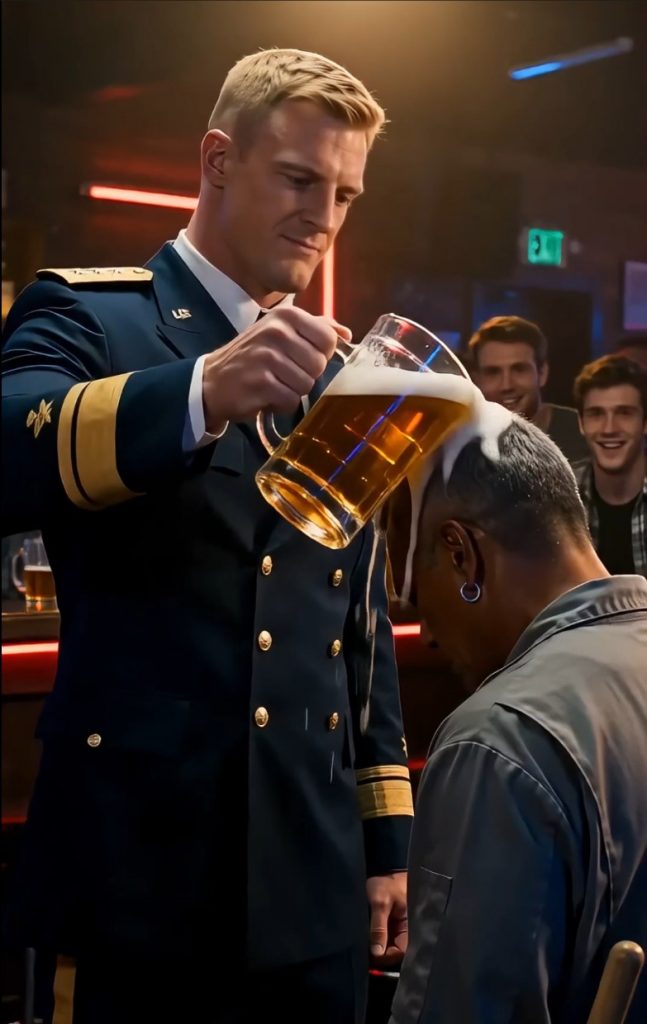
The beer hit David’s head in a thick amber stream.
It soaked through his gray worker’s jumpsuit, ran down the lines of his weathered face, and dripped from his jaw onto the polished wooden floor. Behind him, someone laughed under their breath.
Then another.
Then several.
The room was a rustic social hall attached to a private military club, warm with low bar lights, red and blue neon glowing across the back wall, and young men gathered in a loose semicircle like spectators at a fight they were too cowardly to stop.
At the center stood Captain Adrian Wolfe.
Tall, blond, spotless in a navy-blue ceremonial uniform with gold epaulettes and polished buttons, he held the beer mug above the janitor’s head as if he were pouring out trash.
“Look at him,” Wolfe said, smiling coldly. “This is what happens when people forget their place.”
David did not move.
He stood beside a cleaning cart with a wooden mop handle leaning against it. His gray hair was wet. His eyes were closed. His jaw was tight, but not with fear.
With restraint.
That made Wolfe angry.
Humiliation was supposed to produce a reaction. A flinch. A plea. A lowered head that proved the man understood the hierarchy of the room.
But the old janitor only breathed.
Slowly.
Evenly.
Wolfe tossed the empty mug aside, then turned and kicked the galvanized cleaning bucket at David’s feet. The metal clanged violently across the floor, water sloshing over the boards in silver sheets.
The laughter spiked.
Then faded.
Because David still had not reacted.
He lifted one hand and wiped beer from his eyes. His fingers moved slowly over his forehead, down his cheek, across the edge of his mouth. Then he looked at the small black object in his left hand.
Wolfe noticed it.
So did the crowd.
“What is that?” Wolfe snapped.
David opened his eyes.
They were calm.
Too calm.
The kind of calm men learn only after surviving things louder than insults and colder than beer.
He lifted the black velvet box into the light.
Inside was a gold star insignia surrounded by five smaller stars.
The room went silent.
David’s voice landed like thunder.
“You just poured beer on the Supreme Commander.”
Wolfe’s face went white.
And for the first time that night, everyone understood the man holding the mop had been the most powerful person in the room all along.
Act II
David Mercer had not worn the commander’s uniform in public for nine months.
That was intentional.
The official explanation was recovery. Exhaustion. A quiet medical leave after decades of service, public pressure, diplomatic crises, and the kind of decisions that never fully leave a man once he has made them.
The truth was uglier.
David had gone underground inside his own command.
Not literally at first.
He began with reports. Anonymous complaints. Internal memos. Whispered accounts from junior officers who spoke only after being promised they would not be named. There were stories of officers forcing enlisted workers to serve drinks at private events, cadets being publicly degraded, maintenance staff mocked and threatened, and complaints buried before they reached headquarters.
One name kept appearing.
Captain Adrian Wolfe.
Decorated family. Powerful father. Wealthy donors behind him. The kind of young officer who knew how to salute upward and strike downward.
Wolfe’s record was spotless on paper.
Too spotless.
David had seen that before. Perfect paperwork often meant fear had become part of the system.
So he came to the northern training district without announcement. No motorcade. No aides. No polished boots. He arrived as a temporary maintenance worker assigned to the old social hall where Wolfe and his circle held unofficial gatherings after ceremonies.
The disguise was simple.
Gray jumpsuit. Red name patch. Cleaning cart. A mop.
Men who believed in rank above character rarely looked twice at anyone carrying a bucket.
For three days, David cleaned tables, emptied trash, mopped spilled whiskey, and listened.
He heard cadets whispering about punishments that never appeared in logs. He heard young officers laughing about “breaking soft recruits.” He heard Wolfe brag that headquarters was too political, too distant, too afraid of his family’s influence.
On the fourth night, David watched Wolfe force a kitchen assistant to apologize for dropping a tray by kneeling in front of the bar.
David nearly ended the operation right there.
But his old chief of staff, Colonel Hayes, had warned him before he left.
“You need more than what you see, sir. You need them to show the room who they are.”
David hated that.
He hated waiting.
He hated the way good people often had to suffer one more insult before bad people became undeniable.
But he waited.
Then came the Founders’ Night reception.
Wolfe arrived in ceremonial uniform, glowing under the spotlight, surrounded by men who fed on his confidence. He saw David wiping down the edge of the bar and decided the old janitor was useful.
Not useful as a worker.
Useful as entertainment.
A beer mug appeared in Wolfe’s hand.
A crowd formed.
And David understood that the test had ended.
Now the room would answer for what it applauded.
Act III
Captain Wolfe stared at the insignia as if the gold itself had betrayed him.
The black velvet box trembled slightly in David’s hand, not from fear, but from the beer still dripping down his sleeve. The five stars caught the warm light and threw it back across Wolfe’s face.
Someone in the crowd whispered, “No way.”
Another man lowered his drink.
Wolfe swallowed.
“That’s not real.”
David closed the box with a quiet snap.
The sound echoed.
“Would you like to say that again?”
No one laughed now.
Wolfe’s eyes moved over David’s face, searching for weakness, for fraud, for some escape route back into the version of reality where he had power and the janitor had none.
He found nothing.
David reached into the cleaning cart and removed a folded cloth. He wiped the beer from his hands, not hurriedly, not dramatically. The simple act made the room feel smaller.
Wolfe stepped back.
“Sir, I didn’t know.”
David looked at him.
“That is the problem.”
The captain’s mouth opened.
No defense came quickly enough.
David turned his gaze to the crowd.
Young men who had laughed seconds earlier now stood stiff and pale. Some looked at the floor. Some stared at the insignia as if it might accuse them personally.
It did.
“Which one of you found this funny?” David asked.
Silence.
The neon hummed in the background.
Water spread slowly across the polished floor from the kicked bucket, reflecting red and blue light around David’s boots.
“No one?” David said. “Interesting. A moment ago, the room had a voice.”
A man in a green flannel shifted.
David’s eyes moved to him.
The man froze.
Wolfe tried again.
“Sir, this was a misunderstanding. The men were just—”
“Careful,” David said.
One word.
Enough.
Wolfe stopped.
David stepped closer. Beer still clung to his hair and collar. He looked, from a distance, like a humiliated worker. Up close, he looked like judgment wearing wet fabric.
“You did not misunderstand me,” David said. “You understood exactly who you thought I was.”
Wolfe’s jaw tightened.
“A janitor,” David continued. “A man beneath consequence. Someone you could shame for sport because you believed no one important would care.”
The words hit harder than shouting.
Wolfe’s eyes flicked toward the door.
David noticed.
“You’re wondering who else knows.”
The captain went still.
David turned toward the back of the room.
“Colonel Hayes.”
A side door opened.
Three uniformed officers entered.
Behind them came two investigators and a woman in a dark suit holding a tablet. The crowd parted instantly, all their earlier courage draining into silence.
Wolfe’s face collapsed.
David had not come alone.
He had come prepared.
Act IV
Colonel Hayes walked across the wet floor without looking down.
He was older than Wolfe, broader, with a face that had learned not to waste expressions. He stopped beside David, took in the beer-soaked jumpsuit, the scattered cleaning supplies, the kicked bucket, and the crowd of silent witnesses.
Then he looked at Wolfe.
“Captain.”
Wolfe snapped to attention too late.
“Sir.”
Hayes held out his hand.
“Your sidearm and command badge.”
Wolfe’s head jerked up.
“Sir, with respect, that is unnecessary.”
David’s voice remained calm.
“It became necessary when you weaponized a uniform against someone you believed could not answer back.”
Wolfe looked at the crowd.
No one helped him.
That was perhaps the cruelest reversal for a man who had built himself on public dominance. His audience had vanished while still standing in front of him.
Slowly, Wolfe removed his command badge.
His fingers fumbled at the clasp.
The badge dropped into Hayes’s palm.
The sidearm followed.
David turned to the investigators.
“Secure the hall footage. Take statements from everyone present. Start with those who laughed.”
Several men flinched.
One of them whispered, “Sir, we didn’t know either.”
David faced him.
“You knew enough to laugh.”
The young man lowered his eyes.
David did not shout.
That made it worse.
For men trained to respond to volume, quiet authority felt like standing before a cliff in the dark.
Wolfe suddenly lifted his chin, desperation hardening into arrogance again.
“My father will hear about this.”
David’s expression did not change.
“I expect he will.”
Wolfe blinked.
David took a folded document from his jumpsuit pocket. It was damp at the edges from beer, but still readable.
“Your father’s calls to regional oversight have already been logged. His attempts to interfere with disciplinary proceedings are under review. I advise you not to make him part of your defense.”
Wolfe’s mouth closed.
The crowd understood then.
This was not one bad night.
This was the end of protection.
Hayes ordered Wolfe escorted out, but David raised a hand.
“Not yet.”
He looked at the spilled water, the shattered dignity of the room, the mop leaning where he had left it.
Then he looked at Wolfe.
“Pick up the bucket.”
Wolfe stared at him.
“Sir?”
“You kicked it. Pick it up.”
The room held its breath.
Wolfe bent slowly, his gold epaulettes catching the neon light as he lifted the dented metal bucket from the floor. Water dripped from its rim onto his polished shoes.
David handed him the mop.
“Now clean what you spilled.”
Wolfe’s face burned.
For one second, he looked ready to refuse.
Then Hayes said quietly, “Captain.”
Wolfe took the mop.
The men who had laughed watched their leader wipe the floor in silence.
And David, still soaked in beer, gave them the lesson Wolfe had never learned.
“Service is not humiliation,” he said. “But humiliating those who serve is a disgrace.”
Act V
The investigation lasted four months.
It began with a beer mug and a mop bucket.
It ended with resignations, demotions, criminal referrals, and a public inquiry into abuse hidden beneath tradition.
Captain Adrian Wolfe was removed from command. The official charges were conduct unbecoming, abuse of authority, obstruction of complaint procedures, and retaliatory intimidation. Unofficially, everyone knew the real charge.
He had mistaken fear for respect.
He was not the only one.
The social hall’s camera footage showed more than the beer incident. It showed cadets ordered to clean floors in dress uniforms after refusing drinks. It showed junior staff mocked by officers who later praised discipline in public speeches. It showed Wolfe’s inner circle treating rank not as duty, but as permission.
Some men claimed they had only watched.
David called that confession enough.
At the hearing, one young lieutenant broke down while testifying.
“I laughed because everyone else laughed,” he said.
David watched from the back row.
That sentence haunted him more than Wolfe’s arrogance.
Cruelty rarely survived on one man’s hands alone. It needed the room. The silence. The nervous smiles. The people who told themselves they were not responsible because they had not poured the beer.
After the hearings, David returned to the social hall.
Not in uniform.
Not in disguise.
He wore a plain dark coat and walked slowly across the polished wood floor where the water had spread that night. The neon lights were off. The room looked smaller without the crowd.
The cleaning cart was gone.
The dented bucket had been saved as evidence, then returned to him by an investigator who thought he might want it.
David did not.
But he kept the mop handle.
He placed it in the hall’s newly rebuilt entrance beside a bronze plaque.
Rank is not proven by who stands beneath you.
It is proven by who is safe in your presence.
The plaque made some officers uncomfortable.
David considered that useful.
Months later, the Supreme Commander attended a graduation ceremony at the northern district. The cadets stood in formation under bright morning light, uniforms sharp, faces tense with the awareness that the old order had cracked.
David stepped to the podium.
His formal uniform gleamed with honors, but he did not speak about medals. He did not speak about victory, tradition, or glory.
He spoke about cleaning floors.
“When I wore a worker’s jumpsuit,” he said, “some men saw me clearly for the first time. Not as I was, but as they were.”
The field went silent.
“You will be given authority. Some of you will confuse it with superiority. If that happens, remember this: the uniform does not make you larger. It makes your smallest actions more visible.”
In the front row, a young cadet swallowed hard.
David noticed.
He always noticed now.
After the ceremony, a kitchen worker approached him near the reception line. She was older, with tired hands and cautious eyes.
“My son was in Wolfe’s unit,” she said.
David turned fully toward her.
“Is he alright?”
“No,” she said honestly. “But he is better now.”
David nodded.
“I’m sorry.”
She studied him for a moment.
Then she said, “He told me you let Wolfe mop the floor.”
A faint smile touched David’s face.
“I did.”
“Good.”
She walked away before he could answer.
That one word stayed with him all day.
Not because it sounded like revenge.
Because it sounded like balance.
That evening, David sat alone in his office with the black velvet box open on his desk. The gold insignia rested inside, five stars around the central one. Men had saluted it. Feared it. Envied it. Built careers trying to stand close to it.
But David thought of the gray jumpsuit.
The beer dripping into his eyes.
The crowd laughing.
The bucket rolling across the floor.
He thought of how quickly men revealed themselves when they believed no consequence was coming.
Then he closed the box.
The next morning, he issued a new order.
Every officer entering command training would spend one week assigned to service labor inside the institution they hoped to lead. Kitchens. laundry. maintenance. night cleaning. No cameras. No speeches. No ceremonial humility.
Just work.
Some called it excessive.
David called it education.
Because no leader deserved authority over people whose labor he had never respected.
Years later, the story of the beer incident became legend.
In some versions, David stood instantly and destroyed Wolfe with a single sentence. In others, the insignia glowed like something sacred. Young cadets exaggerated the silence, the fear, the way the crowd supposedly fell to its knees.
David corrected none of it.
But he knew the real story was smaller.
An arrogant officer poured beer on a man he thought could not answer.
A room laughed because it was easier than courage.
And an old commander, soaked and silent, waited long enough for everyone to show who they were.
That was the part worth remembering.
Not the stars.
Not the title.
Not the fear in Wolfe’s eyes.
The lesson was simpler.
Power does not begin when people know your name.
It begins in the moment they do not—and you decide who you are anyway.