Act I
The shoelace lay across the subway floor like a small accident waiting to happen.
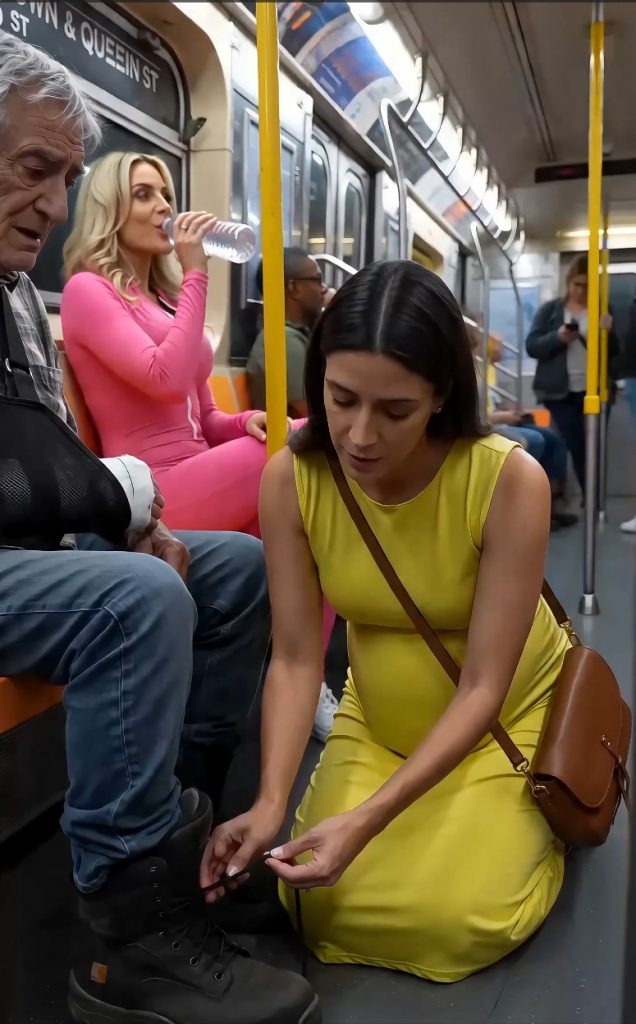
It trailed from the old man’s heavy black boot, dragging over the scuffed gray floor each time the train lurched toward Uptown & Queens 96 St. His right arm was bandaged and held tight in a black mesh sling, pressed carefully against his chest. His left hand rested uselessly on his knee, not injured, just too unsure, too embarrassed, too aware of the crowded car watching without helping.
People saw it.
Of course they did.
A woman in business flats glanced down, then back at her phone. A teenager with headphones nudged the lace with his sneaker and looked away. A man standing near the pole shifted his bag so he would not have to make eye contact.
Then the pregnant woman in yellow noticed.
She was seated two spots away, one hand resting on the curve of her belly, her brown leather crossbody bag tucked against her side. Her dress was bright, almost impossibly bright against the subway’s metal poles, orange seats, and tired faces.
Her name was Lena Brooks.
Eight months pregnant. Ankles swollen. Back aching. Already late for an appointment she could not afford to miss.
Still, she leaned forward.
“Sir,” she said gently. “Let me help you.”
The old man looked up, startled.
“No, no,” he murmured. “Please. You shouldn’t—”
But Lena was already standing.
The train swayed. She steadied herself on the yellow grab bar, took a careful breath, and lowered herself toward the floor in front of him. The movement was slow, awkward, and brave in the quiet way that no one applauds until they feel guilty.
A few passengers watched now.
The old man’s eyes filled with embarrassment.
“I’m sorry,” he whispered.
Lena smiled without looking up.
“Nothing to be sorry for. Happens to everybody.”
She reached for the black lace and began tying it with both hands, fingers moving carefully as the train rattled beneath her knees. The old man held his boot still. His face softened with gratitude so deep it looked painful.
Across the aisle, a woman in a tight pink jumpsuit noticed something else.
Not the old man’s shame.
Not the pregnant woman kneeling on a moving train.
The seat.
Lena’s seat.
The woman in pink had long blonde hair, a clear plastic water bottle in one hand, and the quick, calculating eyes of someone who believed every opening in the world belonged to whoever took it first.
She straightened from the pole.
A young man in a tan T-shirt saw her move. His eyebrows lifted.
Don’t, his face said.
She did.
Before Lena could finish the knot, the woman in pink stepped forward and dropped into the empty seat with a heavy, satisfied thud.
A few passengers gasped.
The woman crossed her legs, leaned back, and took a sip of water as if nothing had happened.
The old man looked up from his newly tied boot.
The young man stared at her in disbelief.
Lena, still kneeling, pulled the lace into a neat bow.
Then she looked over her shoulder.
Her seat was gone.
The woman in pink gave her a small sideways smirk.
And the train kept moving, as if the whole city had just agreed to look away.
Act II
Lena did not speak at first.
She had learned, over the past eight months, that pregnancy made strangers feel entitled to comment on everything except the things that actually mattered. They asked if she was scared. They guessed the baby’s gender. They told her birth stories in grocery lines and touched her belly before asking her name.
But when she needed someone to hold a door, offer a seat, or give her a little space on a crowded sidewalk, suddenly everyone discovered somewhere else to look.
So she was not surprised.
That was the saddest part.
She placed one palm on the subway floor, gathered herself, and tried to stand.
The old man shifted forward, horrified.
“Please, take my seat,” he said.
“Sir, no.”
“I mean it.”
“You have one arm in a sling.”
“And you’re carrying a whole person.”
The young man in the tan shirt stood quickly.
“Ma’am, take mine.”
Lena looked at him, grateful but embarrassed.
Before she could answer, the woman in pink rolled her eyes.
“Oh my God,” she said. “She got up. The seat was empty.”
The words sliced through the car.
The young man turned toward her.
“You watched her kneel down to help him.”
“So?” the woman said, lifting her water bottle. “That was her choice.”
The old man’s face tightened.
“That doesn’t make stealing her seat right.”
The woman in pink looked him over, from his sling to his newly tied boot.
“Maybe you should’ve tied your own shoe then.”
Silence spread fast.
Even New Yorkers, trained by years of subway discomfort to ignore almost anything, knew when a line had been crossed.
Lena finally stood, one hand on the pole, breath shallow. Her cheeks were flushed, but not from shame anymore.
The old man looked stricken.
“I’m sorry,” he said to her. “You helped me, and now this—”
Lena shook her head.
“You didn’t do anything wrong.”
The woman in pink laughed softly.
“Can we not make this a whole performance?”
The young man’s jaw tightened.
“It already is. You’re just not the hero.”
A few passengers murmured. Someone near the door lifted a phone, not dramatically, just enough to record.
The woman in pink saw it and adjusted her posture, suddenly aware of angles. Her smirk returned, but thinner now.
“You people love judging women,” she said. “Maybe I’m tired too.”
Lena looked at her.
There was no cruelty in her expression. That somehow made the woman in pink look smaller.
“Then you could have asked,” Lena said.
The woman blinked.
“You could have said you weren’t feeling well. You could have asked if anyone could help you. But you didn’t. You waited until I was on the floor helping someone who couldn’t help himself, and then you took what I left behind.”
The train clattered into a tunnel.
Lights flickered across the woman’s pink jumpsuit, across the old man’s bandaged arm, across Lena’s bright yellow dress.
The woman opened her mouth, but no answer came quickly enough.
Then the old man spoke.
“My wife used to say character is what you do when there’s nothing to gain.”
The woman in pink gave a sharp laugh.
“Well, your wife isn’t here.”
The old man went very still.
Lena saw it.
So did the young man.
The old man’s left hand curled on his knee, not in anger exactly, but in grief trying to stay quiet.
“My wife,” he said slowly, “died on this line.”
That ended every whisper in the car.
Even the woman in pink stopped moving.
The old man looked down at his boot, at the lace Lena had tied for him.
“Twenty-three years ago. A crowded train. A man fell near the doors at rush hour. People stepped around him because they were late. She stopped.”
His voice trembled once, then steadied.
“She always stopped.”
Lena held the pole tighter.
The old man lifted his eyes.
“She missed her own train helping him. Took the next one. That was the train that derailed outside the yard.”
Nobody spoke.
The woman in pink looked away.
The old man swallowed.
“I spent years angry that she stopped. Then I realized stopping was the part of her I loved most.”
The subway car swayed beneath the weight of it.
The young man lowered his gaze.
Lena whispered, “What was her name?”
The old man looked at her with wet eyes.
“Ruth.”
Then his voice softened.
“She wore yellow too.”
Act III
The next station came and went.
Nobody got off.
At least, nobody near them did.
The woman in pink stayed seated, but the confidence had drained from her body. She kept her eyes fixed on the dark window, where her own reflection stared back harder than any stranger could.
The young man offered Lena his seat again.
This time, she accepted.
Not because she wanted victory.
Because her legs were trembling.
The young man stood beside the pole, still watching the woman in pink with open disgust. His name was Miles Carter, and he had been on his way to a second interview at a design firm in Midtown. Until that morning, he would have described himself as someone who minded his business.
Now he wasn’t so sure.
The phone in his hand had recorded the last minute and a half.
He did not know what he planned to do with it.
He only knew the woman in yellow had done what everyone else avoided, and then nearly got punished for it.
The old man leaned toward Lena.
“My name is Samuel Whitaker,” he said.
“Lena Brooks.”
He smiled faintly.
“Thank you, Ms. Brooks.”
“You don’t have to keep thanking me.”
“Yes,” he said. “I do.”
Lena looked down at the bow on his boot.
“It was just a shoelace.”
Samuel shook his head.
“It never is.”
The woman in pink shifted.
“Okay,” she muttered. “Are we done with the guilt trip?”
Miles stared at her.
“Seriously?”
She snapped her head toward him.
“What? I’m supposed to cry because everybody suddenly has a tragic backstory?”
Lena’s hand moved protectively over her belly.
“Everybody does have a story,” she said. “That’s why kindness matters.”
The woman in pink laughed again, but it sounded more like panic now.
“You sound like a greeting card.”
Samuel looked at her for a long moment.
“What’s your name?”
She hesitated.
“Why?”
“Because I’d rather not remember you as the woman in pink.”
That made a few passengers breathe out, almost a laugh, but not quite.
Her mouth tightened.
“Tara.”
“Tara what?”
She glared.
“Tara Voss.”
The name landed strangely.
A woman near the door looked up from her phone.
Miles frowned.
“Voss? Like Voss Urban Foundation?”
Tara’s face changed.
There it was.
The flicker of someone used to being recognized when it helped her, not when it trapped her.
Samuel noticed too.
His expression shifted in a way Lena could not read.
“Tara Voss,” he repeated.
She sat straighter, defensive now.
“Yes. And?”
Samuel’s gaze moved from her face to the branded water bottle in her hand. It was clear plastic, but the sticker on it had a pink-and-white logo.
VOSS URBAN CARES.
A public kindness campaign. Posters for it had been all over the city that month: smiling young volunteers, polished slogans, soft lighting over staged compassion.
Lena had seen one that morning.
Be the Seat Someone Needs.
The irony was so sharp it almost hurt.
Miles saw it too.
“No way,” he said.
Tara’s face flushed.
“I don’t run the campaign.”
“But you’re in it,” the woman near the door said.
She turned her phone around.
On the screen was a promotional photo.
Tara Voss, smiling in the same pink jumpsuit, standing beside a subway bench with the caption: Kindness Moves the City.
The car went silent again.
This time, the silence belonged to her.
Tara stood halfway, then sat back down, trapped between leaving and pretending she still owned the moment.
“You have no idea what that campaign is,” she said.
Samuel’s voice became quiet.
“I know exactly what it is.”
Tara looked at him.
For the first time, uncertainty entered her eyes.
Samuel reached slowly into the inner pocket of his plaid shirt with his uninjured hand. It took effort. Lena almost helped, but he gave her a tiny shake of his head.
He removed a folded paper.
Old. Soft at the creases.
He opened it carefully.
It was a photograph.
A younger woman in a yellow dress stood on a subway platform, laughing at something outside the frame. Her hand rested on the shoulder of a younger Samuel beside her.
On the back, written in blue ink, were the words:
Ruth Whitaker, founding volunteer, Transit Kindness Initiative.
Tara stared at it.
Samuel’s voice did not rise.
“My wife started the program your family renamed.”
Act IV
Tara’s mouth parted.
“That’s not true.”
Samuel folded the photo back along its old creases.
“It was called the Ruth Whitaker Transit Fund before your father’s foundation acquired the grant rights.”
Passengers looked between them, confused but listening.
Samuel continued, each word careful.
“My wife believed subway stations should have emergency support workers. Seat-priority education. Fare assistance for people in crisis. Volunteers trained to help the elderly, disabled, pregnant, and injured before small problems became tragedies.”
Lena felt something tighten in her chest.
That was not charity for cameras.
That was a system built from grief.
Samuel looked toward the advertisement on the woman’s phone.
“Your foundation took her name off it last year.”
Tara looked suddenly young.
Not innocent.
Just cornered.
“My father handles that.”
“And you represent it,” Miles said.
Tara turned on him.
“You don’t know anything about me.”
Miles lifted his phone.
“I know you took a pregnant woman’s seat while wearing the campaign logo.”
That hit harder than any accusation.
Tara’s eyes dropped to the bottle in her hand.
The logo seemed brighter now.
Uglier.
Lena watched her carefully. Part of her wanted the woman humiliated. Part of her was tired of public cruelty being excused until someone powerful got embarrassed. But another part, the part that had made her kneel in the first place, wondered what kind of person needed to win a seat that badly.
Then Tara spoke, softer.
“I’ve been standing all morning.”
No one answered.
She swallowed.
“My father had me doing press photos since six. Smile here. Hold this sign. Thank the volunteers. Say kindness matters. Then he yelled at me for not looking warm enough.”
Her laugh broke at the edge.
“I hate the campaign.”
Samuel’s face did not soften.
“So you punished her?”
Tara looked at Lena.
For the first time, really looked.
At the tiredness around her eyes. At the way her hand rested on her belly. At the effort it had taken her to get back into a seat after helping a stranger.
“No,” Tara whispered. “I just…”
She stopped.
There was no version of the sentence that made her look good.
The train slowed.
The station sign flashed past the windows.
Tara stood.
For one breath, Lena thought she might leave without another word.
Instead, she stepped into the aisle and looked at her seat.
“I’m sorry,” she said.
The apology came out stiff, unused, and late.
But it came.
Lena did not move.
Tara’s eyes filled with angry tears, the kind people get when they are ashamed but have not learned how to be humble without feeling attacked.
“I saw the seat,” she said. “I didn’t think about you.”
Lena nodded once.
“That was the problem.”
Tara flinched.
Samuel looked at the empty seat.
“Sit down, Ms. Brooks.”
Lena was already sitting in Miles’s seat, but the meaning was clear.
The seat Tara had taken no longer belonged to whoever grabbed it first. It belonged to the truth the whole car had witnessed.
Miles stood aside.
Tara moved away from the bench and held the pole instead.
The train doors opened.
A few passengers got off. A few got on. The city tried to resume its rhythm, but the car had changed. People were watching each other differently now.
A woman offered her seat to a man carrying a sleeping toddler.
A teenager picked up a dropped MetroCard and handed it back.
Someone moved a stroller away from the door before the mother had to ask.
Small things.
But small things were where public decency either lived or died.
Samuel leaned back, exhausted.
Lena looked at him.
“You said your wife started the program.”
He nodded.
“She wanted a city where people didn’t have to beg to be seen.”
Tara stood by the pole, staring down at the water bottle in her hand.
Then she stepped forward and held it out to Samuel.
He looked at it.
She removed the campaign sticker first.
Her fingers shook slightly.
“I don’t deserve to carry that,” she said.
Samuel studied her.
“No,” he replied. “Not yet.”
Act V
The video went public before sunset.
Miles did not post it to chase fame. At least, that was what he told himself while his hands hovered over the screen for ten minutes. He blurred Lena’s face as much as he could. He left Samuel’s words intact only because the world needed to hear Ruth’s name.
By morning, millions had watched the pregnant woman kneel, the seat get stolen, and the heiress of a kindness campaign learn what the word meant in front of a subway car full of strangers.
The internet did what it always did.
It judged too fast, then dug deeper.
People found the old articles about Ruth Whitaker. A nurse. A volunteer. A woman who helped stranded riders after long shifts and built a small fund from church donations, union support, and neighbors who believed the subway could be harsh without becoming heartless.
They found the foundation rebrand too.
The glossy new version.
The missing name.
The slogans.
Tara Voss in pink, smiling beside words she had not yet earned.
By the third day, the Voss Urban Foundation issued a statement.
It called the incident “unfortunate.”
Nobody liked that.
By the fifth day, Samuel Whitaker was invited to speak at the emergency board meeting.
He almost refused.
Lena changed his mind.
They met in the lobby of a glass office building downtown, both of them uncomfortable for different reasons. Lena wore the same yellow dress under a cardigan. Samuel wore his plaid shirt and sling. Miles came too, because Samuel said witnesses should not vanish after telling the truth.
Tara was there before them.
No pink jumpsuit this time. No cameras. No branded bottle. Just a plain black coat and eyes that looked like she had not slept.
She walked up to Lena first.
“I owe you a real apology,” she said.
Lena waited.
Tara took a breath.
“I used your kindness as an opportunity. Then I acted like being tired made me entitled to ignore you. I’m sorry.”
Lena studied her.
“Thank you.”
The answer was not warm.
It was honest.
Tara turned to Samuel.
“And I’m sorry about your wife’s name.”
Samuel’s jaw tightened.
“That apology belongs in the boardroom.”
Tara nodded.
“It will be.”
Inside, the board expected damage control.
Samuel gave them history.
He placed Ruth’s photograph on the conference table. He told them about the day she stopped to help a fallen man and died on a later train. He told them about the fund she built before that, the volunteers she trained, the benches she fought to mark for priority riders long before the city cared about signage.
Then he looked at Tara’s father, Richard Voss, a polished man who wore concern like a tailored jacket.
“You took her grief and turned it into branding,” Samuel said. “Then you forgot the people.”
Richard tried to respond.
Tara interrupted him.
“He’s right.”
The room turned.
Her father’s face tightened.
“Tara.”
She did not sit down.
“You put me in the campaign because I looked good in photos. You put slogans on bottles and posters. You removed Ruth’s name because you said tragedy was too heavy for donors.”
Samuel closed his eyes.
Lena watched Tara’s hands shake at her sides.
“But the tragedy was the reason the work mattered,” Tara said. “And yesterday, I proved I didn’t understand the work at all.”
For the first time, her voice broke without sounding performative.
“I want the name restored.”
Richard stared at her.
“That is not your decision.”
“No,” she said. “But the video made it mine to answer for.”
The boardroom fell into a heavy silence.
A month later, the campaign changed.
Not cosmetically.
Public pressure helped, but it was Samuel who insisted the repair be practical. The Ruth Whitaker Transit Kindness Fund was restored by name. Emergency fare assistance expanded. Priority seating signs were redesigned with clearer messaging. Volunteers were trained not just to smile for photos but to notice the small dangers: untied shoes, faintness, confusion, people too ashamed to ask.
Lena became part of the advisory group after her daughter was born.
She named the baby Ruth.
Not because Samuel asked.
He didn’t.
He cried when she told him.
Miles got the design job after all, partly because the firm admired the video’s restraint and partly because he redesigned the fund’s first poster for free. It showed no models, no staged smiles, no polished campaign lighting.
Just an empty subway seat.
Beneath it were the words:
A seat is not empty when someone is coming back to it.
Tara stayed involved too, though not in front of cameras at first. She spent months doing the unglamorous work: handing out flyers, checking elevators, helping older passengers read service changes, listening when riders told her what the campaign had missed.
Some people never forgave her.
She learned to keep working anyway.
One winter evening, nearly a year after the subway car incident, Tara was riding the 1 train downtown when an exhausted pregnant woman stepped on near 72nd Street.
The car was packed.
Tara was seated.
For a second, the old reflex moved through her.
Mine.
Then she stood.
“Here,” she said.
The pregnant woman looked relieved.
“Thank you.”
Tara nodded and held the pole.
Across the car, Samuel Whitaker sat with his sling gone, his boot laces double-knotted, Ruth’s photograph tucked safely inside his coat pocket. He saw Tara stand.
He said nothing.
He simply gave a small nod.
Not forgiveness exactly.
Something quieter.
Recognition of a step in the right direction.
At the next stop, Lena boarded with baby Ruth strapped against her chest in a yellow blanket. The baby slept through the train noise, cheeks soft, tiny mouth open in perfect peace.
Samuel’s face lit up.
Lena smiled and sat beside him.
Tara looked away, blinking hard.
The train moved beneath the city, clattering through tunnels full of strangers pressed close together, each carrying a story nobody else could see.
A hurting arm.
A tired body.
A dead wife.
A guilty daughter.
A new mother.
A baby named after a woman who had stopped to help and changed more than she ever lived to know.
The city did not become kind all at once.
No city does.
But in that car, when an old man’s shoelace came loose again, three people noticed before it hit the floor.
And this time, nobody stole the seat.