Act I
The first time her sneaker touched his armrest, Jace Whitaker tried to be polite.
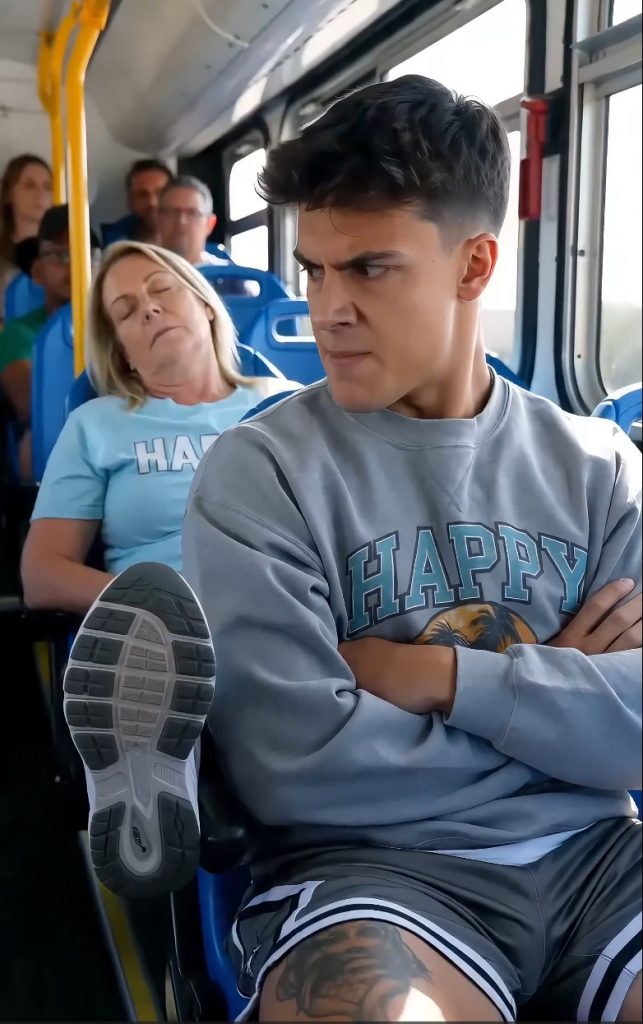
He was squeezed into a blue plastic bus seat near the middle aisle, arms crossed over his gray patterned sweatshirt, knees angled sideways because the rows were too tight for anyone taller than average. Sunlight flickered through the wide windows every time the bus passed a gap between buildings.
Then something gray slid into the corner of his vision.
A shoe.
Not beside him. Not near him.
On his armrest.
Jace looked down at it for three full seconds, hoping the woman behind him would notice and move it before he had to speak.
She didn’t.
Her sneaker stayed there, pressed against the plastic like she owned it.
The man beside Jace, a middle-aged passenger in a blue polo and gray baseball cap, glanced over and made a face before quickly looking forward again. Across the aisle, someone lowered their phone just enough to stare.
Jace inhaled slowly.
“Ma’am,” he said, turning halfway in his seat, “take your dirty foot off my armrest.”
The woman behind him didn’t even open her eyes.
She was blonde, middle-aged, reclined like the bus was her private lounge. Her light blue T-shirt had the word HAPPY printed across the front in bright yellow letters, which somehow made her expression look even more insulting.
“Can’t you see I’m sleeping?” she muttered.
A few passengers went quiet.
Jace stared at her.
He wasn’t looking for a fight. That was the thing everyone would understand later. He had not yelled. He had not cursed. He had simply asked a grown woman to remove her foot from his space on a crowded public bus.
But she stayed leaned back with her eyes closed, as if his discomfort was nothing more than background noise.
Jace’s jaw tightened.
He turned forward again, lifted his right arm, and shoved her sneaker off the armrest with one sharp movement.
Her foot hit the floor with a dull thud.
For half a second, the problem was solved.
Then the woman opened her eyes.
Not all the way.
Just enough to show she was awake, annoyed, and very aware of what she was doing.
Before Jace could settle back into his seat, her leg came up again.
This time, she didn’t place her foot on the armrest.
She planted her sneaker directly on his thigh.
The whole bus seemed to notice at once.
Jace froze.
The man in the blue polo leaned back, his face twisting in open disgust. A woman in a tan cowboy hat near the back lifted her phone higher, recording now without even pretending not to.
The blonde woman reclined again, calm as anything.
Jace looked down at the sneaker resting on him, then slowly looked up.
His face had changed.
The irritation was gone.
In its place was something colder, heavier, and controlled.
Because the woman had not just crossed a line.
She had chosen the one passenger on that bus who had spent the last year learning exactly how to make people answer for crossing lines.
And she had no idea what was already in his backpack.
Act II
Jace Whitaker used to ride the bus because he had no other choice.
Before the tattoos, before the quiet anger, before the gray sweatshirt and the face that made strangers assume he was just another young guy with a short fuse, he had been a kid counting coins at the edge of a kitchen table.
His mother, Denise, worked double shifts at a nursing home on the east side of the city. She took Route 18 every morning before sunrise and every night after dark, rain or heat or snow, always sitting near the front because her knees hurt from standing all day.
She believed in rules.
Not big speeches. Not fancy ideas.
Simple rules.
Give up your seat to someone who needs it. Keep your shoes off other people’s space. Don’t make a driver’s job harder. Don’t embarrass people in public just because you think they won’t fight back.
When Jace was fourteen, he used to meet her at the bus stop after school and ride home with her. He remembered the smell of the bus in summer, warm plastic and old brakes. He remembered her hand resting protectively across his chest whenever the driver stopped too suddenly.
He remembered the day a man shoved past her so hard she hit her shoulder against the pole.
No one said anything.
Denise smiled through it because she hated scenes.
That was what public disrespect did. It counted on decent people staying quiet.
Years later, after Denise died, Jace still heard her voice whenever he rode the bus.
Not because he was sentimental.
Because the city had promised reforms after her final accident.
A driver had reported overcrowding. Passengers had complained about harassment, smoking, blocked seats, threats, and riders making the disabled section unusable. The transit company issued statements, printed posters, and held a press conference where polished officials promised dignity for every passenger.
Then nothing changed.
So Jace changed.
He took the small settlement money from his mother’s case and enrolled in community college. He studied public policy at night and worked warehouse shifts during the day. He learned how contracts worked, how complaints disappeared, how a public service could rot behind smiling slogans.
And eventually, he was hired by the city’s new Transit Accountability Office.
Not as a cop.
Not as security.
As an investigator.
His job was to ride routes anonymously, document violations, identify patterns, and help build cases against contractors and officials who treated ordinary passengers like they were invisible.
That morning, Route 18 was supposed to be routine.
Jace had a backpack under his seat. Inside was a folder with complaint logs, route audits, and printed screenshots from months of passenger reports. He had a small body camera clipped low to the strap, legal under the city’s public-recording policy. He also had a meeting downtown in ninety minutes with the deputy transit commissioner.
The final report was nearly finished.
And the woman behind him was about to become its most unforgettable page.
Her name, though Jace didn’t know it yet, was Marlene Voss.
Plenty of people knew Marlene.
She appeared in campaign photos with her husband, Leonard Voss, the chairman of the private company that operated half the city’s buses. She attended ribbon cuttings. She smiled beside oversized checks. She spoke at community forums about “restoring civility to public spaces.”
She had once told a reporter that bus passengers deserved “comfort, cleanliness, and mutual respect.”
Now her sneaker was sitting on a stranger’s lap.
The bus rolled forward.
Sunlight flashed over Jace’s face.
He did not move at first.
That stillness made the passengers more nervous than yelling would have.
Because everyone understood something was coming.
They just didn’t know whether it would be chaos or justice.
Act III
“Lady,” the man in the blue polo finally said, his voice low but sharp, “you can’t be serious.”
Marlene sighed without lifting her head.
“Mind your business.”
A murmur moved through the bus.
The woman in the tan cowboy hat whispered, “Oh, I got this,” and kept filming.
Jace looked at the sneaker on his thigh. The gray rubber sole had dust along the edge. His hands rested open near his knees, fingers tense but controlled.
He could have shoved her leg away again.
He could have snapped.
That was what she seemed to want. Some kind of ugly reaction she could point to later, proof that she had been the victim of an aggressive young man on public transit.
Jace had seen that trick before.
So he did something that made the whole bus lean in.
He smiled.
Not warmly.
Not happily.
Just enough to show he had made a decision.
Then he reached down, unzipped his backpack, and pulled out a laminated badge.
He held it up without turning around.
“Jace Whitaker,” he said clearly. “City Transit Accountability Office. This interaction is being documented as part of an active route audit.”
The bus went almost silent.
Even the engine hum seemed to sink lower.
Marlene’s eyes opened.
For the first time, she looked at him properly.
Jace turned in his seat, careful not to touch her leg more than necessary.
“Please remove your foot from my body,” he said. “You have been asked more than once.”
Her face tightened.
“I don’t know what little badge you bought online,” she said, but her voice had lost its lazy confidence.
The man in the blue polo leaned forward. “Looks real to me.”
A teenager near the window laughed under his breath. Someone else muttered, “That’s crazy.”
Marlene finally pulled her foot back.
Slowly.
Like she was doing him a favor.
Jace took out his phone and opened a form. His thumb moved across the screen, steady and precise.
Marlene sat up straighter.
“What are you doing?”
“Documenting passenger misconduct,” he said.
“Oh, please.” She scoffed. “You people love making everything dramatic.”
The words landed badly.
Not because they were loud.
Because they revealed what she thought this was.
Not a cramped public bus. Not a stranger’s body. Not a line crossed in front of witnesses.
Just an inconvenience caused by “you people.”
Jace looked at her then, really looked.
Her blonde hair was sprayed into place. Her camo pants looked expensive, the kind bought from a boutique that charged too much for pretending not to care. Her HAPPY shirt was bright enough to be ironic.
Then the woman in the cowboy hat spoke from the back.
“Wait,” she said. “Isn’t that Marlene Voss?”
Several heads turned.
Marlene’s eyes snapped toward her.
The cowboy-hat woman kept her phone raised. “Yeah. You’re Leonard Voss’s wife. The bus-company guy.”
The temperature of the bus changed.
It was not confusion anymore.
It was recognition.
A man standing near the yellow rail pulled up a photo on his phone and showed it to the passenger beside him. A woman across the aisle whispered, “That is her.” The blue-polo man looked from the photo to Marlene and shook his head like he could not believe his luck.
Jace’s expression did not change, but something inside him clicked into place.
Leonard Voss.
BrightLine Transit.
The contractor his office had been investigating for falsified complaint records, ignored safety reports, and a pattern of dismissing rider misconduct unless it happened to wealthy commuters.
Marlene Voss leaned forward.
“You don’t have permission to record me.”
The cowboy-hat woman laughed once. “Ma’am, you put your foot on a stranger in public.”
Jace slid his badge back into his pocket.
Then he said the sentence that made Marlene go pale.
“Mrs. Voss, your husband is scheduled to appear at the city oversight hearing this afternoon.”
Her mouth opened.
Nothing came out.
Jace tilted his head slightly.
“I was on my way there.”
Act IV
The bus driver had heard enough.
At the next stop, he pulled over and opened the doors, but no one got off right away. People were too invested now, trapped between shock and satisfaction, watching a woman who had acted untouchable realize she had picked the wrong seat.
“Everything okay back there?” the driver called.
Jace stood carefully in the narrow aisle.
“Yes,” he said. “Please keep the bus stopped for a moment. I need your incident number and route log.”
Marlene shot up from her seat.
“You are not filing anything.”
Jace looked at her.
“I already did.”
The blue-polo man gave a quiet, pleased snort.
Marlene’s face flushed. “Do you know who I am?”
That was when the entire bus turned against her.
Not loudly. Not violently.
Just with a collective silence so sharp it became humiliating.
Because everyone had been waiting for those exact words.
Jace’s voice stayed even.
“Yes, Mrs. Voss. That appears to be the problem.”
A few passengers murmured. Someone near the back said, “Damn right.”
Marlene grabbed the yellow rail, her knuckles whitening. “This is harassment. I was sleeping. He assaulted my foot.”
The blue-polo man blinked. “Assaulted your foot?”
The cowboy-hat woman lowered her phone for the first time, staring at Marlene like she was witnessing history make a fool of itself.
Jace did not laugh.
That made it worse.
He took out the printed folder from his backpack and opened it.
Marlene’s eyes dropped to the first page.
BrightLine Transit: Route 18 Complaint Suppression Review.
Her anger faltered.
“This route,” Jace said, loud enough for the nearby passengers to hear, “has received forty-six passenger complaints in the last eight months. Harassment. Blocked seating. Intimidation. Unsanitary behavior. Inappropriate contact. According to BrightLine’s public report, only three were logged.”
The driver went still.
Passengers began looking at one another.
Jace turned a page.
“My office has been collecting direct testimony because the contractor claimed riders were exaggerating. Today’s audit was scheduled to verify whether passenger conduct issues were being ignored in real time.”
He looked at Marlene.
“Thank you for clarifying the culture.”
The words were quiet.
They hit harder than shouting.
Marlene stepped into the aisle. “You’re trying to ruin my husband.”
“No,” Jace said. “Your husband’s company did that.”
Her eyes sharpened. “You think people like you understand what it takes to run a city?”
Jace felt that one.
People like you.
There it was again, dressed up in a different outfit.
His mother had heard versions of it her whole life. From supervisors. From landlords. From people who mistook tiredness for weakness and patience for permission.
Jace closed the folder.
“My mother rode this route for eleven years,” he said. “She filed complaints too. They disappeared.”
The bus quieted again, but differently this time.
Marlene’s face tightened with impatience, but some of the passengers softened. The man in the blue polo looked down at his hands. The driver stared at Jace in the mirror.
“She was injured on a BrightLine bus,” Jace continued. “After repeated warnings about overcrowding and unsafe passenger behavior were ignored. Your company called it isolated.”
Marlene swallowed.
For once, she seemed to understand that this was not a random young man she had offended.
This was a history she had stepped on.
Jace looked toward the woman with the cowboy hat.
“Would you be willing to submit that video as part of the record?”
She nodded immediately.
“Absolutely.”
The blue-polo man raised his hand slightly. “I’ll give a statement too.”
“Same here,” said someone near the window.
Then another.
And another.
What had started as one rude sneaker on one plastic armrest became something larger.
A bus full of people who were tired of being told their discomfort didn’t count.
Marlene looked around, searching for one sympathetic face.
She found none.
Then the driver closed the doors, pulled back into traffic, and carried all of them toward the hearing that was about to become very different from what Leonard Voss had planned.
By the time the bus reached City Hall, Marlene was no longer pretending to sleep.
She was calling her husband.
And Jace was already uploading the evidence.
Act V
The oversight hearing was supposed to be boring.
Leonard Voss had prepared for boring.
He arrived in a navy suit with a careful smile, carrying a binder full of clean charts and polished phrases. He planned to talk about budget pressures, staffing shortages, passenger responsibility, and the company’s commitment to “a better rider experience.”
Then his wife walked in twenty minutes late, pale and furious.
Behind her came Jace Whitaker.
Behind him came the man in the blue polo, the woman in the tan cowboy hat, the bus driver, and half a dozen passengers from Route 18 who had decided they had time after all.
Leonard’s smile flickered.
Jace did not sit at the witness table immediately.
He placed the folder in front of the deputy commissioner, then connected the submitted video to the room’s screen.
The footage began with bright bus windows and engine noise.
Then Jace’s voice filled the chamber.
“Ma’am, take your dirty foot off my armrest.”
The room watched Marlene refuse.
They watched Jace remove the foot.
They watched her place it directly on him.
By the time the video froze on Jace’s controlled, furious expression, Leonard Voss was staring at the table.
No chart could explain it.
No slogan could soften it.
The deputy commissioner removed her glasses.
“Mr. Voss,” she said, “your company’s latest report claims passenger conduct complaints on Route 18 are rare and consistently addressed.”
Leonard cleared his throat. “That is our understanding based on internal records.”
Jace opened his folder.
“With respect, Commissioner, those records appear to be incomplete.”
One by one, the truth came out.
Complaint forms marked resolved though no action had been taken. Driver reports missing from official logs. Riders who had been told their concerns were “not serious enough.” Disabled passengers blocked from seating. Elderly riders ignored. Workers, students, parents, and night-shift employees treated as background scenery in a system that only looked clean from a press conference podium.
Then the blue-polo man spoke.
His name was Aaron Bell. He had ridden Route 18 to dialysis appointments for three years. He told the room how often passengers had to police each other because the company never showed up until cameras did.
The cowboy-hat woman, whose name was Tessa Monroe, submitted the full video and said simply, “She acted like the bus belonged to her because she thought nobody important was watching.”
Jace was the last to testify.
He did not dramatize his mother’s story.
He did not need to.
He described Denise Whitaker the way she had lived: early mornings, sore knees, packed lunches, exact change in her coat pocket. He described the complaints she filed and the silence that followed. He described how public disrespect becomes dangerous when institutions teach people there are no consequences.
Then he looked at Leonard Voss.
“Your company didn’t create rude people,” Jace said. “But it protected a system where rude people learned they could do whatever they wanted to everyone else.”
No one spoke for a long moment.
Leonard tried to distance himself from Marlene’s behavior. He called it unfortunate. Personal. Unrepresentative.
But the damage was done.
By evening, the city suspended BrightLine’s contract pending investigation. The oversight office ordered an independent review of all suppressed complaints. Drivers were given a direct reporting channel outside company management. Riders from Route 18 were invited to submit statements without fear of being ignored.
And Marlene Voss became the face of the scandal she had created with one arrogant move.
Not because she put her shoe on an armrest.
Because when asked to respect another human being’s space, she escalated.
She made public what her husband’s company had tried to keep hidden: that some people believed ordinary passengers were too powerless to matter.
Three weeks later, Jace rode Route 18 again.
Same blue seats. Same yellow rails. Same sunlight flashing through the windows.
But something felt different.
Near the front, a new sign had been installed.
Respect the ride. Respect each other. All complaints are reviewed by the City Transit Accountability Office.
Jace stood for a moment beneath it, one hand on the rail.
An older woman boarded at the next stop, carrying a grocery bag and moving carefully. Before Jace could offer, a teenager stood and gave her his seat.
The woman smiled in surprise.
“Thank you, baby,” she said.
Jace looked out the window.
For a second, he could almost see his mother’s reflection in the glass, tired after a long shift but pleased by the smallest proof that decency still existed.
His phone buzzed.
A message from Tessa, the woman in the cowboy hat.
Hearing update posted. Voss is out.
Jace read it once, then slipped the phone back into his pocket.
He did not smile much.
But he breathed easier.
Because justice did not always arrive with sirens or courtroom thunder. Sometimes it arrived on a crowded bus, in a gray sweatshirt, holding a folder no one expected.
Sometimes it began with one person saying no.
And sometimes the people who thought they could put their feet wherever they wanted finally learned the ground beneath them was not theirs at all.