Act I
The wrong chord rang out across the rooftop.
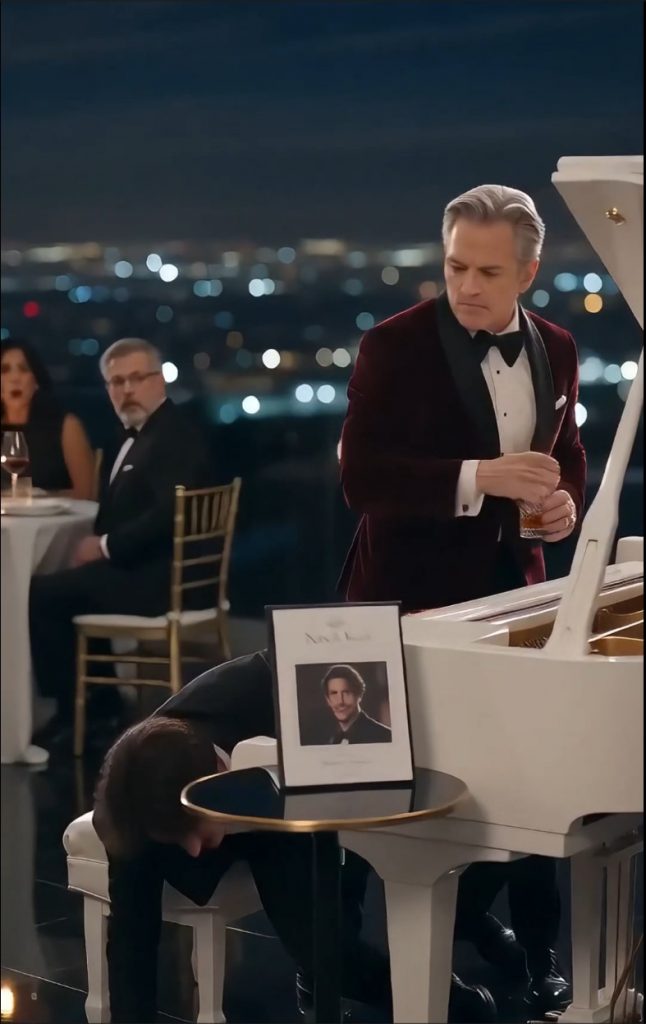
It was sharp, ugly, and impossible to ignore, crashing from the white grand piano as Nathan Reed fell beside it and caught himself against the black marble floor. His hand scraped the stone. A small mark appeared near his lip. The city skyline glittered behind him as if nothing terrible had happened.
But every table had gone silent.
Champagne buckets stopped clinking. Candle flames trembled in the night air. Billionaires, socialites, executives, and servers stared toward the piano where the quiet musician had just been yanked from his bench and punched in front of everyone.
The man standing over him still held a glass of whiskey.
Victor Harlan did not look embarrassed.
He looked annoyed.
His velvet dinner jacket sat perfectly on his shoulders. His gold cufflinks flashed under the rooftop lights. He had the relaxed cruelty of a man who had spent his life believing every room should bend around his mood.
“You’re background noise,” Victor snapped. “Play when rich people tell you to play.”
The words hit harder than the punch.
Nathan stayed low, one hand braced against the floor, the other near the piano leg. His modest black suit had twisted at the shoulder. His breathing was controlled, but his face showed the sting of public humiliation.
No one helped him.
That was what made the moment colder.
The guests had come to the rooftop for an exclusive billionaire dinner, a private preview of a new philanthropic arts fund, and a performance everyone had been promised would be unforgettable. They sat above the city under strands of warm light, surrounded by rare wine, expensive silence, and a white grand piano positioned like a jewel near the glass railing.
Victor had decided the pianist was taking too long between pieces.
So he grabbed him.
Then he struck him.
Nathan looked up slowly.
He did not speak.
Victor leaned down, smiling with contempt.
“Don’t stare at me like that,” he said. “You’re paid to fill silence.”
Then footsteps rushed across the marble.
The restaurant owner, Simone Bell, came fast from the service entrance, an event program gripped in her hand. Her black dress moved sharply around her knees, headset mic still clipped near her cheek, diamond studs catching the rooftop light.
She stopped beside Nathan, horrified.
Then she turned to Victor.
“Sir,” she said, voice tight with disbelief, “he is the composer everyone came here to honor tonight.”
A printed gala program lay open on a nearby table.
Nathan Reed’s portrait was on the cover.
Victor’s face emptied.
“Composer?”
Act II
Nathan Reed had always hated applause before music.
It felt dishonest.
People clapped when a host told them to. They stood when someone important entered. They praised pieces they had not yet heard because the program told them the composer mattered.
Nathan trusted silence more.
Silence told the truth.
It revealed who was listening and who was waiting to speak.
He learned that from his mother, Elise Reed, who had cleaned offices at night and sang old jazz standards in the kitchen when she thought he was asleep. She never had formal training. She could not read music. But she could hear sorrow in a chord before Nathan knew what sorrow was.
When he was seven, she brought home a broken keyboard from a church basement.
Three keys did not work. The speakers hissed. The plastic had yellowed with age.
Nathan loved it like treasure.
He taught himself melodies by ear, then taught himself to write them down from library books. By twelve, he was composing small pieces on napkins, homework margins, and the backs of grocery receipts. By sixteen, he had won a youth competition with a piece written after his mother’s second hospital stay.
He called it “Rooms with No Windows.”
The judges called it extraordinary.
His mother cried when he told her, then apologized for crying because she had always been too tired to hide her feelings properly.
Nathan promised her he would write something beautiful enough to make the world stop rushing.
He was twenty-three when she died.
After that, music changed.
It became less like ambition and more like conversation with someone who could no longer answer. He wrote late at night in rented rooms, on cheap pianos, in hotel lounges where managers paid him just enough to cover rent. He played background music for people who talked through grief, beauty, and genius without hearing any of it.
Then Simone Bell heard him.
She owned Aurelia, the rooftop restaurant that hovered above downtown like a secret made of glass and black marble. It was known for billionaires’ dinners, celebrity proposals, quiet political meetings, and views so perfect people forgot to look at the food.
Simone had built it from nothing.
Not inherited money. Not a husband’s fortune. Not a family restaurant empire. She started as a hostess in Chicago, learned every job in every room, saved everything, and trusted taste over noise.
One rainy night, she found Nathan playing in the corner of a hotel lobby while wealthy guests ignored him.
He was playing a piece so still that Simone stopped walking.
“What is that?” she asked afterward.
Nathan looked embarrassed.
“Mine.”
She hired him the next day.
Not as background entertainment.
As an artist.
Months later, when a group of donors asked Simone to host a dinner celebrating a new arts endowment, she knew exactly whose work should open the evening. Nathan had recently completed a piano suite called The City Above the Wound, written in memory of workers, caregivers, immigrants, night-shift parents, and everyone who made beautiful places possible without being invited into them.
Simone believed the guests needed to hear it.
Nathan was less convinced.
“These people don’t want music,” he told her. “They want atmosphere.”
“Then give them atmosphere with teeth,” Simone said.
He smiled despite himself.
The plan was simple.
Nathan would play the opening section quietly as guests arrived, dressed like any other pianist, unannounced. After dinner, Simone would reveal him formally, introduce the suite, and allow the room to understand that the man they had treated as invisible was the reason they had gathered.
Nathan hesitated.
“You’re testing them.”
Simone looked toward the dining room.
“No. They test themselves.”
Victor Harlan arrived forty minutes late.
That was the first disturbance.
He came with two assistants, a private security guard, and the impatience of a man who thought clocks were for people without power. He complained about his table, the wind, the whiskey, and the fact that the pianist was “too mournful for a dinner with this much money.”
Nathan heard him.
He kept playing.
The piece required restraint.
Victor did not.
Act III
The first time Victor interrupted, he snapped his fingers.
Not at a server.
At Nathan.
“Play something lighter,” he called.
Several guests laughed awkwardly.
Nathan finished the phrase before changing the tempo slightly. Not surrendering the music, exactly. Softening the edge so the room could breathe.
Victor was not satisfied.
“This isn’t a funeral,” he muttered.
His dinner companions smiled because Victor expected smiles.
Nathan looked at the keys.
He thought of his mother’s hands washing dishes at midnight. He thought of Simone’s warning. He thought of every night he had played while men in expensive jackets discussed him as if he were a lamp.
Then he continued.
The second interruption came during the third movement, a piece built around a delicate pause.
Nathan lifted his hands from the keys.
The silence lasted two seconds.
Victor slammed his whiskey glass onto the table.
“Did he stop?”
No one answered.
Nathan let the silence complete itself, then lowered his hands again.
That was when Victor stood.
His chair scraped against the black marble. Conversations died around him as he crossed the rooftop toward the white grand piano, jaw tight, eyes narrowed with the fury of someone unused to being denied instant comfort.
Nathan saw him coming in the piano’s glossy reflection.
He did not move.
Victor grabbed him by the shoulder.
“What are you doing?”
Nathan looked up.
“Playing the piece.”
“I told you to play something else.”
“I heard you.”
The answer was quiet.
Too quiet.
It forced Victor to hear himself.
His grip tightened.
“You think you’re important?”
Nathan did not answer.
Victor yanked him up from the bench.
The punch came before anyone had the courage to intervene.
Nathan fell beside the piano, one hand scraping across the marble. His elbow struck the bench leg. The piano keys rang out in that harsh, broken chord that made every guest turn.
The city sparkled beyond the railing.
The rooftop froze.
Victor stood above him and delivered his verdict.
“You’re background noise. Play when rich people tell you to play.”
Nathan tasted blood near his lip.
For a moment, he was not on a rooftop anymore.
He was seventeen again, playing in a hotel lobby while a man tossed a coin onto the piano lid and told him to “earn the interruption.” He was twenty-one, watching a bride’s father demand a song during his break because “musicians don’t get tired.” He was every invisible artist who had ever been treated as furniture until beauty was required.
He placed one hand on the marble and began to rise.
Then Simone arrived.
Her eyes moved first to Nathan’s face, then to his scraped hand, then to Victor’s whiskey glass, still dangling from two relaxed fingers.
Something in her expression became dangerous.
“Mr. Harlan,” she said.
Victor turned, irritated.
“Your pianist has a problem with instructions.”
Simone lifted the event program in her hand.
“No,” she said. “You have a problem with recognition.”
She opened the program and held it toward him.
On the cover was Nathan’s portrait.
Beneath it, in elegant type:
An Evening Honoring Nathan Reed and The City Above the Wound.
The guests leaned in.
Victor stared.
The rooftop silence became unbearable.
Act IV
Victor tried to laugh.
It failed.
“You’re telling me,” he said slowly, “that this man is Nathan Reed?”
Nathan had managed to stand by then. He remained near the piano, one hand lightly curled, careful not to show how much it hurt.
Simone stepped beside him, not in front of him.
“Yes,” she said. “The composer whose foundation performance you paid twenty-five thousand dollars to attend.”
The number was not the point.
That made it more humiliating.
Victor had not merely struck a musician.
He had struck the honored guest at a dinner built around his name.
One of the socialites at the nearest table picked up her program and turned it over with shaking hands. Another guest whispered, “That’s him.” A server near the champagne buckets looked down, visibly furious and afraid.
Victor’s jaw moved.
“No one told me.”
Nathan looked at him.
The mark near his lip made his calmness feel sharper.
“You didn’t ask.”
Victor flushed.
“I thought you were hired entertainment.”
“I was.”
The answer startled the room.
Nathan continued, voice low but clear.
“I was also the composer. Those two things are not opposites.”
Simone’s eyes softened for half a second.
Victor looked around, searching for someone to rescue him with laughter or status or the old invisible agreement that men like him were not corrected publicly.
No one moved.
He adjusted his cufflinks.
“This is absurd. I reacted to disrespect.”
Nathan’s expression changed slightly.
“From the piano?”
A few guests lowered their eyes.
Victor’s face hardened.
“You ignored a guest.”
“I protected the music.”
“You work here.”
Simone’s voice cut through the air.
“So do I.”
Victor turned toward her.
That was a mistake.
Simone Bell had spent twenty years being underestimated in rooms full of men who mistook service for servitude. She had smiled when investors asked who really owned the restaurant. She had watched chefs get praised for concepts she designed. She had trained staff never to confuse hospitality with surrender.
Now her rooftop had become a stage for the exact cruelty she built Aurelia to resist.
“You will leave,” she said.
Victor blinked.
“Excuse me?”
“You assaulted an artist in my restaurant.”
His voice dropped.
“Be careful, Simone.”
The guests heard it.
So did the servers.
So did Nathan.
Simone’s face remained still.
“I am being careful. That is why security has already been called.”
Victor’s grip tightened around his glass.
“I’m a founding donor of tonight’s arts endowment.”
“You were.”
The word sliced cleanly through the rooftop.
Victor stared at her.
Simone lifted her headset mic slightly.
“Please remove Mr. Harlan from the guest list, refund nothing, and document witness statements before anyone leaves.”
A security manager near the bar nodded.
Victor’s anger turned into panic.
“You cannot do this over one mistake.”
Nathan spoke then.
It was the first time his voice carried across the entire rooftop.
“A mistake is missing a note.”
The room fell silent.
He looked at the white piano, then back at Victor.
“What you did was decide I was safe to hurt because you thought I was beneath you.”
Victor’s mouth opened.
No sentence came.
Simone looked toward the dinner guests.
“And everyone here will decide whether tonight’s arts endowment honors artists or merely purchases proximity to them.”
That did what the reveal had not.
It made the room responsible.
One billionaire at the far table stood first.
“I want my contribution redirected under Mr. Reed’s foundation terms,” she said.
Another guest followed.
“Mine as well.”
Victor’s face drained.
The dinner he thought revolved around him was reorganizing itself around the man he had called noise.
Security approached with professional calm.
Victor looked once more at Nathan, horrified now not by guilt, but by consequence.
“Composer?” he whispered.
Nathan did not answer.
He simply turned back to the piano.
Act V
Victor Harlan left through the service elevator.
That was not Simone’s revenge.
That was logistics.
The private guest elevator was locked down for witness statements, and the service elevator was closest to the security corridor. Still, everyone noticed. Men like Victor built their lives around entrances and exits. Being removed through the route used by workers wounded him in precisely the place he had mistaken for character.
After he was gone, the rooftop remained silent.
No one knew whether to sit, speak, apologize, or pretend the dinner could continue.
Nathan stood beside the white grand piano, flexing his scraped hand carefully.
Simone noticed.
“Doctor,” she said to the nearest manager.
Nathan shook his head.
“Later.”
“Nathan.”
He gave her a faint smile.
“I know. Doctor.”
But he did not leave the piano.
Not yet.
He looked at the guests, at their programs, their wine, their expensive discomfort. He could feel the old temptation to walk away. To let silence punish them. To refuse to give beauty to people who had watched ugliness and waited for permission to object.
Then he saw a server near the champagne table.
Young. Maybe twenty. Hands clasped tightly. Eyes wet.
Nathan wondered how many times she had been spoken to like furniture.
He sat down at the piano.
Simone moved closer.
“You don’t have to play.”
“I know.”
His right hand trembled slightly over the keys.
He waited until it steadied.
Then he played.
Not from the beginning.
From the fourth movement.
The one he had written for his mother.
The notes rose softly into the rooftop night, fragile at first, then gathering strength. The city lights blurred behind the glass. The candles flickered. No one lifted a fork. No one touched a glass.
This time, the billionaires listened.
Not because the program told them to.
Because shame had finally made room for attention.
Nathan played through the pain in his hand, adjusting where he had to, letting certain notes soften rather than forcing them. The imperfection did not ruin the piece.
It made it human.
When the final chord faded, there was no immediate applause.
Only silence.
True silence.
The kind Nathan trusted.
Then the young server began clapping.
Simone joined her.
Slowly, the rooftop followed.
Nathan lowered his head, not as a servant, not as background, but as a composer accepting the sound without letting it own him.
The endowment changed after that night.
Victor Harlan’s contribution was removed. Simone and Nathan rewrote the fund’s mission before accepting replacement donations. Money would go directly to young composers, working musicians, rehearsal space grants, emergency medical aid for artists, and legal support for performers mistreated by venues or patrons.
The foundation’s first rule was simple.
No artist is atmosphere.
Aurelia added it to every performance contract.
So did other venues, after the story spread quietly through the circles where wealth pretended not to gossip and artists always knew the truth first.
Victor tried to repair his reputation.
He issued a statement about stress, misunderstanding, and regret. It sounded like a lawyer had translated fear into manners. Nathan never responded.
He was busy composing.
A year later, The City Above the Wound premiered with a full orchestra.
The hall was not on a rooftop. It was a public venue with student seats, discounted tickets, and an entire section reserved for service workers from restaurants, hotels, hospitals, and event spaces across the city.
Nathan’s mother’s photograph sat backstage in a small frame.
Before the performance, Simone visited him in the greenroom.
“How’s the hand?”
“Still attached.”
“That is not a medical update.”
“It’s a composer update.”
She smiled.
He adjusted his cuffs.
This time, his suit was not modest because he was hiding. It was simple because he liked it. Clean lines. Black fabric. White shirt. Music first.
Before stepping onstage, he heard the audience settling.
Not wealthy silence.
Living silence.
Students whispering. Ushers guiding late arrivals. Someone laughing softly. Programs opening. A cough from the balcony. The ordinary music of people gathering to listen.
Nathan closed his eyes.
For a moment, he was back on the rooftop floor.
The wrong chord.
The black marble.
Victor’s voice calling him background noise.
Then another memory rose over it.
His mother in the kitchen, humming while the sink filled with steam.
That was the sound he chose to keep.
The performance was not perfect.
Nothing alive ever is.
But when the orchestra reached the final movement, the entire hall seemed to lean forward at once. Nathan sat near the front, hands folded, not playing this time. Letting others carry what he had written.
When the last note ended, the silence came again.
Deep.
Earned.
Then the applause rose.
Nathan did not think of Victor Harlan.
Not immediately.
He thought of every artist who had played in corners while powerful people talked over them. Every server who moved quietly through expensive rooms. Every worker told to disappear until someone needed beauty, comfort, sound, or grace.
Later, outside the hall, a young pianist approached him.
She wore a black service uniform under her coat and held a folded program in both hands.
“Mr. Reed,” she said, nervous. “I play at a restaurant downtown. Sometimes people make me feel like I’m not really a musician.”
Nathan looked at her for a long moment.
Then he said, “Do you listen when you play?”
She nodded.
“Do you mean it?”
“Yes.”
“Then you’re a musician.”
Her eyes filled.
That, more than the applause, felt like justice.
Because Victor Harlan had been wrong.
Nathan Reed was never background noise.
He was the silence before the room learned how to listen.