Act I
The entire art classroom froze before anyone found the courage to breathe.
A thirteen-year-old boy sat quietly in his wheelchair, carefully mixing shades of blue and green across a watercolor palette. Painting wasn’t just another school assignment to him. It was the one place where he never felt limited by the wheelchair beneath him.
As he reached for another brush, a tiny splash of watercolor flicked from the bristles.
Only a few drops.
They landed on a pair of spotless white designer sneakers.
The boy looked up immediately, panic flashing across his face.
“I’m sorry,” he said softly. “It was an accident.”
The apology was sincere.
Most students would have laughed it off.
The boy standing beside him wasn’t like most students.
Fifteen years old, dressed in expensive clothes that announced his family’s wealth long before he spoke, he stared down at the paint as though someone had committed an unforgivable crime.
His classmates had seen that look before.
Whenever he felt embarrassed, someone else paid the price.
His jaw tightened.
His eyes hardened.
Without saying a word, he stepped backward.
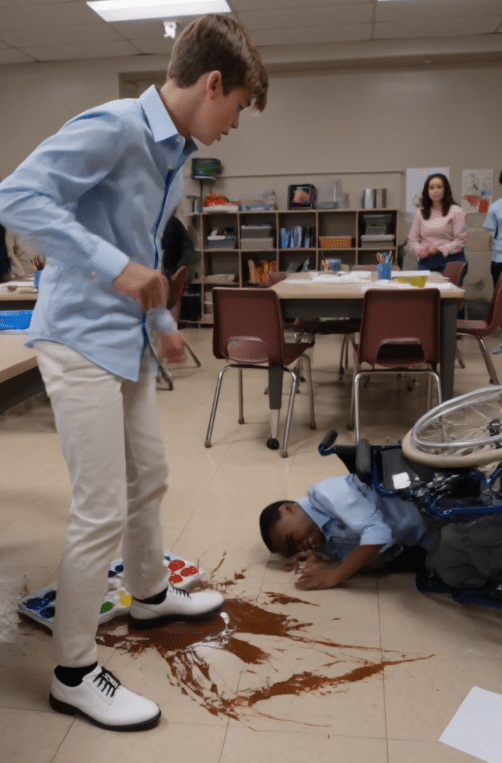
Then, with deliberate force, he drove his foot into the younger boy’s stomach.
The wheelchair lurched violently.
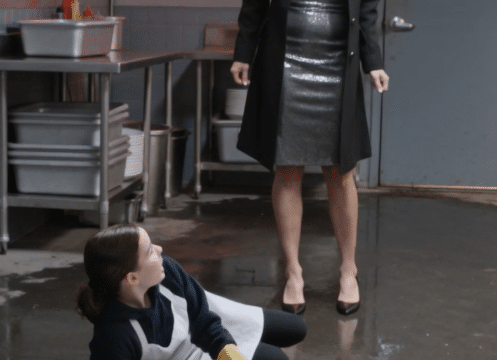
The child was thrown onto the cold tile floor.
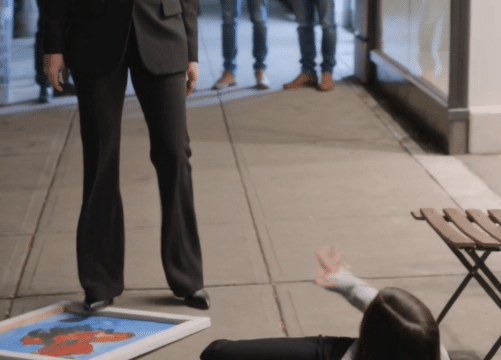
His chair slammed into a drawing table, sending watercolor trays crashing downward. Paint exploded across the tiles while unfinished artwork fluttered through the air like wounded birds.
The room erupted with gasps.
But no one moved.
Because everyone had just witnessed something they never imagined could happen inside a classroom.
And somehow…
The worst was still to come.
Act II
The boy struggled to catch his breath.
Pain radiated through his stomach while his scraped elbow burned against the tile floor. Instinctively, he curled into himself, protecting his head as much as he could.
He didn’t cry.
He didn’t beg.
He simply tried to breathe.
That quiet resilience only fueled the bully’s cruelty.
Stepping through the spilled watercolor, he stood over the younger student as though he were looking down at something beneath him.
“Trash,” he sneered.
“You ruined my shoes.”
Silence swallowed the classroom.
A girl near the drying racks covered her mouth.
Another student reached for his phone before lowering it again, too frightened to draw attention to himself.
Even the art teacher seemed frozen, caught between disbelief and fear.
The bully wasn’t finished.
He lifted his foot again.
One kick landed against the boy’s back.
Another struck his side.
The younger student recoiled, curling tighter against the floor while scattered paint soaked into his pale blue shirt.
Then came the words that echoed through the room with even greater cruelty than the assault itself.
“Paint from the floor.”
The bully smirked.
He wanted everyone watching to laugh.
He wanted humiliation to hurt more than the kicks.
Instead…
An unexpected sound interrupted the silence.
Footsteps.
Fast.
Purposeful.
Growing louder with every second.
Someone was coming.
And the balance of power inside the classroom was about to collapse.
Act III
The classroom door burst open so hard it slammed against the wall.
Every head turned.
The principal entered first, visibly shaken.
Behind him came two school security officers.
The art teacher who had stepped out moments earlier hurried back inside.
Then one final man crossed the threshold.
He wasn’t wearing a uniform.
He wasn’t shouting.
He simply scanned the room once.
His eyes landed on the boy lying beside the overturned wheelchair.
Everything else disappeared.
Without hesitation, he rushed forward and dropped to one knee.
“Easy, buddy,” he whispered as he gently supported the boy’s shoulders.
“It’s okay. Dad’s here.”
Only then did the class begin to understand who had just arrived.
The man wasn’t merely another parent.
He was the chairman of the Parent-Teacher Association.
The school’s largest private donor.
The person whose generosity had funded the renovated science labs, the new library, and the very art classroom where they now stood.
Teachers respected him.
Administrators answered his calls.
Students knew his name.
Yet none of that seemed to matter to him in this moment.
All he cared about was his son.
He carefully lifted the boy back into the wheelchair, checking for injuries before quietly adjusting the footrests himself.
Only after making certain his son was safe did he stand.
The atmosphere changed instantly.
The bully’s confidence evaporated.
His expensive shoes suddenly seemed meaningless.
His arrogance had nowhere left to hide.
Because the person he had chosen to humiliate wasn’t an anonymous classmate.
It was the son of the one man in the room whose respect every adult present had worked years to earn.
Act IV
The father faced the older student without taking a single threatening step.
His expression remained calm.
That calmness frightened everyone more than anger ever could.
The principal lowered his eyes.
The security officers remained silent.
Even the bully’s closest friends quietly stepped away from him.
The father spoke only after placing one reassuring hand on his son’s shoulder.
“Who kicked my son?”
The question echoed across the silent classroom.
Nobody answered.
Nobody needed to.
Several students had witnessed everything from only a few feet away.
One girl’s phone had continued recording after she instinctively pressed the camera button.
Another student pointed toward the security camera mounted near the ceiling.
The truth had already been preserved.
The bully swallowed hard.
Only minutes earlier he had believed everyone feared him.
Now he realized every pair of eyes in the classroom had become a witness against him.
His shoulders slumped.
The smug grin disappeared.
For the first time since entering the classroom, he looked exactly what he truly was.
A frightened teenager hiding behind privilege.
The boy in the wheelchair slowly straightened his back.
His breathing was steadier now.
His elbow still stung.
His stomach still ached.
But his dignity had returned.
Not because someone powerful had rescued him.
Because he had never surrendered it in the first place.
The father looked at his son with unmistakable pride.
Strength, he knew, wasn’t measured by how hard someone could strike.
It was measured by how much kindness someone refused to lose after being hurt.
That lesson was about to become unforgettable for everyone in the room.
Act V
News of the incident spread through the school before the final bell rang.
Students whispered about the attack in hallways.
Teachers spoke in hushed voices behind closed doors.
Parents began receiving messages before their children even arrived home.
The school’s security footage confirmed every second.
The witness statements matched perfectly.
There was no misunderstanding.
No accident.
No excuse.
The older student’s family had always believed influence could smooth over any problem.
This time, influence wasn’t enough.
Policies existed for moments exactly like this.
The disciplinary hearing moved forward.
Scholarship committees were notified.
Athletic privileges disappeared almost overnight.
What had begun with a few drops of watercolor ended with consequences far heavier than stained shoes.
Meanwhile, the boy returned to the art classroom several weeks later.
A fresh sheet of watercolor paper rested on his easel.
His classmates quietly welcomed him back.
No one pitied him.
They admired him.
Because despite everything that had happened, he still chose to paint.
The spilled colors had been cleaned from the floor long ago.
But one image remained impossible to erase.
A frightened teenager standing alone after discovering that cruelty can collapse in a single moment when truth enters the room.
As silence filled the classroom once again, the bully’s trembling voice barely escaped his lips.
“Your son…?”
No one answered.
The father simply turned his wheelchair toward the sunlight pouring through the classroom windows.
Some questions never need a response.
Because the truth has already spoken louder than words ever could.