Act I
The line to board the ferry slowed for only a moment.
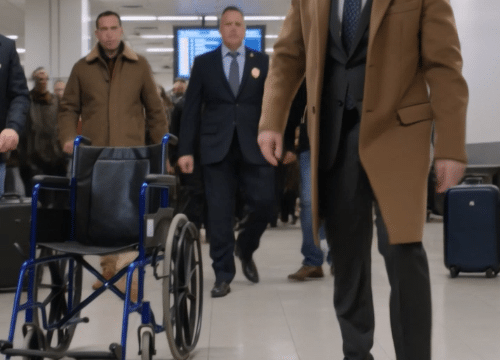
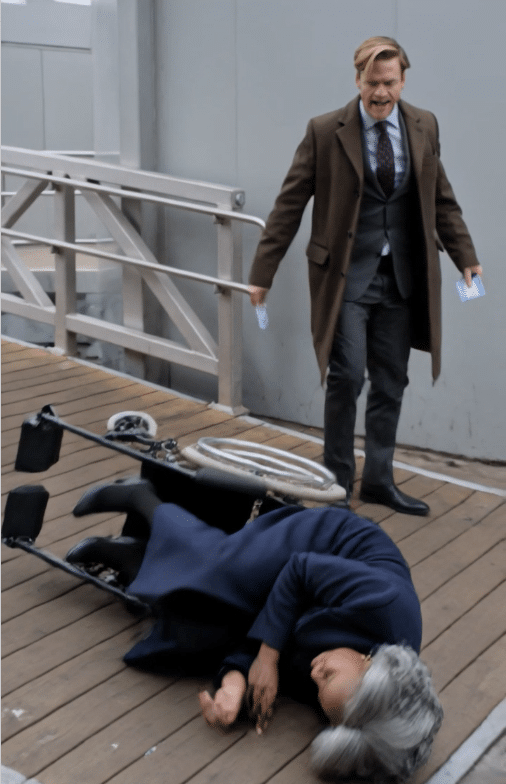
An elderly woman in a wheelchair, wrapped in a faded navy coat, was being carefully guided up the wooden boarding ramp by a terminal employee. The wind coming off the water tugged gently at her coat as passengers waited behind her.
Most people watched with quiet patience.
One man didn’t.
Holding a priority boarding ticket in one hand, he let out an exaggerated sigh loud enough for everyone nearby to hear. His expensive coat, polished shoes, and impatient glare made it clear he believed the world should move at his pace.
Without warning, he shoved past the staff member, causing the wheelchair to lurch violently. The chair tipped sideways, the employee stumbled trying to stop it, and the elderly woman fell hard onto the wooden ramp.
A stunned silence swept across the terminal.
Instead of helping, the man looked down with nothing but contempt.
“Trash,” he sneered. “You’re delaying my ferry.”
No one moved.
Not yet.
They had no idea who the woman really was.
Act II
Her name was Eleanor Brooks.
At seventy-nine, she had spent decades avoiding attention. Most passengers saw nothing more than an elderly woman needing assistance.
They never knew she visited the terminal almost every week—not because she had nowhere else to go, but because she loved watching the harbor where her late husband had spent his career.
The employees recognized her immediately.
They greeted her by name.
She always smiled.
She thanked everyone.
She never asked for special treatment.
The terminal worker who had been helping her knelt beside her, asking if she was hurt.
Before he could help her back into the wheelchair, the businessman stepped closer again.
“Roll out of my way.”
The words echoed through the dock.
Several passengers lowered their eyes.
Others reached for their phones.
No one expected what happened next.
Act III
A black SUV entered the terminal access lane.
It stopped abruptly near the boarding ramp.
Before the engine even went quiet, several uniformed security officers hurried toward the fallen woman.
Behind them walked a man whose face every terminal employee recognized instantly.
Conversations stopped.
Staff members straightened.
The station supervisor hurried forward without being called.
The man ignored everyone.
He walked directly to the elderly woman.
His expression changed the moment he saw her sitting on the wooden ramp.
He knelt beside her.
“Gently,” he told the staff member.
Only after making sure she was safe did he slowly stand.
His eyes found the businessman.
The harbor seemed to fall completely silent.
Then he asked one question.
“Who kicked my mother?”
Act IV
The businessman blinked.
His confidence disappeared almost instantly.
Around him, employees who had been frozen moments earlier stepped aside for the newcomer.
This wasn’t simply another passenger.
He was the director of the entire ferry port.
The man responsible for every employee, every security officer, every operation taking place at the terminal.
More importantly—
He was Eleanor’s son.
The businessman looked from the director to the elderly woman, then back again.
His face lost all color.
The priority boarding ticket that had seemed so important moments earlier suddenly meant absolutely nothing.
Passengers who had stayed silent now began speaking.
Several quietly described exactly what they had witnessed.
Security officers separated the businessman from the crowd while medical staff checked on Eleanor.
For the first time since the incident began, the balance of power had completely shifted.
Act V
Eleanor accepted her son’s hand and slowly returned to her wheelchair.
She never demanded revenge.
She never shouted.
She never insulted the man who had humiliated her.
Her dignity spoke louder than anything else could have.
The ferry director thanked the employees who had tried to help and assured the passengers that the incident would be fully investigated according to port policy.
The businessman stood alone, surrounded not by admirers, but by silence.
Minutes earlier he had believed an elderly woman was insignificant because she looked powerless.
He learned, too late, that respect should never depend on someone’s appearance, age, or status.
As security escorted him away, his voice barely rose above a whisper.
“What… did I just do?”
The ferry eventually departed.
The passengers would remember the delay.
But they would remember something else even more—that a person’s true worth is never measured by how quickly they move, but by how others choose to treat them when they seem to have no power at all.