Act I
Sunday mornings were usually the quietest moments of the week.
The old stone church stood proudly beneath the morning sun, its bell echoing softly through the neighborhood as families arrived dressed in their best. Children held their parents’ hands. Elderly couples climbed the worn steps slowly. Volunteers greeted everyone with warm smiles, making sure fresh flowers decorated every corner of the entrance.
Maria had done that for twenty years.
Long before the first service began, she was already arranging bouquets beside the church doors, replacing wilted blossoms with fresh lilies and white roses. Few people noticed her work, and that was exactly how she liked it.
She believed kindness didn’t need applause.
As another luxury sedan pulled into the courtyard, a sharply dressed businessman stepped out, checking his expensive watch before lighting the last few puffs of a cigar.
Without a second thought, he flicked the burning cigar butt toward one of the flower beds.
Maria looked up.
She didn’t scold him.
She simply smiled and pointed toward a trash can only a few feet away.
“Please use the trash can over there.”
Her voice was gentle.
Respectful.
Exactly the tone one would expect outside a place of worship.
The businessman slowly turned toward her.
His expression darkened as though someone had publicly insulted him.
To him, the suggestion wasn’t about litter.
It was about someone he considered beneath him daring to correct his behavior.
He stepped closer.
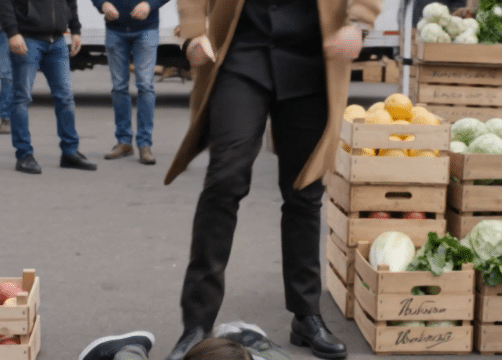
Before anyone could react, he drove his foot violently into her stomach.
The force threw Maria backward onto the stone courtyard.
Her flower basket overturned instantly.
White lilies scattered across the ground.
Her hand scraped against the rough stone, leaving a thin streak of red across her palm.
The church bell continued ringing.
But now it sounded strangely distant beneath the horrified gasps surrounding the courtyard.
No one understood how a simple request for basic respect had turned into an act of shocking cruelty.
And no one realized that the man had just humiliated one of the most beloved people in the entire parish.
That truth was only moments away from changing everything.
Act II
Maria wasn’t an employee.
She wasn’t paid.
Every bouquet, every decoration, every welcoming smile had been offered freely.
For two decades, she had quietly served the parish while asking for nothing in return.
She remembered birthdays.
She visited elderly members who could no longer attend Mass.
She organized food drives during difficult winters and spent countless evenings preparing flowers for weddings, funerals, baptisms, and Christmas celebrations.
Many families couldn’t remember the church without remembering Maria.
Yet newcomers rarely knew who she was.
To strangers, she looked like an ordinary woman wearing simple clothes and carrying an old wicker basket.
The businessman saw only that.
Standing over her, he sneered.
“Trash. Don’t lecture me outside a church.”
Maria struggled to catch her breath.
Pain spread through her stomach as she instinctively curled around herself.
Still…
She never answered with anger.
That silence only fueled his arrogance.
He stepped forward again.
Then kicked her in the side.
Once.
Then again.
Several parishioners cried out in disbelief.
An elderly man instinctively rushed forward before others held him back, afraid the attacker might become even more violent.
The businessman pointed toward Maria with complete contempt.
“Pray from the ground.”
Those words echoed across the courtyard with a cruelty that seemed completely out of place beneath the towering cross above the church entrance.
Some people began recording.
Others simply stood frozen.
No one wanted to believe something so heartless could happen at the very doors of a church.
Then the sound of approaching vehicles interrupted the silence.
Several dark-colored cars entered through the church gates.
At first, no one paid much attention.
The businessman certainly didn’t.
He assumed important guests had arrived.
He had no idea they were about to recognize someone far more important than himself.
Act III
The convoy stopped only a few yards from the church steps.
Doors opened almost simultaneously.
Priests stepped out first.
Then an elderly bishop emerged, greeted respectfully by those waiting nearby.
The businessman straightened his jacket.
He expected to receive polite recognition.
After all, he had donated generously over the years.
Money, he believed, opened every door.
But something unexpected happened.
Not one member of the clergy walked toward him.
Instead, the bishop hurried directly across the courtyard.
His eyes weren’t searching for wealthy benefactors.
They were fixed on the woman lying beside the scattered flowers.
“Maria…”
The bishop’s voice carried genuine concern.
He immediately knelt beside her, gently supporting her shoulders while nearby priests gathered the flowers that had been scattered across the stone.
One young priest carefully picked up every crushed lily as though each flower deserved dignity simply because Maria had prepared it.
The businessman watched in stunned silence.
He had never seen church leaders react with such urgency.
The bishop looked into Maria’s eyes with unmistakable affection.
“Maria, you served this parish for twenty years. Let us help you.”
The courtyard became completely silent.
Twenty years.
The words spread through the crowd almost instantly.
Visitors looked at longtime parishioners.
Longtime parishioners quietly nodded.
Some wiped tears from their eyes.
This wasn’t simply a volunteer.
This was the woman who had quietly shaped the spirit of the parish for an entire generation.
And the businessman had attacked her in front of everyone.
His expensive suit suddenly felt meaningless.
His donations suddenly seemed very small.
But an even greater lesson was still waiting for him.
Act IV
The bishop never raised his voice.
He didn’t need to.
His disappointment carried far more weight than anger ever could.
The priests helped Maria sit upright while another volunteer gently wrapped a clean cloth around her scraped hand.
She apologized for the damaged flowers.
Even now, she seemed more worried about Sunday’s service than about herself.
That simple act broke the hearts of those standing nearby.
One by one, parishioners stepped forward.
Not to confront the businessman.
To stand beside Maria.
A family she had comforted after losing a loved one.
A young couple whose wedding flowers she had arranged without charging a penny.
A mother whose children had grown up receiving warm hugs from Maria every Sunday morning.
Stories quietly filled the courtyard.
The businessman realized something terrifying.
Nearly everyone there knew her.
Nearly everyone had experienced her kindness.
No one cared how expensive his watch was.
No one asked how much he had donated.
Respect could not be purchased.
It had to be earned.
The bishop slowly stood and finally looked toward the businessman.
“There are people who build churches with stone,” he said softly.
“And there are people who build them with love.”
His eyes returned to Maria.
“She has done both.”
Those words struck harder than any public accusation.
The businessman lowered his head.
For the first time that morning, he understood that generosity measured in money could never replace compassion measured over decades.
His status had impressed people.
Maria’s character had transformed lives.
The difference had never been clearer.
Act V
An ambulance was called as a precaution, though Maria insisted others should not delay Sunday worship because of her.
Even while in pain, she smiled at the frightened children nearby, reassuring them that everything would be alright.
That quiet strength spoke louder than any sermon preached that morning.
The businessman remained alone near the stone wall.
No one argued with him.
No one shouted.
The silence surrounding him became its own judgment.
His wealth had earned admiration from a distance.
But respect had always belonged to someone else.
As Maria was gently helped toward the church entrance, parishioners instinctively walked beside her.
Some carried the rescued flowers.
Others carried her basket.
No one left her to walk alone.
The businessman stared at the scene unfolding before him.
His confidence had disappeared completely.
His lips trembled as he finally whispered the only words he could manage.
“Twenty years…?”
The bishop paused before entering the church.
Without anger, he answered quietly.
“Yes.”
“She has spent twenty years serving people who could never repay her.”
He glanced briefly at the flower bed where the discarded cigar butt still lay untouched.
“Character is revealed by how we treat those who expect nothing in return.”
No one responded.
There was nothing left to say.
The church bell rang once more, welcoming worshippers inside.
Sunday service began as it always had.
But many people carried a lesson into the sanctuary that morning more powerful than the sermon itself.
Titles fade.
Money loses its shine.
Pride eventually collapses under its own weight.
Yet a life built on quiet kindness leaves roots so deep that an entire community will rise to protect it.
And on that peaceful Sunday morning, one arrogant man discovered—far too late—that the woman he had treated as invisible had been one of the strongest pillars the church had ever known.