Act I
Saturday mornings at the California farmers market always felt alive.
The scent of fresh peaches mixed with roasted coffee. Children wandered between white vendor tents while musicians played soft acoustic songs in the background. Families examined baskets of strawberries, tomatoes, and oranges stacked neatly inside weathered wooden crates.
Among the crowd walked a modestly dressed woman carrying an old cloth shopping bag.
She wasn’t in a hurry.
She carefully compared prices before stopping at the busiest fruit stand in the market—a stand famous for its premium produce and even more famous for its owner.
Everyone knew him.
Customers admired his success.
Local food bloggers praised his business.
His expensive sunglasses, designer clothes, and constant stream of customers had convinced many people he could do no wrong.
The woman smiled politely.
She selected several pounds of fruit before looking up.
“If I buy more, could you take a few dollars off?”
It wasn’t an unreasonable request.
At farmers markets across California, friendly bargaining happened every weekend.
Some vendors accepted.
Some politely declined.
Most simply smiled.
But this man wasn’t interested in kindness.
His expression hardened instantly.
In front of dozens of waiting customers, he stepped out from behind the stall.
Slowly.
Deliberately.
He walked around the display tables until he stood directly in front of her.
For a brief second, people assumed he wanted to explain his prices.
Instead, he took one step backward.
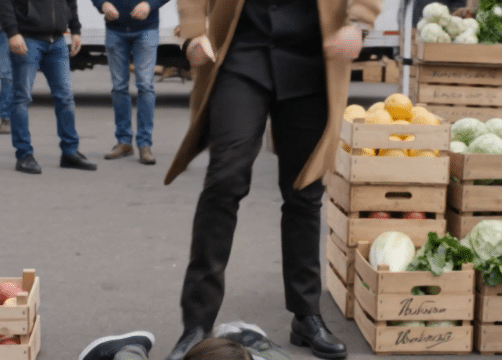
Then drove his foot straight into her chest.
The force knocked the breath from her lungs.
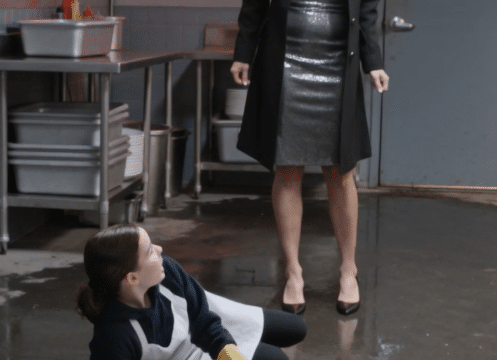
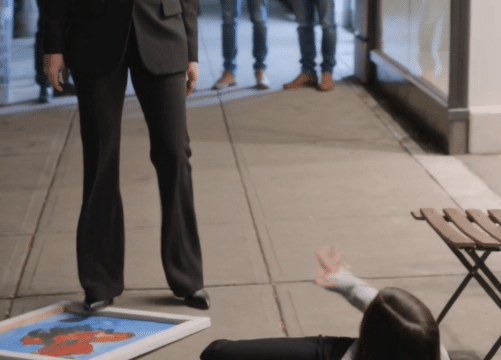
She crashed onto the dusty ground as her cloth shopping bag slipped from her hands.
Apples rolled across the aisle.
Peaches bounced beneath nearby tables.
The lively sounds of the market disappeared beneath a wave of horrified silence.
The woman struggled to breathe.
Dust clung to her clothes.
Yet she never cried out for mercy.
No one standing there realized they were watching a moment that would soon be remembered across the entire market—not because of the violence itself, but because of the truth that was about to arrive.
Act II
Her name was Evelyn Brooks.
Most shoppers had never seen her before.
They assumed she was an ordinary customer trying to stretch a household budget.
In many ways, she was.
Evelyn had never cared for luxury.
She drove an aging pickup truck.
She clipped coupons.
She preferred local markets over expensive grocery chains because she believed buying directly from farmers helped entire communities.
The request for a discount wasn’t born from desperation.
It came from habit.
She respected honest work and appreciated honest deals.
The stall owner saw something entirely different.
He saw someone he believed wasn’t worthy of negotiating with him.
Towering over her, he sneered.
“Trash. Don’t bargain at my stand.”
Several shoppers looked away in embarrassment.
Others stared in disbelief.
Evelyn slowly tried to sit up, one arm wrapped protectively around her chest.
Before she could regain her balance, the man stepped forward again.
He kicked her in the ribs.
Then once more across her side.
Fruit continued rolling across the dusty aisle as gasps echoed from every direction.
One little boy instinctively bent to collect a fallen orange before his mother gently pulled him back, shielding his eyes from the scene.
The stall owner pointed toward the ground with complete contempt.
“Shop from the dirt.”
His words carried farther than he intended.
Phones appeared.
Customers began recording.
Neighboring vendors stopped serving buyers altogether.
Nobody could believe someone would assault a woman over a simple question about price.
Then another sound interrupted the silence.
Powerful engines.
Growing louder.
Heading straight toward the market entrance.
Act III
At first, people assumed it was another celebrity arriving for a publicity visit.
The California farmers market often welcomed public officials and local leaders.
But this convoy was different.
Several black SUVs rolled carefully into the main aisle, gently pushing aside empty crates and lightweight display signs as security officers exited almost before the vehicles had fully stopped.
The stall owner frowned.
He adjusted his jacket.
Perhaps someone important was coming to purchase fruit.
Perhaps this would become good publicity for his business.
Instead, the lead vehicle door swung open.
The Governor stepped out.
His security team immediately formed around him, expecting him to continue toward the scheduled event waiting nearby.
He ignored it completely.
His eyes locked onto the woman lying on the dusty ground.
Without hesitation, he broke into a run.
Security hurried after him, struggling to keep pace.
The crowd instinctively stepped aside.
The Governor dropped to one knee beside Evelyn.
His hands gently supported her shoulders.
“Dust all over your clothes,” he whispered softly, brushing a strand of hair away from her face.
Then, loud enough for everyone nearby to hear, he asked,
“Sis, I’m here. Who did this to you?”
Time seemed to stop.
The market fell completely silent.
The stall owner’s face drained of color.
“Sis…”
The word echoed through the stunned crowd.
No cameras flashed.
No reporters spoke.
Everyone simply stared.
The Governor wasn’t comforting an acquaintance.
He wasn’t helping a campaign volunteer.
He was holding his own sister.
And suddenly, every person present realized that the quiet woman they had mistaken for an ordinary shopper had never needed power to possess dignity.
She already had it.
Act IV
The Governor remained focused on Evelyn first.
Not politics.
Not cameras.
Not public appearances.
Only his sister.
He helped her sit upright while a member of his security team quietly gathered the fruit scattered across the ground, placing each apple and peach back into her cloth bag.
It was a small gesture.
Yet somehow it carried more humanity than everything the stall owner had done that morning.
Only after making sure Evelyn could breathe comfortably did the Governor slowly stand.
He turned toward the stall owner.
He didn’t raise his voice.
He didn’t threaten him.
He simply asked,
“Did you do this?”
The stall owner opened his mouth.
Nothing came out.
Witnesses no longer hesitated.
One elderly vendor described how politely Evelyn had asked for a discount.
Another customer replayed the assault on a phone screen.
Several market workers confirmed every detail.
Even neighboring vendors shook their heads in disappointment.
The Governor listened quietly.
Then looked back toward his sister.
“You’ve always told me people deserve patience,” he said.
“I wish everyone had learned that lesson from you.”
A nearby vendor suddenly recognized Evelyn.
Years earlier, she had quietly organized food donations during a devastating wildfire season, making sure struggling farming families received groceries without asking for recognition.
Another farmer remembered her paying anonymously for produce that low-income seniors couldn’t afford.
Story after story emerged from the crowd.
The stall owner’s reputation had been built over a few successful years.
Evelyn’s had been built over decades of quiet generosity.
Money had made him famous.
Character had made her unforgettable.
The difference became impossible to ignore.
Act V
Paramedics soon arrived to examine Evelyn.
She insisted she would be alright.
Her first concern wasn’t her injuries.
She worried about the farmers whose fruit had been scattered during the chaos.
Even after everything that had happened, she apologized for the inconvenience.
Several vendors lowered their heads in quiet respect.
The Governor watched his sister with unmistakable pride.
Not because of his office.
But because no title he held could ever surpass the strength of the woman sitting beside him.
Around them, the market slowly returned to life.
Families resumed shopping.
Children picked up the last pieces of fallen fruit and handed them back with shy smiles.
Neighbors who had never met Evelyn before now greeted her like an old friend.
The stall owner stood alone.
His expensive stand.
His premium branding.
His long line of customers.
None of it could shield him from the judgment surrounding him.
His eyes remained fixed on the Governor.
Then back to Evelyn.
His lips trembled.
Only one word escaped.
“Sis…?”
The Governor looked at him calmly.
“You should have treated her with respect before you knew who she was.”
Those words settled over the market like a final verdict.
Because the real lesson had never been about political power.
It wasn’t about convoys, security teams, or public office.
It was about the mistake people make every day—judging another human being by clothing instead of character, by appearance instead of dignity, by status instead of kindness.
The shoppers would eventually forget the prices of the peaches.
They would forget which stand sold the sweetest oranges.
But they would never forget the morning an arrogant businessman kicked a quiet woman for asking a simple question…
…only to discover that her greatest strength had never been the Governor who rushed to protect her.
It was the grace she carried long before anyone knew she was his sister.