Act I
The pill bottle never stopped rolling.
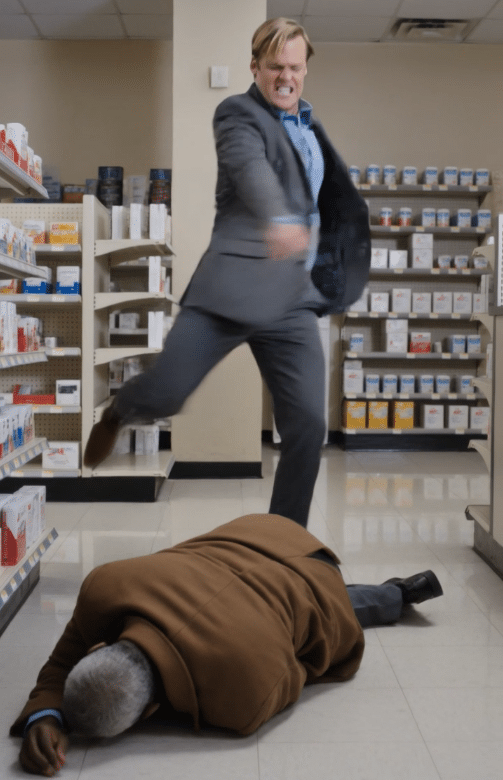
It spun across the bright pharmacy tile while an elderly man collapsed face-first onto the floor, his cane clattering against the prescription counter. A thin red scrape appeared beneath his chin as shocked customers gasped and instinctively stepped backward, unable to believe what they had just witnessed.
The seventy-six-year-old man remained on the ground, one trembling hand pressed against his chest while the other reached weakly toward the medication that had slipped just beyond his fingertips.
He never complained.
He never asked anyone to help.
He simply tried to get back up.
Standing over him was a sharply dressed businessman in a tailored gray suit, polished shoes gleaming beneath the fluorescent lights.
His expensive watch caught the light as he stared down with open contempt.
Instead of offering a hand, he pointed toward the bottle.
“Trash,” he snapped. “Stop wasting everyone’s time.”
The words echoed louder than the murmurs filling the pharmacy.
People exchanged horrified glances.
Some instinctively reached for their phones.
Others froze, unsure whether what they had seen had really happened.
The old man slowly inhaled, fighting through the pain.
Age had weakened his body.
It hadn’t broken his dignity.
Unfortunately, the humiliation wasn’t over.
The man in the suit wasn’t satisfied with knocking him down.
He wanted everyone else to see him stay there.
Act II
The afternoon had begun like any other at the neighborhood pharmacy.
Customers waited patiently in line for prescriptions.
Parents browsed cold medicine.
A pharmacist quietly explained dosage instructions to an elderly couple near the counter.
The old gentleman had arrived alone.
His brown coat showed years of careful use.
His shoes were worn but spotless.
He leaned gently on a wooden cane, apologizing each time someone had to wait an extra second while he walked.
When his prescription bottle slipped from his hand, he immediately bent down to retrieve it.
It should have taken only a moment.
Instead, impatience turned an inconvenience into cruelty.
The businessman standing directly behind him glanced at his watch.
He sighed loudly.
Then, without warning, he drove his foot into the back of the elderly man’s knee.
The impact stole his balance instantly.
He crashed forward onto the unforgiving tile.
The bottle rolled away.
His cane struck the counter before falling beside him.
For a heartbeat, the pharmacy fell silent.
Then came the insults.
The businessman stepped over the fallen medication as though the man lying on the floor wasn’t even human.
When the elderly gentleman struggled to push himself upright, another blow sent pain through his ribs.
Then another.
The old man curled instinctively, protecting himself while trying to steady his breathing.
Still, he refused to plead.
That quiet resilience only seemed to irritate the bully further.
He looked down with cold satisfaction.
“Pick it up from the floor.”
The humiliation was complete.
Or so he believed.
Because at that exact moment, the pharmacy’s glass entrance swung open.
Act III
Urgent footsteps echoed across the tile.
A woman in a white medical coat hurried through the entrance, followed closely by two hospital staff members carrying emergency bags.
The conversations stopped.
Several customers recognized her immediately.
She was the chief physician of the city’s largest hospital.
Ignoring the line entirely, she rushed straight toward the injured elderly man.
She dropped to one knee beside him.
“Gently,” she said.
One hand supported his shoulder while the other carefully examined the scrape beneath his chin.
The medical staff formed a protective circle around him, retrieving his cane and the scattered prescription bottle.
Only after confirming he was conscious did she slowly help him into a seated position.
Her face softened with unmistakable respect.
“Take your time.”
The elderly man nodded gratefully.
The businessman frowned.
He couldn’t understand why the hospital’s chief doctor would personally rush to assist an ordinary old man in a pharmacy.
Then she stood.
Her expression changed completely.
Compassion gave way to controlled fury.
The pharmacy became so quiet that even the humming refrigerators along the medicine aisle seemed deafening.
She looked directly at the man in the gray suit.
“Who attacked the man who built this hospital?”
The sentence landed like thunder.
Nobody spoke.
Nobody breathed.
The businessman felt the confidence drain from his face.
Act IV
He stared at the doctor in disbelief.
“What…?”
But she wasn’t finished.
She turned briefly toward the customers gathered around them.
Many had already begun nodding.
Several longtime residents recognized the elderly gentleman immediately.
Years earlier, before the hospital carried a famous donor’s name, the man had quietly funded its construction after losing his wife because adequate medical care hadn’t existed in the community.
He had never demanded recognition.
Never insisted on a statue.
Never expected anyone to know his name.
The hospital board had begged him to allow a dedication ceremony.
He had declined.
He wanted the building to save lives.
Nothing more.
The businessman looked back toward the elderly man.
The worn brown coat.
The simple shoes.
The modest cane.
He had mistaken humility for weakness.
The chief doctor spoke again, her voice calm but unmistakably firm.
“For decades, thousands of families have received treatment because of this man’s generosity.”
She paused.
“And today you decided he wasn’t worth waiting thirty seconds for.”
Security from the shopping center entered the pharmacy after multiple emergency calls.
Customers immediately offered witness statements.
The pharmacist quietly pointed toward the security cameras mounted above the prescription counter.
Everything had been recorded.
The businessman finally tried to explain.
“I didn’t know who he was.”
The doctor answered without raising her voice.
“No.”
She looked directly into his eyes.
“You didn’t know his name.”
Another pause.
“But you knew he was an elderly man who couldn’t bend down without difficulty.”
There was nothing left to say.
Because everyone understood the same truth.
His cruelty had never depended on status.
It had depended on believing the person in front of him had none.
Act V
The pharmacy slowly returned to life.
But nobody resumed their conversations.
The atmosphere had changed too completely.
Medical staff carefully helped the elderly gentleman to his feet.
His hands still trembled.
His chest ached.
The scrape beneath his chin remained visible.
Yet he thanked every stranger who had offered concern with the same gentle smile.
The chief doctor stayed beside him until she was certain he was stable.
She personally collected his prescription bottle and placed it back into his hands.
The gesture seemed almost symbolic.
A small act of respect replacing an act of humiliation.
Witnesses provided statements.
Security secured the surveillance footage.
The pharmacist quietly closed the register for several minutes so employees could assist the investigation.
Meanwhile, the businessman stood alone near the medicine shelves.
His tailored suit no longer projected confidence.
His expensive watch couldn’t buy back the few seconds of patience he had refused to show.
For the first time all afternoon, he truly looked at the elderly man.
Not as an obstacle.
Not as someone slowing down a line.
But as a human being whose kindness had touched countless lives without asking for recognition.
The old gentleman accepted his cane and prepared to leave with the medical team.
He never demanded revenge.
He never celebrated the man’s humiliation.
His dignity remained untouched by the cruelty directed toward him.
As silence settled across the pharmacy, the businessman whispered the only words he could manage.
“He built… this hospital?”
No one answered.
They didn’t need to.
Some truths carry enough weight to speak for themselves.
That afternoon, everyone waiting for a prescription learned a lesson no medicine could teach.
The people who appear ordinary often carry extraordinary stories.
And the true measure of character is never how we treat those with power.
It’s how we treat those we mistakenly believe have none.