Act I
The cafeteria was packed.
Doctors rushed through lunch between surgeries. Nurses balanced trays while answering pages. Patients and families searched for empty tables beneath the constant buzz of conversation.
No one noticed the elderly woman until she fell.
She walked slowly through the crowded cafeteria, wearing a light blue cardigan and carrying a tray with nothing more than a bowl of soup and a slice of bread. Her hands shook slightly with age, and every careful step showed how much effort even a short walk required.
Then her tray lightly brushed the sleeve of a surgeon’s white coat.
A tiny drop of soup landed on the fabric.
The surgeon stopped.
He stared at the stain as though it were an unforgivable insult.
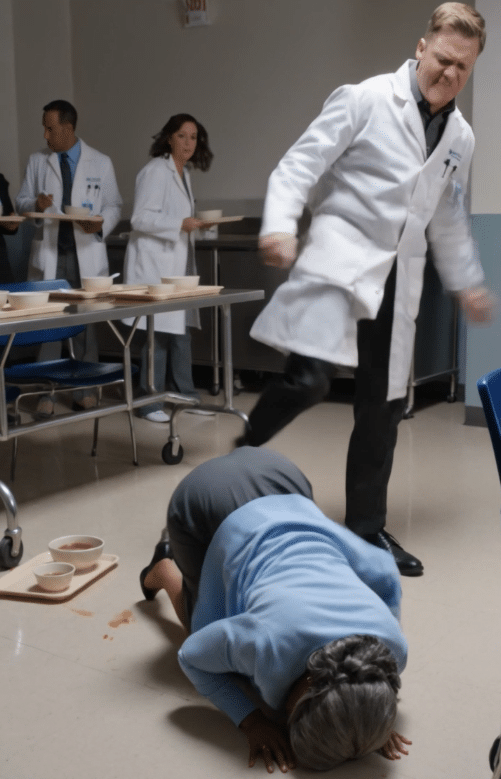
Without warning, he drove a brutal kick into the elderly woman’s chest.
Her tray flew from her hands.
The bowl shattered across the cafeteria floor.
Soup splashed beneath the stainless tables as she crashed onto the cold tile, her chin striking the ground hard enough to leave a thin red trace.
Gasps erupted throughout the room.
Forks stopped halfway to mouths.
Conversations disappeared.
The elderly woman instinctively wrapped her arms around herself, struggling to breathe through the pain spreading across her chest.
Instead of helping her…
The surgeon looked down with open disgust.
He pointed toward the stain on his sleeve.
“Trash.”
His voice cut through the cafeteria.
“You ruined my coat.”
The old woman said nothing.
She simply tried to push herself upright.
That quiet dignity only fueled his anger.
And everyone watching was about to witness something even crueler.
Act II
The surgeon had built a reputation for brilliance.
Patients praised his skill.
Medical journals published his research.
Hospital advertisements proudly displayed his photograph.
But inside the hospital, many employees knew another version of him.
He measured people by titles.
Chief physicians deserved respect.
Executives deserved attention.
Support staff barely existed.
Anyone who looked ordinary became invisible.
The elderly woman fit neatly into that category.
An old cardigan.
Soft walking shoes.
A simple lunch tray.
To him, she looked like another visitor wandering into the cafeteria.
He never asked who she was.
He simply decided she wasn’t important.
As the woman struggled to catch her breath beside the spilled soup, the surgeon stepped forward again.
Then he kicked her twice more across the side and back.
Several nurses cried out.
A young resident instinctively stepped forward before another doctor held him back, whispering that security had already been called.
The elderly woman curled slightly from the pain.
She never screamed.
Never pleaded.
She simply closed one trembling hand around the edge of her stained cardigan as if trying to preserve the little dignity she still had.
The surgeon adjusted his expensive watch.
Then looked down one last time.
“Stay down,” he said coldly.
“And clean it.”
The words echoed through the room.
Nobody realized that only a few yards away…
The hospital’s executive elevator had already begun descending.
Act III
A sharp chime interrupted the silence.
Every head turned toward the VIP elevator.
The polished doors slid open.
Out stepped the hospital director.
Behind him walked members of the hospital board, followed closely by two uniformed security officers.
Their meeting had just ended upstairs.
None of them expected to walk into a scene of violence.
The director didn’t pause to ask questions.
His eyes immediately found the elderly woman lying on the cafeteria floor.
“Oh no…”
He rushed toward her, dropping to one knee without hesitation.
One hand carefully supported her shoulders.
The other gently checked the scrape along her chin.
Security officers immediately stepped between the surgeon and the woman.
Board members surrounded her in stunned silence.
The cafeteria watched in complete confusion.
Why would the hospital director react with such urgency?
The elderly woman smiled faintly despite the pain.
“You always worry too much.”
The director’s eyes filled with emotion.
“Because you taught us to.”
Many years earlier, before the hospital carried its current name, she had sold nearly everything she owned to help build a small community clinic.
She believed healthcare should belong to everyone, not only those who could afford it.
That modest clinic eventually grew into one of the region’s leading hospitals.
She never asked for statues.
Never wanted portraits in the lobby.
She quietly refused every attempt to place her name above the entrance.
Most new employees had no idea what she looked like.
The director slowly stood.
His kindness disappeared.
He turned toward the surgeon.
The cafeteria became utterly silent.
Then came the sentence that changed every career in the room.
“Who attacked the founder of this hospital?”
The surgeon’s face emptied of color.
But the truth was only beginning to unfold.
Act IV
The board members exchanged stunned looks.
Several had personally known the founder for decades.
Even in retirement, she visited quietly every month.
She insisted on eating in the cafeteria.
Talking with patients.
Thanking janitors.
Listening to nurses.
She believed a hospital could only heal people if everyone inside felt respected.
Ironically…
The only person who failed to recognize her was the surgeon who constantly spoke about protecting the hospital’s reputation.
Security officers began collecting witness statements.
Nearly everyone in the cafeteria had seen the assault.
Several doctors had recorded parts of it after realizing no one would believe such violence inside a hospital.
The surgeon tried recovering his composure.
“It was an accident.”
No response.
“I lost my temper.”
Still silence.
“She damaged my coat.”
The director took one slow step toward him.
“This hospital has replaced thousands of coats.”
Another step.
“It has never replaced compassion.”
The words struck harder than any public reprimand.
A nurse quietly brought a clean blanket for the elderly founder.
Another employee knelt to help clean the spilled soup.
Residents who had once admired the surgeon no longer looked at him.
Instead…
Their eyes followed the elderly woman whose vision had built the institution where they now trained.
Despite the pain in her chest and the scrape on her chin, she thanked every employee who tried to help.
Grace survived where arrogance collapsed.
Only one final lesson remained.
Act V
Hospital security escorted the surgeon away while the cafeteria remained completely silent.
No one applauded.
No one celebrated.
Some victories deserve reflection instead of noise.
The founder slowly accepted help into a chair.
Her cardigan remained stained with soup.
The scrape beneath her chin still burned.
Yet her calm smile never disappeared.
She looked around the cafeteria she had dreamed about decades earlier.
Doctors.
Nurses.
Patients.
Families.
Everyone sharing the same space without distinction.
Exactly as she had always wanted.
The director quietly addressed the staff.
“The woman you saw on this floor today gave this community a hospital before she ever asked for recognition.”
He looked toward the employees gathered around her.
“Never judge someone’s worth by what they’re wearing.”
Many lowered their heads.
Some wiped away tears.
The surgeon, once admired for his confidence, now stood isolated beneath the harsh cafeteria lights.
His expensive watch.
His white coat.
His prestigious title.
None of it protected him from the consequences of forgetting the very purpose of medicine.
He had believed authority came from status.
The founder had spent a lifetime proving it came from service.
The camera settled on his face alone against the empty cafeteria wall.
No board members.
No founder.
No witnesses.
Only silence.
His breathing became shallow.
His lips trembled as the realization shattered every illusion he had built around himself.
“Founder…?”
In that single word, he understood the greatest person in the hospital had never worn the most important title.
She had simply lived it every day.