Act I
The wheelchair jolted so suddenly that the elderly man grabbed the armrest.
One wheel had caught a narrow groove between the bricks on the nursing home’s garden walkway.
The nurse reacted instantly.
She bent down beside the chair, inspecting the wheel while keeping one hand close enough to steady the elderly resident if he needed help.
He hadn’t fallen.
He wasn’t even seriously shaken.
But his son saw only the wobble.
The forty-three-year-old man stormed forward in a black leather jacket, dark jeans, and heavy boots, his anger arriving before his reason.
The nurse looked up, trying to explain.
“The wheel caught the groove…”
She never finished.
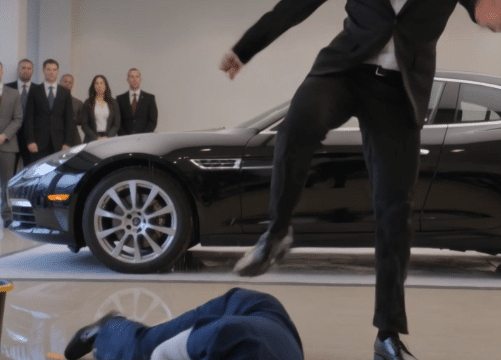
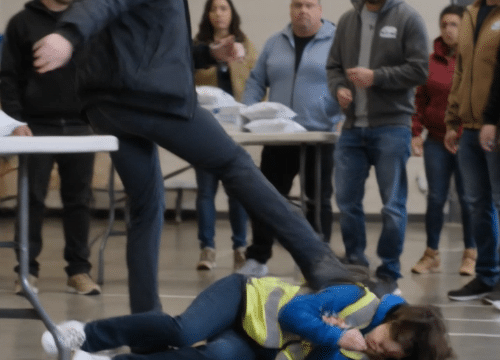
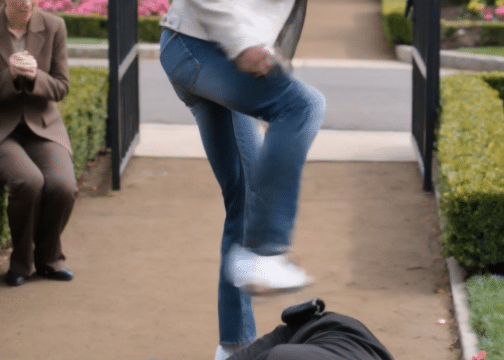
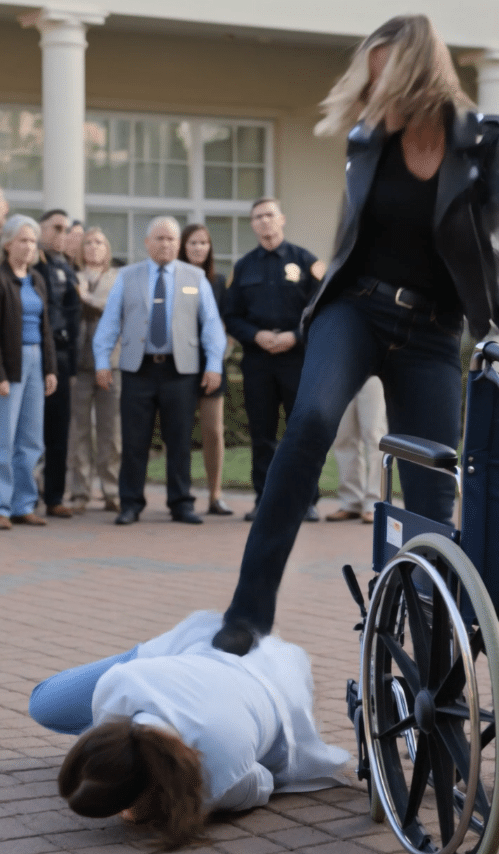
The son rushed in from behind and drove a forceful kick into her upper back and shoulder area.
She was knocked forward onto the brick walkway.
Her care chart struck the ground and opened.
A medical pen skidded across the path.
Her forearm and elbow hit the edge of the flower bed, leaving only a thin trace of blood.
The nurse curled from the impact, breathing hard.
But even while she was hurting, she turned her head toward the wheelchair.
The elderly man was still there.
Safe.
That was the first thing she checked.
The son stood over her.
“Trash. You almost dropped my father.”
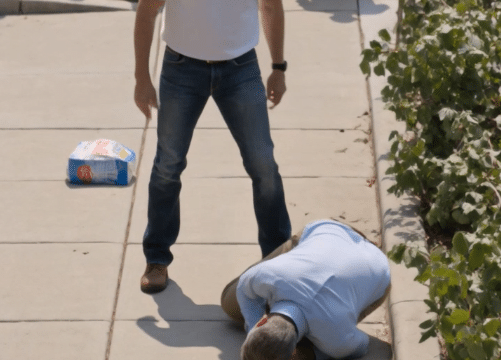
Before anyone could react, he stepped closer and delivered two more hard kicks into her back and side.
Residents sitting nearby gasped.
Visitors covered their mouths.
Other nurses froze.
Nobody touched the attacker.
Nobody moved toward the woman on the ground.
The son looked down at the nurse with open contempt.
“You shouldn’t touch elderly people.”
The irony was almost unbearable.
She had touched his father because his father had nearly lost his balance.
She had been trying to protect him.
And now she was lying on the bricks because of it.
Then a black sedan screeched to a stop near the entrance.
Someone important had arrived.
And the first thing that person wanted was not an explanation from the son.
It was his father’s file.
Act II
The nursing home had spent years building its garden walkway as more than a decorative space.
Residents used it for afternoon walks.
Families sat on the stone benches beside the flower beds.
Nurses pushed wheelchairs through the paths when the weather was pleasant.
For elderly residents, those small routines mattered.
A few minutes outside could become the best part of the day.
The nurse understood that.
At thirty-five, she had learned to notice details other people missed.
A loose wheel.
A change in breathing.
A hand gripping an armrest too tightly.
A resident suddenly looking frightened.
The elderly man had been making his way down the brick path when the wheelchair wheel caught the groove.
It was a minor problem.
The nurse had seen much worse.
She immediately crouched down to inspect the wheel.
That was when his son arrived.
He didn’t ask whether his father was hurt.
He didn’t ask what had happened.
He saw his father wobble and immediately decided the nurse was responsible.
His anger was fueled by something deeper than the incident itself.
He had always believed that his father deserved exceptional treatment.
He had complained about small things before.
He expected staff to anticipate his father’s needs.
And because he was his father’s son, he seemed to believe that questioning him was an insult.
The nurse had no idea any of that mattered.
She was simply doing her job.
Then the attack happened.
The garden path became strangely quiet afterward.
The nurse’s light blue scrubs were dusty from the bricks.
Her care chart lay open near the wheelchair.
The pen had stopped several feet away.
She was visibly shaken, but her eyes remained fixed on the elderly resident.
He was watching her.
Confused.
Frightened.
She wanted him to know that he was safe.
That instinct said more about her than any professional title could.
The witnesses saw it.
They also saw what the son had done.
But fear kept everyone still.
Nobody wanted to make the situation worse.
Then the sound of a car braking sharply came from the front entrance.
A black sedan stopped at the curb.
The doors opened.
The nursing home director stepped out in a navy suit.
Beside him came the chief physician in a white coat.
Two security staff followed.
They moved quickly down the garden path.
The director’s eyes went first to the injured nurse.
Then to the elderly resident.
Then to the man standing over both of them.
But there was something else the director noticed.
The father’s wheelchair.
And the file that documented everything about the man’s care.
That was when the story took a turn nobody in the garden expected.
Act III
The director didn’t waste time arguing.
Security moved between the son and the nurse.
The chief physician went straight to the elderly man, checking him carefully in the wheelchair.
The director remained beside the injured nurse, creating a physical barrier between her and the attacker.
It was the first moment since the assault when she could breathe without wondering whether another kick was coming.
The son stared at the newcomers.
His anger was still visible.
But now confusion had begun to replace it.
Why was the nursing home’s director personally involved?
Why had the chief physician come with him?
And why had security immediately placed themselves between him and the nurse?
The director looked toward the wheelchair.
The elderly man appeared shaken, but he was safe.
Then the director looked down at the care chart lying open on the brick walkway.
He didn’t pick it up.
He didn’t need to.
He knew exactly what it was.
A patient’s record.
A record that could contain the details of the man’s condition, mobility limitations, fall-risk assessments, care instructions, and documented incidents.
The son had accused the nurse of nearly dropping his father.
But the director was interested in something much more specific.
What had actually happened?
Was the wheelchair malfunctioning?
Was the brick groove already documented?
Had the nurse been responding appropriately?
And most importantly, what did the patient’s own care records say about his condition?
The son suddenly looked less certain.
The director turned toward a staff member.
Then he spoke with unmistakable authority.
“Bring me his father’s file. Now.”
The sentence changed the atmosphere immediately.
The witnesses went silent.
The chief physician remained beside the elderly man.
Security held the son back.
And the director stayed close to the nurse.
Nobody explained what was in the file.
Nobody announced what it might prove.
That uncertainty was deliberate.
Because sometimes the most frightening evidence is the evidence you haven’t seen yet.
The son stared at the director.
His father’s file?
Why was that suddenly the most important thing in the garden?
And what could it possibly reveal about the accusation he had just made?
Act IV
The son had entered the garden convinced he knew exactly what had happened.
His father had wobbled.
The nurse had been beside him.
Therefore, in his mind, the nurse was guilty.
It was simple.
Or at least he had made it simple.
But the director was not working from assumptions.
He was working from records.
The chief physician was checking the elderly resident.
Security was protecting the nurse.
And somewhere inside the nursing home’s administrative office, a patient’s file was being retrieved.
The distinction was enormous.
The son had reacted emotionally.
The director was reconstructing the event.
That meant every detail mattered.
The wheel had caught the groove.
The nurse had immediately bent down to inspect it.
The elderly man had not fallen.
The nurse had been positioned close to the wheelchair because she was trying to prevent exactly that.
Then the son had attacked her.
And even after she was knocked down, she had turned her head toward his father to make sure he remained safe.
The evidence wasn’t just physical.
It was behavioral.
The nurse’s actions had told the story before anyone said another word.
She had protected the resident before herself.
The son had done the opposite.
He had prioritized his anger over the safety of both people standing in front of him.
Now he stood behind security, watching the director.
His earlier certainty was fading.
The expensive confidence of someone accustomed to demanding answers was being replaced by a much more uncomfortable question:
What was actually in his father’s file?
The elderly resident remained in the wheelchair.
The chief physician stayed beside him.
The nurse slowly gathered herself on the walkway.
She was still hurt.
Still breathing hard.
Still shaken by what had happened.
But she had not retaliated.
She had not abandoned her patient.
She had not even looked away from him for long.
The director noticed all of it.
So did the people standing nearby.
The son’s accusation had been that the nurse shouldn’t touch elderly people.
Yet the most important person in the garden had just arrived and immediately trusted her enough to protect her while the physician checked the resident.
That was the reversal.
The man who had claimed to be defending his father was now being separated from him.
The nurse who had been accused was the one whose actions were being examined in context.
And the file the director had requested could establish exactly what the son had refused to consider.
The elderly man’s medical history.
His mobility needs.
The documented condition of his wheelchair.
Previous incidents.
Care instructions.
Perhaps even something the son had never been told.
The director didn’t reveal any of it.
Not yet.
He simply waited.
The son stared at him.
His jaw tightened.
The anger was still there.
But underneath it was something new.
Fear.
And finally, he asked the question that exposed how completely the power in the garden had shifted.
Act V
“My father’s file?”
The words hung in the air.
But the real story had already been written.
It was written in the groove beneath the wheelchair.
In the scattered care chart.
In the medical pen lying on the bricks.
In the nurse’s instinct to check the elderly man even after she had been knocked down.
And in the silence of everyone who had watched the attack happen.
The elderly resident had never been dropped.
He had never fallen.
His wheelchair wheel had simply caught a groove.
The nurse had responded immediately.
That was the entire trigger.
Everything that followed had come from a son who refused to pause long enough to see what was actually happening.
He had mistaken a routine safety response for incompetence.
Then he had turned his anger against the person protecting his father.
But now the director had arrived.
And he wasn’t interested in the loudest accusation.
He was interested in the record.
The chief physician remained with the elderly man while security kept the attacker away from the nurse.
The director stood over the injured employee, his presence sending a simple message through the garden:
She would not face this alone.
The witnesses slowly began to understand the significance of the moment.
The son had wanted everyone to believe that the nurse had endangered his father.
Instead, the entire sequence pointed in another direction.
She had seen a problem.
She had responded.
She had checked the wheelchair.
She had tried to keep the elderly man safe.
And when violence came from behind, her first concern afterward was still the resident.
That was the kind of detail no angry accusation could erase.
The director’s request for the file had opened another door.
Whatever was written there would help establish the facts.
Maybe it would confirm what the nurse had done.
Maybe it would reveal important information about the elderly man’s condition that his son had overlooked.
Maybe it would explain why the staff had been monitoring his mobility so carefully.
But one thing was already certain.
The man who had attacked the nurse had believed he was defending his father.
Now the people responsible for his father’s care were examining everything he had done in the name of that defense.
The garden slowly returned to silence.
Flowers moved in the afternoon breeze.
The black sedan remained near the entrance.
The nurse stayed beside the resident.
And the son stood separated from both of them, staring at the director with an expression that had lost its certainty.
The file was coming.
And for the first time, he seemed to understand that the question wasn’t whether his father mattered.
It was whether he had ever truly understood what his father needed.
“My father’s file?”