Act I
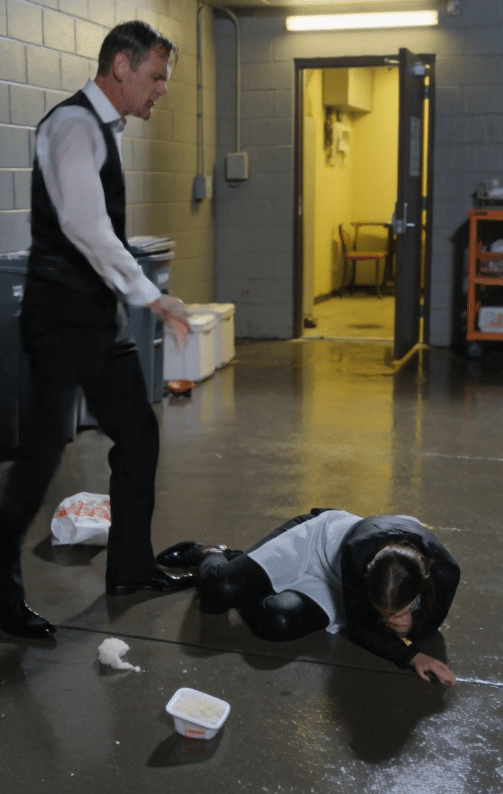
The manager ripped the food bag from her hands and hurled it beside the trash bins.
It struck the wet concrete, split open, and spilled containers across the alley. Rainwater rushed beneath them, carrying grains of rice toward the drain behind the restaurant.
“Please,” the woman whispered. “That’s my daughter’s dinner.”
Daniel Mercer, the restaurant manager, looked down at her as if she had just confessed to a crime. His white shirt was immaculate beneath a black vest, and his leather shoes reflected the yellow kitchen light spilling through the back door. He had spent the evening reminding the staff that every portion, every minute, and every dollar belonged to the restaurant.
Now he was determined to make an example of the woman who had spent the entire night washing its dishes.
Her name was Laura Bennett. She was thirty-nine, a single mother, and the only dishwasher willing to cover the late shift when two other employees called out sick. Her thin coat was soaked through, her apron clung to her clothes, and her old non-slip shoes squeaked against the concrete.
She had worked eleven hours.
She had scrubbed burnt pans until her fingers ached, cleared grease traps, and hauled bags of kitchen waste through the rain. All evening, she had kept one thought alive in her mind: the small apartment where her nine-year-old daughter, Sophie, was waiting for her.
The food in that bag was not stolen.
A cook had packed it after the dinner service, and another employee had told Laura she could take it home. It was food that would otherwise have been discarded, a few portions of chicken and rice that meant her daughter would not have to go to bed hungry.
Laura had not eaten since the afternoon.
She had been looking forward to watching Sophie open the bag at their kitchen table, even if the meal was cold by the time they got home.
Daniel knew none of that—or, more accurately, he had never cared enough to ask.
He had seen Laura leave with the bag and decided that she had taken something without permission. Rather than ask the kitchen staff what had happened, he followed her outside, grabbed the food, and threw it into the rain.
When Laura bent down to retrieve it, Daniel drove a forceful kick into her chest.
She fell hard onto the slick concrete beside the bins. The impact knocked the breath from her lungs, and the food containers burst open around her. Her elbow struck the metal leg of a trash bin, leaving a thin trace of blood as she tried to brace herself against the ground.
For several seconds, she could barely breathe.
Rain tapped against the lids of the bins. Water ran beneath her palms. Her face tightened with pain as she curled inward, struggling to draw air into her chest.
But her eyes kept returning to the food.
She reached toward a container, hoping to save even a little of what remained.
Daniel stepped closer.
He kicked her twice more, striking her back and side as she stretched toward the scattered meal. Laura recoiled with a sharp gasp, her body folding around the pain. Her wet apron twisted beneath her, and her fingers slipped against the concrete.
Behind the restaurant’s back door, two kitchen workers had stopped moving.
A young server covered her mouth. Another employee stood frozen beside a stack of clean trays. Through the narrow window, several people watched the scene unfold, horrified but unwilling to challenge a manager who controlled their schedules, hours, and paychecks.
Daniel noticed them watching.
He did not look embarrassed.
He looked powerful.
“They said I could take it home…” Laura managed to whisper.
Daniel leaned over her.
“Trash. Thieves always cry.”
Laura stared at him, stunned by the cruelty of the words. She had spent months arriving early, staying late, and accepting the least desirable shifts because she needed the job. She had never asked for special treatment. She had never taken cash from the register or food from a customer’s plate.
And now a man who had watched her clean the kitchen for eleven hours was calling her a thief because she was trying to feed her child.
Daniel straightened his vest.
“Your kid can eat excuses.”
The words seemed to hurt Laura almost as much as the kicks.
She could endure being insulted herself. She could endure people looking down on her because she washed dishes instead of serving tables. But the thought of Sophie sitting alone at home, waiting for a dinner that might never arrive, broke through the numbness spreading across her face.
Laura tried to push herself up.
The rain continued to fall.
Then a black sedan came skidding into the alley and stopped behind Daniel.
Its headlights flooded the wet concrete. The engine cut off, and the driver’s door opened.
A man in a dark suit beneath a long coat stepped into the rain. He took one look at Laura, the spilled food, and the manager standing over her.
His expression hardened.
He moved between Daniel and the injured woman, shielding her from the manager before saying a single word about what had happened.
Then he looked directly at Daniel and gave an order that had nothing to do with dinner.
“Give me the payroll records.”
For the first time that night, Daniel Mercer looked as though he had forgotten how to speak.
Because he knew exactly what those records might reveal.
Act II
The man who had stepped into the alley was Robert Hayes, the sixty-year-old owner of Hayes House, the restaurant that occupied the corner of one of the city’s busiest commercial streets.
To most employees, Robert was a name on the company handbook and a signature on documents they rarely saw. He owned several restaurants, but he had built his reputation on a simple promise: every location would be run with the same standards he expected from the first small diner he had opened decades earlier.
He believed in good food, fair treatment, and the idea that a restaurant’s success depended on the people who worked behind its walls.
He also believed that a manager who abused employees was a liability, regardless of how much money that manager claimed to make the business.
Daniel had spent three years convincing everyone that he understood those principles.
He was efficient, disciplined, and relentless about expenses. His location consistently reported strong numbers, and he had a talent for presenting every problem as something he had already solved. When food costs rose, he blamed suppliers. When employees quit, he blamed their work ethic. When overtime appeared on the books, he claimed the kitchen staff could not manage their time.
Robert had admired Daniel’s ability to keep the restaurant operating under pressure.
He had not realized how much of that success depended on making the people beneath him afraid to complain.
Tonight’s visit was supposed to be routine.
Robert had received a message from the regional accounting office about discrepancies in the payroll summaries. Nothing had been proven, and the figures could have reflected a simple reporting error. He had planned to speak with Daniel privately after the restaurant closed, review the original records, and determine whether a more detailed audit was necessary.
Instead, he had arrived in time to see a woman lying in the rain.
Robert did not know Laura personally, but he knew what a closing shift demanded. He had washed dishes himself when his first restaurant could not afford enough staff. He remembered the heat of the industrial sinks, the sting of detergent in cracked hands, and the quiet exhaustion that settled over a kitchen after midnight.
He also knew that no manager had the right to turn that exhaustion into an opportunity for cruelty.
“Stay back,” Robert told Daniel.
The manager opened his mouth, then shut it again.
Robert crouched beside Laura, keeping his body between her and the man who had attacked her. He asked whether she could breathe comfortably and told his driver to contact emergency services. He did not try to pull her to her feet or insist she was fine.
Laura looked at him with frightened, uncertain eyes.
“I didn’t steal anything,” she whispered.
“I hear you,” Robert replied. “You don’t have to explain anything right now. Let’s make sure you’re safe.”
The simple answer nearly undid her.
For hours, Laura had been treated as though her word meant nothing. Daniel had accused her without checking the facts, punished her without listening, and used her daughter’s hunger as a weapon. Now a stranger in an expensive coat was taking her seriously before she had even managed to tell her full story.
Behind Robert, the restaurant employees began to emerge from the back door.
None of them approached Laura. They stood beneath the yellow light, watching with tense faces as the owner knelt on the wet ground beside a woman whose name he had only just learned.
Daniel seized the moment to recover his authority.
“Mr. Hayes, this is a misunderstanding,” he said quickly. “She was removing food without approval. I was handling an employee violation.”
Robert looked up.
“An employee violation?”
“She took restaurant property.”
“Did you ask the kitchen staff whether they gave her permission?”
Daniel hesitated.
“The rules are clear.”
“That wasn’t my question.”
Rain ran from the edge of Robert’s coat. Behind him, his driver had moved toward the restaurant door, preventing Daniel from closing it or retreating inside.
Daniel’s expression tightened.
He had expected Robert to arrive, review the numbers, and leave. He had never imagined the owner would personally witness him losing control in front of his own employees.
“I have a responsibility to protect this business,” Daniel insisted. “If people start taking food whenever they want, where does it end?”
Robert glanced at the ruined dinner.
“Is that what you think this is about?”
Daniel followed his gaze.
For a second, he looked almost irritated by the food lying in the rain, as if its presence were an inconvenience that refused to disappear.
Laura tried to sit up, then winced and lowered herself again. Robert immediately turned back toward her, asking her to remain still until help arrived.
That small movement—the owner’s attention returning to the injured woman instead of the manager’s excuses—made the employees at the door look at one another.
They had watched Daniel behave this way before.
Not always with violence. Sometimes it was a public dressing-down over a misplaced order, a threat to cut someone’s hours, or a warning that asking questions could cost them their jobs. Most employees learned to keep their heads down. A few had quit without explaining why.
But no one had expected the owner to see the pattern for himself.
Robert rose and turned to Daniel.
“Get me the payroll records, the original time sheets, and every schedule you’ve changed in the last six months.”
Daniel’s confidence faltered.
“The accounting office handles that.”
“Then you can help them find everything.”
“I don’t understand why we’re discussing payroll while an employee is making accusations.”
Robert’s eyes narrowed.
“I haven’t heard her make a single accusation about payroll.”
The silence that followed was brief, but it was enough.
Daniel realized he had just reacted to a subject Robert had not yet connected to Laura’s attack. He had answered too quickly, too defensively, and with far too much concern about records that should have been ordinary business documents.
Robert noticed.
So did his driver.
And as the rain swept through the alley, the owner began to suspect that the ruined dinner beside the trash bins was not the only thing Daniel had been trying to keep out of sight.
Act III
The first warning had come four months earlier.
A former server named Emily had sent a confidential complaint to the company’s human resources department, alleging that Daniel regularly changed time sheets after employees had clocked out. She claimed that closing staff were sometimes required to remain at work for another thirty or forty minutes without recording the additional time.
The complaint included screenshots of schedules and messages from a supervisor instructing employees to finish cleaning before leaving, even when their recorded shifts had ended.
Daniel denied everything.
He told the regional office that Emily had been dismissed for poor performance and was trying to retaliate. He produced polished spreadsheets showing labor costs within budget, signed schedules, and payroll summaries that appeared consistent with the restaurant’s reported hours.
The complaint was marked for further review.
Then the reviewer was transferred to another region, the follow-up was delayed, and the matter disappeared into a growing stack of unresolved administrative tasks.
Robert had not known how badly the process had stalled.
He had received a brief update that the complaint was being handled. He had assumed the appropriate people were collecting evidence. His attention was divided among renovations, supplier contracts, and a planned expansion that was supposed to secure jobs across the company.
Daniel understood exactly how to use that distance.
He knew which reports reached Robert’s desk and which details remained buried in routine paperwork. He knew that strong sales figures made a manager look dependable, and he knew how easily a complaint could be framed as a disgruntled employee’s personal grievance.
He also knew that the original records told a different story from the summaries he submitted.
Several employees had stayed late to finish closing duties. Some had been told to clock out first. Others had discovered that their recorded hours were shorter than the time they remembered working. When they questioned the discrepancies, Daniel said the scheduling system had made mistakes and promised to correct them.
The corrections never appeared.
Laura had noticed the problem but could not afford to risk her job by challenging him.
She was raising Sophie alone after her former partner left the state and stopped contributing regularly to their daughter’s expenses. Rent consumed most of her paycheck. The rest went toward electricity, groceries, school supplies, and the occasional bus fare when she could not walk to work.
She had taken the dishwasher position because the restaurant offered predictable hours and a staff meal.
At least, that was what she had been promised.
Over time, the meals became less reliable. Daniel introduced new restrictions on what employees could take home, even when food was destined for disposal. The written policy prohibited unauthorized removal of food, but the kitchen had long operated under an informal practice: staff could take certain untouched portions after the closing manager approved them.
Daniel began insisting that no one had permission unless he personally signed off.
Then he started using leftover food as leverage.
An employee who complained about missing hours might discover that their staff meal had been withheld. Someone who questioned a schedule could be assigned an undesirable shift. Daniel rarely put the connection in writing, but employees began to understand that the rules changed depending on whether he liked you.
Laura had kept quiet because she had no room for another crisis.
Tonight, the kitchen had prepared several portions that could not be served the following day. A cook had packed one for Laura and told her to take it before the closing crew finished. Another employee had seen the exchange and assumed it was approved.
Daniel arrived at the back door just as Laura was leaving.
He asked what was in the bag.
When she explained, he accused her of stealing. She tried to tell him who had packed the food, but he refused to listen. His anger escalated until the bag was ripped from her hands and thrown beside the bins.
The assault that followed had not been an attempt to recover company property.
It had been a display of control.
Now Robert stood in the same alley, watching Daniel struggle to explain why the payroll records were suddenly relevant.
“You’re making a mistake,” Daniel said. “I keep this restaurant profitable. You know that. Every month, I’m the one meeting the targets while other locations struggle.”
Robert nodded once.
“I know the sales figures.”
“Then you know what I bring to this company.”
“I know what you’ve reported.”
Daniel stared at him.
Robert turned to his driver. “Call the regional controller. Tell her to preserve the original payroll files, the time-clock logs, the schedules, and all employee messages connected to changes in recorded hours. Nothing gets deleted or overwritten.”
Daniel took a step forward.
“You can’t launch an investigation because of an argument over leftovers.”
Robert’s voice remained even.
“I’m not launching an investigation because of the food.”
That answer frightened Daniel more than an accusation would have.
Robert had not yet declared him guilty of anything involving payroll. He had not announced a decision or threatened him with a public scandal. He was simply ordering the preservation of records that Daniel had expected to remain under his control.
And that meant the next conversation would not be about excuses.
It would be about evidence.
The kitchen employees exchanged uneasy glances. One of them, a line cook named Marcus, lowered his eyes as though he wished he could disappear. Another worker took a breath, then quietly told Robert that there had been repeated disagreements over staff hours.
Daniel snapped toward him.
“Don’t get involved.”
Marcus flinched.
Robert stepped into the space between them.
“He can speak for himself.”
Marcus looked at Laura on the ground, then at the owner. His face showed the fear of someone who had spent months convincing himself that silence was safer than honesty.
Finally, he began to talk.
He explained that employees were sometimes asked to finish work after clocking out. He described how schedules had been altered and how Daniel discouraged staff from keeping copies. He did not claim to know every detail, but he could identify dates, coworkers, and closing shifts that matched the disputed records.
Robert listened without interrupting.
Then he asked the driver to make a note of Marcus’s account and ensure it was passed to the appropriate investigators.
Daniel’s expression had gone rigid.
The payroll records were no longer a routine request. They were the beginning of a chain of evidence—and he could no longer decide which parts of it other people were allowed to see.
Act IV
The ambulance arrived as the restaurant’s back door remained open behind them.
The paramedics assessed Laura and helped her onto a stretcher, taking care with her painful chest and injured elbow. She was conscious, frightened, and deeply embarrassed by the number of people watching, but Robert stayed nearby until she was ready to be moved.
Before the stretcher reached the ambulance, Laura caught his sleeve.
“My daughter,” she whispered. “She’s waiting for me.”
Robert leaned closer so she would not have to raise her voice over the rain.
“What is her name?”
“Sophie.”
“We’ll make sure she isn’t left waiting alone. Is there someone we can call?”
Laura gave him the number of a neighbor who sometimes checked on Sophie when a shift ran late. Robert asked his driver to help contact the neighbor and confirm that the child was safe, while the paramedics continued their assessment.
He did not promise that everything would be easy.
He promised that Laura would not have to solve every problem by herself tonight.
As the ambulance doors closed, the alley seemed to grow quieter. The food remained scattered near the bins, its containers battered and rain-soaked. The kitchen workers stood beneath the yellow light, no longer pretending they had seen nothing.
Robert turned toward Daniel.
“Give me the payroll records.”
“I already told you, the accounting office has them.”
“Then you will cooperate with the accounting office.”
Daniel straightened his vest, attempting to recover the posture that had intimidated his staff for years.
“You’re taking the word of a dishwasher over the manager who runs your restaurant?”
“No,” Robert replied. “I’m taking the assault seriously, and I’m preserving records that should have been available from the beginning. Those are two separate matters.”
“You don’t know what happened out here.”
“I know what I saw.”
Daniel looked toward the back door.
He could still hear the kitchen equipment humming inside. He could see Marcus standing beside the prep counter, no longer willing to meet his eyes. He could see the server who had watched him kick Laura, her hand still pressed against her mouth.
For the first time, the people around him were not behaving like employees waiting for instructions.
They were witnesses.
Robert asked the staff to remain available for statements and reminded them that they were not to be pressured into changing or withholding what they had seen. He directed his driver to secure the restaurant’s relevant records and contact the company’s legal and human resources teams.
Daniel tried to interrupt every instruction.
He said the staff were exaggerating. He said Laura had violated policy. He said the owner was allowing an emotional scene to distract him from the business. He even suggested that the employees were conspiring against him because he expected them to do their jobs properly.
But each explanation made the problem clearer.
He could not explain away the assault by citing a food policy. He could not make the payroll concerns disappear by pointing to strong sales. And he could not intimidate the witnesses without demonstrating exactly why they had been afraid to speak earlier.
When the regional controller arrived, she did not come alone. A human resources representative accompanied her, carrying a secure laptop and a list of documents that had been requested for review.
Daniel’s face changed when he saw the list.
The original clock-in and clock-out data had been retained by the company’s scheduling system. The restaurant’s submitted payroll summaries could be compared against those records. Staff messages and shift assignments could also be reviewed, along with the dates employees said they had worked beyond their recorded hours.
If the discrepancies were confirmed, the company would have to determine how many employees had been underpaid and whether the changes had been deliberate.
Daniel knew the records would be difficult to explain.
He had spent months relying on the belief that no one would look closely enough to compare them.
Now Robert was demanding precisely that comparison.
The owner did not announce a verdict in the alley. He did not need to. He instructed the controller to preserve the evidence, arrange an independent review, and ensure that no employee’s hours or employment status could be altered in retaliation for cooperating.
Daniel was removed from his managerial duties pending the investigation. The decision was formal, immediate, and witnessed by the same employees he had spent years controlling.
He stared at Robert as if waiting for the familiar conversation to begin—the one where he could defend his numbers, remind the owner of his performance, and bargain his way back into authority.
It never came.
Robert had already turned toward the driver, asking for confirmation that Laura’s neighbor had been reached and that Sophie would have someone with her until her mother could contact her.
That was the difference Daniel could not understand.
Even after being attacked, Laura remained a person to Robert.
To Daniel, she had been a problem to eliminate.
The owner had arrived expecting to investigate payroll discrepancies. He was leaving the alley with evidence of a far more serious failure of leadership—and a workforce that had finally begun to speak.
Daniel watched as the controller carried the records inside.
The documents he had treated as his private territory were now in other hands.
And for the first time, he could not control what they might reveal.
Act V
Laura spent the night under medical observation.
The pain in her chest made it difficult to rest, and every time she closed her eyes, she remembered the sound of the food containers striking the concrete. She remembered the rain soaking through her apron and Daniel’s voice telling her that her daughter could eat excuses.
But there was something else she remembered, too.
A stranger had stepped between them.
He had not asked whether she was a good employee before protecting her. He had not demanded proof that she deserved help. He had seen her on the ground and acted before her circumstances could become another excuse for someone to look away.
Early the next morning, Robert visited the hospital after speaking with his staff. He brought a small bag containing dry clothes, a phone charger, and a meal prepared by the restaurant’s head chef.
Laura looked at the food, then at him.
“I’m sorry about last night,” she said automatically.
Robert paused.
“Why are you apologizing?”
“I caused a scene.”
“You were attacked.”
Laura lowered her eyes.
She had apologized so often for things that were not her fault that the words came out before she could stop them. She apologized when the bus was late, when Sophie needed school supplies, when she asked for an extra shift, and when she had to tell someone that the rent would be a day behind.
Robert pulled a chair closer to her bed.
“You don’t owe anyone an apology for needing dinner for your child.”
Laura’s face tightened. She turned toward the window and cried quietly, one hand pressed over her mouth. It was not only relief. It was the exhaustion of a woman who had spent years believing that survival required her to make herself smaller.
Robert let her have the moment.
Then he explained what would happen next. The company would cooperate with the investigation into the assault, and the payroll records would be reviewed independently. Any verified unpaid wages would be addressed, and employees would have a confidential way to report concerns without going through the manager they were reporting.
He made it clear that Laura would not be expected to return to work before she was ready.
“And Sophie?” Laura asked.
“We’ll help you work out what you need,” he said. “You decide what that looks like.”
That afternoon, Laura was reunited with her daughter.
Sophie ran toward her in the hospital corridor and wrapped both arms around her mother’s waist before realizing that Laura was hurt. The child drew back, frightened, and searched her mother’s face for an explanation.
Laura knelt as carefully as she could.
“I’m okay, sweetheart. I’m here.”
Sophie had spent the previous night with a trusted neighbor, waiting for news. She had not understood why her mother had failed to come home, only that something was wrong. Now she clung to Laura’s coat and refused to let go.
Robert watched from a respectful distance.
He had spent years building restaurants and measuring success in revenue, expansion, and the number of people his company employed. He had never forgotten that businesses depended on workers, but the scene in the alley had forced him to confront how easily a company’s written values could become meaningless when the wrong person held power.
A policy about fair treatment was not enough if employees were afraid to report abuse.
A payroll system was not enough if managers could manipulate the information people trusted.
And a promise to support the community meant very little if the people preparing the food were too frightened to take home a meal that had already been approved.
The investigation took several weeks.
The independent review found discrepancies between recorded shifts and submitted payroll summaries. Investigators compared the system’s original data with employee schedules and messages, then interviewed workers who had previously been too afraid to speak openly.
The review confirmed that multiple employees had worked time that was not fully reflected in the payroll records. The company began correcting the verified underpayments and revised its procedures so that changes to time records required documented authorization and could be audited.
The review also found that Daniel had repeatedly ignored internal rules governing staff treatment and had misrepresented the handling of employee complaints.
He was dismissed after the investigation concluded.
The assault was handled separately through the appropriate authorities. Witness statements and available evidence were preserved, and the company cooperated rather than attempting to bury the incident to protect its reputation.
Robert did not announce that the restaurant had become perfect overnight. He knew that trust was rebuilt through repeated decisions, not a single dramatic gesture. He arranged additional training for managers, established a direct reporting channel for employees, and required regular checks of payroll practices across the company’s locations.
The changes were not made for publicity.
They were made because Laura had been hurt, because other workers had been afraid, and because a business could not claim to value its employees while leaving them defenseless against the people who controlled their shifts.
Laura eventually returned to work after recovering enough to decide what she wanted to do. She was offered a position with a more predictable schedule and access to the company’s employee support program. She accepted the new arrangement on her own terms, with the understanding that she could raise concerns without risking her livelihood.
On her first evening back, the head chef packed a meal for her to take home.
This time, the bag was placed directly into her hands.
No one made her explain why she needed it.
No one asked her to prove that her daughter deserved to eat.
Laura thanked the chef, tucked the bag carefully into her coat, and walked toward the front entrance rather than slipping through the service alley.
Outside, the rain had stopped.
She thought of the night she had fallen beside the trash bins, reaching through dirty water for food that had been meant for her child. She thought of how easily a person’s dignity could be taken from them when everyone around them was too afraid to object.
Then she thought of Sophie waiting at home.
There would be dinner that evening. There would be a story to tell when Laura was ready to tell it. There would still be bills to pay and difficult mornings to face, but she no longer had to carry the belief that asking for help made her a burden.
The restaurant continued operating, though the people inside it had changed. Employees who had once whispered about missing hours began reporting problems through the new system. Managers learned that strong sales could not excuse misconduct, and the company learned to examine the records behind the numbers rather than simply trusting the person who submitted them.
Robert never forgot the image of Laura lying in the rain beside a ruined meal.
Neither did the employees who had watched Daniel attack her.
They remembered the moment he believed he could humiliate a tired mother in front of the entire kitchen and still walk back inside as the man in charge. They remembered the black sedan stopping in the alley, the owner stepping between them, and the sudden change in Daniel’s face when the conversation turned to payroll records.
For years, he had relied on the assumption that the people beneath him would remain silent.
That night, he learned that silence was not the same as innocence, and authority was not the same as ownership.
Robert Hayes owned the restaurant.
Daniel Mercer had only been trusted to run it.
And when that trust was broken, the records he had hoped to control became the evidence that brought his carefully protected world apart.
The last thing Daniel remembered from the alley was the owner’s calm voice, the rain washing across the concrete, and the faces of employees who were no longer looking away.
He had thought the food bag was the problem.
He had thought a poor mother could be frightened into silence.
He had thought the numbers would protect him.
Now, with the payroll records being examined and his authority gone, the first trace of panic finally broke through his practiced arrogance.
He stared at Robert, unable to hide the fear in his expression.
“Payroll records?”