Act I
The bouquet was still in his girlfriend’s hands when the elderly woman asked him to pay for it.
“Excuse me, sir. You haven’t paid yet.”
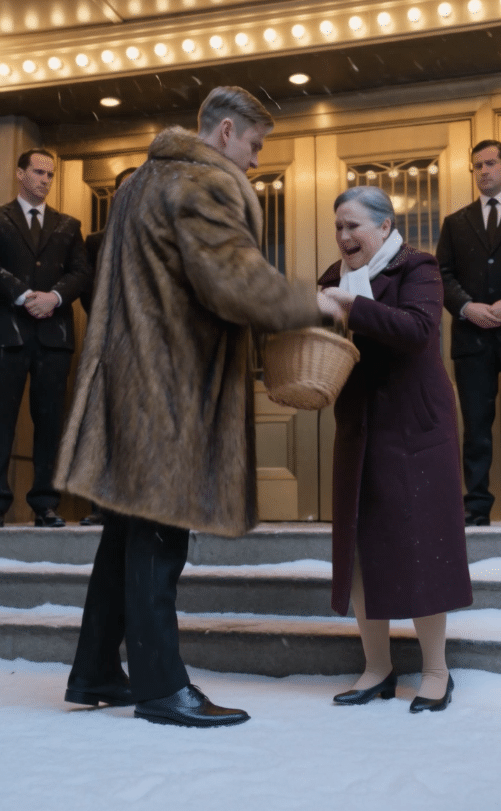
The wealthy man turned around slowly, as if the woman had interrupted something far more important than a simple transaction. Snow fell beneath the golden lights of the luxury theater, collecting along the stone steps and the shoulders of the guests arriving for the evening’s performance.
He wore a black suit beneath an expensive fur coat. His girlfriend stood beside him, holding the bouquet he had just taken from the flower seller’s basket. The woman who had arranged those flowers was seventy-five years old, wrapped in an old purple coat with a white scarf tucked beneath her chin.
Her gloves were torn at the fingertips. Her hands trembled from the cold.
“It’s just a few flowers,” the man said dismissively.
The seller swallowed. “Please… I need that money for rent.”
For a moment, the man appeared amused.
Then he looked at the small basket beside her feet, at the remaining bouquets wrapped in thin paper, and at the elderly woman standing alone in the snow. He seemed to recognize something he liked about the situation: she needed the money, and he believed that need made her powerless.
He had taken the bouquet without paying. Now he intended to leave without paying, too.
His girlfriend glanced at the woman, then at the man beside her. She looked uncomfortable, but she did not put the flowers down.
The seller reached out gently.
“Sir, please. Those are mine to sell.”
He seized the basket and knocked it from her hands.
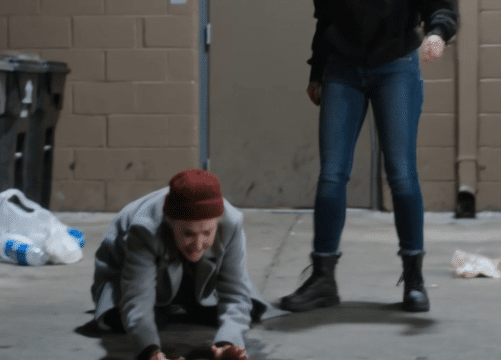
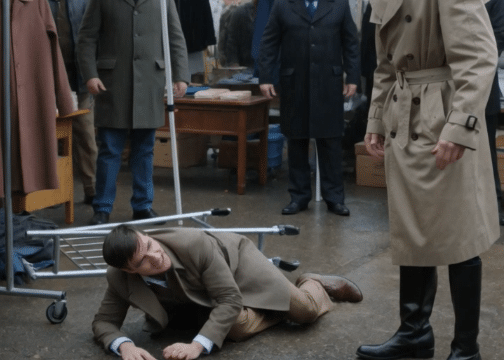
Flowers spilled across the snow-covered steps. Several stems snapped beneath the basket’s edge, and loose petals scattered in the wind. Before the woman could recover her balance, the man drove a forceful kick into her chest.
She fell backward onto the stone steps.
Her elbow struck the edge of a step, leaving a thin trace of blood. She grimaced, curling around the pain as the cold stone pressed against her back. The basket rolled away, and the remaining bouquets scattered across the snow.
For a moment, she could not do anything except breathe in short, frightened gasps.
The woman had spent the entire afternoon arranging those flowers. She had bought them wholesale with money she could barely spare, then carried them to the theater district because performances brought crowds willing to purchase small gifts for their partners.
If she sold enough, she could pay the rent due in the morning.
If she did not, she would have to ask her landlord for more time—again.
She had already made that request twice.
Now the money she desperately needed lay scattered across the steps, and the man who had taken the first bouquet stood above her as though she were an inconvenience he had paid to avoid.
She tried to reach for a fallen flower.
He kicked her twice more, striking her back and side as she stretched toward the scattered stems. Her body recoiled with each impact, and she curled inward, one hand pressed against her side. Her face showed the pain, fear, and humiliation she could no longer hide.
Around them, the theater entrance had gone strangely still.
Well-dressed guests covered their mouths. A man near the ticket doors took a step backward. A woman clutched her companion’s arm, her eyes fixed on the elderly seller lying among the flowers.
Nobody approached.
The wealthy man looked down at the woman and adjusted his coat.
“Trash. Flowers don’t cost dignity.”
The seller blinked against the falling snow.
She had sold flowers outside theaters for years. She had watched couples celebrate anniversaries, parents surprise their children, and strangers buy single roses for people they were afraid to confess their feelings to. She had learned that a small bouquet could mean more to someone than its price suggested.
But she had never imagined that flowers could become the excuse for such cruelty.
She tried to push herself upright, wincing as she reached toward the basket.
The man leaned closer.
“Sell your sadness somewhere else.”
His girlfriend finally lowered her eyes to the bouquet in her hands.
The petals were beautiful. Deep red roses, carefully wrapped in cream paper, with a narrow ribbon tied around the stems. They were exactly the sort of flowers a person might buy to make someone feel cherished.
Yet she had watched the seller fall, and she had done nothing.
The theater’s golden doors stood just behind them. Warm light spilled over the steps, illuminating the scattered flowers and the elderly woman’s trembling hands.
Then the VIP door swung open.
A man in a long navy coat emerged, accompanied by the theater manager and two security officers. He was sixty-four, silver-haired, and instantly recognizable to the staff inside the building.
He was the theater’s principal benefactor, the man whose donations had funded its restoration and kept several of its community programs alive.
He stopped when he saw the woman in the snow.
Then his gaze moved to the bouquet in the girlfriend’s hands.
His expression changed.
He stepped between the wealthy man and the injured seller, while security moved into position to prevent anyone from approaching her. The theater manager hurried down the steps to gather the fallen flowers.
The benefactor looked at the woman, then at the basket lying on its side.
His next words were quiet, but every person nearby heard them.
“Buy every flower she has.”
The wealthy man stared at him.
He had expected the world to continue looking away.
He had not expected the person emerging from the theater’s most important door to turn the entire scene against him.
Act II
The benefactor’s name was Charles Whitmore.
At sixty-four, Charles had become one of the most influential supporters of the city’s arts community. He had built his fortune through commercial real estate, but his reputation rested on something less tangible: the belief that a city needed places where ordinary people could experience beauty without having to justify their existence.
Years earlier, he had helped save the theater from closure. The building had suffered from declining ticket sales and expensive repairs, and its owners had been preparing to sell it to a developer. Charles funded the restoration, protected the historic auditorium, and established a program that provided discounted tickets to students, seniors, and families who otherwise could not afford to attend.
He did not consider himself a hero.
He had simply loved the theater since childhood.
His mother had taken him there when he was a boy, back when the seats were worn and the lobby smelled of polished wood. After his father died, she had used small gifts and occasional theater visits to make difficult years feel less heavy.
One winter evening, she had bought a bunch of inexpensive flowers from a woman standing outside a department store. She brought them home in a glass jar and placed them beside the kitchen window.
Charles remembered how carefully she arranged them.
“They don’t have to be expensive to make a room feel alive,” she had told him.
He had carried that lesson into adulthood.
Now, standing beneath the theater’s golden lights, he watched a seventy-five-year-old woman struggle to breathe on the steps while a man in a fur coat held the flowers she had tried to sell.
The scene made him think of his mother.
It also made him angry.
“Get medical assistance,” Charles told the theater manager. “And have someone bring a blanket.”
One security officer remained between the injured woman and the wealthy man. The other moved toward the entrance to call for help. The manager crouched to gather the fallen bouquets, handling the stems carefully so he would not damage any more of them.
Charles knelt beside the seller without attempting to pull her to her feet.
“Ma’am, can you hear me?”
She nodded faintly.
“What’s your name?”
“Evelyn,” she whispered.
“Evelyn, we’re going to get you help. You don’t have to stand up yet.”
Her eyes moved toward the flowers.
“Please don’t let them get ruined.”
Charles followed her gaze. Some of the roses had fallen into the snow, their petals collecting moisture. Others remained intact beneath the overturned basket.
“We’ll take care of them,” he promised.
Evelyn’s face crumpled.
It was not merely the physical pain that had brought tears to her eyes. It was the terrible embarrassment of lying on the steps while strangers watched, knowing that her rent money had been scattered across the ground along with the flowers.
She had spent most of her life trying not to become a burden to anyone.
After her husband died, she took whatever work she could find. She cleaned offices, cared for an elderly neighbor, and eventually began selling flowers because it allowed her to work at her own pace. She had never become wealthy, but she had always managed to keep a roof over her head.
Until the past few months.
Her landlord had increased the rent after a change in property ownership. Her pension covered less than it once had, and the cost of groceries and heating had climbed. Selling flowers outside the theater had become one of the few ways she could close the gap.
She had not told her family how desperate things had become.
Her daughter lived several hours away, working long shifts while raising two children of her own. Evelyn did not want to add another worry to that household. She told her daughter that she was managing, even when she spent evenings calculating whether she could afford both medicine and groceries.
The flowers were supposed to solve one immediate problem.
Now even that small chance seemed to have disappeared.
Behind Charles, the wealthy man shifted impatiently.
“This is ridiculous,” he said. “She was bothering people outside a private event.”
Charles did not turn around.
“Is that why you took her flowers without paying?”
“I was going to pay.”
“Then why didn’t you?”
The man gave a short laugh.
“Because she made a scene.”
Charles looked up at him.
Evelyn had been lying on the ground when the man kicked her. She had asked for the money she was owed, and he had answered with violence.
There was no scene she could have made that justified it.
The wealthy man glanced at the guests gathering near the entrance. He was accustomed to being recognized in rooms like this. His name opened doors, secured reservations, and attracted invitations to private events. He expected a little deference wherever he went.
He had never considered that someone might know his name and still refuse to protect him.
Charles rose and addressed the theater manager.
“Make sure every flower is accounted for. Pay Evelyn the full value of her stock, and purchase the remaining bouquets at a fair price.”
The manager nodded immediately.
The wealthy man scoffed.
“You can’t be serious. You’re buying all of them?”
Charles looked at him.
“Yes.”
It was a simple answer, delivered without anger or theatrical flourish.
But the man in the fur coat began to understand that he was no longer in control of the situation.
He had taken the flowers because he believed the seller could do nothing about it. He had humiliated her because he believed the people watching would protect his comfort before they protected her dignity.
Now the theater’s most powerful patron had made her flowers the center of everyone’s attention—and had done so without asking the man in the expensive coat for permission.
The manager returned with a blanket and placed it around Evelyn’s shoulders. Security remained nearby while the staff continued collecting the bouquets.
Charles turned toward the entrance.
“Who is this man?” he asked quietly.
The manager hesitated.
Then he answered.
And the name he gave Charles made the benefactor’s expression grow even colder.
Act III
The man was Alexander Reed.
At thirty-seven, Alexander had become a familiar figure on the city’s charity circuit. He owned a successful investment company, attended cultural galas, and appeared regularly in photographs alongside business leaders and nonprofit executives. His girlfriend, Vanessa, was a lifestyle influencer whose social media accounts featured luxury hotels, designer clothing, and carefully staged images of charitable events.
Alexander was proud of his reputation.
He liked to be seen as decisive, sophisticated, and generous. He had sponsored a hospital fundraiser the previous spring and made a sizable donation to a youth arts program. At dinners, he spoke about responsibility and the importance of giving back to the community.
He was also a regular guest at the theater.
Charles knew his name, though they had never been close.
Alexander’s company had recently expressed interest in supporting a new arts initiative, and the theater’s development office had discussed the possibility of including him among its future donors. Nothing had been finalized. Charles had insisted that any major sponsorship be reviewed carefully, including the source of the funds and the terms attached to the donation.
Alexander had found the process frustrating.
He was used to writing a check and receiving the recognition he expected in return. He did not enjoy being asked for documentation, nor did he like the idea that a theater supported by his prospective donation might refuse to follow his preferences.
Now Charles was looking at him as if he had just discovered a serious flaw in an otherwise polished portrait.
“You know who I am,” Alexander said, noticing the recognition in Charles’s face.
“I do.”
“Then you understand this has been blown out of proportion.”
Charles glanced toward Evelyn.
She sat wrapped in the blanket, her face pale, her hands trembling as a security officer spoke with the emergency medical team. Her flowers were being gathered into neat piles on the dry section of the steps.
“What part of it is out of proportion?” Charles asked. “The fact that you took something without paying? Or the fact that you kicked a seventy-five-year-old woman when she asked you for the money?”
Alexander’s jaw tightened.
“She was being aggressive.”
“She was asking to be paid.”
“She embarrassed me in front of everyone.”
Charles let the silence settle.
Alexander seemed to hear his own words only after they had escaped his mouth. He looked toward Vanessa, apparently expecting her to defend him.
She clutched the bouquet more tightly.
“Alex,” she said quietly, “maybe we should just leave.”
He turned on her.
“Stay out of this.”
Vanessa flinched.
For the first time, she looked at the flowers in her hands as though they had become something she could not bear to touch. She had accepted the bouquet because Alexander had offered it with a smile, telling her he wanted to make the evening special.
She had not asked where it came from.
But she had seen the woman fall.
And she had watched Alexander stand over her.
The realization began to erode the glamorous picture she had built around their relationship. She had spent months explaining away his arrogance as confidence and his temper as stress. She had told herself that the sharp remarks he made to waiters were harmless, that the way he spoke about people with less money was merely blunt honesty.
Tonight, there was no easy explanation.
Charles turned to the theater manager.
“Please document what happened. Preserve the security footage and take the names of anyone who witnessed the assault.”
Alexander’s expression changed.
“Security footage?”
“Yes.”
“You’re going to record all this over a disagreement about flowers?”
Charles held his gaze.
“The footage will show what happened. That’s why we preserve it.”
Alexander glanced toward the cameras mounted near the VIP entrance. One of them faced the steps. Another covered the door where he had taken the bouquet.
For the first time, he appeared to consider the possibility that the story he told about himself might not survive contact with evidence.
He tried to recover his composure.
“I have connections here. I know people on the board.”
“I know.”
“I’ve supported cultural organizations in this city.”
“Then you should understand why we protect the people who come here.”
Alexander gave a bitter laugh.
“You’re acting as though I’m some criminal.”
“I haven’t called you anything,” Charles replied. “I’m asking the theater to preserve the facts.”
That was the part Alexander could not control.
He could argue about intentions. He could complain that Evelyn had embarrassed him. He could remind everyone of his money, his business, and the people who returned his calls.
But the cameras would show him taking the bouquet.
The witnesses had seen him refuse to pay.
And the people on the steps had watched him kick an elderly woman into the snow.
Charles had not raised his voice. He had not threatened to destroy Alexander’s career. He had simply stopped allowing him to dictate the meaning of what had happened.
The theater manager returned with the first set of statements and confirmed that the security footage was being secured. The emergency team had arrived and was checking Evelyn’s condition.
Charles stayed close enough to ensure she was protected, then turned back to Alexander.
“There will be a proper review of this incident,” he said. “You will have an opportunity to respond through the appropriate channels.”
Alexander’s face flushed.
“You can’t do this to me.”
Charles’s answer was immediate.
“This isn’t about what I can do to you. It’s about what you chose to do to her.”
For the first time, Alexander had no quick reply.
But Charles was not finished.
He looked at the manager and asked whether Alexander’s proposed sponsorship had been finalized.
The manager said it had not.
Charles nodded.
“Keep it that way until the board has reviewed the situation.”
Alexander stared at him.
The possibility of losing the sponsorship opportunity was not the worst consequence of the evening. What frightened him was that the people whose approval he had counted on were now being asked to examine his conduct rather than his wealth.
The man who had tried to make Evelyn feel powerless was beginning to discover what it felt like to stand in front of people who no longer accepted his version of events.
And then Charles looked toward the remaining flowers.
He had a plan for every one of them.
Act IV
Within minutes, the theater steps had become a scene Alexander could no longer command.
Security had secured the entrance. The manager was documenting the incident, and the staff were gathering statements from the guests who had watched the assault. The emergency team continued checking Evelyn, making sure she was stable enough to be moved safely.
Charles stood beside her.
He had no interest in turning her pain into a public performance. He made sure that she was covered against the cold and that someone remained with her while the medical team worked. When she asked whether the flowers had been ruined, he told her that the staff were saving every bouquet they could.
The manager had already counted the remaining stock.
Charles repeated his instruction.
“Buy every flower she has.”
This time, he made sure the words were directed toward the staff responsible for carrying it out. The theater would purchase the intact bouquets at a fair price, and the damaged flowers would be paid for as well. Evelyn would not lose the money she had invested simply because someone had decided to hurt her.
The manager agreed.
Alexander stared at him.
“You’re actually paying for the damaged ones?”
“Yes.”
“Why?”
Charles looked at him with quiet disbelief.
“Because she paid for them. Because she spent her day preparing them. Because they are her livelihood.”
Alexander glanced toward the basket.
He seemed unable to understand how something so small could matter enough to provoke such a response. In his world, the price of a bouquet was negligible. If he wanted flowers, he could buy them without thinking about the cost.
He had assumed that Evelyn’s poverty made her labor equally insignificant.
Charles had just made the opposite point in front of everyone.
The theater manager carried the flowers inside to keep them from freezing. A staff member brought a chair for Evelyn, while security maintained a respectful distance from Alexander. Guests moved aside as the medical team prepared to help her.
No one was applauding.
No one was cheering.
The silence was more uncomfortable than either would have been, because it left Alexander alone with the people who had seen what he did.
Vanessa finally lowered the bouquet.
“I don’t want these,” she said.
Alexander turned sharply.
“What?”
“I don’t want them.”
She placed the flowers on a nearby ledge, carefully enough not to crush them, and stepped away. Her face had gone pale, but she met his eyes.
“You took them from her.”
“I was going to pay.”
“You didn’t.”
He opened his mouth, then closed it.
Vanessa had never challenged him in front of strangers before. Their arguments usually happened behind closed doors, where he could turn every objection into evidence that she was ungrateful or disloyal. In public, she had learned to smile and wait for the moment to pass.
But there was no way to smile at a seventy-five-year-old woman lying in the snow.
“I saw what you did,” she said.
Alexander looked around, searching for an ally.
He found none.
The theater manager had stopped treating him like an honored guest. Security no longer seemed concerned with preserving his comfort. The witnesses who had once stepped backward were now willing to give their names and explain what they had seen.
Even the staff who had not witnessed the beginning of the incident understood that the night had changed.
Charles asked the manager to ensure that all relevant footage and statements were preserved. The theater’s board would be informed, and any future sponsorship discussions involving Alexander would remain on hold pending a review. The incident would also be referred to the appropriate authorities.
Nothing about the process required Charles to exaggerate what had happened.
The facts were enough.
Alexander had taken the flowers.
He had refused to pay.
He had attacked the woman when she tried to recover what belonged to her.
The cameras, witnesses, and physical evidence would be considered through the proper channels.
His wealth could not make those facts disappear.
Evelyn looked up at Charles.
“Sir,” she whispered, “you don’t have to buy all of them.”
He knelt beside her.
“I know.”
“Some of them are damaged.”
“I know that, too.”
She looked toward the flowers being carried inside.
“I just wanted enough to pay my rent.”
Charles’s expression softened.
“Then let’s make sure you have that.”
He did not promise her a fortune or suggest that one purchase would solve every difficulty in her life. He simply made sure that the money she had hoped to earn would not be taken from her.
The theater manager completed the purchase, and the staff arranged for Evelyn to receive payment before the evening ended. Charles also asked the theater’s community liaison to speak with her privately about local support programs, making clear that she could accept or decline any assistance without pressure.
For the first time that night, Evelyn stopped looking at the ground.
She looked at the people around her and saw something she had almost stopped expecting: concern without contempt.
Alexander watched as the remaining flowers disappeared through the golden doors. Every bouquet was being counted, every payment documented, and every witness given a chance to speak.
The man who had believed Evelyn could do nothing against him was now unable to make a single decision without someone asking whether it was appropriate.
His face tightened.
He tried one final time to regain control.
“This is absurd,” he muttered. “You’re treating me like I have no standing here.”
Charles rose and faced him.
“You have the same standing as anyone else. That’s the point.”
The words landed harder than an insult.
Alexander had built his confidence around the idea that money placed him above ordinary rules. He expected doors to open, people to accommodate him, and mistakes to be forgiven when he offered the right explanation.
But the theater was not his property.
The flowers were not his to take.
And Evelyn was not someone he could humiliate without consequences.
Charles turned away from him and checked that the medical team was ready to assist Evelyn. The manager stood nearby with the purchase record, and security remained in position.
Alexander had nothing left to control.
All that remained was the question he had never expected anyone to ask him—not about his money, his reputation, or his connections, but about the flowers he had assumed he could take for free.
Act V
Evelyn was taken somewhere warm while the medical team continued its assessment.
The pain in her chest and side made it difficult to move comfortably, and her elbow needed attention. She was shaken by what had happened, but she was no longer lying alone on the steps while strangers watched.
Before she left, the theater manager brought her the payment for her flowers.
The money was counted carefully and placed in an envelope. Charles asked the manager to confirm the amount with Evelyn so there would be no confusion about the purchase.
She stared at the envelope for a long moment.
It was not a fortune.
It would not erase the rent increase, restore the flowers that had been crushed, or return the years she had spent worrying about whether she could afford another month in her apartment.
But it meant she would not have to face the next morning empty-handed.
It meant the money she had worked for had not been stolen from her.
And it meant someone had finally treated her labor as something worthy of respect.
“Thank you,” she whispered.
Charles shook his head gently.
“You don’t need to thank me for making sure you were paid.”
Evelyn looked at him, uncertain what to say.
Most of her life, she had believed that people with money helped only when they wanted something in return. She had watched neighbors accept donations with embarrassed smiles, listened to politicians promise support that never arrived, and seen people step around the poor as though need itself were contagious.
Charles had not asked her to tell a dramatic story. He had not demanded that she praise him. He had not made her dignity conditional on gratitude.
He had simply intervened when someone hurt her.
As the staff prepared to help her leave, Evelyn asked whether the remaining flowers would be used.
Charles glanced toward the theater lobby, where the bouquets had been arranged safely away from the snow.
“Some will go to the theater’s community reception tomorrow,” he said. “The rest will be offered to the staff and visitors. We’ll make sure they’re enjoyed.”
Evelyn smiled faintly.
“That’s what I hoped for when I brought them.”
Charles understood.
She had not spent the day arranging flowers because she expected to become wealthy. She did it because she liked making ordinary moments beautiful. She liked imagining a couple taking home a bouquet, a child surprising a parent, or someone placing fresh flowers beside a window on a cold evening.
The work gave her a reason to leave her apartment, speak to people, and feel that she still had something to offer.
The attack had threatened to turn that small source of pride into another humiliation.
The purchase gave it back to her.
In the days that followed, the theater preserved the security footage and cooperated with the authorities reviewing the assault. Witnesses provided statements, and the incident was documented rather than dismissed as a disagreement between strangers.
Charles also informed the theater’s board that Alexander’s proposed sponsorship would not proceed while the incident was being reviewed. The decision was not presented as a personal vendetta. It was a matter of responsibility: the theater would not attach its name to a partnership without considering the conduct of the person seeking public recognition through it.
Alexander found the consequences difficult to accept.
He contacted people he knew on the board, arguing that the incident had been exaggerated and that Charles had acted emotionally. He insisted that the flower seller had provoked him and that the theater was jeopardizing a valuable donation over a minor confrontation.
But the footage and witness accounts could not be reshaped to fit his preferred version.
The issue was not that he had failed to buy a bouquet.
It was that he had treated an elderly woman as though her poverty made her less human, then used violence when she refused to surrender what was hers.
Vanessa ended their relationship shortly afterward.
She returned the expensive gifts he had given her and stopped appearing beside him at public events. When friends asked why, she did not offer a dramatic explanation. She simply told them that she had seen enough to understand who he was when he believed no one could challenge him.
Alexander’s reputation did not collapse in a single afternoon, and his life did not transform into a fairy tale in which every consequence arrived at once. The process that followed took time. There were statements to review, questions to answer, and decisions that belonged to the appropriate authorities.
But the certainty he had once carried into every room was gone.
He had believed his wealth could insulate him from ordinary accountability.
Instead, he discovered that the people he had dismissed were the very people who could describe what happened, preserve the evidence, and refuse to let the truth be rewritten.
Evelyn’s life changed more quietly.
She continued selling flowers after she recovered, though she chose her locations more carefully and began working with a small local vendor who offered her a sheltered place near the market. The theater invited her to participate in a community flower event, where she helped arrange bouquets for visitors and received payment for her work.
She did not become rich.
She did not stop worrying about money.
But she was no longer entirely alone with those worries. The theater’s community liaison helped her identify housing assistance resources, and her daughter learned how difficult the past few months had become. For the first time, Evelyn allowed herself to accept help before a crisis forced it upon her.
One afternoon, she returned to the theater with a fresh basket of flowers.
The steps had been cleared of snow. Golden light spilled from the doors, and guests moved through the entrance beneath the restored stone archway. Evelyn arranged her bouquets carefully, tying ribbons around the stems and adjusting the petals until each one looked the way she wanted.
Charles came outside while she was finishing.
He stopped beside the basket and chose a small bouquet of white roses.
“How much?” he asked.
Evelyn smiled.
“For you? The same price as everyone else.”
He laughed softly and paid her.
She handed him the flowers, and for a moment they stood beneath the theater lights while the city moved around them.
Then Evelyn noticed a young couple approaching the entrance. The man was holding his partner’s hand, looking nervous as he glanced toward the flowers. Evelyn selected a small bunch of tulips and offered them to him.
He paid without bargaining.
His partner accepted the bouquet with a delighted smile.
It was an ordinary exchange, so small that almost nobody else noticed it.
But Evelyn watched them walk through the golden doors, and something in her expression eased.
The flowers were doing what she had always hoped they would do: carrying a little beauty into someone else’s life.
That winter night, Alexander Reed had believed that a woman selling flowers in the snow could be made to disappear beneath his contempt. He had taken her work, refused to pay, and attacked her when she insisted that her labor mattered.
He thought she was powerless because she was poor.
He thought the witnesses would remain silent because he was wealthy.
And he thought the theater’s golden doors would open for him no matter what he did outside them.
He was wrong.
The man who emerged through those doors had protected Evelyn first, then made sure her flowers were paid for. He had not needed to shout, threaten, or promise revenge. He had only needed to recognize that dignity was not something Alexander had the right to take away.
By the time the snow stopped falling, every flower Evelyn had brought to the theater had been purchased.
And the man who once refused to pay for a single bouquet was left staring at the consequences of his own entitlement, unable to understand how the smallest act of cruelty had become the moment everyone finally saw him clearly.
His eyes widened as he looked toward the basket being carried inside.
“Every flower?”