Act I
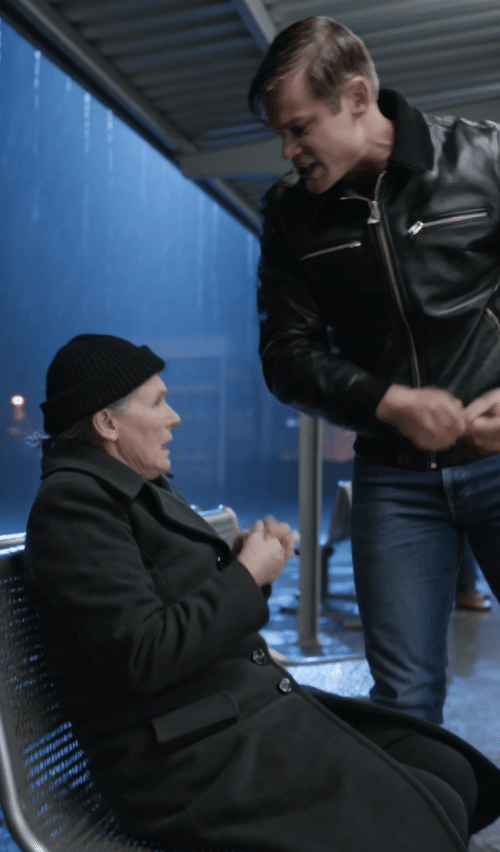
The young man snatched the watch from the old man’s wrist and held it above his head, grinning as the seventy-seven-year-old reached desperately for it.
“Please,” the old man whispered. “Give it back.”
Rain poured through a leaking metal roof at the American bus terminal, dripping onto the cold waiting bench and spreading across the concrete floor. Under dim blue lights, distant passengers watched from behind their bags, uncertain whether they were witnessing a robbery or another ugly confrontation that would end as quickly as it had begun.
The old man wore a dark, threadbare coat and a black knit cap pulled low over his silver hair. His name was Walter Hayes, and he had learned to make himself almost invisible in public. He slept wherever he could find shelter, carried his few possessions in a battered canvas bag, and avoided looking people in the eye because he had grown accustomed to seeing contempt there.
But the watch was different.
It was old, scratched, and worth very little at a pawnshop. Its leather strap had been repaired twice, and the glass carried a thin mark near the edge. To anyone else, it was a worn object that might buy a few dollars.
To Walter, it was the last thing he had left from his wife.
The man holding it was thirty-four-year-old Blake Turner, a broad-shouldered stranger in a black leather jacket. He had noticed the watch while Walter sat on the bench, turning it gently between his fingers to check whether it was still working.
Blake had assumed it could be sold.
He had not asked permission. He had simply grabbed Walter’s wrist, twisted the watch free, and stepped back with a predatory smile.
Walter tried to stand.
“Please. It was my wife’s…”
Blake looked down at him as though the explanation had made the situation more amusing.
“Trash. Dead memories don’t need watches.”
Walter froze.
The words struck somewhere deeper than the cold rain. He had heard people call him worthless before. He had been told to move along, to stop sleeping near shop entrances, to keep his belongings out of sight. He had endured those things because he knew how he looked and understood that many people preferred not to think about the lives of those who had fallen through the cracks.
But no one had ever mocked the woman he had buried.
Walter reached for the watch again.
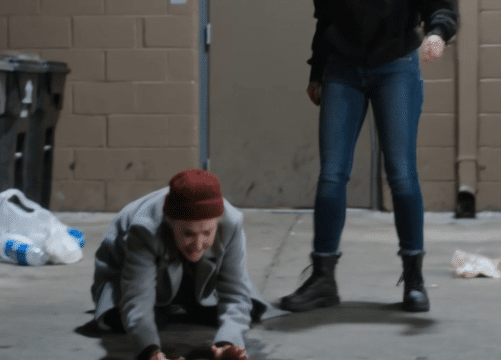
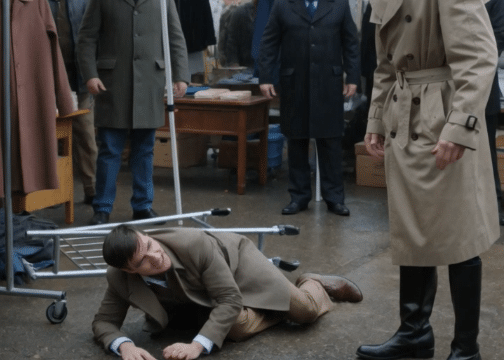
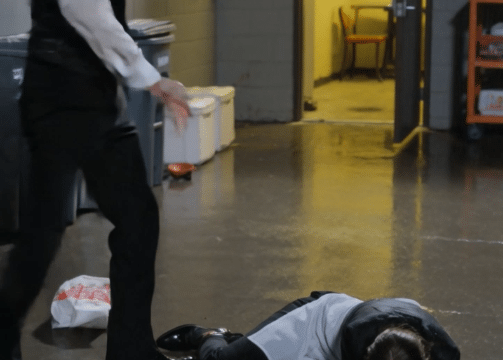
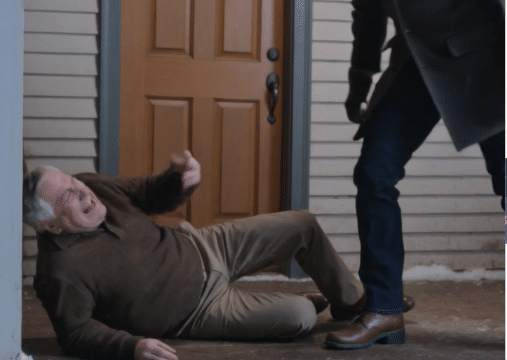
Blake’s expression hardened. He drove a forceful kick into Walter’s chest, knocking the old man backward off the bench and onto the wet terminal floor.
Walter’s knit cap flew from his head. His shoulder struck the concrete, and his elbow hit the metal leg of the bench, leaving a thin trace of blood where the skin scraped. He curled instinctively around the pain, gasping for breath as rainwater soaked through his coat.
Yet his hand kept reaching toward the watch.
Blake stepped away just enough to keep it beyond his grasp.
Walter’s face tightened with pain. His fingers trembled against the wet floor.
“Please,” he tried again. “That was all she left me.”
Blake glanced at the watch, then back at the old man.
He seemed offended that Walter still cared.
He delivered two more forceful kicks into Walter’s back and side while keeping the stolen watch in one hand. Walter recoiled with each impact, curling tighter and struggling to breathe. His face showed pain, fear, and the humiliation of being hurt in front of strangers who seemed afraid to move.
Several passengers gasped.
A woman standing near a ticket machine covered her mouth. A man with a suitcase stepped backward until his shoulders touched a pillar. An older traveler stared at the floor, unable to look directly at what was happening.
Nobody approached Walter.
Blake stood over him, the watch dangling from his fingers.
“Cry over something valuable.”
Walter’s eyes remained fixed on the little silver case.
He was no longer thinking about money, shelter, or the cold. He was seeing a small kitchen years earlier, sunlight coming through a window, and his wife sitting across from him with a watchmaker’s box open on the table.
He could almost hear her laugh.
Then a sharp engine noise cut through the rain.
A black classic car braked hard beside the terminal entrance. Its polished body gleamed beneath the blue lights, and its tires sent a sheet of water across the curb. The driver’s door opened, and an elderly man in a long brown coat stepped into the rain, followed by a formally dressed assistant.
The newcomer was Charles Whitmore, a renowned collector whose name appeared in museum catalogs and at auctions around the world. His collection included historic watches, rare clocks, and personal artifacts whose value came not only from their craftsmanship but from the stories they carried.
He had been on his way to a private appointment when his driver spotted the commotion near the terminal.
Charles took only a few steps before his attention locked onto the watch in Blake’s hand.
He stopped.
Then he moved quickly toward Walter, placing himself between the injured widower and the man who had attacked him. His assistant immediately knelt nearby, ready to help Walter without crowding the responders who would soon be called.
Charles looked directly at Blake.
“Return that watch to him right now.”
The terminal fell silent.
Blake stared at the stranger, still gripping the watch. He had no idea why a man arriving in a classic car would care about a homeless widower’s possessions.
But something in the collector’s face suggested that the watch was far more important than Blake understood.
Blake lifted his chin, trying to recover his swagger.
“Who are you to order me around?”
And for the first time that night, the man holding the stolen watch seemed less certain that he controlled what happened next.
Act II
Walter Hayes had once owned a small house with a white porch, a vegetable garden, and a kitchen window that rattled whenever the wind came from the north.
He and his wife, Margaret, had lived there for nearly forty years.
They were not wealthy. Walter repaired heating systems for a local maintenance company, while Margaret worked in a school cafeteria before arthritis forced her to retire. They measured their lives in practical things: the mortgage payment that arrived on time, the roof that needed patching, the birthdays they celebrated with homemade cakes, and the long walks they took after dinner when the weather was good.
Margaret had a habit of checking the time on Walter’s wrist before they left the house.
“You’re always five minutes behind,” she would tease.
“I’m not behind,” he would reply. “I’m giving everyone else a head start.”
She had bought him the watch for their thirtieth wedding anniversary. It wasn’t an extravagant gift. She had saved a little money each week and found it at a small jewelry shop that repaired older timepieces. She chose it because Walter admired the clean face and sturdy metal case.
When she gave it to him, she fastened it around his wrist herself.
“Now you’ll have no excuse for being late,” she said.
Walter wore it every day afterward.
When Margaret became ill, the watch accompanied him to hospital waiting rooms and pharmacy counters. He checked it while sitting beside her bed through the long nights when machines hummed softly and the nurses spoke in quiet voices.
The final time he looked at it while she was alive, she was asleep beneath a thin hospital blanket.
He remembered the second hand moving.
He remembered holding her fingers.
And he remembered promising that he would be all right.
After Margaret died, Walter discovered that grief could make a familiar house feel like an unfamiliar place. Her slippers remained beside the bed. Her favorite mug sat in the kitchen cabinet. A half-finished knitting project stayed in a basket near the living room chair.
He could not bring himself to move any of it.
Then the bills began to gather.
The company where Walter had worked for decades had closed its local branch. His retirement income was smaller than he had expected, and a series of medical expenses consumed the savings he had put aside. When he fell behind on the mortgage, he tried to recover by taking temporary work, but his age and worsening health made regular employment difficult.
The house was eventually sold to settle the debt.
Walter told himself he would find a room and start over.
For a while, he managed. He rented a small room above a laundromat and took whatever short-term work he could find. But when the building changed owners and the rent increased, he fell behind again. One missed payment became two, and soon he was carrying his belongings in the same canvas bag he had once used for weekend trips with Margaret.
He never sold her watch.
He sold his television first. Then the extra tools in his old toolbox. He parted with a radio, a set of fishing rods, and a collection of books Margaret had bought him over the years.
Every sale felt like surrendering a small piece of his former life.
But the watch remained.
It was not valuable enough to rescue him from homelessness. Even at its best, it would have paid only a fraction of what he needed. He knew that. He had been offered money for it before, and each time he had refused.
He could lose the house. He could lose his bed. He could lose the small comforts that had once made his life feel ordinary.
He could not willingly sell the last object Margaret had fastened to his wrist.
That night, he had been waiting for a late bus to a shelter on the other side of town. The weather had turned bitter, and the terminal offered some protection from the rain. He sat on the cold bench with his hands folded, occasionally turning the watch over to make sure the strap had not loosened.
He had been watching the second hand when Blake approached.
The theft happened so quickly that Walter barely understood what was happening until the watch was already gone.
Now he lay on the wet floor while Charles Whitmore stood between him and the thief.
Charles’s assistant took off her own coat and folded it beneath Walter’s head, careful not to move him unnecessarily. She asked whether he could breathe comfortably and whether he felt dizzy. Walter answered in short, strained phrases.
Charles remained close.
“Help is coming,” he told him. “You don’t need to reach for anything right now.”
Walter tried to point toward Blake.
“The watch.”
“I see it.”
“Please don’t let him take it.”
Charles looked at the watch again.
“I won’t.”
There was no grand promise, no attempt to impress the people watching. He said it with the steadiness of a man who understood that the most important thing in that moment was not the object itself but the person who had been hurt trying to keep it.
Blake shifted his weight.
“It’s an old watch,” he said. “He probably found it somewhere.”
Walter’s eyes widened.
“No. My wife gave it to me.”
Blake rolled his eyes.
“Sure she did.”
Charles turned toward him.
“You have no idea what that object means to him.”
“I know what it could be worth.”
“That isn’t the same thing.”
Blake laughed, but the sound came out thinly. He looked around, perhaps expecting someone to agree with him. The passengers remained silent, their attention fixed on the confrontation.
Charles’s assistant called emergency services and reported the assault. She also asked terminal staff to preserve any available security footage. A supervisor emerged from a nearby office, looking startled by the presence of the classic car and the cluster of passengers.
Charles gave him a brief explanation and asked that no one disturb the scene.
The supervisor immediately began cooperating.
Blake’s expression changed when he realized that the people around him were no longer treating the incident as a private argument.
“You people are making a huge deal out of nothing,” he muttered.
Charles looked at him.
“A man is lying on the floor because you wanted something he owned.”
Blake lifted the watch again.
“Then maybe he shouldn’t carry things he can’t protect.”
The words landed in the terminal like a slap.
Walter shut his eyes.
He had spent years trying to survive without making himself a burden. He had apologized when strangers stepped around him, moved away from warm entrances when asked, and swallowed his anger when people treated his existence as an inconvenience.
Now, even after being attacked, he was being told that the crime was his own fault.
Charles’s expression grew still.
He had spent decades studying objects whose owners had been separated from them by wars, disasters, theft, and death. He knew that the smallest artifact could carry a lifetime inside it.
And as he studied the watch, he began to recognize details that Blake could not possibly have understood.
The worn case.
The unusual shape of the crown.
The faint engraving near the clasp.
Charles looked at Walter.
“Sir,” he asked carefully, “did your wife ever tell you where she bought this watch?”
Walter swallowed.
“She said it was from a little shop. She saved up for it. I don’t remember the name.”
Charles glanced at the engraving again.
He did not explain what he had noticed.
Not yet.
Because before he could tell Walter why the watch had caught his attention, he needed to make sure the man who had stolen it understood that it would not leave the terminal in his pocket.
Act III
Charles Whitmore had spent most of his adult life collecting objects that other people underestimated.
He had purchased broken clocks that later proved to contain rare movements. He had rescued neglected family archives from estate sales and helped museums identify artifacts that had sat unidentified in storage for generations. His reputation had been built on patience, research, and an unusual ability to remember the details of objects he had encountered years earlier.
But his interest in the watch at the bus terminal was not simply professional.
The engraving on the clasp had caught his eye because he had seen it before.
Nearly twenty years earlier, Charles had acquired the remaining records of a small American watchmaker whose workshop had closed after its founder died. The collection included sketches, repair ledgers, correspondence, and photographs of unusual commissions made during the shop’s final decades.
Among the records was a watch with a distinctive case and an engraving made by hand.
Charles had never forgotten it.
The watch had belonged to a woman named Margaret Hayes.
He remembered the name because the old workshop’s owner had written about her in a letter. Margaret had ordered the watch as an anniversary gift for her husband, explaining that he had spent his life repairing other people’s heating systems and rarely bought anything for himself.
The watchmaker had taken particular care with the commission. The case was made from a limited batch of metal, and the movement had been adjusted by hand. Inside the back cover, he had engraved a short dedication.
The piece was not one of the world’s most expensive watches. Its market value had always been modest compared with the masterpieces Charles collected.
But the surviving records made it unique.
Charles had once been asked whether he would purchase it if it ever appeared at auction. He had said he would be interested in studying it, although he had never expected to encounter it in person.
Now it sat in the hand of a man who had stolen it from an elderly widower on a rainy terminal floor.
Charles kept his expression controlled.
He did not want to make Walter’s situation more confusing by announcing a discovery before he could verify it. More importantly, he did not want Blake to mistake the watch’s possible rarity for the reason he should return it.
The watch belonged to Walter because Margaret had given it to him.
That was enough.
Charles turned to his assistant.
“Please contact my office. Ask them to locate the Hayes commission file and bring the relevant records to the terminal. Also, let the police know we have an identified item that may be connected to a documented collection.”
His assistant nodded and stepped away to make the call.
Blake caught the words.
“Collection?” he repeated.
Charles did not answer him.
Blake’s eyes moved from the watch to the collector’s coat, then to the classic car outside. The uncertainty on his face deepened.
He had assumed the watch was worth a few dollars. Now he was wondering whether he had stumbled across something more valuable.
He tightened his grip.
“How much is it worth?”
Charles looked at him.
“That’s not the question you should be asking.”
Blake tried to laugh.
“Everything has a price.”
“Not everything belongs to the person who wants to sell it.”
For the first time, Blake looked genuinely unsettled.
He had built his little scheme around an assumption: that Walter was poor enough to be powerless and that the watch was insignificant enough for no one to care. He had counted on the old man’s lack of money to make his own cruelty seem inconsequential.
But the collector had recognized the object.
And now the terminal staff were preserving the footage, the witnesses were being identified, and the police had been called.
Blake looked toward the exit.
A terminal security officer stood near the entrance, speaking quietly with the supervisor. Neither man had approached him yet, but both were watching the scene.
Charles noticed Blake’s glance.
“Stay where you are,” he said.
Blake bristled.
“I’m not going anywhere.”
“Then returning the watch should be easy.”
Charles extended his hand again.
Blake stared at it.
The silence stretched.
At last, he tried a different approach.
“Look, old man. I didn’t know it meant that much to you.”
Walter slowly opened his eyes.
“You knew I asked you to give it back.”
Blake ignored him and kept addressing Charles.
“I thought it was abandoned property. He was sitting here like he didn’t know what to do with it.”
“He was holding it on his own wrist,” Charles replied.
Blake’s mouth tightened.
He had no answer that could survive even the most casual examination.
The terminal supervisor approached with two security officers. One asked Blake to keep his hands visible while they waited for the responding officers. Blake objected, but the officers remained calm and repeated their instructions.
No one struck him. No one threatened to ruin his life. They simply prevented the confrontation from escalating and waited for the authorities to take over.
Charles crouched near Walter again.
“Can you tell me whether there’s an inscription inside the back cover?”
Walter nodded faintly.
“Margaret’s name. And our anniversary date.”
Charles felt a quiet certainty settle over him.
The assistant returned a few minutes later with a secure digital copy of the relevant records. Charles studied the photograph of the watchmaker’s original commission, then compared it with the object in Blake’s hand.
The case matched.
The engraving matched.
Even the small mark near the edge of the glass appeared in the workshop’s old repair photograph.
There was no need to turn the discovery into a spectacle. The records could be verified later by specialists, but the connection was compelling.
Charles looked down at Walter.
“Your wife’s watch may have a documented history,” he said. “A watchmaker recorded the commission when she purchased it.”
Walter stared at him.
“Why would anyone write that down?”
“Because the man who made it cared about his work. And because your wife gave him a reason to remember the order.”
Walter’s eyes filled with tears.
For years, he had believed that his wife’s gift had disappeared into an ordinary life that no one else would remember. Now a stranger was telling him that someone had recorded the story of how it came to exist.
Charles glanced toward Blake.
“But its history doesn’t change who owns it.”
The security officers remained near the thief. The witnesses were ready to speak. The watch was still in Blake’s hand.
And the truth was beginning to catch up with him.
Act IV
The responding officers arrived while the rain continued to strike the terminal roof.
They separated the people involved, spoke with the supervisor, and began gathering the information needed to document the assault. The security footage was preserved, and the witnesses who had seen Blake take the watch and kick Walter agreed to provide statements.
Blake’s confidence began to crumble as the questions became specific.
When had he first seen the watch?
Why had he taken it?
Why had he continued holding it after Walter asked for it back?
What had caused Walter to fall from the bench?
Blake attempted several explanations. He claimed Walter had offered to sell the watch, then said he had picked it up from the floor. When the witnesses contradicted him, he insisted that the entire confrontation had been exaggerated.
But the security recording showed the sequence clearly enough to undermine those claims.
The watch was on Walter’s wrist.
Blake took it.
Walter begged for its return.
Then Blake attacked him.
Charles gave the officers his account of what he had witnessed and explained the reason he believed the watch might be connected to the historical records in his collection. He did not claim ownership of it, and he did not ask the officers to treat Blake differently because of the watch’s potential significance.
The matter of the assault belonged to the authorities.
The ownership of the watch belonged to Walter.
And the watch itself needed to be handled carefully until its identity could be verified.
Blake seemed to understand, at last, that he could not talk his way out of every consequence.
He looked at Charles with open resentment.
“You’re doing all this over some homeless guy?”
Charles’s expression hardened.
“No. I’m doing this because you hurt a man and stole something that belonged to him.”
“He’s got nothing!”
Walter flinched at the words.
Charles stepped between them again.
“You don’t get to decide that.”
The officers instructed Blake to hand over the watch. After a moment of hesitation, he surrendered it. One officer documented the recovery while another arranged for it to be returned to Walter once the necessary details had been recorded.
Charles asked permission to inspect the clasp without removing it from the officer’s custody. The officer allowed him to point out the inscription, which matched the photograph in the historical record.
Walter watched every movement.
When the watch was finally placed back in his hands, he held it with both palms as though it might vanish if he loosened his fingers.
He ran his thumb over the worn case.
Then he pressed it against his chest.
“Margaret,” he whispered.
The name barely carried above the rain.
Charles turned away for a moment, giving the old man privacy.
The officers continued their work. Blake was not permitted to approach Walter, and the witnesses were escorted to a quieter area to provide their accounts. The terminal supervisor offered a dry room where Walter could wait for medical assistance without being exposed to the leaking roof.
Charles’s assistant remained with him until the responders had assessed his injuries. She brought a blanket from the terminal office and placed it around his shoulders. Walter was advised to receive further medical evaluation, given his age and the force of the assault.
He hesitated when the responders asked about payment.
Charles heard him.
“Please don’t worry about that right now,” the collector said. “Let them make sure you’re safe first.”
Walter looked at him with exhausted embarrassment.
“I don’t want charity.”
Charles nodded as though he understood the difference Walter was trying to protect.
“Then don’t think of it as charity. Think of it as making sure you get the care you need after someone hurt you.”
Walter had no strength left to argue.
The assistant arranged transportation for him to receive medical attention, and Charles made sure the terminal’s staff knew that Walter should not be left alone while those arrangements were made. He also asked his office to contact a local outreach organization that could help Walter explore safer housing options, but he left the decision to Walter rather than making promises on his behalf.
The old man had spent too many years watching other people make decisions about his life.
Charles did not intend to become another person who took control simply because he could.
Before Walter left, Charles sat beside him on the waiting bench.
“May I ask you something about your wife?” he said.
Walter looked at the watch.
“What would you like to know?”
“Did she ever tell you why she chose this particular one?”
A faint smile crossed Walter’s face.
“She said it looked like something that would last.”
He turned the watch carefully in his hands.
“She knew I was always fixing things for other people. She said I needed one thing that I wouldn’t have to repair myself.”
Charles smiled softly.
“Then she chose well.”
Walter looked at him.
“You said someone kept a record of it.”
“Yes. The original maker wrote down the details of the commission. I can arrange for a copy of the record to be given to you, once everything has been verified.”
Walter’s lips trembled.
“I thought the only person who remembered that day was me.”
Charles glanced at the watch.
“Your wife left more behind than you realized.”
For a long moment, Walter sat without speaking. The terminal lights reflected in the glass, and the rain beyond the windows had begun to soften.
He had arrived that evening trying to protect one memory.
He was leaving with the watch in his hands and the knowledge that the story behind it had survived somewhere beyond his own heart.
Blake, meanwhile, was facing the immediate consequences of the assault and theft. His statements had changed repeatedly, but the witnesses and footage provided a clear basis for the authorities to continue their investigation.
He could no longer dismiss Walter as a man whose word would not matter.
The collector had not needed to threaten him.
He had simply made sure the truth could not be ignored.
And the watch that Blake had believed was easy money had become the one object he wished he had never touched.
Act V
The first thing Walter noticed when he arrived at the clinic was how warm the room felt.
A nurse brought him a blanket and helped him settle into a chair while the medical staff evaluated his chest, back, and elbow. The scrape near his elbow required cleaning and a dressing, and the clinicians advised further observation because of the force of the assault and his age.
Walter answered their questions quietly.
He was accustomed to minimizing his discomfort. He had learned that asking for too much could make people impatient, and that admitting pain did not always mean anyone could help.
But the nurse did not rush him.
When he winced while shifting in his chair, she adjusted the blanket and asked whether he needed a moment before continuing.
That small kindness nearly undid him.
He sat with Margaret’s watch resting in his palm, turning it gently while the rain tapped against the clinic window.
The metal felt cold.
The strap was still worn, and the glass still carried the same fine scratch. Nothing about the object had changed.
Yet Walter could not stop thinking about what had happened in the terminal.
For a few terrible minutes, he had believed he would lose the last physical reminder of his wife to a stranger who considered him too insignificant to deserve mercy. He had watched Blake hold the watch above him while people stood nearby, afraid to intervene.
He had felt the helplessness of being old, homeless, and injured in a place where no one knew his name.
Then Charles Whitmore had stepped from a black classic car and ordered the watch returned.
Not because Walter was rich.
Not because he could offer anything in exchange.
Simply because it was his.
The next morning, Charles visited the clinic with his assistant. He brought a printed copy of the historical record from his collection, along with a photograph of the original watchmaker’s entry.
Walter read it slowly.
The document described Margaret’s commission in careful handwriting. It noted the anniversary date, the engraving, and a brief comment about the intended recipient: a hardworking husband who deserved something made to last.
Walter’s vision blurred before he reached the end.
He had not heard those words in decades.
He touched the paper with one finger.
“She told him about me.”
Charles sat across from him.
“She wanted him to understand why the watch mattered.”
Walter let out a shaky breath.
“She always did things like that. She could make an ordinary gift feel like it had a whole life inside it.”
“She understood something that collectors sometimes forget,” Charles said. “The value of an object isn’t always the price someone would pay for it.”
Walter looked down at the watch.
“Blake thought he could sell it.”
“Yes.”
“He thought I was nothing.”
Charles did not offer a quick reassurance. He knew that words could not erase what Walter had endured.
Instead, he said, “What he thought about you doesn’t determine who you are.”
Walter sat quietly with that.
For most of his life, he had believed that dignity came from the things a person managed to keep: a job, a home, a family, a place at the table. Losing those things had left him feeling as though he had lost the right to be seen as the man he once was.
But Margaret’s watch had remained with him through every loss.
It had accompanied him when he packed the house, when he sold his tools, when he spent his first night without a bed, and when he sat alone in the terminal listening to the rain.
It had not made him wealthy.
It had reminded him that he had been loved.
And that was something Blake had never understood.
Charles offered to arrange for the watch to be professionally examined and documented, at no cost to Walter. He explained that the surviving records could help establish its provenance and ensure that it would be recognized as the specific piece commissioned by Margaret.
Walter agreed, but only after Charles promised that the watch would remain his throughout the process.
“It’s not going into a display case,” Walter said.
Charles smiled.
“No. It’s going home with you.”
The investigation into the assault continued through the appropriate channels. The footage and witness accounts were reviewed, and the authorities handled the case without any special arrangement from Charles. The collector provided the historical documentation when requested, but he did not attempt to dictate the outcome.
Blake had wanted to turn the watch into quick money.
Instead, his attempt to take it had brought his own actions into the open.
There was no magical reversal in which Walter suddenly became wealthy or every hardship disappeared. He still needed a stable place to live, medical follow-up, and practical support. Charles helped connect him with a local outreach organization, and Walter chose to accept assistance with temporary accommodation while he considered longer-term options.
For the first time in a long while, he had a warm room where he could close the door and rest without worrying that someone would order him to leave before morning.
The watch sat beside his bed.
Each night, before turning off the light, Walter wound it carefully and listened to the faint mechanical movement beneath the case.
It was not perfectly accurate anymore. It occasionally lost a minute, and the strap needed replacing.
But Walter knew a watchmaker who could repair it without changing what made it his.
A few weeks later, Charles invited him to visit the small archive where the watchmaker’s records were kept. Walter arrived wearing a clean dark coat and carrying Margaret’s watch in a padded case.
He moved slowly, but his shoulders were straighter.
Charles showed him the original ledger, the workshop photograph, and the letter Margaret had written when she placed the order. The handwriting was neat and slightly slanted, familiar enough that Walter recognized the shape of her name before he could read the words.
He sat down.
For a long time, he simply looked at it.
Then he laughed softly through his tears.
“She always said I never listened when she told me something important.”
Charles waited.
Walter smiled at the letter.
“She was probably right.”
The two men spent the afternoon talking about Margaret. Walter told stories about the white porch, the kitchen window that rattled in the wind, and the way she used to tap the watch face when he pretended he had not heard her calling him to dinner.
Charles listened without checking the time.
When Walter finally prepared to leave, he fastened the watch around his wrist.
The strap had been repaired, and the glass had been cleaned, but the small scratch remained. Charles had insisted that the watchmaker preserve the marks that belonged to its history rather than make it look new.
Walter looked down at it.
For the first time in years, he felt that he had not merely survived the loss of his old life. He had carried something precious through it.
Outside, the rain had stopped.
Charles walked with him to the door and paused beside the black classic car.
“Take care of yourself, Walter.”
Walter nodded.
“I’ll try.”
Then, after a moment, he added, “Thank you for seeing me that night.”
Charles’s expression softened.
“I saw a man who needed help.”
Walter shook his head.
“No. You saw me.”
Charles did not answer immediately.
He understood what Walter meant. The old man was not thanking him for recognizing a rare watch or for making a few calls. He was thanking him for refusing to look through him as though he were part of the wet floor, another inconvenience at a crowded terminal.
Charles reached out and shook his hand.
Walter walked away with the watch on his wrist.
It was still old. It was still scratched. It was still worth far less on the open market than the finest pieces in Charles Whitmore’s collection.
But its value had never been the money someone could make from it.
It was the sound of Margaret laughing when Walter arrived five minutes late. It was the warmth of her fingers as she fastened the strap. It was every ordinary day they had shared before illness, debt, and grief changed his life.
Blake had seen an object he could sell.
Charles had seen a history worth preserving.
And Walter had carried the truth all along.
The last thing his wife left him was not simply a watch.
It was proof that someone had loved him, and that love did not become worthless just because the world stopped treating him as valuable.
For all his money, Blake had failed to understand the simplest thing in that terminal.
Some things are precious because they cannot be replaced.
And some people deserve to be protected long before anyone discovers what they are holding.