Act I
“That’s my science project.”
Nia’s voice was quiet, but it stopped the room.
She stood in the doorway of the dining room, still wearing the cream-white top and black trousers she had put on for school that morning. Her backpack hung from one shoulder. A few loose curls had escaped her low ponytail, and the strap of her bag slipped slowly down her arm as she stared at the dining table.
There, beneath the warm afternoon sunlight, sat the science model she had spent weeks building.
Every component was familiar. Every carefully connected piece reminded her of the evenings she had spent studying diagrams, testing measurements, and starting over whenever something failed. She remembered the tiny adjustments that had taken hours and the moment the entire structure finally worked exactly as she had imagined.
She had been proud of it.
Now her stepmother was standing beside the table, pressing a new nameplate onto the finished model.
AVA.
Nia looked at the name, then at the woman attaching it.
Her stepmother, dressed in a fitted black V-neck dress with a delicate gold necklace resting against her collarbone, worked with the calm precision of someone arranging a centerpiece before guests arrived. Her glossy black bob framed a face that showed no embarrassment, no hesitation, and no indication that she understood she was doing anything wrong.
“It will represent this family better with Ava’s name,” she said.
For a moment, Nia wondered whether she had misunderstood what she was seeing.
Perhaps the nameplate belonged somewhere else. Perhaps there was an explanation she had not heard. Perhaps her stepmother would look up, recognize her expression, and admit that the whole thing was a mistake.
But the woman merely smoothed the label down with her fingertips.
Nia stepped closer.
“I built all of it.”
Her stepmother finally looked at her. The glance was brief, almost impatient, as if Nia had interrupted an important conversation rather than discovered someone claiming ownership of her work.
“You made a school project,” the woman replied. “Ava can turn it into something people respect.”
The words landed harder than Nia expected.
She had spent nights hunched over the dining table, researching the science behind the model while the rest of the house settled into sleep. She had filled notebook pages with sketches, crossed out incorrect calculations, and carefully recorded each adjustment.
There had been no shortcuts. No one had handed her the finished result.
And now the person standing in front of her was suggesting that her work only mattered if someone else put a name on it.
Nia reached for the model, intending to protect it. Her stepmother pulled it toward Ava’s side of the table before Nia could lift it.
The movement was small, but its meaning was unmistakable.
This was not a misunderstanding. Her stepmother had already decided whose achievement this would become.
Nia swallowed the words gathering in her throat. She refused to cry in front of the woman who had just treated weeks of effort as something disposable.
Then she heard footsteps approaching from the adjoining living room.
And before Nia could explain what had happened, the person her stepmother most needed to convince walked into the room.
Act II
Marcus had always believed that a family revealed its true character in the smallest moments.
He was a quiet, observant man, the kind who noticed when someone stopped speaking as soon as another person entered a room. He noticed misplaced objects, unfinished sentences, and the strange tension that sometimes appeared at the dinner table when everyone insisted everything was fine.
That afternoon, he noticed the silence first.
He entered the dining area in his dark-brown tailored suit, loosening his attention from whatever work had occupied him earlier. His eyes moved across the polished table, the school supplies, and the science model.
Then he saw the nameplate.
“Ava?”
He looked at the girl standing beside it, then at Nia.
“Why is Ava’s name on Nia’s project?”
His stepmother—or, more precisely, his wife—did not miss a beat.
“They worked on it together,” she said. “Nia agreed Ava should present it.”
The explanation came so quickly that Marcus barely had time to finish his question.
Nia looked at him.
She had spent much of her life learning how to make herself smaller in situations where speaking up seemed to create more trouble than staying quiet. She knew how to recognize the difference between being heard and merely being allowed to talk.
But Marcus was looking directly at her now, waiting for an answer.
She opened her mouth.
Before she could speak, her stepmother continued arranging the materials on the table. Her movements were casual, almost theatrical in their normality. She shifted a pencil, straightened a sheet of paper, and adjusted the model as if the discussion concerned nothing more important than whose turn it was to present at school.
Marcus did not look convinced.
He knew Nia had been working on the project for weeks. He had seen the notebook she carried from room to room, its pages crowded with sketches and handwritten notes. He had heard her explain the scientific principles behind the model during dinner, when excitement occasionally overcame her natural reserve.
He also knew Ava.
Ava was thirteen, with long natural curls and a black-and-white striped top that made her look even younger when she stood uncertainly beside the table. She was capable and bright, but Marcus had never heard her claim to have built this particular project.
Now she was staring at the model as if it had suddenly become something dangerous.
Her eyes moved from the replacement nameplate to Nia’s face.
“Mom, I didn’t make this,” Ava said.
The room changed.
Until that moment, Marcus had been listening to two competing versions of what he saw. Nia claimed the project was hers. His wife insisted the girls had worked together.
Ava’s words removed the convenient middle ground.
His wife turned toward her daughter.
“Then accept the advantage and stop being difficult.”
Ava’s shoulders tightened.
She did not reach for the model. She did not smile or pretend to be pleased by the attention. Instead, she stood with her hands at her sides, looking increasingly uncomfortable with the name that had been placed in front of her.
Marcus watched the exchange.
He had seen his wife push for appearances before. She cared about how the family looked to neighbors, colleagues, and the parents they encountered at school events. She liked accomplishments that could be displayed and stories that made the family appear unusually successful.
But this was different.
Ava was being offered recognition for something she openly said she had not done, while Nia was standing beside her own creation, struggling to explain why it had been taken from her.
Marcus turned back to his wife.
“Are you saying Nia agreed to this?”
“Yes,” she answered. “They discussed it.”
Nia finally spoke.
“She took it from my room.”
Nobody moved.
For the first time, her stepmother’s composure faltered—not enough to become an admission, but enough for Marcus to notice.
His gaze dropped to the table.
Beside the model lay several school supplies, a handwritten notebook, and a loose label that looked as though it had been removed from something.
The nameplate on the model was new. The one beneath it was missing.
And Marcus was beginning to understand that the question was no longer whether the girls had worked together.
It was why someone had gone to such lengths to make it appear that they had.
Act III
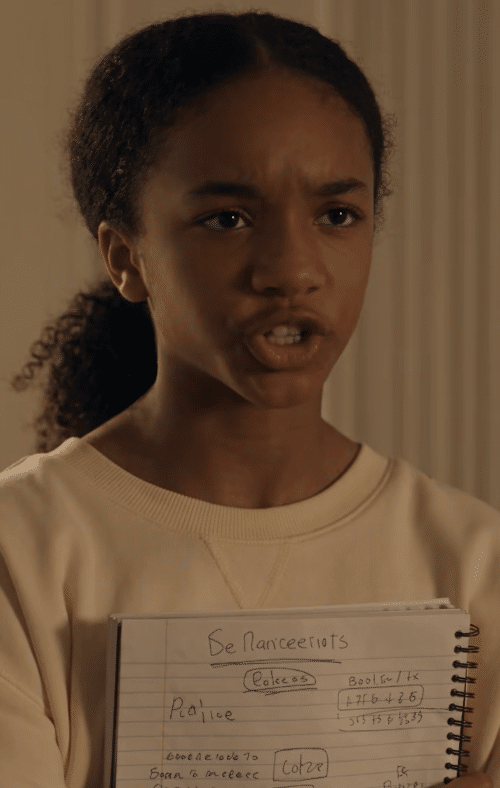
Nia reached for her research notebook.
She handled it carefully, even now. Its corners were bent from being carried in her backpack, and the cover had a faint crease from the afternoon she had accidentally left it beneath a stack of textbooks. A strip of tape reinforced the spine where it had begun to separate.
It was not an impressive object.
There was no expensive binding, no polished presentation, no decorative lettering. The notebook looked exactly like what it was: the working record of a student who had put time, patience, and thought into a project that mattered to her.
She opened it on the dining table.
The first pages contained rough sketches of the model, with arrows pointing to individual components and short notes explaining how they were supposed to work together. Later pages showed revised designs, calculations, and observations written in Nia’s distinctive handwriting.
Several entries were dated.
Some pages contained corrections. Others showed measurements that had been crossed out and recalculated. In the margins, Nia had recorded problems she encountered and changes she wanted to test the following day.
The notebook did not tell a polished story of effortless success.
It told the story of someone learning through mistakes.
Marcus leaned closer.
His wife glanced at the pages, then looked away.
Nia turned to another section, where she had documented the final stages of construction. The writing became more crowded near the end, as if she had been eager to record every detail before she forgot it.
“I wrote everything down,” Nia said.
Her voice was steadier now.
She was no longer asking the adults in the room to believe that the project was hers simply because she said so. She was showing them the evidence she had preserved throughout the process.
Her stepmother folded her arms.
“A notebook doesn’t prove anything,” she said.
The comment sounded dismissive, but it also revealed how quickly she had begun searching for a reason to discount what lay in front of them.
Marcus raised his eyes.
Before he could respond, Caleb appeared at the edge of the dining area.
At ten years old, he was accustomed to being overlooked when adults were talking. He had short curly hair, a black hoodie, and a habit of watching conversations long after everyone assumed he had stopped paying attention.
He had been quiet since Marcus entered the room.
Now he held up his phone.
“Nia recorded the whole build.”
Every face turned toward him.
Caleb had a habit of recording small family moments, especially when Nia worked on something complicated. At first, he had simply found it interesting to watch the model take shape. He liked seeing how a pile of disconnected pieces became a finished structure.
Over time, the recordings had become a kind of running record.
There were clips of Nia sorting components, comparing her sketches with the pieces in front of her, and making adjustments when something did not fit. There were recordings of her working at the table after school and checking her notes before returning to the model.
The footage was not dramatic.
There were no speeches about ambition or scenes of anyone congratulating her. There was only Nia, working through one stage after another, sometimes pausing to study a problem before continuing.
Caleb tapped the screen.
The first clip began.
Nia appeared at the table, arranging the model’s components beside an open notebook. The next recording showed her adding pieces to the structure. Another captured her checking a measurement against a handwritten diagram.
Then came a later stage, when the model was almost complete.
The camera angle shifted slightly as Caleb moved around the room, but the same person remained at the center of every recording.
Nia.
Building.
Testing.
Documenting.
Finishing.
Ava watched without speaking.
The discomfort on her face changed into something deeper. She was not merely embarrassed that someone had put her name on a project she had not made. She was watching the hours of another girl’s work unfold in front of her, realizing that the credit she had been offered had come at that girl’s expense.
She turned toward her mother.
Her stepmother did not look at her.
For the first time, the story about the girls working together had nothing to stand on. Nia’s notebook documented the process in her own handwriting, while Caleb’s footage independently showed her building the model from beginning to end.
Two separate records.
One unmistakable truth.
And still, the replacement nameplate remained attached to the finished project.
Ava stared at it for another moment.
Then she reached toward the model.
What she did next would leave no room for her mother to pretend that the problem was simply a misunderstanding between two sisters.
Act IV
Ava placed her fingers beneath the edge of the nameplate.
She hesitated.
It was her name printed there, clean and unmistakable. A name she had not asked to have attached to someone else’s work. A name that, only minutes earlier, her mother had insisted should replace Nia’s.
Now Ava could see the faint outline beneath it.
She carefully lifted the label.
The adhesive resisted for a moment before releasing. Ava pulled slowly, making sure she did not damage the model her mother had tried to make her claim.
Underneath was a clean rectangular outline, with traces of adhesive still visible along the edges.
The original nameplate had been attached there.
And it had been removed.
The discovery was small enough to fit beneath Ava’s fingertips, but it transformed everything that had happened in the room.
This was not a case of two girls casually sharing a project. It was not an innocent mix-up involving similar school assignments. Someone had removed the original label and deliberately placed a different name in its position.
Nia stared at the exposed adhesive marks.
She had suspected what happened as soon as she entered the dining room, but seeing the outline made the violation feel more real. Her name had not simply been overlooked. The space where it belonged had been cleared for someone else’s.
Ava held the removed nameplate away from the model.
“Mom removed Nia’s name while she was at school.”
Her voice trembled, but she did not take the words back.
The sentence hung over the table.
Marcus looked at Ava first. She was holding the label with an expression of disbelief that had gradually hardened into recognition. She had not participated in the deception. She had not even understood what her mother was attempting until the evidence appeared in front of her.
Then he looked at Nia’s notebook.
He saw the dated entries, the sketches, the corrections, and the careful record of the work. He remembered the evenings when Nia had occupied one end of the dining table, surrounded by supplies, concentrating so deeply that she sometimes failed to notice when someone entered the room.
He looked at Caleb’s phone.
The footage continued to show Nia assembling the model, piece by piece. Nothing about it resembled a shared project that had merely been presented under the wrong name.
Finally, Marcus looked at the model itself.
Its finished structure stood exactly where Nia had left it, apart from the label someone had placed over her own.
All the pieces of the story were now in front of him.
The evidence had not arrived through a dramatic confession or an argument about who deserved more attention. It had come from ordinary things that could not easily be explained away: a notebook, a series of recordings, a removed nameplate, and the visible marks left behind when someone tried to replace the truth with a more convenient version.
His wife stood on the opposite side of the table.
A moment earlier, she had controlled the conversation. She had decided which girl deserved recognition, dismissed Nia’s objection, pressured Ava to accept the credit, and supplied Marcus with an explanation before he could examine the facts.
Now nobody was following her version of events.
Ava was holding the label bearing her own name. Caleb’s phone displayed the record of Nia’s work. The notebook lay open beside the model, and the adhesive outline made the removal impossible to ignore.
Marcus’s expression changed.
It was not an explosion of anger. It was something colder and more deliberate, the look of a man who had asked a question expecting an explanation and discovered that the answer was much worse than he had imagined.
His wife shifted her weight.
For the first time since Nia had walked into the room, she seemed uncertain about what to say.
Marcus took one step toward her.
And the question he asked next stripped away the last excuse she had left.
Act V
“You stole her work to make your daughter look better?”
Marcus did not raise his voice.
He did not need to.
The accusation landed in the middle of the dining room, surrounded by the evidence his wife could no longer control.
She stared at him.
For several seconds, the only sounds were the faint movement of paper and the quiet hum of the house. Afternoon sunlight stretched across the polished table, illuminating the open notebook, Caleb’s phone, and the small rectangle of adhesive left exposed on the model.
His wife opened her mouth.
Nothing came out.
The confidence she had carried into the room was gone. Her carefully arranged explanation had collapsed under the weight of details she could not dismiss without contradicting what everyone had just seen.
Nia stood beside her project.
She had imagined many possible reactions when she first saw her name missing. She had imagined arguing until her voice broke, being told she was overreacting, or being expected to accept an apology that never quite acknowledged what had been done.
She had not imagined standing in a room where the evidence would speak more clearly than she could.
Her research notebook remained open to the pages documenting her work. Every sketch, correction, and dated observation was still there. Caleb’s recording continued to show the process that had brought the model into existence.
The project had never belonged to the person whose name was printed on the replacement label.
It had belonged to the girl who built it.
Ava lowered her hand.
She moved the removed nameplate away from the model, no longer willing to let it sit in the place where her mother’s decision had put it. She did not claim the project, and she did not attempt to soften the truth to protect herself from the discomfort of being caught in the middle.
She simply stood beside Nia, facing the reality of what had happened.
Caleb remained near the table, his phone still in his hand.
Marcus kept his eyes on his wife.
The woman who had insisted that Ava’s name would represent the family better now had to face the one person in the room who had asked her to explain herself—and the question she could not answer.
Her eyes widened slightly.
Her lips parted again.
Still, there was no explanation.
No denial that could survive the notebook.
No claim of shared effort that could survive the footage.
No innocent mistake that could account for the adhesive outline beneath the nameplate.
Only silence.
Nia looked down at the model she had spent weeks creating. For the first time since entering the dining room, she no longer needed to defend the fact that it was hers.
The truth was sitting on the table.
And across from her, her stepmother stood frozen, unable to answer the question that had finally exposed what she had done.
Hard cut.
Fix Marcus’s confusing family roleCut repeated evidence explanations