Act I: The Card on the Floor
Luxury hotels teach people to whisper.
The carpets absorb scandal. The lighting flatters liars. Even panic arrives dressed properly if the room is expensive enough. At Laurent House, our hallways were designed to make cruelty look discreet.
That night, cruelty lost control of its volume.
I heard the woman before I saw her.
“You were in his room!”
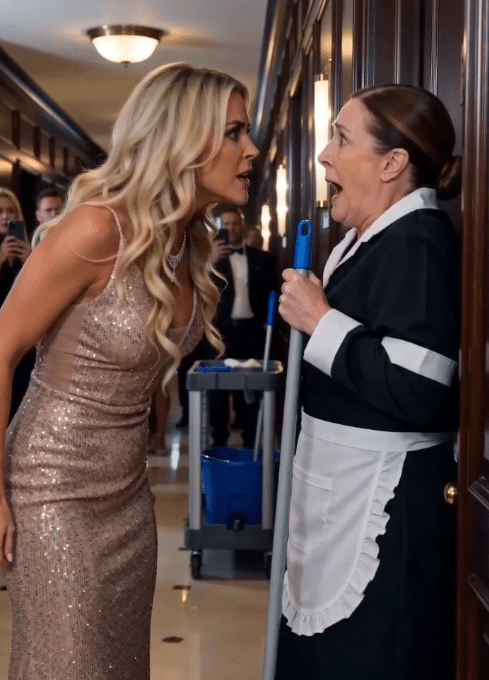
When I turned the corner into the west residential corridor, Celeste Vale had one of my housekeepers pinned against a dark wood door with both hands. Her champagne-colored cocktail dress caught the recessed lights like spilled gold. Diamonds flashed at her throat. Her face was white with fury.
Elena Ruiz looked half my age and entirely too frightened to be standing alone in that hallway.
She was pressed backward against the door, clutching a green broom like it might pass for protection. Her hair had started to come loose from its knot. She looked like she had already cried enough and knew it would do her no good.
“I… I was told to clean,” she stammered.
Around them, gala guests had spilled out from the ballroom at the end of the corridor, drawn by the sound the way wealthy people always are—outraged, delighted, careful not to intervene too quickly in case the humiliation is entertaining enough to justify itself. Some stood in tuxedos and silk gowns with their phones up. Others stared over champagne flutes with the bright, hungry quiet of people who know a public ruin is starting.
Celeste loosened her grip only enough to lean closer.
“Then why did you lock the door?”
Elena’s hand flew to her apron pockets.
She looked suddenly more panicked by that question than by the woman pinning her to the wall. Then she dropped the broom. It clattered across the marble. A blue hotel key card fell after it and skidded under the light.
The whole hallway heard it.
Plastic on stone.
Small sound.
Big consequence.
I stepped forward before anyone else did and crouched to pick it up. The card was warm from Elena’s body heat. A blue stripe ran across the top—wrong color for housekeeping access, wrong coding for guest rooms, wrong for anything that should have been in a maid’s apron at midnight.
Celeste saw my face change.
That was the moment her rage faltered.
Just for a second.
But enough.
“Well,” I said.
Every eye in the corridor shifted to the card in my hand.
I turned it over and read the embossed line under the magnetic strip.
NURSERY LEVEL — LEO LAURENT
The hallway stopped breathing.
Because Leo Laurent had been dead for two years.
At least, that was what the family told the press, the board, the courts, and everyone else who mattered after the yacht accident off Capri.
And if Elena Ruiz was carrying access to a nursery assigned to a dead child in the private family wing of my hotel, then the problem in front of me was no longer a jealous fiancée and a terrified maid.
It was a living heir.
Act II: The Child They Said the Sea Took
My name is Julian Mercer, and I had worked at Laurent House long enough to learn that old-money tragedies are rarely as clean as their obituary language.
The hotel had once been a palace.
That fact mattered too much to the family and too little to everyone else. Laurent House carried itself the way dynasties do—high ceilings, carved cornices, ancestral portraits in the private halls, and a staff trained to understand that discretion was not merely a policy. It was part of the architecture.
Adrian Laurent inherited the place after his father’s stroke.
He was younger than the board wanted and less obedient than his mother preferred. The papers called him modern, charming, philanthropic. Staff called him decent when he wasn’t trying too hard to sound like he didn’t need them to. He married Sofia Navarro three years after taking control, and for a little while the family looked almost normal from the outside.
Then came the yacht accident.
A summer storm.
A broken radio.
One lifeboat.
Too much press.
Sofia’s body was recovered near dawn. Their son Leo—five years old, solemn, obsessed with train schedules and sea monsters—was listed missing and presumed dead after two weeks of searching. The funeral was private. The board shifted. Adrian vanished from public view for months.
When he returned, he returned thinner, colder, and with Celeste Vale standing half a step behind him in almost every room.
Celeste was not old aristocracy. She was something worse.
Adjacency.
Her late father financed port acquisitions for families like the Laurents and taught his daughter early that one generation of money is never enough unless it marries the right old one. She moved through the hotel like a woman measuring drapes she expected soon to own. Staff learned to smile and lower their eyes when she passed because she always seemed to arrive with some complaint already loaded.
The accident changed the inheritance.
That was the part no one outside the family discussed in the open, but everyone in management understood. Leo had been primary beneficiary under the family trust. If he died, voting control consolidated back through Adrian and, through him, through Evelyn Laurent’s branch influence until a future child or marriage arrangement shifted it again.
Leo’s death did not just devastate a father.
It simplified a board.
I remembered that the second I read the blue card.
Nursery Level.
Leo Laurent.
That card should not have existed anymore. The nursery wing had been sealed after the funeral and converted, officially, into storage for heritage textiles and unlisted archives. The staff directory marked it inactive. The access system had supposedly been scrubbed after the accident.
Apparently not.
I stood in the hallway with the card in my hand and looked at Elena.
She was crying now, but in that stunned, silent way people do when the truth has arrived too quickly to sort fear from vindication. Celeste had taken one step back. Her expression was not guilt exactly. Guilt belongs to people with intact moral nerves. What I saw in her face was calculation collapsing.
“What room were you in?” I asked Elena.
She swallowed.
“Seventeen-oh-three.”
There was a collective murmur behind us. Guests knew that number. Everyone on the gala invitation list knew it, because 1703 had once been the family residence suite on the private floor. Closed to bookings. Closed to tours. Closed to inquiry.
The door at Elena’s back was 1705.
Storage, officially.
Celeste found her voice first.
“This is absurd,” she said. “She stole that card.”
No one answered her immediately.
I think we all understood at the same moment that the real question was not whether Elena stole it. The real question was what she had seen in 1703 that made Celeste choose public humiliation over a quieter solution.
I turned toward the crowd.
“Phones down,” I said.
Not because I wanted secrecy.
Because if Leo Laurent was alive and trapped somewhere behind those doors, the last thing I wanted was his face entering the world through gossip before he had a chance to enter it through truth.
Some complied. Some didn’t. Enough did.
I looked back at Elena.
“What was in the room?”
She shut her eyes once, and when she opened them, I saw something far more dangerous than fear.
Resolve.
“A little boy,” she whispered. “And he knew her name.”
Then she pointed straight at Celeste Vale.
Act III: The Boy Behind the Wallpaper Door
It happened fast after that.
Not because wealthy people move quickly when justice is at stake. They usually don’t. They move quickly when exposure is at stake. The difference matters. One is moral. The other is practical.
Celeste lunged for Elena before anyone else reacted.
I caught her by the wrist.
That earned me a look from her I will not forget—a pure, glittering hatred made ugly by the fact that it had been interrupted rather than challenged. She did not scream. She hissed.
“You have no idea what you’re doing.”
Maybe not.
But I knew enough.
I handed the blue card to our head of security, Tomas, who had just arrived from the ballroom stairs with two plainclothes officers hired for the gala. Tomas had worked the private corridors with me for six years and possessed the rare gift of treating rich women in diamonds exactly the way he treated drunk groomsmen in linen suits: as logistics if necessary, as liabilities if proven.
“Seal the floor,” I said. “Now.”
He didn’t ask why.
That was another reason I trusted him.
Elena took a breath like someone about to jump into winter water.
“She was already in the room when I came with the cart,” she said. “The boy was crying. She told me to strip the bed and say nothing if anyone asked why the family wing lights were on.”
Celeste closed her eyes for one fraction of a second.
Enough.
“When I went into the nursery,” Elena continued, “he grabbed my apron and asked if his father was dead too.”
The hallway went silent again.
There are certain sentences that do not belong in expensive places. They sound too honest against marble. Too human. Too uncurated.
I looked at the door marked 1705.
Then at the hidden seam in the wood paneling beside it.
Not a door, exactly. More like the outline of one.
The old nursery wing had always been rumored to include a service passage from the original palace days, a concealed corridor meant for wet nurses and governesses to move unseen between family rooms. I had never found the release panel.
The blue card did.
It opened a lock behind the paneling with a soft electronic click.
The guests behind us gasped like a single organism. Even Celeste looked briefly toward the opening with something dangerously close to dread. That was when I understood she had expected scandal, yes. But not discovery. Not tonight. Not in the hallway. Not by a maid with trembling hands and a conscience inconvenient enough to keep the wrong card.
The hidden door swung inward.
Warm light spilled out.
So did the smell of children’s shampoo, medicine, and the stale closed-air scent of rooms kept too neat for too long.
A little boy stood in the doorway.
He wore pale blue pajamas and held a stuffed fox by one ear. His hair was darker than I remembered from photographs, but his face—
God.
No sea could have altered those eyes.
Leo Laurent looked from me to the crowd and then, instinctively, to Elena, as if he had already decided she was the safest adult in the room.
“Did she go away?” he asked.
No one answered.
Not because we didn’t know what to say. Because the dead child had just walked out of the wall.
Act IV: The Woman Who Needed Him Missing
Adrian Laurent arrived thirty seconds later, still in his black dinner jacket, with half the ballroom following him and the other half pretending not to.
Someone must have whispered enough of the truth downstairs to pull him from the receiving line. He crossed the corridor fast, expression hard with annoyance first, then confusion, then something I can only describe as the soundless collapse of a man watching his grief stand up in front of him.
Leo saw him and did not move.
That, more than anything, told me how long the child had been hidden.
A five-year-old who thinks he is dead in his father’s life does not run on instinct. He waits to see whether the adult in the doorway is memory, ghost, or danger.
“Leo?” Adrian said.
The boy’s little fingers tightened around the stuffed fox.
Then he whispered, “Papa?”
I have managed high-profile deaths, board feuds, political fundraisers, celebrity overdoses, and one discreet kidnapping on the upper terrace in my years at Laurent House. Nothing I’ve ever seen looked as private and devastating as Adrian’s face in that second.
He crossed the distance in three strides and dropped to his knees on the marble.
Leo went into his arms like a body remembering home.
Around them, the corridor broke into noise—guests, staff, security, one old countess crying openly against her husband’s sleeve, Tomas barking orders into his earpiece, someone from the board demanding to know what the hell was happening.
Celeste did the only thing left available to her.
She lied.
“He was ill,” she said quickly. “You weren’t stable, Adrian. Your mother and I protected him until the board could decide—”
Adrian rose slowly, still holding Leo against his shoulder.
“Until the board could decide what?”
She faltered.
That was fatal.
Because once a lie begins to improvise, hierarchy leaves the room. Guests knew it. Staff knew it. Even Leo knew it in the small animal way children know which adults have stopped controlling the weather.
The truth came not from Celeste, but from Evelyn Laurent.
She had arrived silently, and somehow that felt worse than Celeste’s shouting. She stood at the far end of the corridor in dark silk and pearls, the widow-matriarch version of consequence, as if she had always intended to step in precisely when things became too real for amateurs.
“You were not fit to keep him,” she said to her son.
No one spoke.
Not because she was right.
Because the clarity of her cruelty stunned the hallway into stillness.
Evelyn continued, as if discussing a temporary trust disbursement rather than a living child.
“You were sedated, unstable, and impossible after Sofia died. The board required continuity. Leo’s existence complicated the succession at a vulnerable time. It was safer to let the world believe what the sea had nearly accomplished.”
There it was.
Not grief.
Not protection.
Not a tragic misunderstanding stretched too far.
An estate calculation.
A mother had looked at her son’s surviving child and weighed him against board stability and preferred outcome. A fiancée had helped. Staff had been chosen carefully. Records altered. Floors sealed. Lights kept low. A living heir converted into a private inconvenience and stored in the hotel his father still ran without ever being allowed to know.
Adrian looked at his mother as though the room itself had become unreliable.
“You hid my son,” he said.
Evelyn met his gaze without flinching.
“I preserved this family.”
The boy in his arms lifted his head then.
“Am I family?”
That sentence, spoken in a child’s quiet, cut the hallway cleaner than any accusation.
And for the first time all night, Evelyn Laurent looked as if she might understand that she had not merely lost control of a scandal.
She had lost the right to narrate it.
Act V: The Floor That Stopped Belonging to Them
By midnight, the board was in emergency session.
That phrase sounds powerful until you’ve seen one up close. It means old men sweating into expensive collars, family lawyers pretending their pens are steady, and donors suddenly eager to discover they had always favored transparency. It means the illusion of permanence taking notes while security stands at the doors.
Leo slept in the doctor’s suite with Elena beside him because he refused every other face.
That mattered to me.
Children under coercive care reveal truth faster than any forensic interview ever will. He trusted the maid who opened the hidden door. He recoiled from the women who had “protected” him. No board statement in the world could make those instincts disappear.
Adrian never went downstairs.
He stayed on the family floor, one room away from his son, reading through the sealed medical files, nanny logs, and staff contracts Tomas recovered from the nursery office. Sedation records under another name. Behavioral notes describing Leo as “resistant to transition.” One appalling schedule limiting his view of outside windows during major public events in case “recognition anxiety” caused distress.
Recognition anxiety.
They had turned missing a father into a diagnosis.
Celeste tried once more around eleven, asking for privacy, mercy, context, some human arrangement in which she could remain adjacent to power after helping bury its rightful heir in wallpaper and hush.
She approached me while I stood outside the doctor’s suite.
“I was doing what his mother asked,” she said.
I looked at her.
For a second, she almost passed for tragic.
Not because she was innocent. Because all truly selfish people become pitiable eventually once the structure around them stops reflecting their choices back as elegance. She had built herself around proximity to the Laurents so long that without them, she seemed thin, almost unfinished.
“Which mother?” I asked.
That ended it.
Because the answer was Evelyn, not Sofia. Convenience, not love. Calculation, not grief. The wrong mother had been served every time.
The board removed Evelyn before 1 a.m.
Not from family blood, of course. Rich families are rarely that brave. They removed her from trust administration, advisory authority, and all property discretion pending criminal and civil review. Celeste lost her engagement, her residence privileges, and the protection of being merely ornamental. Several staff were suspended. Two private physicians were named. One attorney vanished before morning and was later found in Geneva pretending not to understand his own passport.
As for Elena, the maid they tried to break against a hotel door and call disreputable before everyone, she got the first honest contract Laurent House had probably offered any woman in her position in years. Full salary. Full legal protection. Full whistleblower status. Adrian asked for it personally after Leo fell asleep with his hand wrapped in her apron and refused to let go.
Three weeks later, when the tabloids had exhausted the words hidden heir and palace wall and socialites moved on to other ruins, I watched Leo walk through the front lobby in daylight holding his father’s hand.
He paused beneath the chandeliers and looked up.
“Is this my house?”
Adrian crouched to answer him.
“It’s a hotel,” he said. “But part of it was always supposed to be yours.”
Leo considered that seriously, as children do.
Then he pointed toward the west corridor and asked whether Elena could come too.
She did.
Of course she did.
That, to me, is where the truth of the whole thing finally settled.
Not in the board minutes.
Not in the lawyers.
Not in the apology statements or the frozen accounts or the headlines that made old money look briefly mortal.
In the fact that the child they had hidden chose the maid they tried to disgrace as the one person he wanted beside him when the walls opened.
The blue key card still sits in my locked desk drawer downstairs.
I kept it not because it is evidence—though it was that too—but because it reminds me how the grandest lies often fail. Not from conscience. Not from strategy. From one frightened person dropping the wrong object onto the right floor in front of the wrong witnesses.
Celeste thought she was pinning a maid to a hotel door.
She was really holding shut the entrance to a life she and Evelyn had tried to erase.
And once the card hit the marble, the whole house had no choice but to remember its dead weren’t dead, its servants weren’t blind, and the floor beneath its luxury had always been built over a child waiting for someone decent enough to open the wall.