Act I: The Boy in the Grass
The party had gone soft around the edges by then.
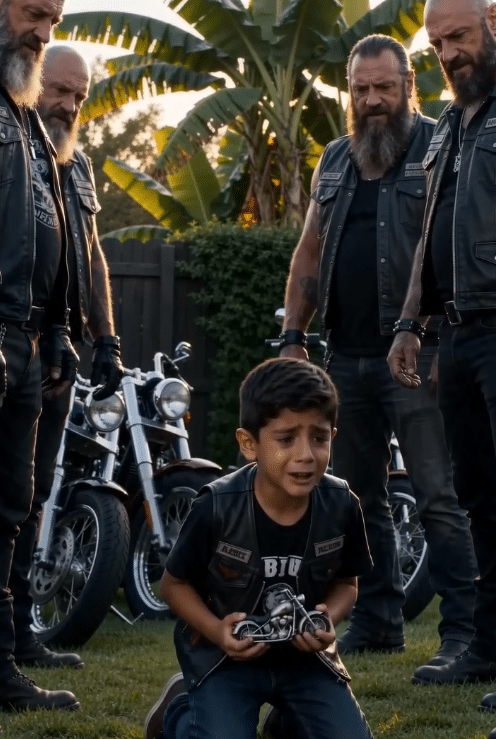
Beer bottles sweated in our hands. Old bikes cooled beside the fence with little metallic ticks. Somebody had a speaker playing classic rock too low to offend the neighbors and too loud for real conversation. It was one of those late-afternoon gatherings that looked rough from the outside and felt almost peaceful from within.
Then the kid came running through the side gate.
He couldn’t have been older than seven. Skinny. Dark-haired. Eyes swollen from crying. He wore a tiny black biker vest over a black T-shirt, the denim too big at the shoulders, like someone had made it for a future he hadn’t grown into yet.
He tripped in the grass before he reached us.
Dropped hard to both knees.
But he never let go of what he was carrying.
“Please, sir!” he cried. “Please buy it!”
A few of the guys laughed at first. Not because it was funny. Because a child showing up in the middle of a backyard full of patched men with a toy motorcycle in his hands is the kind of sight the brain resists for half a second before it understands it.
He held the model up toward me with both hands.
Silver. Hand-built. Heavy enough not to be plastic. Every line of it too careful for a child’s toy and too personal for store-bought work. It was a miniature chopper with a long front fork, tiny wire spokes, and an engine block detailed by someone who knew motorcycles with the intimacy of religion.
“What is this, kid?” I asked.
He looked up at me with tears hanging off his lashes.
“It’s real,” he said. “My dad made it.”
That changed the air around the circle.
The men stopped smiling. Beer bottles lowered. Even the guys who hadn’t been paying much attention came closer when they heard the certainty in the boy’s voice. Children lie differently than adults. This wasn’t that. This was grief trying to sound useful.
I crouched in front of him and took the model carefully.
It was heavier than I expected.
Not just because of the metal. Because memory hit it first.
On the underside of the handlebars, almost invisible unless you knew where to look, was a tiny rain-mark carved into the steel. Three short slashes, one long. A signature hidden in the work. A joke from twenty years ago that turned into habit because one man I knew believed every machine should carry a trace of the hand that loved it.
I hadn’t seen that mark since the night Gabriel Navarro disappeared.
My throat tightened.
The boy wiped his nose with the back of his hand and said the next line like he had rehearsed it all morning.
“My dad… he won’t wake up.”
Nobody in that yard moved.
I looked at the model again. Then at the child.
“Why are you selling it?”
His mouth trembled.
“Because he said if he didn’t wake up, I should find you.”
The backyard seemed to tilt under me.
I already knew the answer before I asked, but I asked anyway.
“What’s your father’s name?”
The boy cried harder then, because saying it out loud must have made the whole thing feel real.
“Gabriel,” he said. “Gabriel Navarro.”
And just like that, a dead man was sitting in the center of our yard in the hands of his son.
But the real shock came when I turned the little bike over and found the fuel tank had been welded with a seam that shouldn’t have been there.
Act II: The Brother We Buried Without a Body
Gabriel Navarro had been my brother in every way that mattered except blood.
We grew up in the same county, got arrested in the same summer for the same stupid bar fight, and built motorcycles in a tin-roof garage long before any club patch found our backs. He was better with engines than anyone I’ve ever known. Better with children too, though he hid that under all the usual swagger.
The club called him Ghost because he moved quietly and left no mistakes behind.
Then one night eight years ago, the cash reserve for our garage expansion vanished, the land deed to our old clubhouse went missing with it, and Gabriel disappeared before sunrise. Same night. Same timing. Same empty space where trust used to be.
Deke Rains, our president then, called it what everyone else started calling it within a week.
Betrayal.
There had even been a fire at the old machine shed that same night. Nothing huge. Just enough damage to bury what couldn’t be explained cleanly. When a man vanishes beside stolen money and burned records, people stop asking for nuance and start asking who they should hate.
I hated Gabriel for a long time.
That’s the truth.
I hated him because he was the one person I would have trusted with keys, cash, my bike, and the code to my front gate. I hated him because disappearing is the cruelest confession a man can make when he leaves everyone else alive to sort the wreckage. And I hated him because some part of me never fully believed he’d done it, which made the anger harder to put down.
Now his son was kneeling in my grass.
My fingers found the false seam on the miniature gas tank and pressed where Gabriel used to hide spare ignition pins. The metal clicked. A tiny compartment opened under my thumb.
Inside was a key.
And a strip of folded paper.
I opened it with hands that no longer felt steady.
If Diego finds you, don’t call Deke.
Unit 19. Harbor Storage.
Bring no one who drinks my name like a curse.
For a second, the whole yard went silent enough that I could hear banana leaves brushing the fence in the wind.
The boy—Diego, apparently—watched my face too closely for his age.
“You know him,” he whispered.
I looked at him.
He had Gabriel’s eyes.
Not the color. The way they held on. The way grief and stubbornness sat side by side in them without asking permission.
“Where is your dad?”
“At home,” he said. “He’s breathing, but he won’t wake up. He fell down after the men came.”
That got the full attention of every patched man in the yard.
“What men?” I asked.
“I don’t know. They asked for the box. My dad told me if he couldn’t get up, I had to take the bike and find you.”
One of the brothers behind me muttered a curse.
I stood.
“Who brought you here?”
“I walked.”
He said it so simply it made several grown men look at the ground.
I pocketed the key, folded the note once, and handed my beer bottle to the nearest guy without looking.
“Get the truck,” I said.
Deke’s name was burning in my head already.
Not because I believed the note automatically. Because Gabriel knew exactly what he was doing when he wrote the one instruction most likely to split the room before anyone even reached his door.
And if he was right about Deke, then eight years of club history had just changed shape.
But first I needed to see whether Gabriel Navarro was really alive.
And if he was, I needed to know what kind of box men were willing to knock a father cold to find.
Act III: The House at the End of Orchard Lane
Gabriel lived in a rental at the far edge of Orchard Lane, just beyond the trailer park where the county stopped pretending the roads deserved proper lights. The porch sagged. The yard was mostly weeds. A rusted red bicycle lay on its side beside the steps, and one curtain in the front room had been torn half off its ring.
The front door was unlocked.
That never calms anyone.
I told the guys to stay outside with Diego while I went in first. He grabbed my sleeve before I could step through and pressed something else into my hand—a brass Saint Christopher medal on a chain.
“Dad said if you saw this, you’d know he wasn’t lying.”
I recognized that too.
I gave it to him twenty-three years ago after our first run down to Mexico, when a truck drifted across the line and nearly turned the whole ride into a funeral. Gabriel laughed at the medal when I handed it over. Then he wore it every day after.
Inside, the house smelled like cold coffee, rubbing alcohol, and fear.
Gabriel lay on the living-room floor on a folded blanket beside the couch, one arm bent under him wrong enough to tell me he had gone down fast. There was a bruise darkening near his temple, but no blood, nothing dramatic. That made it worse somehow. Real life often does. It leaves damage looking almost ordinary.
I dropped beside him and checked his pulse.
Fast, but there.
Breathing shallow.
One of the kitchen chairs had been overturned. Drawer contents were dumped across the table. The place had been searched in a hurry by people who expected to find something obvious and got angry when they didn’t.
I called 911 first.
Then I searched the room.
Not out of panic. Out of instinct. Men like Gabriel never left the real thing in the first place men would look. Not if they had enough warning to make the model bike and send his boy walking through town to find me.
The answer was in the couch.
One seam along the underside had been hand-restitched in black thread. I cut it open with my pocketknife and found a steel cash box wrapped in an old shop rag. Inside was a flash drive, a stack of title papers, three old photographs, and a cassette tape labeled in Gabriel’s handwriting:
FOR RAFE IF I’M TOO LATE
I stared at it for one long second.
Then the sirens started in the distance.
Gabriel made a sound behind me. Small. Not waking, not yet. Just proof that whatever had been done to him hadn’t quite won. I knelt again, slid one arm under his shoulders, and said his name once, low and furious and far too late.
His eyelids fluttered but didn’t open.
The EMTs were good. Better than this county usually deserves. They got him loaded quickly and asked efficient questions I answered without hearing my own voice. Diego sat in the back of my truck holding the little silver motorcycle in both hands while one of my guys told him his father was still here, still breathing, still fighting.
That was the easy part.
The hard part waited in the cassette tape.
Because if Gabriel had gone to the trouble of hiding evidence under his couch instead of taking it to the police, it meant he trusted me more than the law.
And that meant whatever was on the tape was going to name someone I had worn a patch beside for years.
Act IV: The Tape Under the Dash
We didn’t listen to it at the hospital.
Not with Diego there. Not with nurses moving in and out and every fluorescent hallway making secrets sound cheaper than they are. I waited until one of the doctors said Gabriel would live if the swelling stayed down and the boy had finally fallen asleep in a plastic chair with the toy bike in his lap.
Then I walked out to the truck and slid the cassette into the old deck I never bothered replacing.
Gabriel’s voice came through rougher than I remembered.
If you’re hearing this, I ran out of time.
No greeting. No apology. Classic Gabriel.
He said the missing money had been real, but he never stole it for himself. Deke did. Not all at once. Not in a single duffel bag. Slow siphoning over months through fake parts invoices and cash withdrawals tied to the land purchase. Gabriel found out because he did the garage books when nobody else wanted the job.
He confronted Deke the night of the shed fire.
Deke brought Sheriff Collier.
That name hit harder than Deke’s did, because Collier had been around our club for years pretending he only tolerated us for community peace while actually drinking our beer, running our charity rides, and dipping into our poker nights when it suited his reelection posters.
Gabriel kept talking.
The deed hadn’t just been stolen. It was being used to transfer the old clubhouse land to a shell company owned by a developer who planned to clear the whole block for storage condos and river-view rentals. The fire in the shed was to destroy the original records and blame Gabriel before he could hand the bookkeeping over to the rest of us.
He ran because Deke told him, plain as weather, that if he stayed, I’d be next.
That sat in the cab of my truck like a live thing.
All those years I thought he left me holding the humiliation while he saved himself.
Instead, he had disappeared to keep me alive long enough to learn who my president really was.
The flash drive from the box filled in the rest.
Bank statements. Audio clips. Title transfers. A video of Deke laughing in the garage office with Sheriff Collier about how “Rafe always did trust pretty easy when it looked like family.” Even now, writing that line, I can feel how cold it made me.
There was one more file.
A scanned birth certificate.
Diego Navarro.
Father: Gabriel Navarro.
Mother: Elena Ruiz.
Below it, in Gabriel’s notes, one line:
If I don’t make it back, ask Rafe to keep the boy away from the patch until he’s old enough to choose it.
I sat there with the truck off and the hospital lot lights buzzing overhead and understood three things at once.
Gabriel had not betrayed me.
Deke had built eight years of club loyalty on my anger.
And the little boy asleep inside with the silver motorcycle in his arms had just become my responsibility whether I felt ready or not.
When I went back in, Gabriel was awake.
Not fully. Not strong. But awake enough to see me standing in the doorway and say, through cracked lips and pain, the line I had waited eight years to hear.
“I never took it.”
I walked to the bed.
“I know.”
He closed his eyes then, and one tear slipped sideways into his hairline like it had been trapped there a long time.
But before he drifted off again, he gripped my wrist and whispered one last warning.
“Don’t bring it to the club,” he said. “Bring the club to it.”
Act V: The Patch I Took Back
We called an emergency chapter meeting at the old machine yard instead of the clubhouse.
That was deliberate.
Neutral ground. Open air. No hidden ledgers. No office walls Deke could lean against like ownership. Just concrete, floodlights, rusted tool benches, and every patched man in the county looking at me like they knew from my face this wasn’t about a medical update.
Deke arrived late.
Also deliberate.
He liked entrances when he thought they still belonged to him. Black vest. Black shirt. Calm expression. Sheriff Collier not far behind him with his thumbs hooked in his belt and his smile already half-loaded.
I set the little silver motorcycle on the workbench in the center of the yard.
That got the room quiet fast.
Even the men who never knew Gabriel personally recognized good work when they saw it. Deke looked at the model, then at me, and some part of him understood the shape of the evening before I even touched the truck bed.
I laid out the deed.
The bank statements.
The photos.
Then I hit play on the speaker and let Gabriel’s voice fill the yard.
No theatrics.
No yelling.
No speech from me first.
Just the dead man they’d spent eight years cursing, calmly telling them who robbed them and why.
You could feel belief changing hands around the circle. It’s not a clean process. Men don’t drop old loyalty in one graceful motion. They resist. They reinterpret. They go still. Then, piece by piece, the weight of truth rearranges where they stand.
Deke tried denial first.
Then outrage.
Then the old trick—claiming Gabriel had forged everything to crawl back into sympathy now that his life had gone nowhere. That might have worked five minutes longer if Collier hadn’t made his mistake.
He reached for the deed.
Not the flash drive.
Not the tape.
The deed.
The original thing he knew could still undo the land transfer if the county auditors got it before he could.
Two of the older patched members saw that and moved before I did. Not violently. Just enough. A hand on his wrist. Another on his shoulder. The kind of correction brotherhood should have given him years earlier.
By then state investigators were already on the road.
Not county. State. I sent the whole archive from the hospital parking lot before the meeting began, because I trusted Gabriel’s evidence more than my own anger. Sheriff Collier realized too late that his uniform no longer meant control in that yard. Deke realized too late that the men he counted on to protect the patch from scandal cared more about the patch than they did about protecting him.
They were taken out under floodlights with every brother watching.
No one said much after the cars left.
There are nights when a club becomes older in an hour than it did in the ten years before. That was one of them.
I brought Diego to the machine yard three days later.
Gabriel was still in the hospital, but he was sitting up and cursing the food, which was the most comforting thing I’d heard all week. The kid walked in wearing the same little black vest, clutching the silver motorcycle like it was both map and home.
The brothers went quiet when they saw him.
Not because of pity.
Respect.
That matters more.
I lifted him onto the workbench where the evidence had sat and handed him the tiny bike back. He looked at me with all the wary hope a child can hold without breaking under it.
“Did you sell it?” he asked.
“No,” I said.
He waited.
Then I told him the truth.
“Your dad built it to get you to me. That makes it worth more than anything I could’ve bought.”
He nodded as though that made perfect sense.
Maybe it did.
A week later, Gabriel asked me from his hospital bed if I was still angry.
I told him yes.
He laughed once and winced for his trouble.
Then I told him something else.
“I was angry at the wrong man.”
That seemed to settle deeper in him than any apology could have.
People always think betrayal is the worst thing a brother can do.
Sometimes it’s silence.
Sometimes it’s leaving.
Sometimes it’s letting another man tell your story for so long that even your closest people start repeating it like fact.
But sometimes, if luck breaks your way for once, a little boy crashes into the center of your life carrying a tiny silver motorcycle and asks you to look again.
And if you do, really do, the whole lie starts rattling loose from the inside.