Act I: The Ball in the Road
The road was so narrow that my driver had to slow every time the wind pushed the hay too far over the shoulder.
It was late afternoon, the kind of golden hour people in cities romanticize and people in the countryside barely notice. Wheat bent in soft waves under the breeze, and the white SUV moved through it like something too polished for the landscape.
Then the ball hit the side of the car.
A dull thud.
Not violent enough to matter. Just sharp enough to break the silence inside the vehicle and make my driver glance into the mirror. I looked up from the file in my lap and saw a boy standing at the edge of the road, frozen beside a field where other children had already stopped playing.
My driver braked.
I told myself I was only stepping out because rural accidents become rumors too quickly, and rumors follow women like me farther than they follow men. I opened the rear door and stepped onto the shoulder in white heels that did not belong on gravel.
The boy looked about seven or eight.
Light brown hair. Pale blue polo shirt. Dark shorts. Skinny knees and sneakers worn hard at the toes. He stood clutching nothing now, because the ball had rolled to the edge of the road and come to rest near my foot.
“Did you just hit my car?” I asked.
He looked up at me like children do when they know they have done something wrong but cannot yet tell how cruel the consequence will be.
“I… I’m sorry,” he said.
I bent to pick up the ball.
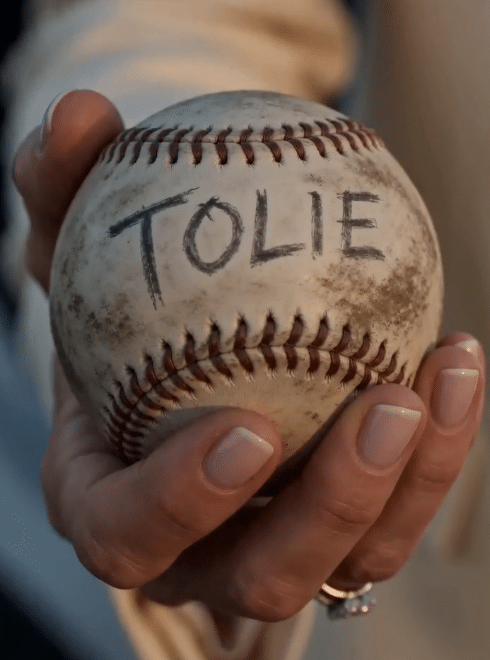
It was not a proper soccer ball or baseball, just an old leather practice ball worn almost smooth from years of use. Someone had written on it in black marker, and time had faded the letters enough that I had to tilt it toward the sun to read them.
TOLIE
My hand stopped.
For a second, the road, the field, the driver, the boy, all of it seemed to go thin around that one little word. I had not seen it written in eight years. I had not heard it spoken in longer than that.
Tolie.
The name I gave my son before he was born.
Not his legal name. He never had one, according to the story they fed me. Just a private nickname whispered into my pillow at nineteen while I pressed both hands over my stomach and imagined a life I was not allowed to keep.
“This is impossible,” I said.
The boy’s eyes widened.
He didn’t look scared now. He looked confused, maybe even hopeful in the strange, careful way children look when a secret finally hits the right door.
I held the ball out between us.
“Where did you get this?” I asked. “What is your mother’s name?”
He swallowed once.
“My mom gave it to me,” he said. “She said if someone recognizes it… she’s my real mother.”
I did not breathe.
Behind me, inside the driver’s seat, I heard the smallest sound—a sharp inhale quickly buried.
I turned.
My driver, Miles, was staring straight ahead with both hands tight on the wheel.
And I knew that expression too.
Because it was the same expression he wore eight years ago, the night my mother told me my baby had died.
Act II: The Child They Told Me Never Lived
I was nineteen when I got pregnant.
Old enough to understand exactly how much damage a child could do to a family like mine, and still young enough to believe love might outrun consequence if I was brave enough. His father was Tomas Reyes, the son of a mechanic who worked our family’s stables and fixed the old tractors on the southern property line.
My mother called him “that boy” long after he had become a man.
She hated how easily I laughed with him. Hated the way I changed around him. Hated, most of all, that for once I looked happier outside our world than inside it.
Tomas bought the little leather ball from a roadside market one Sunday and handed it to me with a grin.
“When he’s old enough,” he said.
I laughed at him because I was only four months along and because he said he with such confidence I thought certainty itself might be a kind of blessing. I wrote TOLIE across the leather with a black marker that night, short for Anatole, the name we whispered to each other when we were alone and foolish enough to think whispering made something real.
My mother found out in winter.
After that, events moved with the efficiency wealthy women always call necessity when they are about to commit cruelty. I was sent away to a private recovery house outside the city under the excuse of exhaustion. Tomas was warned off the property. His father was paid to keep him quiet. Miles drove me there and never once looked at me in the rearview mirror.
Labor came early.
I remember pain. A bright room. Someone saying there was a complication. Then my mother’s face above mine afterward, grave and composed, already dressed in the kind of mourning that tells you the narrative has been decided before your body caught up.
“The baby didn’t survive,” she said.
I asked to see him.
She said there was nothing to see.
For three days I screamed until my throat bled. Then I stopped, which pleased everyone so much they called it recovery. Tomas vanished from town within the week. My mother said grief had made him unstable and that I must never try to find him again.
The ball disappeared too.
I had kept it under the pillow, even after the birth, even after the doctor told me there had been no chance. When I asked for it, a nurse told me the staff had cleared all personal effects.
I should have known then.
Not because grief makes you wiser. It doesn’t. It makes you easy to lead. But because the people around me were too careful, too rehearsed, too relieved when I finally went quiet.
Now, on a country road with a little boy staring up at me, all those years rearranged themselves with a single ugly grace.
I stepped closer to the driver’s door.
“Miles,” I said. “Look at me.”
He didn’t.
His jaw tightened once. That was all.
The boy shifted on the grass behind me.
“My mom is sick,” he said softly. “She told me to keep the ball with me all the time.”
I turned back to him.
“Where is she?”
He pointed toward the fields.
“There’s a house at the end of Orchard Lane,” he said. “By the broken fence.”
Miles finally spoke, but only to say the one thing that made the world tilt fully into place.
“Madam,” he said, still looking ahead, “you should not go there alone.”
Not you shouldn’t.
Not it might be dangerous.
You should not go there alone.
As if he already knew exactly who waited at the end of Orchard Lane.
Act III: The Woman Who Raised My Son
The house leaned slightly to one side, as if even the foundation had grown tired of holding itself upright.
It sat behind a broken fence with one porch step missing and a patch of garden too dry to save. Someone had tried, though. There were marigolds in chipped pots and a child’s sneakers left beside the door.
The boy ran ahead and pushed inside without knocking.
“Mom?” he called. “Mom, she came.”
I followed more slowly.
The room smelled like old medicine, warm dust, and the thin tomato soup of people stretching what little they have. A woman lay half-propped on a narrow couch under a faded blanket, her face gray with illness and her hair tied back with a scarf that had once been floral.
She looked at me only once and began to cry.
Not loudly.
Not dramatically.
The sort of crying that comes from a person who has spent years preparing for a moment and still finds herself unready when it arrives.
“You know me,” I said.
She nodded.
“Yes,” she whispered. “I know exactly who you are.”
The boy came to her side, still clutching the ball as if it might vanish now that it had done what it was meant to do.
“Mom, she recognized it.”
The woman touched his hand.
Then she looked at me again.
“My name is Rosa Calder,” she said. “I was the night nurse at Hawthorne House the night your son was born.”
I had to sit down.
Not because I was weak. Because standing would have required my body to believe one impossible truth at a time, and there were already too many in the room. The old wooden chair near the window creaked under me as if it, too, knew the weight of delayed things.
“You told me he died,” I said.
Rosa flinched.
“No,” she whispered. “I let them tell you.”
There is a difference, but not one that feels kind when you hear it.
She told me everything in fragments because sickness kept stealing her breath between sentences. My mother had arranged the entire thing long before labor started. The doctor was hers. The recovery house was hers. When the baby was born healthy, the plan changed only in detail, not in purpose.
I was to be told he died.
The child was to be taken away before I woke fully enough to demand proof.
Rosa was meant to carry him to a foster placement under a false name and disappear from the household payroll in exchange for money my mother called “resettlement assistance.” But somewhere between the nursery door and the waiting car, conscience struck too hard and too late to stop anything cleanly.
So Rosa ran.
Not far enough to be noble.
Not honestly enough to be innocent.
Just far enough to keep a newborn alive.
“She threatened my own daughter,” Rosa said. “She told me if I ever came back, if I ever told you, she would take her too.”
My hands went numb in my lap.
“And Tomas?”
At that, Rosa closed her eyes.
This time, when she cried, I knew the answer before she said it.
“He came looking,” she whispered. “Your mother’s men found him first.”
Not dead, she said quickly. Not that she knew. But beaten badly enough, warned hard enough, and paid to vanish under another name. She had not seen him since.
The room had gone so quiet by then that I could hear the ticking of the cheap wall clock above the stove.
My son—my son—stood between us holding the ball, listening in that rigid, terrible stillness children acquire when they understand the adults in the room are not merely telling a sad story but rearranging their whole life in front of them.
“What’s my real name?” he asked.
Rosa looked at me.
I looked at him.
And for the first time in eight years, the answer did not belong to grief or imagination.
“Anatole,” I said. “But his father called him Tolie.”
He considered that.
Then nodded once, as if some missing part of the sky had finally been put back where it belonged.
That should have been the whole story.
It wasn’t.
Because when I stepped back outside to breathe, Miles was standing by the gate with his hat in both hands like a man waiting for judgment.
And in his pocket, as I would soon learn, was the original death certificate for a child who had never died.
Act IV: The Man Who Drove the Lie
Miles had worked for my family for twenty-three years.
Long enough to know where the silver was kept, which cousins drank too much before noon, and which family secrets were too heavy to carry without a salary. He had driven me to school, to church, to my wedding, to my father’s funeral, and to the recovery house where I was told my child was dead.
I used to think loyalty was what kept men like him close.
Standing by that broken fence, watching his hands shake around his hat, I understood something uglier.
Fear keeps people longer than loyalty ever will.
He reached into his jacket and handed me a folded official paper so worn at the edges it looked like it had been opened hundreds of times and never thrown away.
Certificate of Stillbirth.
Male infant.
No surviving issue.
It carried the doctor’s signature.
And my mother’s private seal in the lower corner.
“It was never filed,” Miles said quietly. “She kept it in her desk safe. I took it the week your father died.”
I looked up slowly.
“Why now?”
He flinched.
“Because she’s dying.”
There it was. The rotten little engine beneath half of rich people’s morality. Not conscience. Timing. My mother had entered hospice two weeks earlier, and with death finally close enough to touch her own skin, people around her were suddenly discovering fragments of decency they’d managed perfectly well without for years.
“She asked for you yesterday,” he said. “I think she knew the boy had found the ball.”
I laughed then.
A terrible sound.
“She knew?”
Miles nodded.
Rosa had not hidden as well as she believed. My mother always knew where the child was. That was the final cruelty. She let him live because distance was useful and because a hidden son frightened me less than a buried one would have if proof ever surfaced.
“He wasn’t a mistake to her,” Miles said. “He was leverage.”
I hated him in that moment almost as much as I hated her.
Not because he lied. Because he had kept the lie alive with perfect chauffeur hands and a soft voice while I built a life on its grave. Men like Miles love to think they are merely adjacent to evil. But the car still moves because someone keeps their foot on the pedal.
I took the certificate.
Then I asked the only question that still mattered enough to hurt.
“Is Tomas alive?”
Miles looked away toward the field.
“Yes,” he said. “At least he was two years ago.”
I closed my eyes.
The afternoon sun felt suddenly too warm on my face. My son was inside with Rosa, learning his name. The father who should have stood beside me all these years was somewhere in the world under another life forced on him by money and fear. And the woman who started it all was lying in a bed waiting, at last, to see what came back for her.
Miles spoke again.
“She kept one more file,” he said. “Trust papers. If Anatole lives, the Calder holdings don’t go where she promised.”
Of course they didn’t.
In families like mine, children are not just loved or lost. They are routed. Named. Removed. Restored. All according to who inherits when an old woman finally stops breathing.
I put the certificate in my bag and turned toward the house.
“Get the car,” I said. “We’re going to see my mother.”
Act V: The Boy She Couldn’t Erase
My mother was lying under white linen when we arrived, as if death had already started staging her.
The room smelled of lilies and antiseptic. The curtains were half drawn against the evening, and the nurse took one look at my face and quietly disappeared into the hall with more wisdom than anyone else in the house had shown in years.
My mother looked smaller than I had ever seen her.
But not softer.
Even dying, she had the bones of command in her mouth. Her eyes went first to me, then to the boy standing half-hidden behind my leg, then to the ball in his hands.
“So,” she said. “He found me after all.”
Not he lived.
Not forgive me.
Not even is that him?
Just recognition, like a banker acknowledging a delayed transfer.
I moved aside so she could see him fully.
“This is your grandson.”
Her gaze sharpened.
She looked at him the way she had once looked at fabric samples, board votes, and women she wanted removed from photographs. Measuring damage. Calculating consequence. Even now.
“I protected you,” she said to me.
From all the things she believed wealth could solve and love could not.
I set the false death certificate on her blanket.
Then the real one—blank, unsigned, waiting all these years to be filled by truth rather than convenience. Her fingers twitched once but did not touch either.
“You stole my son,” I said.
“You were weak,” she replied.
That was the first honest thing she’d ever said to my face.
Weak from childbirth.
Weak from love.
Weak from believing a child mattered more than an inheritance map.
She had not killed him because she thought that would make a scandal. Hiding him was cleaner. A private mutilation. Easier to dress as necessity. Easier to explain to herself while she continued hosting fundraisers and placing silver at long tables.
Anatole stepped out from behind me then.
No hesitation.
No fear.
Children know more about power than adults do because they have not yet learned to confuse its clothing for its substance.
“Did you hate me?” he asked.
The room stilled.
I think that question cut deeper than mine because it asked for something she had spent a lifetime evading: the moral truth, not the strategic one. Did you do this because of money? Because of shame? Because of fear? Or because somewhere inside you, hating me was easier than letting me live where I belonged?
My mother looked at him for a long time.
Then she answered in the only way she ever really could.
“I hated what you changed.”
That was enough.
Not justice.
Not remorse.
Not absolution.
But enough.
Because some truths are cleaner when the guilty stop trying to make themselves sound humaner than they were.
My mother died two days later.
She died with no priest in the room because I did not want anyone translating her choices into softer language. The lawyers came first, then the trust officers, then the cousins who always appear when blood and money begin using the same nouns.
Anatole inherited far less cleanly than fairy tales would promise and far more lawfully than my mother ever intended. We spent months untangling records, finding Tomas, and teaching a little boy that his real name was not a dangerous thing someone might take away if he spoke it too loudly.
Tomas cried when he saw him.
So did I.
No one in my family found that dignified. I no longer cared.
The ball sits on my desk now.
Old leather. Faded ink. The name almost worn away except where black marker settled deeper into the cracked seams. Every now and then Anatole turns it over in his hands and asks how I knew it was his.
I always tell him the same thing.
“Because I wrote your name before anyone else got the chance.”
For years, they told me the child I loved had died before he ever became real. They built their lie in paperwork, distance, silence, and the polished certainty of people who think money makes their version of events permanent.
It didn’t.
Because one day, on a country road under a gold sky, a ball rolled to my feet with my son’s name still written on it. And once that happened, no car door, deathbed, or family fortune in the world could keep the truth from coming home.