Act I: The Bread in the Dust
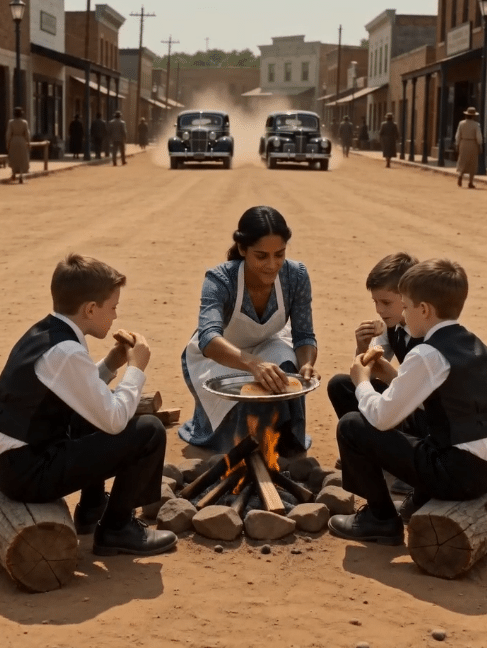
By the time the first car came down the road, Maria had already divided the bread into four careful pieces.
She always cut it unevenly on purpose. The boys never noticed, because she had trained herself to move quickly enough that the largest piece always landed in the smallest hands. Mothers who live close to hunger learn that trick the way other women learn embroidery or church hymns.
The street was all dust and heat.
Brick storefronts leaned toward one another like tired men in old coats. The road itself was more dirt than road, its surface churned by wagon wheels, cheap boots, and the occasional rich man’s car that tore through town as if poverty were something best observed at speed. Maria knelt in the packed earth beside a low fire, stirring a dented pot with one hand and shielding the boys with the other whenever the wind changed.
The children sat in a rough circle around her.
Three boys. Thin shoulders. Worn collars. Hungry eyes trying not to look hungry in front of their mother. The oldest chewed slowly so the younger two would not notice that he had already given up half his portion.
Then the engines came.
Not one.
Two.
The sound arrived long before the cars themselves appeared at the edge of the street. It rolled over the dust and the fire and the little metal spoon Maria held between her fingers until even the boys stopped chewing and turned to look. The cars were not the sort of machines that belonged in their town. Long, shining, and dark as polished secrets, with silver grilles and whitewall tires that made the rest of the street look even poorer by contrast.
They did not simply pass.
They slowed.
Then, in a spray of dust and gravel, they stopped around her.
Maria rose at once.
Not quickly enough to seem frightened, not slowly enough to seem rude. She had learned how to stand in front of powerful men the way other women learn to stand in church—straight-backed, careful, and very aware of how small the room becomes if you say the wrong thing. One hand stayed behind her, as if the boys might disappear into her apron if she held the fabric tightly enough.
The car doors opened one after another.
Three men stepped out.
They were young in the expensive way certain men remain young even after hard years try to claim them. Dark tailored suits. White shirts. Shoes too clean for their surroundings. Their hair was slicked back, their expressions serious, and their silence felt heavier than if they had arrived shouting.
They came toward her through the settling dust.
Maria looked from one face to the next, searching for a clue that might tell her whether these were tax men, land agents, debt collectors, or simply the sort of strangers who treated poor neighborhoods as if they were places to conduct private business away from respectable eyes.
“Can I help you?” she asked.
The man in front stopped only a few feet away.
He looked at the boys, the bread in their hands, the fire at her feet, the blackened pot, the silver plate balanced against her hip. His face shifted in a way she could not yet read—not pity, not contempt, something steadier than both.
“You already did,” he said.
Maria frowned.
The youngest boy gripped her apron.
The rich man took one slow breath, as though the next words mattered more than the whole road behind him.
“You fed us with your last loaf,” he said. “And we never forgot.”
Act II: The Day Hunger Knocked at Her Door
At first, Maria thought he must be mistaken.
She knew men like that by reputation if not by name. They belonged to marble foyers, private clubs, and the kind of homes where curtains stayed white because someone else washed them. Men in tailored suits did not remember women like her. They passed them. Paid them. Occasionally shamed them. But they did not remember them.
Then the oldest of the three looked past her shoulder toward the pot over the fire and smiled with one corner of his mouth.
“You still add the onion first,” he said softly.
That froze her.
There are details the poor do not invent about one another unless they have once stood inside the same desperate room. Onion first. Then water. Then salt if there is any. Then whatever can be made to look like stew if someone hungry enough is willing to call it that.
Maria stared at him properly then.
Really stared.
His face was fuller now. Better fed, certainly. His suit was cut with the sort of authority only money can purchase. But the eyes—dark, steady, slightly too old for his age—were not the eyes of a stranger.
Memory came back not as a picture but as weather.
Rain. Cold rain. A winter dusk years earlier when the river had flooded the lower road and half the town had shut its doors against the storm. Her husband had already been dead then. The boys had been babies. She had only one candle left and one loaf of bread meant to carry them through two days.
There had been three young men at her door.
Not rich then. Not polished. Just soaked through, shivering, and trying very hard not to look desperate. One of them had blood on his sleeve. Another had a split lip. The third kept glancing over his shoulder as though men with worse intentions might still be following the road behind them.
She had almost sent them away.
That was the truth she never told the priest. Not because she was cruel, but because fear makes cowards of all of us before it makes saints of a few. Three strange young men at night could mean ruin for a widow with children. Even then, part of her knew that.
But the one with the cut lip had said, “Please, ma’am. We just need warmth until the rain breaks.”
So she let them in.
She fed them soup so thin it embarrassed her to serve it. She tore the last loaf into seven pieces instead of four. She made the boys sleep on the mattress and gave the young men the floor by the stove. In the morning, when the floodwater dropped and the sky cleared, they tried to leave money on the table.
She refused it.
Not out of nobility. Because the amount was insultingly small and she had not wanted her kindness priced like a room in a roadside inn.
One of the men—the tallest, the one now standing in front of her in a dark suit—had smiled and said, “Then I’ll owe you properly one day.”
She had laughed at him.
Men say such things when they have nothing else respectable left to offer.
Now he stood in front of her again, broad-shouldered, composed, and too wealthy to be confused for anything but exactly what he was.
“You were the widow on Alder Lane,” he said. “With the red stove and the leaking roof.”
Maria’s hand went to her mouth before she could stop it.
The boys looked between them, wide-eyed and silent.
“You’re those boys,” she whispered.
The man nodded.
“We were.”
The second man stepped closer then, his voice lower, more careful.
“We came back two years later, but the house was empty.”
Maria’s eyes dropped to the dirt.
That had been after the landlord raised the rent and after her youngest nearly died in winter from a cough that turned blue around the lips. She had moved twice after that, each time farther from the river and closer to the kind of hunger that leaves no room for sentiment.
“I didn’t know,” she said.
The lead man glanced toward the boys again.
“What are their names?”
She told him.
One by one.
The men listened like people taking inventory of something sacred.
And when she finished, the third man, who had not spoken yet, looked at the smallest child and said quietly, “There should have been four.”
Maria felt the air leave her lungs.
Because only one person outside the family had ever known she once carried a fourth child.
And he had died before dawn in the same winter she fed three shivering boys on her floor.
Act III: The Promise He Made in the Rain
The name of the man in front of her was Samuel Vale.
That, too, came back late.
Not from the storm night itself, but from the papers that started appearing a few years later. Factory purchases. Railway contracts. Shipping rights. Every month there seemed to be another story about the Vale brothers who had risen out of nowhere and built a trading empire faster than the old families knew how to resent it properly.
Samuel, Thomas, and Eli Vale.
The same three boys who once warmed their hands over her stove while pretending the blood on one jacket belonged to a fall and not a beating.
“We searched for you,” Samuel said.
Maria almost smiled at that, though there was no real humor in it.
“Poor people are easy to lose,” she said.
His face changed then.
Not from discomfort. From recognition. He was the sort of man who had learned enough over the years to know when truth arrived in a plain dress and should not be argued with.
Thomas, the one with the once-broken lip, crouched so he could meet the boys at eye level. He asked their ages. Their names again. Whether they were in school. The boys answered in the clipped, wary way children of poverty speak to strangers whose shoes cost more than honesty feels worth.
Eli walked to the pot over the fire and looked inside without shame.
“Still stretching water into supper,” he murmured.
Maria straightened.
“If you came to make a memory into charity, don’t,” she said.
The words came out sharper than she intended, but shame does that when kindness arrives dressed too well. She did not need spectators to her struggle. She did not need gratitude so delayed it arrived as pity. Most of all, she did not need her sons learning to look at rich men as the authors of rescue.
Samuel studied her a moment.
Then he did something she had not expected.
He took off his gloves and set them on the hood of the nearest car.
Not to show gentleness. To show seriousness.
“That isn’t why we’re here.”
The boys had stopped moving now.
Even the smallest one sensed that the road had become something more than a road. The dust hung in warm gold around them. The bread was still in their hands, untouched now. From farther down the street, faces had begun to appear at windows and doorways. Poor towns do not ignore the arrival of luxury. They learn to watch it the way sailors watch weather.
Samuel reached into his coat and drew out a folded legal envelope.
Maria stepped back instinctively.
She had seen too many papers in her life not to fear them. Eviction papers. Debt notices. Hospital balances. Notices from men who always wrote kindly when they meant to ruin you.
Samuel didn’t hold the envelope toward her yet.
He looked instead at the silver plate in her hand, the one she had been using to serve bread to the boys.
“There’s an inscription on the back,” he said. “My brother remembered it before any of us remembered your face.”
Her fingers tightened around the plate.
Of course there was an inscription. It had been her mother’s wedding gift, one of the last things she still owned from a life before widowhood turned everything into tradeable necessity. Most days she forgot the engraving was there because memory has to become practical to survive.
Samuel held out his hand.
“May I?”
She gave him the plate without fully understanding why.
He turned it over and read the words scratched along the back edge.
To Maria — For every table you keep warm.
His jaw hardened for a second.
Then he showed the plate to his brothers, and whatever uncertainty remained among them vanished entirely.
“This is the house,” Thomas said.
Samuel nodded once.
Then he finally handed her the envelope.
“I made you a promise in the rain,” he said. “I came back to keep it.”
Maria did not open it.
Not yet.
Because the road had gone too quiet, and something about the driver still sitting behind the wheel of the first car had begun to bother her. He had not moved once since they arrived. Not even when the brothers stepped away from the vehicles. He sat watching through the windshield with the stillness of a man waiting for a different part of the story to begin.
And when she glanced at him, he lowered his eyes at once.
That frightened her more than all the cars put together.
Act IV: The Driver Who Knew Her Husband’s Name
Maria did not open the envelope until she was forced to.
That is the simplest way to say it. Not because she lacked courage, but because experience had taught her that papers alter the world whether one reads them or not. The longer they stay folded, the longer life can keep pretending it belongs to ordinary problems.
“What is it?” she asked.
Samuel answered plainly.
“The deed.”
She stared at him.
“The deed to what?”
“To your house,” he said. “And the lot behind it. And the two adjoining plots to the east.”
That made no sense.
This house wasn’t hers. Nothing in her life had been hers in years except the boys and the plate and the habit of rising before dawn whether or not there was enough food to justify it. The landlord in town owned the place, and he liked reminding her of that every month.
Samuel opened the envelope himself and held the papers so she could see.
Signed.
Stamped.
Filed.
Transferred three weeks earlier to Maria Alvarez, widow of Luis Alvarez.
Her husband’s name hit her harder than the deed did.
Luis.
No one in town said it anymore except the priest when he remembered, which was less often than she liked. Men disappear strangely in poor places. They die in mills, on roads, in strikes, in fights that leave too few witnesses willing to speak. Luis had died under a freight rig nine years earlier after a warehouse lockout turned ugly and hungry men started pushing against the wrong gates.
Or so she had been told.
Samuel watched her face carefully.
“That’s not all,” he said.
Of course it wasn’t.
The second paper in the envelope was a settlement transfer from a freight insurance fund that had somehow remained untouched all these years. The third was worse: a sworn affidavit from a former foreman stating Luis Alvarez had not been killed in an accident at all, but beaten by company guards during a labor protest and left under the rig to make it look cleaner for the papers.
Maria stopped reading.
The boys were watching her now with the terrible stillness children use when they know adults have started speaking in the language of death.
“Why do you have this?” she asked.
Samuel didn’t answer right away.
The driver opened the car door and stepped out.
Older than the brothers. Black suit, careful hands, the stiff posture of a man who had lived too long inside service to trust himself around confession. When he came close enough for her to see his face clearly, Maria felt her stomach turn.
She knew him.
Not from today.
From the dock office where Luis once worked night loading.
He had been there the week before her husband died. He had stood beside the warehouse manager in a brown hat and never once met her eyes while she begged for her husband’s final wages.
“My name is Arthur Bell,” he said.
“I know who you are.”
He nodded.
And then, to the visible shock of the three suited brothers, he removed his hat and said the words that explained why he had been left behind the wheel until now.
“I was there the night your husband died.”
The dust seemed to settle all at once around the road.
Samuel and his brothers turned toward him, their faces gone hard in an entirely different way than before. This was not part of the reunion they had promised her. This was something else. Something the driver had likely insisted on bringing himself because men with guilt eventually learn that certain truths refuse to stay delivered by proxy.
Arthur continued before anyone could stop him.
“I signed the false report. I told myself I was protecting my own children. Then I spent nine years watching yours starve from my rearview mirror.”
That last line hit Samuel like a blow.
“You what?”
Arthur looked at the boys.
Then at Maria.
“I told the Vales about you after I realized whose house I’d once slept in during the flood. I knew the plate. I knew the road. I knew the names. I should have come sooner.”
Now it made sense.
Not just the deed.
Not just the land.
Not just the promise remembered by rich men after a rainstorm.
This driver had carried the truth to them because his conscience had finally become heavier than his wages.
Maria wanted to hate him.
Part of her did.
But hate is not a clean thing when the man standing in front of you is also the reason your sons may never again fear the month’s rent. It tangles with necessity, and necessity always wins the first round.
Samuel stepped toward Arthur.
For one hot second Maria thought he might hit him.
Instead, he said, “You could have fixed this nine years ago.”
Arthur nodded once.
“Yes.”
No excuse.
Just yes.
That honesty was the first decent thing he had offered the world.
Then the smallest boy tugged Maria’s apron and asked the question no one else had yet dared say aloud.
“Does this mean Papa didn’t leave us?”
Maria closed her eyes.
Because for years, in her cruelest private moments, she had half-hated the dead for how completely they vanish into silence. Now the dead had come back not alive, but altered. Dirtier. More wounded. Less accidental.
And before she could answer her son, a truck turned onto the road at speed and sent another plume of dust toward the cars.
The landlord had arrived.
Act V: The Street That Watched It Change
Mr. Harlan stepped out of his truck already shouting.
He was one of those men who build their bodies from bad meat and unpaid mercy, wide through the middle and mean around the mouth. He took one look at the luxury cars, the suited strangers, the deed papers in Maria’s hands, and understood faster than most educated men would have.
Predators are quick where territory is concerned.
“What is all this?” he barked.
No one answered him immediately.
That was the interesting thing about power when it changes shape in public. For a moment, everyone involved is forced to stand inside the transition and feel who still believes the old order holds.
Harlan pointed at Maria.
“She owes me two months.”
Samuel turned toward him with a stillness that made the whole road seem to recoil by instinct.
“Not anymore.”
Harlan laughed.
Then he saw the transfer papers.
Then he stopped laughing.
It would be pretty to say justice happened elegantly after that. It didn’t. Justice in towns like that is clumsy, suspicious, and often embarrassingly administrative. There were signatures to confirm, the county clerk to call, witnesses to gather, and an ugly little scene in which Harlan accused Maria of trickery before Samuel’s younger brother explained, in the smooth voice of a man who could afford to be patient, that forgery claims sound very different when spoken beside two chauffeurs, three lawyers arriving from the city, and a police captain who happens to owe the Vales a campaign favor.
By sunset, the whole street knew.
Not rumor.
Fact.
The widow on Alder Lane owned her house.
The land behind it too.
The boys did not need to leave school at harvest time anymore.
Luis Alvarez had not died drunk and foolish beneath a truck, as the papers once hinted. He had died because powerful men feared hungry workers more than they feared God.
And the rich men in the dark cars had not come to remove her.
They had come to put something back.
Maria signed the final acknowledgment with flour still on one wrist and smoke still in the hem of her dress. The boys stood so close to her skirts they looked like they might disappear into them if she moved too fast. Arthur Bell remained a few paces back, hat in hand, not asking forgiveness because he understood at last that some wrongs must first survive being named before anyone earns the right to discuss mercy.
When the papers were done, Samuel looked at the little fire, the half-empty pot, and the bread still sitting untouched on the silver plate.
“You were feeding them with your supper,” he said.
Maria almost smiled.
“With our supper.”
He nodded.
Then, in front of the whole road, he reached into his coat and took out a folded bank draft that would have fed them for a year. He placed it on the plate and said, very quietly, “This is for the bread. The rest is for the years.”
She stared at it.
Then at him.
Then she pushed it back.
The brothers looked startled.
The street looked shocked.
Maria lifted her chin.
“I’ll take what’s owed,” she said. “Not what makes me look grateful for your conscience.”
For the first time that day, one of the men laughed.
Not at her.
In admiration.
That was the moment the street truly changed, I think. Not when the deed moved. Not when Harlan went pale. Not when the lawyers arrived. But when a hungry widow in an apron refused to let wealth rename justice as charity in front of everyone who had once watched her stir water into supper.
Samuel inclined his head once, like a gentleman before a queen he had only just recognized.
“Fair enough,” he said.
By the next week, the east plots were being fenced for a proper garden, the roof repairs had started, and the smallest boy had discovered that eating bread without counting the bites felt almost suspiciously luxurious. Arthur Bell came every Thursday after that to haul lumber and fix what his silence had once helped destroy. Maria never thanked him in a way that made his burden lighter. That, too, was fair.
People in town told the story for years afterward.
About the day two great cars rolled into the poorest street in dust and sunlight and stopped around a widow cooking over a fire. About how the men who stepped out wore suits that belonged in capitals, not fields. About how everyone assumed the worst and got the truth instead.
But the version I like best is simpler.
Three starving boys once knocked on a poor woman’s door in the rain.
She fed them with her last loaf.
Years later, when they had become men rich enough to buy almost anything, they returned not to save her, but to settle the debt properly and name the men who had profited from her silence.
That is the thing about real kindness.
It is rarely lost.
Sometimes it just takes years to come back down the road wearing the wrong clothes before you recognize it.