Act I
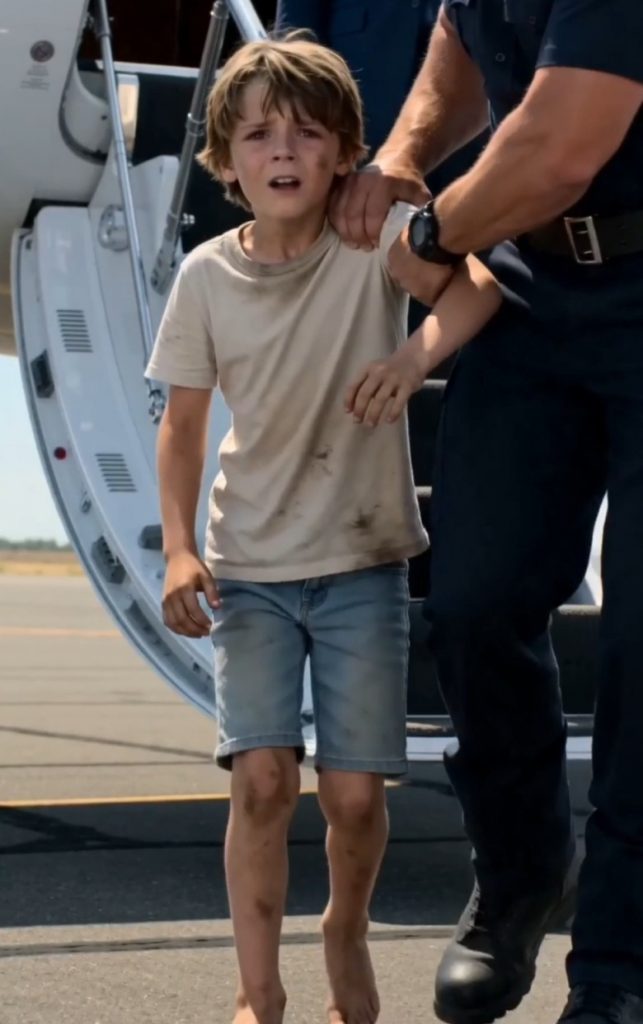
The boy was barefoot on the tarmac.
His small feet dragged across the sun-heated asphalt as Officer Miller gripped his arm and marched him away from the private jet. The aircraft gleamed behind them, white and perfect beneath the clear blue sky, its blue stripes shining like ribbons of money.
The boy kept twisting back toward it.
“Wait!” he cried. “Don’t go!”
The executive stood near the stairs with his arms crossed.
Victor Langley had spent sixty-two years learning not to react in public. He had built companies, bought newspapers, survived investigations, buried rivals, and watched men with louder voices lose everything because they could not control their faces.
So when a dirty child in torn denim shorts and a stained shirt screamed at him from the tarmac, Victor did not move.
Officer Miller tightened his grip.
“That’s enough,” he snapped.
The boy winced but did not stop fighting.
His hair was messy, collar-length and brown, stuck to his forehead with sweat. Dirt smudged his cheeks. His eyes were wide, wet, and fixed on Victor like he was the only person alive who could stop the world from ending.
“It’s dangerous!” the boy screamed. “Please, listen to me!”
The jet waited behind Victor, engines quiet, stairs lowered, crew ready. A black sedan idled near the service gate. In less than ten minutes, Victor was supposed to fly to San Francisco for the meeting that would decide the future of Langley Aerospace.
The boy should have been irrelevant.
A trespasser.
A nuisance.
A security problem.
Victor’s assistant had already whispered as much.
“Sir, airport police will handle it.”
But then the boy shouted again.
“Don’t take the blue plane!”
Victor’s eyes narrowed.
Not because the jet was blue. It was not. It was white with blue stripes.
But because only three people outside his executive team knew the aircraft’s internal name.
Bluebird.
His late wife had named it.
No press release had ever mentioned it. No employee outside the private fleet office should have known. No barefoot child from the wrong side of the security fence should have been screaming it across a runway.
Officer Miller dragged the boy another few steps.
Victor finally uncrossed his arms.
“Stop.”
The single word traveled across the tarmac with more force than a shout.
Miller froze.
The boy stopped struggling and stared at Victor, chest heaving.
Victor descended the jet stairs slowly, each polished shoe striking metal with a sharp, clean sound. His face remained cold, but inside him something old had awakened.
Suspicion.
Fear.
Memory.
He stopped in front of the boy.
“What did you call that plane?” Victor asked.
The boy swallowed hard.
His voice came out small, cracked, desperate.
“Bluebird.”
Victor went still.
Behind him, the pilot stepped out of the jet doorway.
Officer Miller shifted uncomfortably.
And the boy, trembling under the officer’s hand, whispered the next sentence like a match dropped into dry grass.
“My mom said your daughter died because no one listened either.”
Act II
For nine years, Victor Langley had avoided the word daughter.
Not in public, of course.
In public, he spoke of Rebecca with polished grief and expensive restraint. He funded aviation safety scholarships in her name. He sat stone-faced at memorial dinners. He gave short speeches about innovation, accountability, and loss.
But in private, her name was a locked room.
Rebecca Langley had been thirty-one when she died.
Brilliant. Stubborn. Impossible to intimidate. She had inherited Victor’s eyes and her mother’s conscience, which made her dangerous inside a company built on contracts, silence, and hierarchy.
She was an engineer at Langley Aerospace before anyone could accuse her of being given a ceremonial title. She started in testing, worked night shifts, argued with senior managers, and refused to let anyone call her “Miss Langley” on the floor.
To the board, she was inconvenient.
To Victor, she was the future.
Then came the accident.
A company test aircraft went down over the Mojave during a private demonstration. The official report blamed weather, pilot error, and a string of small mechanical failures no single person could have predicted.
Victor signed the statement.
He stood before cameras and repeated it.
Rebecca had raised concerns two weeks earlier. Victor knew that. He also knew the internal review had labeled them “inconclusive.” His advisers told him grief made people search for villains. His general counsel warned him not to destabilize the company with emotional accusations.
So Victor accepted the report.
Or told himself he did.
A year later, Rebecca’s husband disappeared from public life with their infant son.
Victor never forgave him for it.
He told people the man had taken the child away out of bitterness. He told himself the same story until it became easier than asking why a grieving father would rather vanish than accept Langley money.
The boy on the tarmac had Rebecca’s eyes.
Victor saw it all at once, and the ground seemed to tilt beneath him.
“What is your name?” he asked.
The boy’s lower lip trembled.
“Caleb.”
Victor felt the name like a blow.
Rebecca had wanted to name her first son Caleb. She said it sounded like someone who would grow into courage.
Officer Miller cleared his throat.
“Sir, with respect, this kid got through a restricted access point. We need to remove him and file charges.”
Victor did not look at him.
“Let go of his arm.”
Miller hesitated.
That hesitation told Victor more than obedience would have.
“I said let go.”
Miller released the boy.
Caleb immediately pulled his arm against his chest and stepped back, but he did not run. His eyes stayed on the jet.
“My mom is in the hangar,” he said. “She told me to find you.”
“Your mother?”
“Not my real mom. My foster mom. Mara. She works on planes.”
Victor turned toward the service hangars beyond the tarmac.
Mara.
He knew that name too.
Mara Ortiz. Senior maintenance technician. One of the few employees who had refused to sign Rebecca’s final internal clearance report after the crash. She had been demoted within months, transferred twice, then buried in fleet maintenance where no one important had to hear her voice.
Victor remembered her now.
A woman with oil on her hands, standing in a conference room full of suits, saying, “You’re calling it weather because weather can’t hire lawyers.”
He had let security escort her out.
The shame of that memory moved through him slowly, like poison finally reaching the heart.
Caleb dug into the waistband of his shorts and pulled out a torn red tag, folded twice and damp from sweat.
He held it up.
“She put this on the jet door,” he said. “A man ripped it off. Then he locked her in the storage room.”
Victor took the tag.
The handwriting was hurried but clear.
DO NOT RELEASE AIRCRAFT. SAFETY HOLD. ORTIZ.
Victor looked toward the jet.
Then toward Miller.
The officer had gone pale.
And for the first time that morning, Victor Langley understood the boy had not come to beg.
He had come carrying proof.
Act III
“Ground the aircraft,” Victor said.
The pilot stepped down from the stairs.
“Sir?”
Victor turned on him with a look that ended the question before it grew.
“Now.”
The pilot reached for his radio.
Officer Miller moved half a step forward.
“Mr. Langley, we have protocols. We can’t take the word of a child who trespassed—”
Victor faced him.
“You already took the word of whoever told you to drag him away.”
Miller’s jaw tightened.
“I was securing the area.”
“You were removing a witness.”
The tarmac went quiet.
Even the heat seemed to pause.
Caleb stood beside Victor, shaking so hard his dirty shirt fluttered against his ribs. Victor removed his suit jacket and placed it around the boy’s shoulders. It swallowed him almost completely.
Caleb looked up, confused by the kindness.
Victor did not explain.
He was not sure he deserved to.
“Where is Mara?” Victor asked.
Caleb pointed toward a low maintenance building beyond the fuel trucks.
“There. The gray door. I heard her banging.”
Victor’s assistant hurried closer.
“Sir, we should let airport security—”
“No,” Victor said. “Call federal aviation safety. Call local police. Call corporate counsel and tell them if anyone touches a file before investigators arrive, I’ll bury them under the building.”
His assistant blinked.
Then nodded and ran.
Victor began walking toward the hangar.
Caleb followed.
Miller reached for his radio.
Victor stopped without turning.
“Officer Miller,” he said, “place both hands where I can see them.”
Miller froze.
Two private security agents near the sedan moved in immediately. Miller started to protest, but the sound died when one of the agents removed the radio from his shoulder and found a second phone clipped behind his belt.
Not department-issued.
Its screen lit up with a message.
Is the kid gone?
Victor read it.
His face did not change.
That was when Miller knew he was finished.
They found Mara Ortiz behind the gray door.
She was sitting on the floor of a narrow storage room, one wrist bruised, her work shirt torn at the sleeve. When the door opened, she blinked against the light, then saw Caleb and tried to stand too quickly.
“Caleb.”
He ran into her arms.
She held him fiercely, then pushed him back just enough to look at him.
“You did it,” she whispered.
“I found him,” Caleb said.
Mara looked past him.
At Victor.
The warmth vanished from her face.
“Mr. Langley.”
Nine years of anger lived in the way she said his name.
Victor accepted it.
“Ms. Ortiz.”
She pointed toward the jet without rising.
“That aircraft cannot leave the ground.”
“Why?”
Her eyes flashed.
“Because someone wants you on it.”
The sentence landed heavily.
Victor crouched in front of her.
“Tell me.”
Mara’s breath shook.
“I found a safety discrepancy during the morning inspection. Not wear. Not accident. Something changed after yesterday’s clearance. I tagged the aircraft, called it in, and twenty minutes later two men came down with Miller. They said the hold was canceled by executive order.”
“I gave no such order.”
“I know,” Mara said. “That’s why I refused to release it.”
Caleb pressed closer to her.
“They yelled at her,” he whispered.
Mara touched his hair.
“I told Caleb to hide. But he heard them say you were boarding in ten minutes. I told him to run to the jet and scream if he had to.”
Victor looked at the boy.
Bare feet. Torn shorts. Dirt on his face. Courage bigger than the airport.
“You ran across the tarmac alone?”
Caleb nodded.
“I thought no one would listen if I just walked.”
Victor closed his eyes briefly.
That was what the world had taught him.
That truth needed to scream, bleed, or break rules before powerful men paused long enough to hear it.
Mara pulled a tablet from beneath a shelf.
“I copied the inspection images before they took my main device.”
Victor took it.
On the screen were time-stamped records, access logs, and a name attached to the canceled hold.
Thomas Greer.
Victor’s chief operating officer.
The man waiting in San Francisco for Victor to sign the merger documents.
The man who would become acting CEO if Victor never arrived.
Act IV
Victor did not fly to San Francisco.
Instead, San Francisco came to him.
By noon, the private terminal was locked down. The jet sat grounded under guard, its white fuselage no longer a symbol of power but a crime scene beneath the sun. Federal inspectors arrived in dark vehicles. Airport police removed Officer Miller in handcuffs. Mara gave her statement with Caleb’s hand locked in hers.
Victor watched from ten feet away.
He did not interrupt.
He did not soften her words.
When she described being ignored for years, his face remained still, but every sentence found its mark.
Thomas Greer called seventeen times.
Victor answered the eighteenth.
“Victor,” Greer said, breathless but controlled. “I just heard there’s some confusion at the airport.”
Victor looked through the glass wall at the grounded jet.
“Confusion?”
“A maintenance misunderstanding. Ortiz has been unstable since Rebecca’s crash. You remember how she gets.”
Victor’s grip tightened around the phone.
There it was.
The old machinery.
Discredit the witness. Question her emotions. Make urgency look like hysteria. Make courage sound like instability.
“I remember,” Victor said.
Greer relaxed slightly.
“Good. Then you know this is a stunt. We need you here. The board is waiting.”
“So is the FBI.”
Silence.
Victor could almost hear Greer’s mask slipping.
“What?”
“The aircraft is grounded. Miller is in custody. Ortiz copied the inspection logs. And I have the canceled safety hold with your authorization code.”
Another silence.
Longer.
Then Greer spoke softly.
“Victor, listen to me. You don’t understand what’s at stake.”
Victor looked at Caleb sitting beside Mara in the terminal, wrapped in his suit jacket, drinking water from a paper cup with both hands.
“No,” Victor said. “For the first time in years, I do.”
Greer hung up.
He was arrested that evening in a conference room overlooking the bay, still wearing the smile he had prepared for investors.
The investigation widened quickly.
It was not only the jet.
That was the first truth.
The second was worse.
Rebecca’s old files had been altered. Her warnings had been buried. Engineers who supported her were reassigned, pressured, or paid to stay quiet. Mara’s refusal to sign the original report had saved copies of documents Greer believed destroyed.
For nine years, Victor had been sleeping inside a lie built by men who understood his grief better than he did.
They knew he would avoid the details because the details hurt.
They knew he would trust executives because the alternative meant admitting his daughter died fighting people he had promoted.
The hardest truth came from Mara.
“She tried to tell you,” she said that night in a private terminal office.
Victor sat across from her, looking suddenly older than his sixty-two years.
“I know.”
“No,” Mara said. “You don’t. She stood outside your office for forty minutes the day before the demonstration. Greer told her you were unavailable.”
Victor’s eyes lifted.
“I was in the building.”
“I know.”
The room went painfully quiet.
Caleb had fallen asleep on a leather couch nearby, still wearing Victor’s jacket. His dirty feet were tucked under him. His face, finally calm, looked so much like Rebecca at eight years old that Victor could barely look at him for more than a few seconds.
Mara followed his gaze.
“He’s her son,” she said.
Victor’s throat tightened.
“I thought his father took him away.”
“His father tried to fight the report. He was threatened with lawsuits until he disappeared. When he got sick, he brought Caleb to me. He said Rebecca trusted me.”
“What happened to him?”
“He died last winter.”
Victor closed his eyes.
Another person gone while he sat in glass towers signing papers over sealed rooms.
Mara’s voice softened, but only slightly.
“Caleb knows who you are.”
Victor looked at her.
“He does?”
“He knows you’re his grandfather.”
The word moved through Victor like something breaking open.
“Why didn’t he say?”
Mara looked at the sleeping boy.
“Because he didn’t know if grandfathers listen.”
Act V
Victor Langley did not return to his office for three days.
When he did, he did not enter through the executive garage.
He came through the engineering floor.
People stopped working when they saw him. Conversations died. Screens dimmed. Men and women who had spent years learning that truth moved upward at great personal risk watched the CEO walk past their desks with a barefoot boy beside him and Mara Ortiz on his other side.
Caleb now wore clean clothes and new sneakers, though he kept looking down at them like they belonged to someone else.
Victor stopped in the center of the floor.
“This company failed my daughter,” he said.
No speechwriter had touched the sentence.
That was why everyone believed it.
“It failed the people who warned us. It failed the families who trusted our reports. It failed because men with power decided silence was cheaper than correction, and I allowed my grief to become useful to them.”
The room did not move.
Victor turned to Mara.
“Ms. Ortiz has been appointed interim director of independent safety review. She will answer to the board, not operations. Any employee who interferes with her office will be removed before lunch.”
Mara looked startled, then wary.
She was not ready to trust him.
Good, Victor thought.
Trust should not be demanded by the people who broke it.
The board fought him.
Not openly at first.
They used phrases like market confidence, reputational exposure, strategic timing. Victor listened to all of it, then released the internal findings before they could bury them under legal varnish.
Stock prices fell.
Headlines screamed.
Investors panicked.
Victor did not blink.
At a press conference, he stood before cameras and said Rebecca’s name without flinching for the first time in nine years.
“My daughter warned this company,” he said. “She was right. Mara Ortiz warned this company. She was right. Caleb ran barefoot across a runway to warn me. He was right. The least powerful people in this story told the truth. The most powerful people tried to survive it.”
Reporters shouted questions.
Victor ignored most of them.
He had spent too much of his life answering the wrong rooms.
The legal consequences came slowly, then all at once. Greer was indicted. Miller’s role in the airport incident exposed a private security channel used to suppress safety objections. Old files were reopened. Families who had been fed polished explanations began receiving documents, not condolences.
Mara testified.
So did Victor.
Caleb did not have to.
Victor made sure of that.
Children should not be asked to carry adult corruption any longer than survival requires.
Months later, Victor visited Rebecca’s grave with Caleb.
The cemetery sat on a hill above the city, bright with wind and winter sunlight. Caleb carried a small blue paper bird he had folded himself. He placed it against the stone.
“Hi, Mom,” he whispered.
Victor stood back, hands folded in front of him, unable to speak.
Caleb turned.
“Mara says you loved her.”
Victor nodded.
“I did.”
“Then why didn’t you listen?”
The question was clean.
No cruelty.
That made it harder.
Victor looked at Rebecca’s name.
“Because listening would have made me choose between the truth and the company I built,” he said. “And I told myself I could protect both.”
Caleb thought about that.
“Could you?”
“No.”
The boy nodded slowly.
At last, Victor knelt beside him.
“I can’t undo what I failed to hear,” he said. “But I can listen now. Not because you saved me. Because you deserved that before you had to.”
Caleb looked at him for a long time.
Then he leaned against Victor’s shoulder.
It was not forgiveness.
Not yet.
But it was weight.
Warm. Real. Alive.
Victor closed his eyes.
Years later, people would still tell the airport story in polished, dramatic pieces.
A boy broke through security.
A CEO almost boarded his private jet.
A warning saved a life.
But Victor hated the version that made him the center.
The real story was smaller and braver.
A maintenance worker saw danger and refused to lie.
A child trusted her enough to run.
A man who had ignored one warning finally heard another before it was too late.
Langley Aerospace changed after that, though not without pain. Safety holds became impossible to override without independent review. Whistleblower complaints went outside the chain of command. Rebecca’s buried memos were added to the company’s training archive, not as memorial decoration, but as required reading.
At the entrance to the private fleet hangar, Victor installed a simple plaque.
Listen before power makes you deaf.
Beside it, in a glass case, lay the torn red safety tag Mara had written and Caleb had carried.
Some executives found it uncomfortable.
Victor hoped they did.
As for Bluebird, the jet never flew again.
Victor had it stripped, inspected, and eventually donated as a training aircraft for young mechanics. He asked Caleb whether he wanted the blue stripes removed.
Caleb shook his head.
“No. My grandma named it, right?”
“Yes.”
“Then keep them.”
So they did.
On the first day of the new training program, Mara stood beside the aircraft wearing a clean work jacket and a lanyard that gave her access to every door men once tried to close. Caleb stood next to Victor, taller by then, still serious, still watching everything.
A student asked why the plane was called Bluebird.
Victor looked at Caleb.
Caleb answered.
“Because it was supposed to carry people safely through the sky,” he said. “And because someone loved it enough to warn them when it couldn’t.”
Mara turned away, blinking hard.
Victor rested one hand lightly on Caleb’s shoulder.
The boy did not pull away.
That was enough.
On the day everything almost ended, the tarmac had been bright, sterile, and cruel. A boy had screamed until his voice cracked while adults decided whether he looked worth believing.
But truth does not always arrive polished.
Sometimes it arrives barefoot, dirty, terrified, and too young to know the proper channels.
Sometimes it reaches out one small hand toward a private jet and begs power to stop moving long enough to listen.
And sometimes, if the world is lucky, someone finally does.