Act I
Julian Vale heard the song at 11:42 p.m.
At first, he thought it was coming from the city beyond the balcony, some distant performance drifting up through the dark. The mansion was full of strange echoes at night. Crystal, marble, polished wood, long corridors built by people who believed wealth should make every footstep sound important.
But this sound was softer.
Closer.
A woman’s voice.
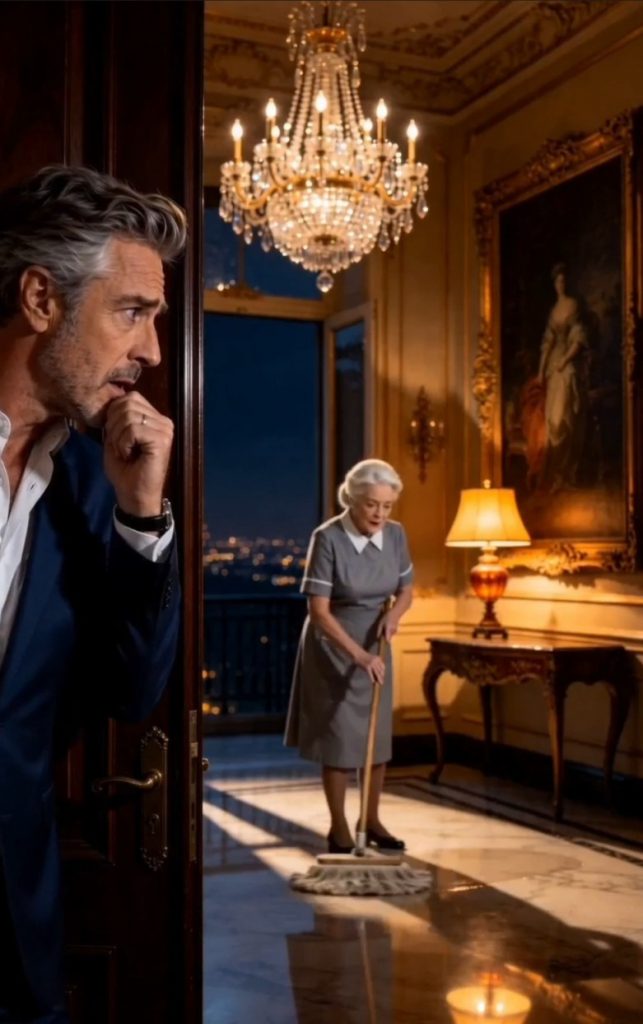
Julian stopped in the doorway of the east drawing room, one hand still resting against the dark wood frame.
Inside, the chandelier hung above the room like frozen rain. Gold-framed oil paintings watched from the walls. A vintage table lamp cast warm amber light over the marble floor, where Evelyn, the elderly maid, moved a mop in slow circles.
She thought she was alone.
Her gray uniform was neat despite the late hour. Her white hair was pinned into a bun at the back of her head. Her shoulders were slightly bent, not from laziness, but from a lifetime of carrying things other people never noticed.
And she was singing.
Not loudly.
Not for anyone.
The melody rose and fell in a haunting, almost operatic lullaby, rich with grief and tenderness. The notes slipped through the room like something old finally finding air.
Julian’s body went cold.
He knew that song.
He had known it before he knew words. He had heard it in dreams since childhood, waking with tears on his face and no memory of why. He had hummed it once as a boy at breakfast, and his adoptive mother had dropped a porcelain cup so hard it shattered across the floor.
“Never sing that again,” she had said.
Julian had been six.
He never forgot the fear in her voice.
Now, forty-three years later, a maid in his own mansion was singing it while mopping the floor.
He stepped into the room.
Evelyn stopped at once.
The mop handle trembled in her hands as she turned. “Mr. Vale,” she said, startled. “I’m sorry. I didn’t know anyone was still awake.”
Julian could barely breathe.
“Where did you learn that song?”
The question came out raw.
Evelyn’s face changed.
At first, there was confusion. Then recognition. Then something deeper and older than fear.
She gripped the mop handle with both hands.
Her eyes filled with tears she did not allow to fall.
“I…” She took a shaky breath. “I sang that song to my son when he was little.”
Julian stood five feet away from her, frozen beneath the chandelier.
The room seemed to tilt.
“Your son?”
Evelyn nodded once.
A faint, broken smile appeared on her face.
“He used to cry at night,” she whispered. “That song was the only thing that calmed him.”
Julian’s hand rose slowly to his chest.
Beneath his open collar, hidden under his white shirt, hung a tiny gold charm he had worn his whole life. A crescent moon with one small dent along the edge.
He had never known where it came from.
He pulled it free.
Evelyn saw it.
The mop slipped from her hand and struck the marble floor.
Her face went white.
And before Julian could ask another question, she whispered the name no one had called him since before he could remember.
“Gabriel?”
The mansion went silent around them.
And Julian suddenly understood that the woman cleaning his floor might be the mother he had been told was dead.
Act II
Julian Vale had grown up inside beautiful rooms where no one told the truth.
His adoptive parents, Richard and Celeste Vale, were old money in the way American families pretend to be when they have enough portraits and lawyers. They lived in houses with gates, hosted dinners for judges, donated to hospitals, and taught Julian that gratitude was the first duty of a rescued child.
Rescued.
That was the word Celeste used.
“You were given a life,” she told him whenever he asked about his birth family. “Do not insult it by digging through tragedy.”
The official story was simple.
Julian’s biological parents had died in a fire at a boarding house on the edge of Boston. He had been an infant. No relatives had come forward. Richard Vale, a friend of the charity that handled the case, had adopted him quietly.
Julian was expected to feel lucky.
For many years, he tried.
He grew into the life he was given. Private schools. Law degree. Board seats. A company built from investments he expanded into a fortune of his own. By forty-eight, he owned properties in three countries, appeared on magazine covers, and had learned how to smile in rooms where every person wanted something.
But the questions never left.
They hid in small things.
The gold crescent charm Celeste refused to discuss.
The lullaby that made her angry.
The sealed adoption file Richard kept in a locked cabinet.
The way family friends paused whenever Julian asked whether anyone remembered the fire.
Then Richard died.
Celeste followed five years later, leaving Julian the old Vale mansion and a letter with only four sentences.
Some doors should remain closed. You were loved in the only way possible. Do not punish the dead. Forgive us.
Julian had spent months trying to understand whether it was an apology or a warning.
He found nothing in the mansion at first. The file cabinet had been emptied. The family attorney claimed all adoption papers had been “lost in an office flood” decades earlier. Former staff had either died, vanished, or developed very convenient gaps in memory.
Then Evelyn Marsh applied for a housekeeping position.
She came with references from old estates, museums, and private homes where discretion mattered. She never complained, never gossiped, never asked personal questions. She moved through the mansion quietly, as if she had trained herself not to disturb the lives of people who would not notice hers.
Julian noticed her anyway.
Not at first because of the song.
Because of the way she looked at the house.
Most staff saw expensive furniture, difficult marble, fragile antiques.
Evelyn saw ghosts.
Once, Julian caught her standing in the nursery wing, now used for storage. She had one hand on the doorframe and tears in her eyes. When he asked if she was all right, she said the dust had irritated them.
He did not believe her.
Another time, she found an old blue blanket in a cedar chest and sat down so suddenly the housekeeper thought she might faint.
Julian began watching her without knowing why.
Not suspiciously.
Carefully.
As if some buried part of him had recognized her before his mind had permission to.
And now she stood in the drawing room with both hands pressed to her mouth, staring at the crescent charm around his neck.
“Where did you get that?” she asked.
Julian’s voice barely worked.
“I’ve had it since I was a baby.”
Evelyn closed her eyes.
A tear escaped.
“I tied it around his neck myself.”
“Whose neck?”
She opened her eyes.
“My son’s.”
Julian shook his head slowly.
“No. My mother told me—”
“Your mother?” Evelyn’s voice cracked. “Was her name Celeste Vale?”
The name struck like a bell.
Julian stepped back.
Evelyn looked suddenly afraid, not of him, but of the truth arriving too fast.
“I worked for the Vales,” she said. “A long time ago. Before you were born.”
Julian’s pulse roared in his ears.
“You never told me that.”
“I didn’t know who you were.”
“But you came here.”
“I came because I heard the mansion had changed hands. I wanted to see the nursery once before I died.”
Julian stared at her.
The chandelier glittered above them, cold and perfect.
“What happened to your son?”
Evelyn’s lips trembled.
“They told me he died.”
Julian felt the floor vanish beneath him.
And somewhere in the mansion, behind locked walls and dead names, a forty-eight-year-old lie began to break open.
Act III
Evelyn told the story in the library because she could not stand in the drawing room anymore.
Julian poured tea neither of them drank.
Outside the French doors, the balcony looked over the dark city. Inside, the old books watched from mahogany shelves as if they too had been waiting.
“I was twenty-four,” Evelyn began. “My name was Evelyn Marsh then. I was a junior maid in this house.”
Julian sat across from her, the crescent charm still warm against his palm.
“Richard Vale was already married to Celeste?”
“Yes.”
“Then who was my father?”
Evelyn looked at him with a sorrow that made the answer arrive before she spoke.
“Richard.”
Julian went still.
Not because scandal shocked him. Wealth had taught him that powerful men often built respectable lives on quiet harm.
But this was not abstract.
This was his blood.
Evelyn lowered her eyes.
“I was foolish enough to believe kindness meant love. Richard was charming when no one was watching. He told me he would help me leave service. He told me I mattered.”
Her mouth twisted faintly.
“Men like him can say beautiful things when there is no cost attached.”
Julian said nothing.
His own life suddenly felt like a house built on a grave.
“When I became pregnant, Celeste found out before I could leave,” Evelyn continued. “I thought she would throw me out. Instead, she sent me to a private clinic under another name. She said the child would be cared for. She said if I tried to expose Richard, she would have me declared unstable and the baby taken anyway.”
Julian’s hands tightened.
“What did Richard do?”
Evelyn laughed once, softly and without humor.
“He disappeared into business trips until the worst was over.”
The worst.
Julian hated the phrase.
“When my son was born, they let me hold him for one night. I sang to him because he cried and cried. Then a nurse came in before dawn and said he had breathing trouble. By morning, they told me he was gone.”
Her voice thinned.
“I begged to see him. They refused.”
Julian looked down at the charm.
“You tied this around me before they took me.”
“My mother gave it to me,” Evelyn said. “I had nothing else. I wanted him to have one thing that was mine.”
For a long time, neither of them spoke.
Then Evelyn reached into the pocket of her uniform and removed a folded cloth pouch.
“I kept his other things.”
She placed it on the table.
Inside was a hospital bracelet, yellowed with age. A tiny photograph, blurred but clear enough to show a newborn wrapped in a pale blanket. And a brittle piece of paper with a melody written by hand.
The lullaby.
Julian touched the music sheet with trembling fingers.
“What was his name?”
Evelyn looked at him.
“Gabriel Marsh.”
The name moved through him like memory.
Not remembered exactly.
Felt.
“I was told my birth name was unknown,” Julian whispered.
“They erased it.”
The library door opened.
Both turned.
Margaret Bell, the mansion’s long-serving estate manager, stood in the doorway in a dark robe. She was nearly eighty, rigid-backed, with silver hair and a face shaped by decades of secrets kept too well.
“I knew this night would come,” she said.
Julian stood.
“You knew?”
Margaret’s face did not change, but her eyes were wet.
“I was the upstairs maid then. Celeste made me carry the child from the clinic carriage into this house.”
Evelyn gripped the arm of her chair.
“You saw him alive?”
Margaret nodded.
“They told me he was being adopted out. I didn’t know they had told you he died.”
Julian’s voice turned cold.
“Where is the proof?”
Margaret hesitated.
The hesitation was answer enough.
“Where?” he demanded.
She looked toward the portrait wall.
“Behind Celeste’s painting.”
Julian crossed the library in three strides and pulled the gold-framed portrait from the wall. Behind it, set into the paneling, was a small safe.
Margaret gave him the combination from memory.
The safe clicked open.
Inside lay the file Celeste had spent a lifetime hiding.
Birth records.
Payments to the clinic.
A false death certificate for Gabriel Marsh.
Adoption papers signed by Richard and Celeste Vale two weeks later.
And a letter in Celeste’s handwriting.
The child is Richard’s. He will be raised as ours. The maid is never to know.
Julian read the sentence once.
Then again.
His vision blurred.
Evelyn made a small sound behind him, as if her heart had been struck after all these years and still somehow found a new place to break.
But at the bottom of the file lay one more document.
A trust amendment.
Richard Vale had left controlling shares of the family estate not to Julian directly, but to “my biological issue, born Gabriel Marsh, once identity is confirmed.”
Julian understood at once.
Celeste had not only stolen Evelyn’s son.
She had stolen Evelyn’s truth because Richard, in his cowardice, had tried to confess through money after death.
And the family attorneys had buried that too.
Act IV
By morning, the mansion was full of lawyers.
By noon, it was full of enemies.
Julian’s cousins arrived first, dressed in outrage and expensive wool. They had lived for years on distributions from the Vale estate, treating Julian as the adopted branch of a family tree they considered theirs by natural right.
Now they learned he was Richard Vale’s biological son.
Worse, they learned the trust gave him more power than they had ever imagined.
And that Evelyn, the maid they had ignored at Christmas dinners and charity receptions, was his mother.
“This is absurd,” his cousin Lawrence said, pacing the drawing room. “You’re letting an old servant manipulate you.”
The word servant landed like a slap.
Julian looked at him.
“Say that again.”
Lawrence stopped pacing.
Evelyn sat on the sofa near the table lamp, still in her gray uniform because she had refused to change into borrowed silk for anyone’s comfort. Her hands were folded in her lap. Her posture was straight.
She looked frightened.
But not ashamed.
Julian stood beside her.
The family attorney, Mr. Caldwell, cleared his throat.
“We need to verify the documents before making emotional accusations.”
Julian turned to him.
“You told me the adoption file was destroyed.”
Caldwell adjusted his glasses.
“That was the information available at the time.”
“You were Celeste’s attorney for thirty years.”
“I represented the family.”
“No,” Julian said. “You protected its lies.”
Caldwell’s mouth tightened.
Lawrence pointed toward Evelyn.
“What proof does she have besides a song and a trinket?”
Julian placed the hospital bracelet on the table.
Then the birth certificate.
Then Celeste’s letter.
Then a DNA test request form already signed.
“Enough to begin,” he said. “More than enough to scare you.”
His cousin’s face reddened.
“You would destroy this family over her?”
Julian’s answer came softly.
“This family was built by destroying her.”
The room fell silent.
Evelyn looked down, but Julian saw the tear slide along her cheek.
For most of her life, people had spoken around her, over her, about her. They had called her unstable, unfortunate, replaceable. They had made her grief look like madness because madness was easier to dismiss than theft.
Now, at last, someone with power was saying what had happened plainly.
Caldwell tried one final move.
“Mr. Vale, even if the story is true, public exposure would damage the foundation, the board, the charities—”
“The image,” Julian said.
Caldwell did not answer.
Julian almost laughed.
The Vale family had stolen a child, broken a mother, forged records, and hidden behind philanthropy for nearly five decades. Yet still, the first concern in the room was reputation.
He walked to the French doors and looked out over the city.
For years, he had believed wealth made him rootless because he had been brought in from tragedy. Now he understood the opposite.
He had roots.
They had been cut.
He turned back.
“Here is what happens next. The documents go to the court. The clinic records are subpoenaed. The foundation issues a public correction. Evelyn Marsh’s name is restored to every record where it was erased.”
Lawrence scoffed.
“And if we refuse?”
Julian looked at him with the full coldness of a man who had inherited not only fortune, but the truth behind it.
“Then I release Celeste’s letter, Richard’s file, and every payment record by sunset.”
No one spoke.
Then Evelyn rose slowly.
Everyone turned toward her as if startled she could stand without permission.
“I don’t want revenge,” she said.
Her voice was soft, but it carried.
“I wanted my son. That was all. I wanted to know if he laughed. If he liked music. If he was kind. I wanted to know whether he was cold at night, whether someone held him when he cried.”
Julian’s face broke.
Evelyn looked at the cousins, the attorney, the portraits on the wall.
“You had money. You had houses. You had names on buildings. And still, you took the only thing I had.”
No one could answer her.
Because there are some truths even rich people cannot buy their way around once they are spoken aloud.
Julian stepped toward her.
For the first time, he did not call her Evelyn.
He whispered, “Mother.”
She covered her mouth.
Then he held out his hand.
And after forty-eight years of being robbed of that word, Evelyn took it.
Act V
The DNA results came back on a rainy Thursday.
Julian already knew.
So did Evelyn.
But when the report confirmed a biological parent-child relationship, Evelyn held the paper to her chest and wept so hard Julian had to sit beside her until the storm passed.
“I thought I buried you,” she whispered.
Julian could not speak.
He had spent his life believing he was the rescued child of dead strangers. Now he was a stolen son sitting beside the mother who had sung him through his first night on earth.
There was no simple way to heal that.
They did not pretend otherwise.
At first, Evelyn refused to move out of the staff room.
“I’ve slept in smaller,” she said, embarrassed by the guest suite Julian offered.
“That isn’t the point.”
“It feels too grand.”
“It’s your house too.”
She looked at him then, startled.
He meant it.
Not sentimentally. Legally.
Julian amended the estate structure, creating a restitution trust in Evelyn’s name and funding an investigation into the private clinic that had helped arrange the fraud. The Vale Foundation issued a public statement that did not hide behind careful language.
Gabriel Marsh was taken from his mother through falsified medical and adoption records.
Evelyn Marsh was lied to, threatened, and erased.
The Vale estate accepts responsibility.
The statement shook old circles.
Former nurses came forward. Other women called. Some had similar stories, half-memories of babies declared gone, papers signed under pressure, wealthy families appearing where grief had left no strength to fight.
The scandal grew beyond Julian.
He let it.
Some relatives cut him off. Some donors withdrew support. The portrait of Celeste Vale was removed from the library wall and placed in storage, not destroyed, because Julian wanted the record kept intact.
Pretty lies were still evidence.
Evelyn changed more slowly.
For weeks, she moved through the mansion like someone afraid the rooms would reject her. She apologized for sitting on expensive chairs. She tried to help the staff clear dishes. She folded her own towels and called Julian “Mr. Vale” whenever she was nervous.
Each time, he corrected her gently.
“Julian is fine.”
One evening, while snow fell beyond the French doors, he found her in the nursery wing.
The room had been restored.
Not to erase the past, but to make it visible. The cedar chest stood open. The blue blanket lay folded over a rocking chair. On the wall hung a framed copy of the lullaby she had written from memory after the original was placed in evidence.
Evelyn stood beneath it.
“I don’t know how to be your mother now,” she admitted.
Julian stood beside her.
“I don’t know how to be your son.”
She looked at him.
The honesty seemed to comfort them both.
“We can learn,” he said.
So they did.
Awkwardly.
Tenderly.
In small pieces.
She told him he hated carrots as a baby, though she only had one night to learn it. He told her he hated them still. She told him she had once dreamed of singing on stage before service swallowed her life. He arranged a private vocal coach, and she scolded him for extravagance before secretly enjoying every lesson.
He played recordings of operas in the evenings.
She corrected his pronunciation.
He asked her about his first hours.
She answered when she could.
Sometimes she cried.
Sometimes he did.
Neither apologized for it anymore.
Months later, the mansion held a concert.
Not a gala. Julian refused to call it that.
No champagne towers. No press wall. No cousins pretending forgiveness under chandeliers.
Just a benefit for families harmed by illegal adoption practices, with survivors invited as honored guests rather than symbols for wealthy people to applaud.
At the end of the night, Evelyn stood in the drawing room beneath the chandelier.
She wore a dark blue dress Julian had not chosen for her, because she insisted on choosing for herself now. Her white hair was still pinned neatly, but the maid’s uniform was gone.
Julian stood near the doorway, exactly where he had stood the night he first heard her sing.
The room quieted.
Evelyn looked at him.
For a second, she was back in that clinic room forty-eight years ago, holding a baby she was told she would never see again.
Then she began the lullaby.
The same melody.
Soft.
Operatic.
Haunting.
But different now.
It no longer sounded like a ghost calling from behind a locked door.
It sounded like a mother singing to the son who had finally come home.
Julian did not hide his tears.
When the last note faded, no one clapped immediately. The silence that followed was too full for applause.
Then Julian crossed the room.
He took Evelyn’s hands in his.
Under the chandelier, surrounded by people who understood what it meant to have a life rewritten by truth, he bent and kissed his mother’s knuckles.
“Thank you for singing,” he whispered.
Evelyn smiled through tears.
“Thank you for listening.”
Outside, the city lights shimmered beyond the balcony.
Inside, the mansion that had once hidden a stolen child held the truth in every corner.
And for the first time in nearly half a century, the song did not end in loss.