Act I
The laughter was louder than the jukebox.
It rolled through the diner in ugly waves, bouncing off the red vinyl booths, the polished tile floor, and the wide front windows looking out at a gray afternoon. Plates sat half-eaten. Coffee cooled in white mugs. The waitress behind the counter froze with a pot in her hand, unsure whether to move or pretend she had not seen.
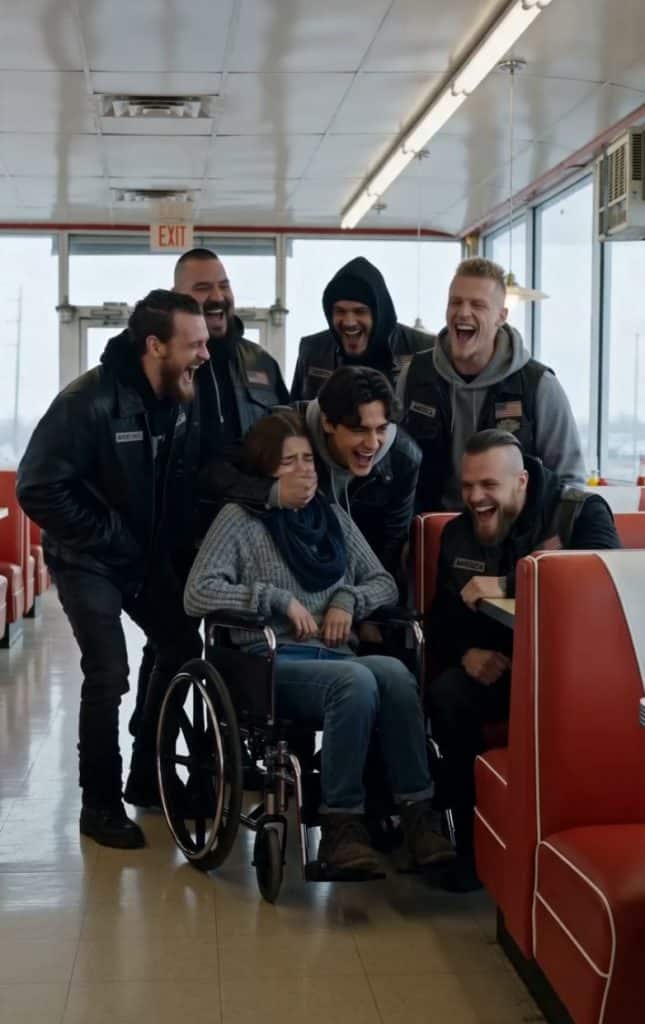
At the corner booth, Ava Monroe sat trapped in her wheelchair.
Her long brown hair had fallen across her face. Her gray sweater was stretched at one shoulder where someone had grabbed it. Her blue scarf, the one she wore every winter since the accident, had slipped loose against her lap.
And Trent Harlan had his hand clamped over her mouth.
He leaned over the back of the booth, dark hair falling into his eyes, black leather jacket creaking as he pressed closer. Behind him, three of his friends crowded in like a wall. Two more sat in the booth beside Ava, laughing as if they had bought tickets to her humiliation.
“What’s wrong?” Trent sneered. “Can’t stand up and leave?”
Ava squeezed her eyes shut.
Tears slipped down her face and onto his hand.
That made them laugh harder.
“Why are you even here?” one of the boys at the table said.
Ava tried to turn her head away, but Trent held her jaw still.
“This isn’t a hospital, you know,” he said, releasing her just enough so she could gasp for air.
Across the diner, people stared into their plates.
A man in a business shirt shifted in his seat and looked toward the exit.
A woman whispered, “Someone should do something.”
No one did.
Because Trent Harlan was not just cruel.
He was protected.
His father owned half the block. His uncle sat on the city council. His family’s construction company had been trying to buy the old diner for months, and everyone in town knew the Monroes were the only ones standing in the way.
Ava knew it too.
That was why she had come.
Not for lunch.
For a meeting.
She had a folder in the side pouch of her wheelchair, full of papers her mother had hidden before she died. Papers proving the diner was worth more than the Harlans offered. Papers proving they had been harassing tenants, bribing inspectors, and trying to force the last independent businesses off the street.
Trent knew about the folder.
He had come to take it.
His hand slid toward the pouch.
Ava grabbed his wrist.
For one second, her fear became defiance.
Trent’s smile disappeared.
“Don’t.”
Then the glass doors at the front of the diner opened hard.
The bell above them gave a violent little ring.
Three men walked in.
Black leather. Heavy boots. Broad shoulders. Patches stitched across their vests: AMERICA. MOTOR. VETERAN. ROAD SAINTS.
The man in front was the largest.
Shaved head. Salt-and-pepper beard. Tactical gloves. Calm eyes that swept the diner once and understood everything before anyone spoke.
His boots struck the tile in slow, heavy beats.
The laughter died.
He stopped beside the booth.
“Hey,” he said.
Trent looked up, irritation turning to uncertainty.
The biker leader reached out and gripped Trent’s shoulder, not violently, but with enough strength to remind him how small arrogance looks when it meets real authority.
He pulled him back from Ava.
“Wait a second,” the man said, voice low and gravelly. “I don’t get it. What’s going on here?”
Trent’s face drained of color.
Because he recognized the man.
Everyone in that diner did.
Gideon Cross had buried soldiers, found missing daughters, and once dragged a burning driver out of a wreck before the fire trucks arrived.
And three years ago, he had stood beside Ava Monroe’s hospital bed and made her father a promise.
Now he was here to keep it.
Act II
Before the wheelchair, Ava had been the fastest waitress at Monroe’s Diner.
She could carry four plates on one arm, remember six orders without writing them down, and slide a milkshake across the counter to a kid before he finished asking for extra whipped cream.
The diner had belonged to her parents.
Frank and Lily Monroe opened it when Ava was five, back when the street was still mostly pawn shops, laundromats, and tired brick buildings with good bones. Frank cooked. Lily handled customers. Ava grew up in a booth near the back, doing homework under the smell of coffee and frying onions.
On Saturday mornings, the Road Saints came in.
They were not the kind of bikers people crossed the of bikers people crossed the street to avoid. They were veterans, mechanics, truckers, nurses, widowers, and men who looked frightening until a child asked about the patches on their vests.
Frank had served with Gideon Cross years earlier.
They called each other brothers, though blood had nothing to do with it.
When Ava was little, Gideon would lift her onto one of the motorcycles outside and tell her, “Never let anybody make you feel small, kid.”
She believed him.
Then the accident happened.
Ava was nineteen, driving home from a late shift with a box of leftover pie in the passenger seat. A black pickup ran a red light on Sycamore Avenue and hit her car hard enough to fold the driver’s side inward.
The driver fled.
Ava survived.
Her legs did not fully recover.
For months, the town brought casseroles and flowers. People cried beside her hospital bed. People called her brave. People said she was lucky.
Ava hated that word for a while.
Lucky meant alive, yes.
But lucky did not help her into the shower. Lucky did not stop strangers from staring. Lucky did not make the old diner doorway wider or the kitchen aisles easier to navigate.
Her father blamed himself for not picking her up that night.
Her mother blamed the city for the broken traffic camera.
Gideon blamed the driver.
He searched quietly.
So did Frank.
Then Frank died the following winter of a heart attack, though Ava always thought grief had done half the work.
Lily kept the diner alive after that.
Barely.
Medical bills stacked up. Repairs went unfinished. Developers began calling. Harlan Construction made their first offer six months after Frank’s funeral.
Lily refused.
“This place fed half this town when they had nothing,” she told Ava. “I’m not selling it to men who want to turn it into a luxury parking garage.”
But Lily got sick.
Quietly at first. Then all at once.
Before she died, she gave Ava a blue scarf and a locked metal box.
“Your father kept records,” she said. “Gideon knows some of it, but not all. If the Harlans push too hard, open it.”
Ava had opened it three days ago.
Inside were photographs of the black pickup from the night of her accident.
A repair invoice.
A witness statement.
And a security still from a gas station showing Trent Harlan getting out of the damaged truck less than twenty minutes after the crash.
His father had paid cash for the repairs.
His uncle had made sure the police report went nowhere.
Ava had spent three days shaking with rage.
Today, she came to the diner to meet a lawyer.
Instead, Trent came first.
And now Gideon Cross stood beside her booth, staring at the boy who had laughed at the damage his family helped create.
The diner was no longer quiet from fear.
It was quiet because everyone could feel the past walking in behind him.
Act III
Trent tried to laugh.
It came out thin.
“Relax, man. We were just joking.”
Gideon looked at Ava.
Her face was wet. Her hands were trembling. One wheel of her chair had been shoved awkwardly against the table leg, trapping her in place.
“That true?” Gideon asked her.
Ava swallowed.
“No.”
The single word hit harder than a shout.
Gideon turned back to Trent.
“There’s your answer.”
One of Trent’s friends stood from the booth.
“Dude, let’s just go.”
“No one’s going anywhere yet,” Gideon said.
The boy sat back down.
Ava reached for the side pouch of her chair, but her fingers shook too badly to grip the zipper. Gideon noticed and crouched beside her.
“Folder?”
She nodded.
He pulled it free and placed it gently in her lap.
Trent’s face changed.
“That’s private property.”
Ava looked up at him.
“No,” she said. “It’s evidence.”
The word moved through the diner like a match struck in the dark.
Gideon opened the folder.
He did not rush.
He read the first page. Then the second. Then the repair invoice with Harlan Construction’s company account printed at the top.
His jaw tightened.
Ava watched him reach the photograph.
The black pickup.
The broken headlight.
The date.
Then the gas station image of Trent.
Gideon stood slowly.
“You were driving.”
Trent’s mouth opened.
His friends stared at him.
“I don’t know what that is,” Trent said.
Ava’s voice shook, but she forced it out.
“You hit my car.”
The diner seemed to shrink around them.
“You left me there,” she continued. “Then your dad paid to hide it.”
Trent looked toward the front door.
One of the other bikers stepped in front of it.
Not threatening.
Simply present.
Gideon took out his phone and dialed.
“Detective Ramos,” he said when the call connected. “It’s Cross. I need you at Monroe’s Diner. Bring the warrant file you said was missing a witness.”
Trent went pale.
Gideon listened, then looked at Ava.
“Yes,” he said. “She has the invoice.”
Ava’s heart pounded.
“You knew?” she whispered.
Gideon’s expression softened.
“I suspected. Your father suspected more.”
He reached into the inside pocket of his vest and pulled out a small envelope, creased from years of being carried.
“Frank gave me this before he died. Said if Lily ever found the rest, we’d open both together.”
Ava stared at the envelope.
Her father’s handwriting ran across the front.
For my girl, when the cowards finally show their faces.
Ava pressed a hand to her mouth.
Gideon opened it.
Inside was a flash drive and one folded letter.
He handed her the letter first.
Ava read only the first line before tears blurred the page.
Baby, if you’re reading this, I need you to know your pain was never invisible to me.
She could not keep reading.
Gideon did it for her, voice low enough that only the nearest tables heard.
Frank had tracked the truck. Frank had found the repair shop. Frank had confronted Robert Harlan and been warned to stay quiet if he wanted the diner to survive.
The flash drive held the recording.
Frank’s final insurance policy.
Ava looked at Trent.
For the first time, he did not look like a bully.
He looked like a boy standing under the weight of the men who taught him he could get away with anything.
Then the double doors opened again.
Detective Ramos entered with two uniformed officers.
Behind them came a man in an expensive camel coat.
Robert Harlan.
Trent’s father.
His eyes found the folder in Ava’s lap.
Then Gideon’s vest.
Then the entire diner watching.
And for the first time in years, the Harlans had walked into a room they did not control.
Act IV
Robert Harlan did not raise his voice.
That was how men like him survived.
He smiled, adjusted his coat, and looked at Detective Ramos as if they were two reasonable adults interrupting children at play.
“This is a misunderstanding,” he said. “My son and his friends were being stupid. I’ll pay for any damage.”
Ava almost laughed.
Damage.
As if a body were a bumper.
As if years of fear could be polished out of existence.
Detective Ramos did not smile back.
“Mr. Harlan, we’re past that.”
Robert’s eyes flicked toward Gideon.
“Cross, this doesn’t concern you.”
Gideon folded his arms.
“Frank Monroe made it concern me.”
At the sound of her father’s name, Ava straightened in her chair.
Robert’s jaw tightened.
“He was a desperate man.”
“He was a father,” Ava said.
The words surprised even her.
The diner turned toward her.
For months after the accident, Ava had hated being looked at. She hated the pity most of all. But this was different. Nobody was looking at her like she was broken.
They were looking at her like she was finally being heard.
Robert stepped toward her.
Gideon moved half a step.
Robert stopped.
“You have no idea what kind of trouble you’re inviting,” he said.
Ava opened the folder and lifted the repair invoice.
“No. I think I finally do.”
Detective Ramos took the flash drive from Gideon and handed it to one of the officers, who plugged it into a laptop at the counter.
Frank Monroe’s voice filled the diner.
Steady.
Tired.
Furious.
“My name is Frank Monroe. If this recording is being played, it means Robert Harlan kept pushing. On November 14th, his son Trent struck my daughter’s vehicle at Sycamore and 8th, then fled the scene. I have obtained the repair invoice, a witness statement, and audio of Mr. Harlan offering to buy my silence.”
The recording crackled.
Then Robert’s voice came through.
Clear.
Cold.
“Take the money, Frank. Your daughter’s already damaged. Don’t make the rest of your life worse.”
Ava closed her eyes.
The diner erupted.
Not in chaos.
In disgust.
The waitress behind the counter whispered, “Oh my God.”
One of Trent’s friends stood up so fast he hit the table.
“You said it was just an accident,” he snapped at Trent.
Trent looked sick.
Robert’s face hardened.
“That recording is illegal.”
Detective Ramos looked at him.
“You can discuss that with your attorney.”
An officer stepped toward Trent.
He backed away.
“I didn’t mean to hurt her,” he said, panic cracking his voice.
Ava looked at him.
“That might have mattered if you stopped.”
The words cut through him.
Trent lowered his eyes.
For once, he had no joke.
No smirk.
No wall of friends laughing behind him.
The officer read him his rights.
Robert tried to intervene. Then Detective Ramos placed a hand on his arm and said his name in a tone that made the whole diner understand the father was not leaving untouched either.
The other boys were separated and questioned.
Some began talking before they reached the police cars.
Bullies often look loyal until consequences arrive.
The two at the booth admitted they came because Trent said Ava had “papers” that needed to disappear. One confessed Robert had ordered the group to scare her off before the lawyer arrived.
The lawyer, late because of traffic, stepped into the diner just as Robert Harlan was being escorted out.
She looked at Ava.
Then at Gideon.
Then at the open folder.
“I assume,” she said carefully, “the meeting has started.”
For the first time that day, Ava laughed.
It broke through tears, shaky and stunned, but real.
Gideon looked down at her.
“You okay, kid?”
Ava wiped her face.
“No.”
He nodded.
“Fair answer.”
Then he picked up the ruined scarf from her lap, shook it once, and placed it gently around her shoulders.
Her mother’s scarf.
Her father’s evidence.
Her own voice.
All of it had survived.
Act V
The diner stayed closed for three weeks.
Not because Ava was hiding.
Because the front booth had to be repaired, the security cameras upgraded, the doorway widened properly, and the old back office cleared of every document her parents had saved for a day they prayed would never come.
The case against the Harlans spread faster than anyone expected.
Once Trent’s hit-and-run reopened, other things surfaced. Threatened tenants. False code violations. Payments to inspectors. Quiet lawsuits settled before trial. The family business, once treated like a pillar of the city, began to look more like a machine built to grind down people who could not fight back.
Robert Harlan resigned from two boards before charges were even filed.
His brother lost his council seat.
Trent’s friends hired lawyers and learned quickly that laughter recorded on diner security footage does not age well in court.
Ava did not watch every hearing.
Some days, she could. Some days, she could not.
Healing was not a straight road just because the truth finally had headlights.
But the diner helped.
Gideon and the Road Saints showed up the first Saturday after the police tape came down. They did not ask what needed doing. They brought tools.
One fixed the ramp.
One repaired the booths.
One spent six hours rewiring the old jukebox.
Gideon sanded the front door himself, quiet and focused, until Ava rolled up beside him.
“You don’t have to do all this,” she said.
He kept working.
“I know.”
“My dad asked you?”
“He did.”
She looked at him.
“And if he hadn’t?”
Gideon stopped sanding.
“Then I’d still be here.”
Ava nodded, unable to speak for a moment.
The reopening happened on a bright morning after a week of rain.
Someone had painted the window letters fresh.
MONROE’S DINER
Coffee. Pie. Open since 1989.
A line formed before nine.
Old regulars came first. Then neighbors. Then people who had never cared about the diner until they saw what almost happened to it and realized caring late was better than never caring at all.
Ava sat near the register, nervous hands folded around a mug of tea.
She still hated the corner booth.
So Gideon changed it.
He removed the table that had trapped her chair and replaced it with an accessible one built from dark wood. On the wall beside it, he mounted a small framed photograph.
Frank and Lily Monroe on opening day.
Young. Smiling. Covered in flour.
Below it was a sentence from Frank’s letter.
My girl, never let them convince you that surviving made you smaller.
Ava stared at it until the words blurred.
Then the bell above the door rang.
Detective Ramos entered with the lawyer, carrying a signed injunction that halted the forced property sale and opened a civil case against Harlan Construction.
Ava took the papers.
For once, legal language looked beautiful.
By noon, the diner was full.
Not loud like the day of the bullying.
Alive.
Plates clattered. Coffee poured. Someone laughed from the counter. The jukebox played an old rock song Frank used to love.
Gideon sat in the booth nearest the door, as if guarding it without needing to say so.
Ava rolled over with a coffee pot.
“You know,” she said, “customers usually order before they sit for two hours.”
He looked up.
“I’m waiting on the pie.”
“You’ve had two slices.”
“I’m a patient man.”
She smiled.
It came easier now.
Across the diner, a teenage boy held the door open for an elderly woman with a walker. A little girl at the counter asked Ava if her chair was fast. Ava told her, very seriously, that it depended on whether she was chasing pie.
The girl giggled.
No one looked away.
That was what Ava noticed most.
People were learning how to see her without turning her into a tragedy.
Near closing, she wheeled outside.
The sky had cleared. The wet street reflected the diner’s red sign. Gideon followed a few steps behind and leaned against his motorcycle.
“You did good today,” he said.
Ava looked through the window at the booth where she had cried.
“I was so scared.”
“I know.”
“I still am.”
“That doesn’t mean you lost.”
She turned to him.
“What does it mean?”
Gideon’s face softened beneath the beard.
“It means you’re human.”
Ava breathed in the cold evening air.
For years, she had thought courage would feel like fear disappearing.
It did not.
Courage felt like opening the diner anyway. Like signing the papers. Like facing the booth. Like saying no to men who expected her to fold because they mistook a wheelchair for weakness.
Inside, the lights glowed warm against the red vinyl seats.
Her parents’ diner still stood.
So did she.
And this time, when the bell above the door rang behind her, Ava did not flinch.
She turned toward the sound, ready to go back in.