Act I
The ice hit Maya before she could raise her hands.
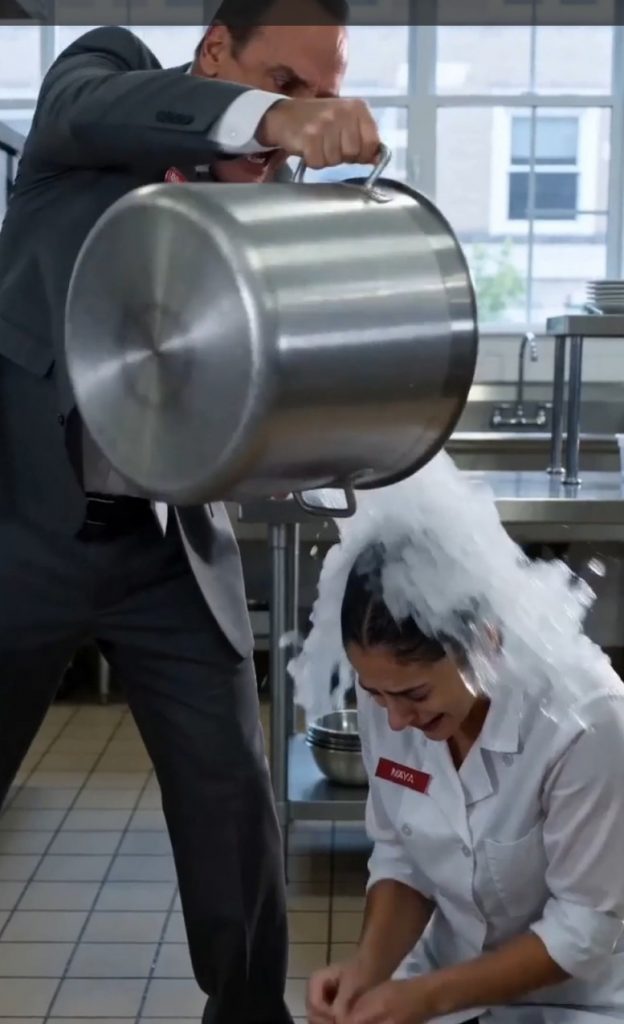
One second she was kneeling on the beige kitchen tiles, trying to explain through tears. The next, a steel pot tilted above her head and a freezing wave crashed over her hair, her face, her white chef’s coat, her red name tag.
MAYA.
Ice cubes clattered across the floor like thrown stones.
The whole kitchen stopped.
Steam rolled from a stockpot on the left burner, thick and white beneath the fluorescent lights. Knives lay abandoned on cutting boards. A chef holding a ceramic plate stood frozen with his mouth slightly open. Another gripped his apron so tightly his knuckles whitened.
Mr. Dixon stood over Maya, red-faced and shaking with rage.
The empty pot hung in his hand.
Then he slammed it onto the stainless steel counter.
The bang echoed through the kitchen.
“Do you even know what you’ve done?” he shouted. “Huh? Do you?”
Maya lowered her hands from her face.
Water dripped from her lashes, her chin, the strands of light brown hair plastered to her cheeks. Her whole body trembled from the cold, but the fear in her eyes was worse than the shivering.
“I…” she whispered. “I…”
Dixon leaned closer, his gray silk tie hanging loose from his collar, his red MANAGEMENT badge flashing under the lights.
“This is so you remember next time,” he roared. “Pay attention, you idiot!”
Maya collapsed inward, arms folded against her chest, shoulders shaking.
No one moved.
That was the worst part.
Not the ice. Not the humiliation. Not even the sting of Dixon’s words.
It was the silence of people who knew something was wrong and still chose the safety of doing nothing.
Dixon pointed toward the floor, toward the spilled water, toward the tiny white ticket still clutched in Maya’s hand.
“You almost destroyed tonight’s service.”
Maya looked down at the ticket.
The ink had begun to bleed from the water, but the warning was still visible.
TABLE 12 — VIP TASTING
NO SHELLFISH
NO CROSS-CONTACT
SEVERE ALLERGY
Her lips trembled.
“I was trying to stop it,” she said.
Dixon’s eyes narrowed.
“Stop what?”
Before Maya could answer, the swinging kitchen doors opened behind him.
And the woman standing there had already heard enough.
Act II
Maya Chen had been at Aster House for forty-three days.
She counted.
Not because she was excited, though she had been at first. She counted because every day she stayed felt like surviving a test no one had explained to her.
Aster House was one of the most famous restaurants in the city, the kind of place where people booked tables months ahead and whispered about the tasting menu like it was theater. The dining room had velvet chairs, candlelight, and hand-painted plates. The kitchen had heat, speed, pressure, and Mr. Dixon.
Dixon was not the chef.
That mattered.
He did not create the food. He did not sharpen knives, reduce sauces, butcher fish, or stand over a station for fourteen hours until his feet went numb.
But he controlled schedules, payroll, table timing, vendor notes, staff complaints, and fear.
Fear was his real station.
He called it discipline.
He called it standards.
He called it “the price of excellence.”
Maya had believed that at first.
She was twenty-two, fresh out of community culinary school, living with two roommates, sending money home when she could. Her mother had worked in kitchens her whole life, mostly invisible ones: hotel banquets, airport lounges, hospital cafeterias, places where the food mattered but the names never did.
When Maya got the job at Aster House, her mother cried on the phone.
“Keep your head down,” she said. “Learn everything. Don’t let proud people make you small.”
Maya tried.
She arrived early. Stayed late. Labeled containers perfectly. Burned her fingers without complaining. Took corrections. Took insults. Took Dixon’s habit of calling her “little prep girl” in front of the line cooks.
The chefs saw it.
Some looked sorry.
None stopped him.
Because Dixon could cut hours. Dixon could block promotions. Dixon could make a young cook disappear from the schedule and call it “performance.”
That night was supposed to be the most important service of the year.
Aster House’s owner, Evelyn Vale, was coming in for a private tasting with investors, critics, and her teenage son, Henry. Evelyn had inherited the restaurant from her father, the founder, but she rarely appeared in the kitchen anymore. People said she had become all business after her father died.
Dixon had spent the whole week polishing the staff into terror.
“No mistakes,” he said. “No delays. No excuses. Tonight decides our expansion.”
The VIP ticket came in just before seven.
Table 12.
No shellfish. No cross-contact. Severe allergy.
Maya saw it first because she was sorting garnish trays near the pass.
She checked the tasting menu.
Course four was supposed to be a roasted corn agnolotti finished with smoked tomato butter. Vegetarian. Safe.
But the sauce pot at the station smelled wrong.
Not bad.
Just wrong.
Deep. Sweet. Briny.
Maya checked the label.
SMOKED TOMATO BUTTER.
Then she checked the prep sheet.
The pot had been moved from the cold shelf marked for shellfish sauces.
Her stomach tightened.
She lifted the lid and saw the faint orange sheen along the edge.
Lobster stock.
Someone had used the wrong base.
Maybe by mistake. Maybe because they were rushing. Maybe because Dixon had been yelling all evening that no one had time to remake anything.
Maya grabbed the ticket and stepped toward the line.
“Don’t plate that,” she said.
The sous-chef, Adrian, glanced at her.
“What?”
“The sauce. It has lobster stock.”
His face changed.
Dixon heard her from across the kitchen.
“What did you say?”
Maya held up the ticket.
“Table 12 can’t have shellfish. We need to stop course four.”
Dixon crossed the kitchen fast.
He looked at the pot, the ticket, then the clock.
Course four was already late.
The dining room was waiting.
His face hardened.
“It’s fine.”
Maya stared at him.
“It’s not fine.”
The line cooks froze.
Dixon’s voice dropped.
“You are a prep cook. You do not stop service.”
Maya’s hand shook, but she kept holding the ticket.
“If this goes out, someone could get hurt.”
Dixon looked around the kitchen and saw the worst thing a man like him could see.
People listening.
So he made an example.
He ordered the dish remade, but not because he believed her. Because the sous-chef quietly refused to plate it. The delay reached the dining room. The VIP table asked questions. Dixon came back from the front with humiliation burning in his face.
Then he saw the ice bath near pastry.
And Maya was still holding the ticket.
That was when he picked up the pot.
Now, drenched on the floor, Maya finally understood the truth.
Dixon was not angry because she had been careless.
He was angry because she had been right.
And the woman in the doorway knew it too.
Act III
Evelyn Vale did not look like the owner of a restaurant empire when she stepped into the kitchen.
She looked like a mother.
Her black dress was elegant but simple. Her hair was pinned back, and her face was pale with the kind of controlled shock that comes when rage has to wait behind restraint. Beside her stood a boy of about fifteen in a navy blazer, his hand resting lightly over his stomach as he stared at the ticket in Maya’s hand.
Henry Vale.
Table 12.
Dixon straightened so quickly his expression nearly broke.
“Ms. Vale,” he said. “There’s been a misunderstanding.”
Evelyn did not look at him.
She looked at Maya.
The young cook was still on the floor, soaked through, ice melting around her knees.
“What happened?” Evelyn asked.
Dixon stepped in front of Maya.
“She mishandled a critical allergy ticket and disrupted service. I was correcting—”
Evelyn turned to him.
“Move.”
The word was not loud.
It did not need to be.
Dixon moved.
Evelyn crouched in front of Maya, ignoring the wet floor.
“What is your name?”
Maya’s lips barely moved.
“Maya.”
“Maya,” Evelyn said gently, “did you stop the dish because you believed my son’s allergen warning had been ignored?”
Maya nodded.
Dixon laughed once, desperate and sharp.
“She’s guessing. She doesn’t understand the stations.”
The sous-chef Adrian looked down.
Evelyn saw it.
“Adrian,” she said. “Is she guessing?”
The kitchen went silent again.
This time, the silence belonged to him.
Adrian swallowed.
“No, ma’am.”
Dixon turned on him.
“Careful.”
Adrian lifted his eyes.
“No,” he said, voice shaking. “I should have said something sooner.”
A line cook stepped forward.
“The sauce was mislabeled.”
Another added, “It came from the shellfish shelf.”
The chef holding the plate set it down with a trembling hand.
“Maya caught it before it went out.”
Evelyn’s face tightened.
Henry’s eyes filled with tears, though he tried to hide it.
Dixon’s voice rose.
“This is absurd. A bunch of panicked kitchen staff trying to cover for a delay. I have managed this restaurant for six years.”
Evelyn finally stood.
“Yes,” she said. “I’m beginning to understand that.”
She reached for the ticket in Maya’s hand.
Maya hesitated, then gave it to her.
The paper was wet and wrinkled. The warning had bled at the edges. Evelyn held it like evidence.
Then she looked toward the corner of the kitchen, above the walk-in door.
Dixon followed her gaze.
The security camera.
His face changed.
Evelyn noticed.
“Pull the footage,” she said to the assistant behind her.
Dixon’s mouth opened.
“Ms. Vale, with respect, kitchen cameras are for liability only. Reviewing staff interactions without HR present could create—”
“Liability?” Evelyn asked.
Her voice went colder.
“You poured ice water over an employee on camera in my kitchen, and you want to lecture me about liability?”
No one breathed.
Dixon’s red face drained toward gray.
Maya slowly tried to stand.
Her legs buckled.
Henry moved first.
He grabbed a clean towel from the counter and rushed toward her, but stopped just short, looking to Evelyn for permission.
Maya nodded weakly.
Henry handed her the towel.
“Thank you,” he whispered.
Maya clutched it to her chest.
For the first time that night, Dixon looked truly afraid.
Not because Maya had cried.
Because the boy who could have been harmed was thanking her.
Act IV
The footage played in Evelyn’s private dining room twenty minutes later.
Maya sat wrapped in a chef’s jacket three sizes too large, a warm towel around her shoulders, a cup of tea untouched in front of her. Her hair was still damp. Her hands would not stop trembling, so she held them under the table.
Dixon sat across from her.
He had changed tactics.
His rage had become wounded professionalism.
“I regret the optics,” he said. “But kitchens are intense environments. Young staff often don’t understand pressure.”
Evelyn stood near the screen.
Henry sat beside her, silent.
Adrian and two line cooks stood by the wall as witnesses. Their faces were tense, ashamed, and tired in a way that suggested this night had not come from nowhere.
The footage began.
Dixon shouting.
Maya holding up the ticket.
The sauce pot being checked.
Adrian hesitating.
Dixon insisting it was fine.
Maya saying, clearly, “It has lobster stock.”
Then the delay.
The dining room call.
Dixon returning with the ice bath.
The pot rising.
The water falling.
Maya collapsing.
No one spoke when the video ended.
Dixon stared at the table.
Evelyn looked at him with an expression that made the room feel smaller.
“You called this correction.”
Dixon’s jaw worked.
“It was unacceptable. I admit that. But I was under extraordinary stress because she caused panic during a VIP service.”
“No,” Evelyn said. “She prevented one.”
Henry’s voice came quietly from beside her.
“I could have eaten it.”
Dixon looked at him.
“It never would have reached you.”
Henry held his gaze.
“Because she stopped it.”
That simple sentence ended something.
Dixon turned to Evelyn again.
“I have protected this restaurant for years.”
Evelyn’s eyes sharpened.
“From what?”
“Failure.”
“No,” she said. “You protected your control.”
Adrian stepped forward.
His voice was low.
“This isn’t the first time.”
Dixon’s head snapped toward him.
Adrian kept going.
“He screams. He threatens schedules. He changes time cards. He tells people if they complain, they’ll never work in this city again.”
One by one, the others spoke.
A dishwasher fired after asking for overtime.
A pastry assistant mocked until she quit.
A server blamed for a customer complaint Dixon had caused.
A prep cook before Maya who left mid-shift and never came back.
Maya listened, stunned.
She had thought she was alone because everyone stayed quiet.
Now she realized the silence had been full of people drowning separately.
Dixon shoved his chair back.
“This is a coordinated attack.”
Evelyn did not blink.
“No. This is a workplace finally exhaling.”
He pointed at Maya.
“She is manipulating this. She wants sympathy.”
Maya flinched.
Evelyn saw that too.
She walked to the table and placed the wet ticket in front of him.
“This ticket has my son’s name attached to it,” she said. “This ticket carried a warning that mattered. Maya honored it when you did not.”
Dixon’s mouth pressed into a hard line.
“You’re going to take the word of a prep cook over mine?”
Evelyn leaned forward.
“Yes.”
The room went still.
“And do you know why?” she continued. “Because my father built Aster House on the belief that every person in the kitchen had the authority to stop a plate if safety was at risk. Dishwasher. prep cook. executive chef. Anyone.”
Dixon said nothing.
“You buried that rule,” Evelyn said. “She remembered it without ever being taught.”
Maya looked up.
Evelyn turned to her.
“How did you know?”
Maya swallowed.
“My mom.”
Everyone looked at her.
“She worked in kitchens. She always said the person holding the lowest knife can still save the whole room if they pay attention.”
Evelyn’s face softened.
“What was her name?”
“Lina Chen.”
The room changed.
Adrian’s eyes widened.
Evelyn went very still.
“Lina Chen worked here,” she whispered.
Maya nodded slowly.
“Before I was born. She never told me much. Just that this place was beautiful once.”
Evelyn covered her mouth for a second.
Then she said the words that made Dixon’s face collapse completely.
“Your mother saved my father’s life.”
Act V
Maya stared at Evelyn as if she had spoken in another language.
“My mother?”
Evelyn nodded, tears shining in her eyes.
“Twenty-three years ago. My father had a severe reaction during a menu test. Everyone panicked. Lina was the commis on prep. She caught the ingredient error before anyone else understood what was happening and called emergency services.”
Maya’s eyes filled.
Her mother had never told the story that way.
Lina Chen had described her years at Aster House with careful distance, as if the memories were wrapped in both pride and hurt. She had mentioned the founder sometimes, an old-school chef who believed soup could taste like a childhood you had never lived.
But she never said she had saved him.
Evelyn looked toward the kitchen doors.
“My father trusted cooks like your mother more than any manager in a suit. After he died, I stepped away from daily operations. I thought systems would preserve what he built.”
Her voice hardened.
“I was wrong.”
Dixon stood abruptly.
“I’m leaving.”
Two security officers appeared at the door.
Evelyn did not look at them.
“Mr. Dixon, you are suspended effective immediately pending termination and investigation. Your access to payroll, scheduling, vendor accounts, and staff files has been revoked.”
His face twisted.
“You’ll regret this. Service will collapse without me.”
Adrian stepped forward.
“No,” he said. “It might finally run.”
Dixon looked around for support.
There was none.
Not from the chefs.
Not from Evelyn.
Not from the boy he had nearly endangered.
Not from Maya, who sat wrapped in a borrowed jacket, still shaking, but no longer looking at the floor.
Security escorted him out through the back corridor.
No one applauded.
It did not feel like victory yet.
It felt like a door closing on a room that had been locked too long.
The kitchen did not finish service that night.
Evelyn walked into the dining room herself and told every guest there had been a serious safety issue, that no meal was worth risking a life, and that the restaurant would cover all charges. Some guests complained. Most did not. A few stood when the kitchen staff came out, unsure what had happened but aware something brave and painful had taken place behind the swinging doors.
Henry found Maya near the staff lockers.
He held a folded note in both hands.
“I asked my mom if I could write this,” he said.
Maya accepted it carefully.
Inside, in neat teenage handwriting, were two words.
You noticed.
That was when she finally cried.
Not because Dixon had hurt her.
Because someone had named what she had done correctly.
She had noticed.
In a kitchen built on speed and fear, she had paused long enough to see danger. She had trusted her training. She had held the line when everyone above her wanted the plate to move and the problem to vanish.
The next weeks were ugly.
Truth usually is at first.
An outside investigation uncovered altered time records, ignored complaints, unsafe labeling shortcuts, and a culture of intimidation that had been polished over with awards and profitable nights. Dixon’s name disappeared from the restaurant website. Then his influence disappeared from the schedule. Then, slowly, his fear disappeared from the walls.
Evelyn came back to the kitchen every day for a month.
Not as a savior.
As someone learning what she had allowed by being absent.
She listened to dishwashers. Prep cooks. Servers. Porters. Line cooks. People whose names had never appeared in magazine articles but whose labor had carried every glowing review.
Adrian became interim kitchen director.
His first rule was simple.
Anyone can stop a plate.
He printed it in black letters and taped it above the pass.
Maya took three days off.
Evelyn insisted.
When Maya returned, a clean chef’s coat waited for her. Same name tag. Same station. But the kitchen felt different. Not gentle. Professional kitchens are rarely gentle. But the fear had lost its throne.
One morning, Evelyn handed Maya an old photograph.
It showed a younger Lina Chen in a white coat, standing beside Evelyn’s father in the original Aster House kitchen. Lina’s hair was tied back. Her eyes were bright. She looked exhausted and proud.
On the back, written in the founder’s hand, were the words:
Lina sees what others miss.
Maya pressed the photo to her chest.
“My mom kept everything,” she whispered. “But not this.”
“She left it here,” Evelyn said. “Maybe she meant to come back for it.”
Maya shook her head, crying softly.
“Maybe she meant for me to.”
Months later, Aster House reopened fully under a new code of conduct, new safety policies, and a kitchen leadership structure that no longer treated fear as discipline.
The first staff meal after reopening was not fancy.
Rice. roast chicken. vegetables. soup.
Maya made the soup.
She used her mother’s method: low heat, patient hands, salt only after the broth had time to speak.
The staff ate together at the prep tables.
For once, no one stood apart.
Henry visited with Evelyn that afternoon. He brought flowers, not for the dining room, but for the kitchen. White lilies and small yellow chrysanthemums, because Evelyn remembered Lina used to bring those on New Year’s.
Maya placed them near the pass.
Above the sign.
Anyone can stop a plate.
People later told the story of that night in many ways.
Some said a manager lost his career because he humiliated the wrong prep cook. Some said a young woman saved the owner’s son. Some said Aster House changed because one act of cruelty was finally too visible to ignore.
Maya knew the truth was quieter.
A kitchen had been sick long before ice water hit the floor.
She had only been the person kneeling in the middle of it when everyone finally had to look.
Still, she carried that moment with her.
The freezing shock.
The laughter that did not come, because even cruel people knew it had gone too far.
The silence of the bystanders.
The ticket in her hand.
And Evelyn’s voice cutting through the steam.
Move.
Years later, when Maya became head chef of her own small restaurant, she trained every new cook the same way.
She taught knife skills, labeling, station setup, and timing.
Then she taught the rule that mattered most.
“If something feels wrong,” she would say, “stop the plate. I don’t care if the mayor is waiting. I don’t care if I’m yelling. I don’t care if the whole room is watching. Stop the plate.”
Sometimes a young cook would ask why.
Maya would think of her mother.
Of Henry’s note.
Of the cold water running down her face while a powerful man called her an idiot for doing the bravest thing she had ever done.
Then she would answer simply.
“Because paying attention can save someone. And no meal is worth your silence.”