Act I
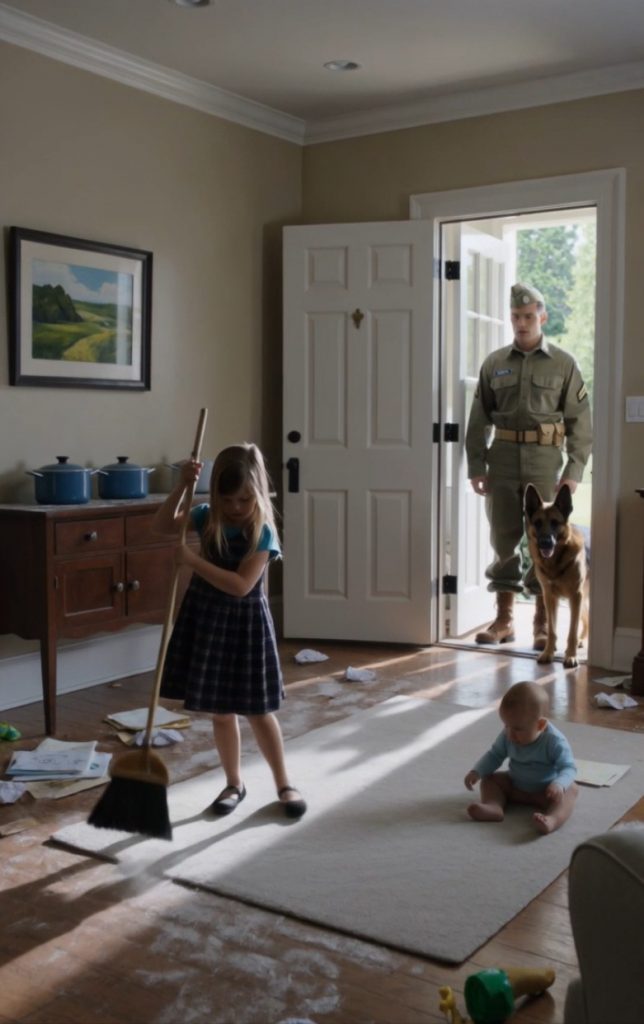
Elias Smith knew something was wrong before he crossed the threshold.
The front door was open.
Not wide. Not broken. Just open enough for sunlight to spill across the hardwood floor in a pale strip that made the broken glass shine.
His duffel bag slipped from his hand and hit the porch behind him.
Max, his German Shepherd, stopped at his heel and gave one low, uncertain whine.
Inside the living room, the house looked as if a storm had passed through it and learned how to hate.
Ceramic shards scattered beneath the sideboard. Papers lay crumpled near the fireplace. Toys were overturned. A stainless steel pot sat on the floor beside a broken plate. The landscape painting above the mantel hung crooked, as if even the walls had flinched.
Then Elias saw his daughter.
Lily was five years old.
She stood in the middle of the ruined room with a broom too long for her small hands, sweeping glass into a careful pile. Her blonde hair fell across her wet face. Her grey plaid pinafore was wrinkled, and her white socks were dark on the bottoms from walking through dust and spilled water.
A baby was tied to her back in a red-and-white checkered cloth sling.
His son.
Noah.
The baby’s tiny hands clutched Lily’s shoulders as he cried into the room, exhausted and hoarse. Lily shifted under his weight, her knees bending as though she might collapse, but she kept sweeping.
Scrape.
Sob.
Scrape.
Sob.
Elias could not move.
For months, he had dreamed of this doorway.
He had imagined Lily running into his arms. Noah blinking at him with the confused wonder of a child who barely remembered his father. His wife, Anna, standing in the hall with one hand over her mouth, laughing and crying at the same time.
Instead, his little girl was cleaning broken glass with a baby on her back.
Elias stepped inside.
His boots sounded too heavy on the floor.
“Lily.”
She froze.
The broom stopped moving.
Slowly, she lifted her head.
For one breath, she stared at him as if she did not trust her own eyes.
Then her face broke.
“Daddy…”
The word nearly brought him to his knees.
Elias crossed the room, careful of the glass, his heart pounding so hard it hurt.
“What are you doing?” he whispered. “Where is your mother?”
Lily’s chin trembled. Her fingers tightened around the broom handle.
Tears rolled down both cheeks.
“Daddy,” she sobbed, “Mommy is gone.”
The baby stopped crying for half a second, as if the house itself had gone silent to hear the answer.
Elias dropped to his knees.
The soldier vanished.
The uniform, the cap, the months of discipline, the hard line of his shoulders—none of it survived the sight of his children shaking in front of him.
He reached for Lily and Noah both, pulling them into his arms with a sound that was more pain than voice.
Lily dropped the broom.
Her small hands clutched the front of his uniform.
“I tried,” she cried into his chest. “I tried to be good. I tried to clean it before she came back.”
Elias held her tighter.
“Before who came back?”
Lily did not answer at first.
She only buried her face against him.
Max stood at the open door, staring down the empty street.
Then, from the kitchen, something moved.
Act II
Elias lifted his head.
The sound had been small.
A scrape.
Not from the children.
Not from Max.
His right arm stayed around Lily while his left hand reached instinctively toward his belt, though he carried no weapon there anymore. He had left the war behind him. Or he had tried to.
“Stay behind me,” he whispered.
Lily grabbed his sleeve.
“No, Daddy. Don’t go in there.”
Her fear froze him more than the sound had.
“Who’s in the house?”
Lily’s eyes darted toward the kitchen doorway.
“No one now.”
That answer was worse.
Elias gently loosened the sling and lifted Noah from Lily’s back. The baby whimpered, then pressed his damp face into Elias’s shoulder. He was heavier than the photograph Elias had carried in his breast pocket. War made babies grow in absence. It made fathers return to strangers who shared their blood.
He passed Noah carefully to Lily only long enough to stand and clear the kitchen.
It was empty.
But not untouched.
Cabinets hung open. Flour dusted the counter. A chair lay on its side near the stove. A cracked jar of peaches had spilled sticky syrup across the tiles. Beside the sink, Elias saw a torn envelope.
His name was written on it.
Captain Elias Smith.
Anna’s handwriting.
He picked it up with shaking fingers.
Only one page remained inside.
Elias,
If you come home and I am not here, do not believe what they tell you. I did not leave the children. I would never leave them. I went to the station because I finally found proof, and if I waited until morning, they were going to take everything.
Please listen to Lily. She sees more than people think.
Forgive me for not telling you sooner. I thought I could keep the danger away from the children until you came home.
I love you.
Anna
Elias read the letter twice.
Then a third time.
The words did not become easier.
They became heavier.
He turned back toward the living room.
Lily stood exactly where he had left her, holding Noah on her hip with effort far beyond her years. Max had moved beside her now, pressing his body against her leg.
“Lily,” Elias said softly, “when did Mommy leave?”
The little girl looked down.
“Yesterday.”
His stomach clenched.
“Yesterday morning?”
She shook her head.
“Night.”
Elias closed his eyes for one terrible second.
His wife had been gone all night.
His children had been alone all night.
“Did she walk out by herself?”
Lily wiped her nose with the back of her hand.
“She said she had to take papers to the police. She said if Mrs. Bell came back, I should lock the door.”
“Mrs. Bell?”
Lily nodded.
Elias knew that name.
Martha Bell lived two houses down. She had been friendly in letters, always inserting herself into Anna’s life under the cover of kindness. She wrote Elias twice while he was overseas, telling him Anna seemed overwhelmed, emotional, perhaps unfit to manage alone.
Elias had hated those letters.
But from across an ocean, worry easily becomes helplessness.
“What did Mrs. Bell do?” he asked.
Lily’s mouth trembled.
“She came with the man.”
“What man?”
“The man with the shiny shoes. He said this house wasn’t ours anymore.”
Elias felt the room tilt.
Lily pointed toward the floor where the broken ceramic lay.
“Mommy told him to leave. He pushed the sideboard. The bowl broke. Noah cried. Then Mommy screamed at him and told me to hide.”
Elias looked around at the wreckage.
This was not neglect.
This was a warning written in broken things.
And Anna had run into the night carrying proof.
Act III
Elias did not wait.
He wrapped Noah in a clean blanket, put Lily’s shoes on her feet, and walked both children to the porch. Max stayed close, his ears up, his body tense.
Across the street, a curtain moved.
Elias saw it.
The curtain fell still.
He carried Noah in one arm and held Lily’s hand with the other as he crossed the lawn toward Martha Bell’s house.
The front door opened before he knocked.
Martha Bell stood there in a floral house dress, her grey hair pinned neatly, her face already arranged into sympathy.
“Elias,” she said. “Oh, thank heaven you’re home.”
He looked at her.
There had been a time when he might have trusted that voice.
Not now.
“Where is my wife?”
Martha pressed one hand to her chest.
“I wish I knew. Poor Anna has been so unstable lately.”
Lily squeezed his hand hard.
Elias glanced down.
The child was staring at Martha with pure terror.
Martha noticed and smiled.
“Oh, Lily, sweetheart, don’t look at me like that. I was only trying to help.”
“No,” Lily whispered.
Martha’s smile tightened.
Elias stepped forward.
“What man came to my house?”
Martha’s eyes flickered.
“I don’t know what she’s told you.”
“She hasn’t told me anything. She’s missing.”
Martha leaned closer and lowered her voice.
“That’s what I feared. Elias, you need to understand. Anna was behind on bills. She was selling things. Talking nonsense about forged papers and stolen benefits. I tried to contact you, but of course you were away.”
Away.
As if he had been on holiday.
As if he had not spent months sleeping under canvas, carrying Anna’s letters until the folds nearly split.
Lily pulled at his hand.
“Daddy,” she whispered. “She’s lying.”
Martha’s face hardened.
“Children imagine things when their mothers frighten them.”
Elias stared at her.
Then Max growled.
Low.
Deep.
From behind Martha, somewhere inside the house, came the faint ringing of a telephone.
Martha did not move.
The ringing stopped.
A man’s voice called from inside.
“Martha? Is it him?”
Elias pushed the door open.
Martha gasped, but he was already past her.
The man in the parlor turned with a cigarette in one hand and a folder in the other. He wore a brown suit, polished shoes, and the irritated expression of someone interrupted during business.
Elias recognized the type immediately.
Not a soldier.
Not a worker.
A man who carried danger in paper.
The man tried to close the folder.
Elias crossed the room and snatched it from his hand.
Inside were documents bearing his name.
Not just his name.
His signature.
A deed transfer.
A guardianship petition.
A military death benefits claim.
The room went silent.
Martha whispered, “Elias, let us explain.”
But Elias was already looking at the date.
Two weeks earlier.
While he was still overseas.
While Anna was alone.
While someone had tried to declare him unfit, unreachable, or as good as dead on paper.
His voice came out colder than he felt.
“Where is my wife?”
The man lifted his chin.
“I’m an attorney.”
Elias stepped closer.
“You’re a thief with stationery.”
The man’s composure cracked.
“Your wife attacked me last night. She stole confidential documents and ran.”
Lily cried out, “He grabbed Mommy!”
Everyone turned.
Her small face had gone pale, but she kept speaking.
“He grabbed her arm. She hit him with the pot. Then she told me to lock the door and run if they came back.”
Martha snapped, “That is enough.”
Elias turned on her.
“No. It is finally enough.”
Outside, tires crunched against gravel.
A police car pulled up to the curb.
For half a second, Martha looked relieved.
Then Elias saw Anna in the back seat.
Act IV
She was alive.
That was the first thing Elias saw.
Not safe. Not well. Not whole.
But alive.
Anna sat in the back of the police car wrapped in a dark coat that was not hers. Her hair had come loose from its pins. One cheek was bruised. Her hands were clasped tightly in her lap.
Elias was off the porch before the officer opened the door.
Anna saw him and broke.
“Elias.”
He reached her just as she stumbled out of the car, and then she was in his arms, shaking so violently he could feel it through the uniform.
“I came home,” he whispered against her hair. “I’m here.”
“I tried to get back,” she sobbed. “I tried, but they kept me at the station all night. They said the papers were complicated. They said I sounded hysterical.”
Lily ran to her then.
Anna dropped to her knees, pulling both children close. Noah began crying again, but this time it was not the abandoned wail Elias had heard in the house. It was relief.
Messy. Loud. Alive.
The officer approached slowly.
“Captain Smith?”
Elias stood, keeping one hand on Anna’s shoulder.
“Yes.”
The officer looked uncomfortable.
“We received your wife’s complaint last night. There were allegations of fraudulent documents and attempted coercion.”
“Allegations?” Elias repeated.
Anna wiped her face.
“I brought proof.”
She reached into the coat and removed a packet wrapped in oilcloth.
Martha Bell made a small sound from the doorway.
The attorney stepped back.
Anna held the packet out to Elias.
“I found them in Martha’s sideboard when I went to ask why she kept taking our mail.”
Martha’s mouth opened.
No words came.
Inside the packet were letters.
Some addressed to Elias.
Some from Elias.
Letters Anna had never received.
Letters Elias had written from overseas, filled with promises, money orders, instructions, love.
There were also notices from the bank, military benefit documents, and a forged statement claiming Anna had agreed to sell the house to cover debts.
Debts that did not exist.
Elias looked at Martha.
“You stole our mail.”
Martha’s face changed.
The soft neighbor vanished.
In her place stood a woman furious at being seen.
“You left her alone,” she spat. “You men go off to war and leave women to drown in bills and babies and foolish hope. I was practical.”
Anna stood slowly.
“You told me Elias had stopped writing.”
Martha’s mouth tightened.
“You needed to accept reality.”
“You told me the house would be seized.”
“It would have been easier if you had listened.”
The attorney raised both hands.
“I was retained in good faith.”
Lily pointed at him.
“He broke the bowl.”
The officer looked toward the shattered house visible through the open door.
Then at Elias.
Then at Anna’s bruised face.
The scene finally arranged itself into something he could not ignore.
“Ma’am,” he said to Martha, “I need you to step outside.”
Martha laughed once.
“You cannot be serious.”
Elias looked at her.
For months, he had imagined enemies as men across distant fields.
He had forgotten how easily harm could wear a neighbor’s smile.
The officer escorted Martha from the doorway. The attorney tried to follow, talking too quickly about misunderstandings and civil matters, until a second officer arrived and took the folder from his hands.
Anna leaned against Elias.
“I thought you were gone,” she whispered.
He closed his eyes.
“I wrote every week.”
“I know now.”
He looked at Lily, who stood beside them holding Noah’s blanket.
His daughter’s face was still streaked with tears, but her eyes were fixed on the officers, on Martha, on the papers.
She had seen everything.
Too much.
Elias knelt in front of her.
“Lily,” he said, voice breaking, “you should never have had to be brave like that.”
Her chin trembled.
“I didn’t want Noah to step on the glass.”
That was the sentence that undid him.
Not the stolen letters.
Not the forged papers.
Not even Anna’s bruised face.
His five-year-old daughter had swept broken glass because she was protecting her baby brother while the adults around her failed.
Elias pulled her into his arms again.
“I’ve got you now,” he whispered. “Both of you. All of you.”
But Lily shook her head against his uniform.
“No, Daddy.”
He pulled back, confused.
She looked at Anna.
“We got each other too.”
Act V
The house was not cleaned that night.
Not fully.
Elias wanted to sweep every shard, scrub every mark, fix every broken thing before the children slept. He wanted to prove with his hands that he was home, that danger had passed, that the room where he found Lily crying could become a living room again instead of a wound.
Anna stopped him.
“Not tonight,” she said softly.
So they cleared only a path.
Enough to reach the sofa. Enough to make the kitchen safe. Enough to lay blankets before the fireplace and let the children sleep within sight of both parents.
Max stretched out by the door like a guard.
Lily fell asleep first, one hand still clutching Elias’s sleeve.
Noah slept against Anna’s chest.
Elias sat awake for hours, watching them breathe.
Morning came quietly.
Sunlight touched the broken glass they had not yet swept, turning the pieces gold. It should have looked ugly. Instead, it looked honest. Proof of what had happened. Proof that it had not been imagined. Proof that the house had been attacked and survived.
The investigation lasted months.
Martha Bell had not acted alone. The attorney, Mr. Crane, had built a small business around targeting military families, widows, and wives whose husbands were deployed. Missing letters. Forged notices. Fake debts. Pressured sales. Homes bought cheap and resold quickly.
Martha found the vulnerable households.
Crane made the paperwork look official.
Anna had been harder to break than they expected.
She kept records. Hid receipts. Copied signatures. Noticed when Elias’s letters stopped but the postman swore deliveries had been made. The night everything shattered, she had finally found the stolen mail in Martha’s sideboard and run to the police with enough proof to pull the whole scheme into daylight.
But proof in the hands of a frightened woman is not always treated like proof.
Sometimes it is treated like emotion.
Until a man in uniform comes home.
That knowledge haunted Elias.
Anna saw it.
“You’re angry they listened when you stood beside me,” she said one evening.
He stared at the floor.
“They should have listened when you stood alone.”
“Yes,” she said.
No comfort.
Just truth.
He loved her more for that.
The town learned the story in pieces.
First as gossip.
Then as scandal.
Then as shame.
People who had accepted Martha’s pies, her church committee smiles, her folded sympathy notes, now crossed the street rather than meet her eyes. Crane’s office closed. Families came forward. Old cases reopened.
Elias testified.
Anna testified longer.
When asked how she kept going, she looked at Lily sitting in the back row with a ribbon in her hair and said, “Because my daughter was watching. I needed her to know that fear is not the same as defeat.”
Lily did not understand every word.
But she understood enough to sit a little taller.
The house changed slowly after that.
The broken sideboard was repaired, though Elias left one faint scar in the wood because Anna asked him to.
“Let it remember,” she said.
The shattered bowl was replaced by a blue ceramic one Lily picked from a shop window. It was too expensive, and Elias bought it anyway. Noah learned to walk by gripping the edge of the sofa, while Max followed him around like a nervous nurse.
Elias built a new lock for the front door.
Then a stronger gate.
Then, at Anna’s insistence, a flower box under the window.
“This house needs to look loved,” she said. “Not guarded.”
So he planted marigolds with Lily.
She wore the same plaid pinafore, washed and mended, and asked if glass could grow back into bowls.
“No,” Elias said.
She thought about that seriously.
“Can houses grow back happy?”
Elias looked toward the doorway, where Anna stood holding Noah, sunlight falling across her face.
“Yes,” he said. “But everyone has to help.”
Lily nodded.
“I can sweep.”
His throat tightened.
“No, little one. You can play.”
It took time for her to believe that.
For weeks, she tried to carry Noah whenever he cried. She hid crumbs in her pocket in case food disappeared. She woke at night asking if Mommy was still there, if Daddy was still there, if the lady next door was coming back.
Elias answered every time.
“I’m here.”
Anna answered too.
“I’m here.”
Sometimes Max answered with a huff from the foot of the bed, which made Lily giggle even through tears.
That giggle became the first sign of healing.
Not the court dates.
Not the repaired furniture.
Not the neighbors bringing casseroles out of guilt.
Lily laughing again.
One year after Elias came home, they hosted dinner in the same living room.
Nothing grand.
Soup. bread. roasted chicken. The blue bowl full of apples. The sideboard polished but still marked. The painting straightened above the mantel.
At the table sat Anna, Elias, Lily, Noah in his high chair, and three other families whose stolen letters had been recovered because Anna had refused to be dismissed.
Before they ate, Lily tugged Elias’s sleeve.
“Daddy,” she whispered, “is this the family you fought for?”
He looked around the room.
At the mothers who had been called unstable.
At the fathers who had come home to debts they never owed.
At the children now laughing on the floor where glass had once scattered.
Then he looked at Anna.
“No,” he said softly. “This is the family that fought while I was gone.”
Anna’s eyes filled.
Lily smiled, satisfied.
Years later, Elias would remember the moment of his return with a pain that never fully dulled.
The open door.
The ruined room.
His daughter bent beneath a baby’s weight, sweeping danger from the floor because she believed being good meant cleaning up after adults who had failed her.
He would spend the rest of his life making sure she never had to confuse love with burden again.
But he would also remember what came after.
The letter.
The truth.
Anna standing on the lawn with stolen proof in her hands.
Lily saying, We got each other too.
Because that was the real homecoming.
Not the soldier stepping back through the door.
The family finding one another in the wreckage and deciding, together, that the house would not be remembered for the night it was broken.
It would be remembered for the morning light that found them still inside it.
Alive.
Holding on.
Ready to rebuild.