Act I
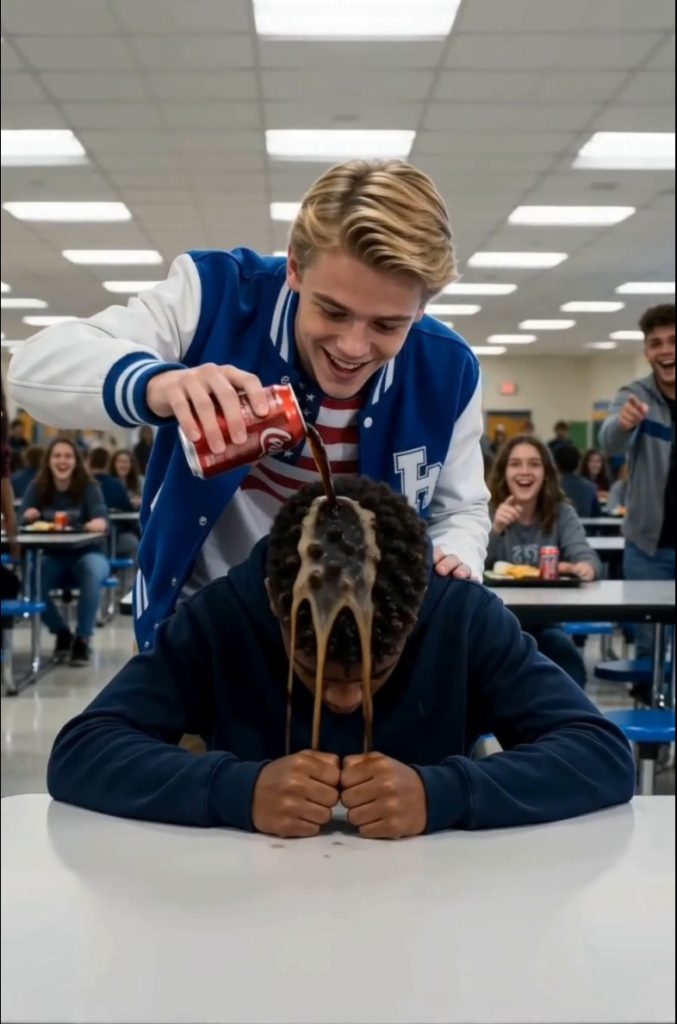
Marcus Hale did not move when the soda hit his hair.
That was what made them laugh harder.
The cafeteria was packed wall to wall with noise. Trays clattered. Sneakers squeaked against the light gray tile. Students shouted over each other beneath the flat white ceiling lights, turning lunch into a stage where cruelty could hide inside crowd sound.
Marcus sat at the end of a long table on a round blue stool, shoulders hunched, hands locked together in front of him.
He kept his eyes on the white tabletop.
The first cold stream of soda ran over his curls and down the back of his neck.
Someone gasped.
Someone else laughed.
Then Tyler Grayson leaned closer with the red can tilted over Marcus’s head, his blue-and-white varsity jacket bright under the fluorescent lights. The American flag shirt beneath it stretched across his chest like he thought it made him untouchable.
“Did anyone invite him,” Tyler said loudly, “or did he just appear?”
The table erupted.
Dark soda dripped from Marcus’s hair, splashing onto the tabletop and pooling around his clenched hands. It rolled down his forehead in thin streams, crossing his brows like tears he refused to cry.
Across from him, Chloe Bennett held her gold phone sideways, grinning as she recorded.
“Say something!” she shouted. “Oh wait—you can’t!”
That got the biggest laugh.
Marcus’s jaw tightened.
But he still said nothing.
To the crowd, his silence looked like weakness. To Tyler, it looked like permission. To Chloe, it looked like content.
Only Marcus knew what it cost.
Every nerve in his body begged him to stand. To knock the can from Tyler’s hand. To shout until the whole cafeteria heard the words that had been trapped inside him for nearly a year.
But Marcus did not give them what they wanted.
He had learned the hard way that some people hurt you twice: first with their hands, then with the version of the story they tell afterward.
So he sat there.
Soda soaking into his hoodie.
Students pointing.
Phones rising.
Laughter growing.
Then Chloe stepped closer, shoving the camera almost into his face.
“Come on, Marcus,” she taunted. “Give us your scary face.”
Something in the cafeteria shifted.
Marcus slowly lifted his head.
The laughter thinned.
Not stopped.
Thinned.
Because the look in his eyes did not match the boy they thought they were humiliating. His eyes were red, not with tears, but with the effort of holding back everything that could not be safely released in that room.
He looked straight into Chloe’s phone.
Unblinking.
Steady.
Silent.
And for the first time all lunch period, Tyler’s grin flickered.
Because Marcus was not looking at them like a victim.
He was looking at them like witnesses.
Then, from the far end of the cafeteria, the principal’s office door opened.
And the woman who stepped out froze when she saw the soda dripping down Marcus Hale’s face.
She had come to the school to hear one complaint.
Instead, she had walked into proof.
Act II
Marcus had not always been quiet.
Before Lincoln Grove High, before the videos, before the nickname “Mute Marcus” spread through the halls like mold, he was the kind of kid teachers described as bright without realizing how small that word was.
He debated.
He sang badly on purpose to make his little sister laugh.
He argued about history with his grandfather at Sunday dinner and always lost because Grandpa Hale believed every conversation was a courtroom and every courtroom needed a dramatic closing statement.
Then came the fire.
It started in the apartment building where Marcus lived with his mother and sister. Bad wiring, the report said. Smoke in the hallway. Confusion. People shouting through doors.
Marcus got his sister out.
His mother did not make it.
After that, his voice changed.
At first, doctors said it was from smoke irritation and shock. Then the weeks passed. Then the months. Marcus could speak in short bursts at home, sometimes, if he felt safe enough. But at school, under pressure, with eyes on him, his throat locked completely.
Words became stones.
His therapist called it trauma-related speech loss.
Tyler called it funny.
Chloe called it viral.
Lincoln Grove High called it a “social adjustment issue.”
Marcus arrived in January with two things in his backpack: a folder of transfer papers and a letter from his mother that had survived in a fireproof box under her bed.
He had read that letter so many times the creases were soft.
Baby, if the world tries to make you hard, don’t let it make you cruel. Strength is not how loud you get. Strength is knowing who you are when people lie about you.
His mother, Denise Hale, had been a school district auditor.
That mattered more than Marcus understood at first.
Before she died, she had been investigating Lincoln Grove’s athletic booster program. Missing funds. Fake tutoring hours. Discipline reports that vanished when star athletes were involved. Private donations that moved around like they were being chased.
Tyler Grayson’s father chaired the booster board.
Chloe Bennett’s mother ran the school’s parent media committee.
The same names appeared over and over in the notes Denise left behind.
Marcus knew because he had found them.
At first, he thought the papers were just work.
Then students started whispering that his mother had been “digging into stuff.” Then Tyler cornered him near the gym and said, “Your mom should’ve minded her business.”
That was the first time Marcus understood the bullying was not random.
It was pressure.
A warning disguised as teenage cruelty.
Every time Tyler shoved him, every time Chloe filmed him, every time the school ignored it, Marcus heard the same message.
Stay small.
Stay silent.
Disappear.
But Marcus had inherited more than grief from his mother.
He had inherited her habit of keeping records.
So he wrote everything down.
Dates.
Times.
Names.
Which teachers looked away.
Which students laughed.
Which administrators called incidents “misunderstandings” before asking a single real question.
And three weeks before the cafeteria, Marcus sent copies of everything to one person outside the school.
Dr. Elise Warren.
The new deputy superintendent.
His mother’s former colleague.
The woman now standing in the cafeteria doorway with a leather folder in her hand and shock draining the color from her face.
Marcus had not known when she would come.
He only knew that if she did, Tyler would eventually show her exactly who he was.
Now soda dripped from Marcus’s chin onto the table.
Chloe’s phone was still recording.
And Tyler Grayson, who had spent months performing cruelty for an audience, had finally performed it for the wrong one.
Act III
Dr. Warren did not shout.
That was why everyone heard her.
“Stop.”
One word.
It cut through the cafeteria so cleanly that even the students in the back tables went quiet.
Tyler turned first, soda can still in his hand.
His face changed when he recognized her.
Not fear yet.
Calculation.
“Dr. Warren,” he said, trying to smile. “We were just joking.”
Marcus watched that smile appear.
He had seen it before.
Tyler wore cruelty loosely, but innocence like a costume.
Chloe lowered her phone halfway.
Dr. Warren walked toward the table.
Her heels clicked against the tile. Every step made the silence sharper.
She stopped beside Marcus.
For a moment, she only looked at him.
Not at the soda. Not at the crowd.
At him.
“Marcus,” she said gently, “are you hurt?”
He shook his head once.
It was not fully true.
But it was the answer he could give without breaking.
Dr. Warren removed a clean handkerchief from her bag and placed it beside his hands, not touching him without permission.
Then she turned to Tyler.
“Put the can down.”
Tyler did.
Chloe suddenly lifted her phone again, but Dr. Warren’s eyes moved to her.
“Keep recording if you want,” she said. “You may have already preserved evidence.”
Chloe’s smile vanished.
A murmur passed through the cafeteria.
Evidence.
The word changed the room.
A joke could be laughed off. A prank could be minimized. Evidence had weight. Evidence had consequences. Evidence did not care whose father donated new uniforms.
The principal, Mr. Landry, hurried in from behind Dr. Warren, his face tight with panic.
“What’s going on here?”
Dr. Warren did not look at him.
“That’s an interesting question.”
Tyler stepped back.
“Marcus is fine. He always acts like this.”
Marcus’s hands tightened.
Dr. Warren opened her folder.
Inside were printed emails, complaint forms, and screenshots.
“No,” she said. “Marcus has documented seventeen incidents since February. His guardian has requested meetings six times. Three reports were marked resolved without Marcus’s signature. Two video links were deleted from school devices after being submitted.”
Mr. Landry’s mouth opened.
No sound came.
Chloe looked at Tyler.
Tyler looked at the crowd, searching for laughter that was no longer there.
Then Dr. Warren placed one more paper on the table.
A copy of an old audit memo.
Denise Hale’s name was at the bottom.
Marcus stopped breathing.
“I also came today,” Dr. Warren said, “because Marcus sent me files recovered from his mother’s records.”
Tyler’s face went pale.
Mr. Landry whispered, “This is not the place.”
Dr. Warren finally turned to him.
“This became the place when your school allowed a child to be publicly humiliated to protect adults.”
The cafeteria stayed silent.
Then Marcus moved.
Slowly, he reached into the front pocket of his soaked hoodie and pulled out a small plastic sleeve.
Inside was a flash drive.
His mother’s flash drive.
He placed it on the table.
Chloe’s phone trembled in her hand.
Tyler stared at it as if Marcus had pulled out a weapon.
He had not.
He had pulled out the truth.
And the truth was far more dangerous to boys like Tyler than rage ever could be.
Act IV
The adults wanted to move everything to the office.
Marcus refused.
Not with words.
He simply did not move his chair.
For months, every ugly thing had happened in public and every apology had been demanded in private. Every shove had been witnessed by students, while every report vanished behind closed doors.
This time, Dr. Warren understood.
She stood beside him and said, “We will begin here.”
Mr. Landry looked horrified.
The assistant principal tried to clear the room.
Nobody left.
Students who had laughed now sat stiffly, suddenly aware that silence did not make them invisible. Some still held phones. Some lowered their heads. Some stared at Marcus with the uneasy shame of people realizing too late that they had helped build the moment they were now judging.
Dr. Warren asked Chloe for her video.
Chloe hesitated.
“You can provide it voluntarily,” Dr. Warren said, “or we can request it through the investigation.”
Chloe handed over the phone.
Her hands shook.
Tyler snapped, “Don’t give it to her.”
Dr. Warren looked at him.
“Mr. Grayson, sit down.”
He did not.
Then the cafeteria doors opened again.
A man in a dark suit entered with two district security officers. Behind them came Marcus’s grandfather, Elijah Hale, leaning on a cane, his silver beard trimmed neatly, his eyes fixed on his grandson.
Marcus’s face changed.
For the first time, the mask cracked.
Grandpa Hale walked straight past Tyler as if the boy were furniture and stopped beside Marcus.
He took one look at the soda.
His jaw tightened.
But when he spoke, his voice was steady.
“Your mother would be proud of how still you stood.”
Marcus looked down.
His shoulders shook once.
Elijah placed a hand on the table, not on Marcus, giving him space to choose.
After a moment, Marcus reached out and gripped his grandfather’s fingers.
The whole cafeteria saw it.
That mattered.
Dr. Warren plugged the flash drive into a district laptop.
Files filled the screen.
Booster transfers.
Altered discipline logs.
Email chains between Mr. Landry, Tyler’s father, and members of the athletic committee.
One message was projected accidentally when the laptop connected to the cafeteria display system.
Mr. Landry lunged toward the cable, but the security officer stopped him.
The email stayed on the screen.
Keep the Hale boy contained. If he talks about his mother’s audit, we have a bigger problem than a few bullying complaints.
The room went dead.
Tyler stared up at the words.
Then at Marcus.
For the first time, he looked afraid of him.
Not because Marcus had raised a fist.
Because Marcus had survived long enough for the truth to speak.
Dr. Warren read the email once, then turned to Mr. Landry.
“You’re on administrative leave effective immediately.”
The principal tried to protest.
The district officer escorted him out.
Tyler backed away from the table.
“This is crazy,” he said. “I didn’t know about that.”
Marcus looked at him then.
Soda still on his face.
Hands still trembling.
But his gaze was clear.
Tyler’s voice cracked.
“I was just messing with you.”
Marcus reached for the small notepad he carried everywhere.
He wrote slowly.
The cafeteria waited.
Then he turned the page outward.
You knew enough to enjoy it.
No one laughed.
Chloe covered her mouth.
Tyler looked as if the sentence had struck him harder than any shout could have.
And Marcus, who had been told for months that silence made him powerless, finally watched silence become a verdict.
Act V
The video spread before the final bell.
By evening, the town had seen what Lincoln Grove High tried to bury.
Tyler pouring soda over Marcus’s head.
Chloe laughing behind her phone.
Students pointing.
The principal entering too late.
Dr. Warren standing beside the boy everyone else left alone.
At first, people argued the way people do when truth threatens comfort. They said teenagers make mistakes. They said the video lacked context. They said Marcus looked angry, as if anger after humiliation were a crime.
Then the emails leaked.
After that, the arguments changed.
Tyler was suspended pending disciplinary action. Chloe faced consequences too, not because she held a phone, but because she used it like a weapon. Mr. Landry resigned before the board could vote. Tyler’s father stepped down from the booster committee, then hired an attorney when the financial investigation widened.
Denise Hale’s audit was reopened.
Her name, once whispered like a complication, became the reason the district could no longer pretend not to know.
Marcus did not become magically okay.
That was not how pain worked.
For days, he could still smell soda when he washed his hair. He avoided the cafeteria. He flinched when students got too close behind him. He deleted messages from people who had laughed at him on Monday and apologized on Tuesday because guilt had finally become inconvenient.
His grandfather told him he did not owe anyone instant forgiveness.
“Forgiveness without change is just another way folks ask you to carry their mess,” Elijah said.
Marcus wrote that down.
He liked the sound of it.
The school tried to hold an assembly about kindness. Dr. Warren stopped them.
“This is not about kindness,” she said in a board meeting that Marcus watched from the back row. “Kindness is too small a word for what failed here. This is about safety, accountability, and the courage to interrupt cruelty before it becomes culture.”
The cafeteria changed after that.
Not all at once.
No room changes simply because adults give speeches.
But the tables felt different.
Students were assigned trained lunch monitors who actually watched. Reporting systems bypassed school administrators. Videos submitted as evidence could no longer be deleted by campus staff. The athletic department was audited. The booster board was rebuilt from scratch.
And one Friday in April, Marcus walked into the cafeteria again.
The room went quieter when he entered.
He hated that.
Then someone stood.
Maya Chen, a junior who had been at the table the day of the soda, stepped into the aisle.
“I’m sorry,” she said.
Marcus stopped.
Maya’s voice shook, but she did not look away.
“I laughed because everyone else was laughing. That was cowardly.”
Another student stood.
Then another.
Not everyone.
Not enough to erase anything.
But enough to make the room feel less like the place where Marcus had sat alone under fluorescent lights while the crowd fed on his silence.
Chloe was not there. Tyler was gone. Mr. Landry’s office had a new nameplate.
Marcus sat at a different table.
His grandfather had packed him lunch that day in a brown paper bag with a note folded inside.
Your mother taught you to stand. Some days standing looks like sitting still until the truth catches up.
Marcus read it twice.
Then he took out his notebook.
For a long time, he stared at the blank page.
Words still did not come easily. Speaking remained difficult, especially at school. Trauma did not care that justice had begun. The body kept its own calendar.
But Marcus had stopped hating his silence.
It had protected him when rage might have been used against him. It had carried his mother’s files through months of pressure. It had forced people to look at what they had done without letting them twist his reaction into the story.
Slowly, he wrote one sentence.
I am still here.
He looked at it.
Then, for the first time in that cafeteria, Marcus smiled.
Not because the pain was gone.
Because he was more than what they had poured on him.
More than a video.
More than a victim.
More than the boy they tried to make disappear beneath laughter.
At the front of the cafeteria, Dr. Warren passed through the doorway and saw him sitting there. She did not interrupt. She only gave him a small nod.
Marcus nodded back.
The lunchroom noise rose around him again, but this time it did not swallow him.
He unfolded his mother’s old letter from his pocket and touched the softened crease near the bottom.
Strength is knowing who you are when people lie about you.
Marcus knew now.
And so did everyone else.