Act I
Dr. Aris shouted before Sarah even reached the table.
“Take that dog out of here!”
His voice cracked through the forensic lab like a slap.
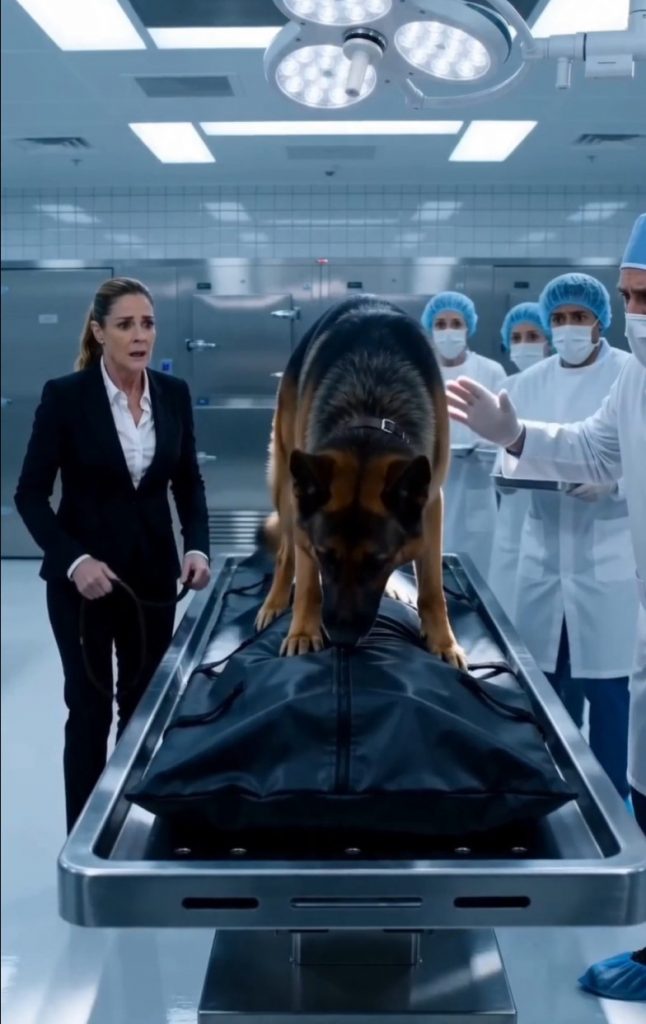
The room was bright, cold, and painfully clean. White tiles shone under fluorescent lights. Stainless steel morgue drawers lined the back wall. In the center of everything sat a mobile autopsy table, and on it lay a black body bag zipped to the top.
Sarah Bennett stopped three steps inside the doorway.
Her fingers tightened around the leash.
At her side, Atlas stood perfectly still.
The German Shepherd did not bark. He did not sniff the floor. He did not look at the strangers in masks and lab coats who had turned toward him with alarm.
He stared only at the zipper.
Sarah’s face was pale beneath the lab lights. She wore the same black blazer she had put on that morning for the identification appointment, though she had buttoned it wrong in the parking lot and never noticed.
Inside the bag was her younger sister, Claire.
Or that was what they had told her.
Found unresponsive in her apartment. Pronounced dead at the hospital. Sent to pathology before Sarah could even reach the emergency room.
Everything had happened too fast.
Too smoothly.
Too quietly.
“Mrs. Bennett,” Dr. Aris said, sharper now, “this is a restricted medical environment. Animals are not permitted.”
Sarah barely heard him.
Atlas began to whine.
Low. Guttural. Desperate.
The sound went through Sarah’s chest.
Claire had raised Atlas from a puppy. She found him abandoned behind a grocery store during a thunderstorm and brought him home wrapped in her coat. From then on, he followed her everywhere. To the mailbox. To the clinic where she worked nights. To Sarah’s house every Sunday.
After Claire was taken away, Atlas had refused food. He had clawed at the front door until his paws were raw. When Sarah brought him to the morgue, she told herself it was cruel, but she could not leave him behind.
Now she knew he had not come to say goodbye.
He had come to argue.
“Atlas,” Sarah whispered.
The dog’s ears shot forward.
Then he lunged.
The leash ripped from Sarah’s hand. Medical assistants shouted and jumped back as Atlas launched onto the stainless steel table, claws skidding against the metal. He landed across the body bag, bracing himself over the chest area as if shielding the person inside.
“Get it off!” Dr. Aris snapped. “Remove it now!”
But Atlas lowered his head.
With impossible care, he caught the metal zipper pull between his teeth.
Sarah forgot how to breathe.
The dog dragged the zipper down.
Slowly.
Deliberately.
The black bag opened enough to reveal Claire’s face.
Still. Pale. Silent.
Atlas began licking her cheek with frantic tenderness, whining between each breath, nudging her jaw, pressing his nose against her mouth as if begging her to answer.
“Stop him,” Dr. Aris ordered.
Nobody moved.
Sarah stared.
At first, she saw only grief.
Then Claire’s eyelid trembled.
Once.
So faintly Sarah thought pain had invented it.
Then it happened again.
Sarah gasped.
“Oh… my God.”
Dr. Aris went rigid.
Atlas barked once, sharp and commanding, directly into Claire’s face.
And Claire Bennett, the woman lying in a body bag beneath the morgue lights, pulled in the smallest breath Sarah had ever heard.
The dead woman was alive.
And someone in that room had known she might be.
Act II
Claire Bennett was not the kind of woman who disappeared quietly.
That was the first thing Sarah had told the police.
Her sister was forty-two, stubborn, brilliant, and incapable of leaving a room without turning off the lights and correcting someone’s grammar. She worked as a night-shift records supervisor at Whitcomb Medical Center, a private hospital with marble floors, donor walls, and a reputation polished so hard nobody looked underneath it.
Claire noticed things.
Missing signatures.
Duplicate patient files.
Insurance approvals on procedures that never happened.
Discharge records changed after midnight.
Most people ignored paperwork because paperwork was boring. Claire understood that paperwork was where powerful people hid crimes.
Two months before her death, she called Sarah at 1:13 a.m.
“You awake?”
“No,” Sarah muttered. “That’s why I answered like a corpse.”
Claire did not laugh.
That scared Sarah immediately.
“I found something,” Claire whispered.
“What kind of something?”
“The kind that could put people in prison.”
Sarah sat up in bed.
Claire told her about patients moved between departments without proper consent forms. About medical billing tied to wealthy donors. About a private research wing no one discussed openly. About sealed files that kept changing after patients died or were declared beyond recovery.
“Claire,” Sarah said, “go to the authorities.”
“I am.”
“When?”
“Tomorrow.”
But tomorrow became a locked office, a missing laptop, and Claire insisting she was fine while Atlas growled at every car that slowed outside her apartment.
Then came the call.
Claire had been found unresponsive.
No signs of struggle, they said.
Likely natural causes, they said.
A tragic medical event.
Sarah heard those words and felt something inside her reject them before her mind could.
Claire ate oatmeal every morning because she said aging was just a negotiation with fiber. She walked Atlas twice a day. She complained about her knees but still beat Sarah up three flights of stairs.
Natural causes did not feel right.
Nothing felt right.
At the hospital, Dr. Aris met Sarah in a consultation room instead of the morgue. He spoke quickly. Clinically. Kindly enough to pass inspection, but not kindly enough to comfort.
“I’m sorry for your loss,” he said. “Your sister arrived with no detectable response. Resuscitation efforts were unsuccessful.”
“Can I see her?”
“Soon.”
“Why not now?”
“There are procedures.”
Sarah hated the word.
Procedures had become a wall.
She asked who signed the death certificate. He gave a name she did not recognize. She asked why no one called her until hours later. He said emergency contacts were not immediately clear. She asked where Claire’s phone was.
He said it had not come in with her belongings.
That was when Sarah knew.
Claire never went anywhere without her phone.
Not even to take out trash.
But grief makes people look unstable when they ask too many questions too fast. Sarah saw it in the nurse’s face. In the security guard’s posture. In Dr. Aris’s careful silence.
So she stopped arguing.
She went home.
Atlas was waiting by the door with Claire’s old scarf in his mouth.
The moment Sarah touched it, he began pulling her toward the car.
Not whining.
Not confused.
Certain.
He dragged her to the passenger side and refused to move until she opened the door.
Sarah understood then that the dog still smelled Claire.
Not memory.
Not grief.
A trail.
So she took him to the morgue.
And now, under cold fluorescent light, Atlas had opened the body bag himself.
Sarah did not need a doctor to tell her what that meant.
Her sister had been buried in paperwork before her body had stopped fighting.
Act III
The lab erupted.
One assistant ran for emergency equipment. Another called upstairs, voice shaking. Dr. Aris stood frozen for two seconds too long before moving.
Sarah saw it.
Not shock.
Calculation.
“Step back,” he ordered.
Sarah did not.
Atlas planted himself between Claire and everyone else, teeth visible, growling low enough to make the metal table vibrate.
“Atlas,” Sarah said softly. “Guard.”
The dog obeyed with terrifying focus.
Dr. Aris pulled down his mask.
“Mrs. Bennett, this is an extraordinary medical complication.”
“No,” Sarah said. “This is my sister breathing inside a body bag.”
His eyes sharpened.
“You are emotional.”
“You are stalling.”
A monitor was attached. Then another. A nurse from the emergency response team pushed past the lab staff and checked Claire herself.
“She has a pulse,” the nurse said, stunned. “Weak, but present.”
Sarah gripped the edge of the table.
Dr. Aris’s face changed.
Only slightly.
Enough.
Claire was rushed upstairs under emergency protocol. Sarah followed until security stopped her outside the critical care unit. Atlas stayed pressed against her leg, trembling with adrenaline, his gaze fixed on the doors that had swallowed Claire.
Detective Jonah Reyes arrived forty minutes later.
He was not hospital security. He was city police, called by the nurse who had checked Claire’s pulse and clearly trusted hospital administration about as much as Sarah did.
“What happened?” he asked.
Sarah looked at the ICU doors.
“My dog found my sister alive.”
The detective did not laugh.
That made her trust him a little.
Dr. Aris tried to control the story before anyone else could tell it. He called it a rare medical presentation. A tragic but correctable error. An incident under internal review.
Detective Reyes listened politely.
Then he asked for the morgue camera footage.
Dr. Aris went quiet.
The footage had been disabled for maintenance.
Of course it had.
But the lab had not been empty of witnesses.
One of the assistants, a young woman named Priya, followed Sarah into the hallway with her hands shaking around a paper cup.
“I shouldn’t say this,” she whispered.
Sarah turned.
Priya looked toward the ICU desk.
“Dr. Aris got a call before you came in. He told us to begin quickly. No delay. No family viewing.”
Sarah’s blood chilled.
“Who called him?”
“I don’t know. But he said, ‘Yes, Director Vale.’”
Sarah knew that name.
Everyone at Whitcomb did.
Malcolm Vale, hospital director, donor favorite, media darling, the man who appeared in glossy brochures promising compassionate innovation.
Claire had mentioned him once.
Not fondly.
“He signs nothing,” she had told Sarah. “But somehow everything dirty leads back to him.”
Detective Reyes returned holding a sealed evidence bag.
Inside was a small object taken from Claire’s coat pocket.
A flash drive.
Sarah stared at it.
The label was written in Claire’s handwriting.
IF I DON’T WAKE UP.
Sarah’s knees nearly gave out.
Reyes opened the drive on a secure laptop.
Files appeared.
Patient transfers.
Altered death records.
Financial accounts.
Internal messages between administrators and private contractors.
And a video.
Claire appeared on screen, seated in her apartment, Atlas sleeping behind her.
“If you’re watching this,” she said, voice steady but eyes afraid, “then Whitcomb tried to make me disappear.”
Sarah covered her mouth.
Claire continued.
“They are declaring vulnerable patients dead too early, moving them through research channels, and hiding the paperwork under charitable care programs. I found proof. If anything happens to me, start with Director Malcolm Vale and Dr. Elias Aris.”
Detective Reyes stopped the video.
In the hallway behind them, someone dropped a clipboard.
Dr. Aris stood ten feet away.
And for the first time, he looked less like a doctor than a man whose grave had opened beneath his own feet.
Act IV
Claire woke eighteen hours later.
Not fully.
Not easily.
Her eyes opened under the dim ICU light, unfocused at first, then terrified. Sarah was beside her before any monitor could announce the change.
“Claire,” she whispered. “It’s me.”
Claire’s lips moved.
No sound came.
Sarah leaned closer.
Atlas, who had been allowed into the room after every nurse on the floor threatened quiet rebellion, lifted his head from the corner.
Claire saw him.
A tear slipped down her temple.
“Good boy,” she breathed.
Atlas stood and placed his head gently beside her hand.
Sarah cried then, but silently, afraid any loud sound might break the miracle.
Detective Reyes waited until Claire was strong enough to answer simple questions. A doctor from outside Whitcomb examined her and confirmed what Sarah had feared: Claire had been placed into a state so deep and dangerous that ordinary checks, rushed or intentionally mishandled, could mistake her for gone.
No one explained the method in detail.
No one needed to.
The point was not the substance.
The point was intent.
Claire remembered leaving work late. She remembered finding her office door open. She remembered Dr. Aris standing near her desk, telling her Director Vale wanted to discuss her “concerns privately.”
Then a sharp smell from a cloth held near her face.
Then darkness.
Then, impossibly, Atlas.
“I heard him,” Claire whispered. “Before I could open my eyes. I heard him whining.”
Sarah took her hand.
“He opened the bag.”
Claire gave the faintest smile.
“Of course he did.”
By then, state investigators had taken over Whitcomb Medical Center.
Director Vale tried to hold a press conference before they reached his office. He spoke of misinformation, rare complications, and the danger of public panic.
Then Detective Reyes walked in with a warrant.
The cameras caught everything.
Dr. Aris broke first.
Not from guilt.
From fear.
Men like him rarely confess because they are sorry. They confess when they realize they were never partners, only tools.
Vale had promised him protection. A promotion. Research prestige. Instead, the recovered messages showed Aris was meant to take full blame if the scheme surfaced.
So he talked.
He named the private fund.
The hidden wing.
The donors.
The patients whose families had been told comforting lies while their records were altered behind locked doors.
He admitted Claire discovered the pattern and refused to be bought.
He admitted he signed the paperwork.
But when asked who ordered Claire moved to the morgue, he looked through the interrogation glass and said one name.
“Vale.”
Sarah was watching from the other side.
So was Claire, in a wheelchair, pale but upright, Atlas sitting beside her like a soldier.
Director Malcolm Vale was arrested that evening.
As officers led him through the hospital lobby, he saw Claire.
For one moment, his polished confidence cracked.
“You should have stayed out of things,” he said.
Claire’s voice was weak.
But clear.
“You should have checked for a pulse.”
Reporters shouted.
Cameras flashed.
Atlas barked once.
Vale flinched.
That single bark became the sound every news station replayed by morning.
Not because it was loud.
Because everyone understood what it meant.
A dog had shown more loyalty, more intelligence, and more humanity than the people entrusted with human lives.
Act V
Claire’s recovery was slow.
Miracles, Sarah learned, still required physical therapy, nightmares, paperwork, and mornings when gratitude sat beside rage at the breakfast table.
Claire hated being called lucky.
She had been nearly erased by men with degrees, titles, and clean hands. Surviving that was not luck. It was Atlas refusing to accept what humans had signed.
The first time she returned home, the German Shepherd ran room to room, checking every corner before allowing her inside. Then he curled beside her couch and did not move for six hours.
Sarah stayed too.
She cooked badly. Claire complained professionally. They cried over burnt toast and laughed because crying had become too familiar to deserve the whole room every time.
The investigation expanded across state lines.
Whitcomb was not the only hospital involved. Vale’s network had hidden behind research partnerships, charity language, and the assumption that grieving families would not know which questions to ask.
Some families received answers.
Some received apologies.
Some received news so painful that Sarah stopped reading the updates at night because sorrow had started following her into sleep.
Claire testified six months later.
She walked into court with a cane in one hand and Atlas’s leash in the other. The judge allowed the dog to sit beside her. No one objected.
Director Vale looked smaller without cameras and donors around him.
Dr. Aris avoided Claire’s eyes.
Claire told the court about the records. The threats. The moment she realized her own name had been added to a file before she ever lost consciousness.
Then she looked directly at Vale.
“You did not just try to kill me,” she said. “You tried to turn me into paperwork.”
The courtroom went silent.
Sarah sat in the front row, hands clasped, tears on her face.
Atlas watched Vale without blinking.
The verdicts came weeks later.
Guilty.
Not on everything.
The law rarely gives grief everything it wants.
But enough.
Enough to remove powerful men from powerful rooms. Enough to force hearings. Enough to tear open every sealed file Claire had risked her life to expose.
After court, a reporter asked Sarah what had saved her sister.
Sarah looked at Claire.
Then at Atlas.
“Love,” she said. “And a dog who knew the truth before the rest of us were brave enough to say it.”
A year after the morgue, Claire and Sarah returned to Whitcomb.
Not inside.
The hospital had changed names, leadership, and ownership. The old pathology wing had been closed. A memorial wall now stood near the entrance, listing patients whose cases had been reopened because of Claire’s files.
Claire stood before it for a long time.
Atlas leaned against her leg.
Sarah watched her sister touch one name, then another.
“You okay?” Sarah asked.
Claire shook her head.
“No.”
Sarah nodded.
“Me neither.”
Claire smiled faintly.
“But I’m here.”
That was enough for the moment.
Later, they drove to the park where Claire had first found Atlas as a puppy. Rain had fallen that day too, though Claire insisted the dog had looked “dignified and misunderstood” rather than abandoned and muddy.
Now Atlas trotted ahead of them, older in the eyes but still strong, still alert, still convinced every squirrel was part of a conspiracy.
Claire sat on a bench beneath a maple tree.
Sarah sat beside her.
For a while, neither spoke.
Then Claire said, “I heard you.”
Sarah turned.
“When?”
“In the dark,” Claire said. “Before Atlas. Before I opened my eyes. I heard you crying.”
Sarah’s throat tightened.
“I thought I lost you.”
“You almost did.”
“I know.”
Claire reached for her hand.
“But you brought him.”
Sarah looked at Atlas, who had stopped at the path and turned back as if impatient with human emotion.
“No,” she said softly. “He brought me.”
The sisters laughed quietly.
Not because the past was light.
Because they were alive inside the same afternoon, breathing the same air, with the truth no longer sealed behind steel doors.
The morgue had been built for endings.
Cold lights. Stainless steel. Zippers. Labels. Silence.
But Atlas had refused the ending written by men who thought a life could be closed before it was finished.
He had jumped onto the table.
Opened the bag.
Licked the face he loved.
And forced a room full of experts to admit what his heart already knew.
Claire Bennett was not gone.
She was waiting to be found.