Act I
Dr. Evelyn Bennett had spent forty-one years learning what was possible inside the human body.
She had seen rare tumors, misdiagnosed conditions, strange birth defects, and scans that made younger doctors step backward from the monitor. She was not easily frightened. She did not gasp for drama. She did not believe in miracles until every ordinary explanation had failed.
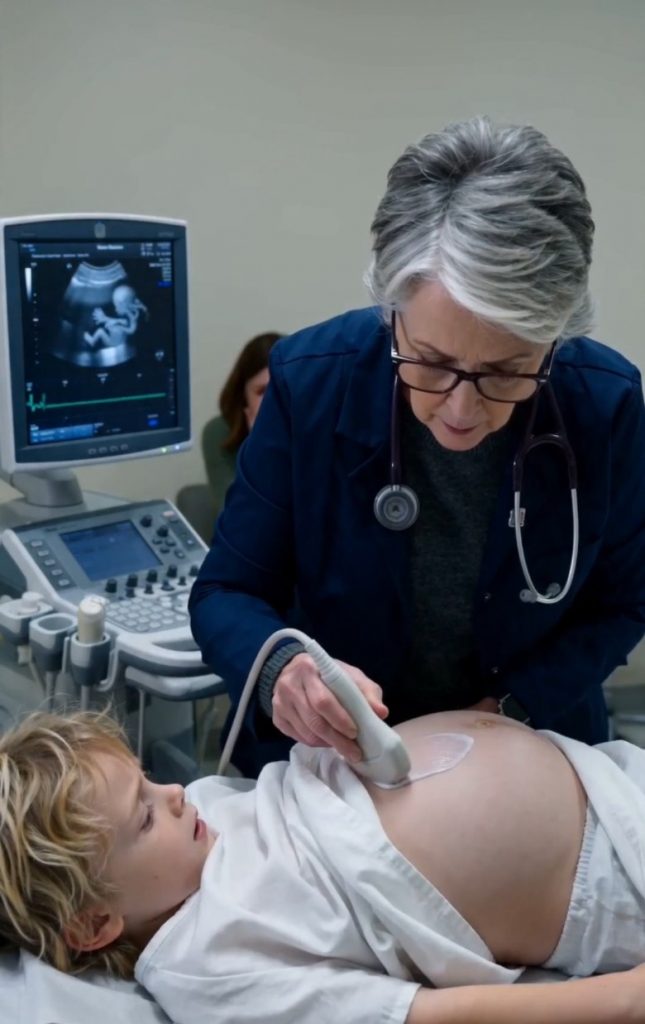
Then she placed the ultrasound probe on Oliver Reed’s swollen abdomen.
And the room filled with a heartbeat.
Thump-thump.
Thump-thump.
The boy lay on the padded gurney in a white patient gown, small hands resting at his sides, messy blond hair sticking to his damp forehead. His stomach rose beneath the cold fluorescent lights, round and severe, far too large for a child who had walked into the clinic barely able to stand upright.
His mother, Rachel, stood near the wall in a green knit sweater, both hands clamped over her mouth.
“Oh,” she gasped when Dr. Bennett lifted the gown and revealed the full swelling.
Oliver looked down at himself with quiet confusion, as if his own body had become a locked room no one had given him the key to.
“It feels heavy,” he whispered.
Dr. Bennett kept her face calm.
“That’s why we’re looking, sweetheart.”
She applied the gel and moved the transducer slowly, searching through shadows and grainy shapes on the monitor.
At first, she expected fluid. A mass. A severe obstruction. Something urgent, yes, but something she could name.
Then the image sharpened.
A head.
A curved spine.
Tiny limbs folded inward.
Dr. Bennett stopped moving.
The heartbeat line pulsed green at the bottom of the monitor.
Thump-thump.
Thump-thump.
Her breath caught.
No.
That was her first thought.
A child cannot carry another child.
Her second thought was worse.
This was not a pregnancy.
It was something hidden since before Oliver was born.
Dr. Bennett leaned closer to the screen, the blue glow reflecting in her glasses. Her professional certainty shattered piece by piece.
“My… my God,” she whispered.
Rachel made a sound behind her, low and broken.
Oliver tried to sit up. “What is it?”
Dr. Bennett pulled the probe away and turned sharply toward Rachel.
“What is this?” Her voice cracked despite herself. “This is simply impossible.”
Rachel’s face collapsed.
Tears spilled down her cheeks. Her hands twisted together in front of her stomach, fingers interlocked so tightly the knuckles whitened.
“I didn’t know,” she said.
But the terror in her eyes said something else.
She had not known everything.
But she had known enough to be afraid.
Dr. Bennett stepped toward the door, her voice ringing into the hallway.
“Call the father in here immediately!”
Rachel flinched as if the words had struck her.
“No,” she whispered.
Dr. Bennett turned back.
Rachel shook her head, crying harder now.
“Please,” she said. “If Daniel finds out we came here, he’ll take Oliver away.”
The heartbeat on the monitor continued.
Thump-thump.
Thump-thump.
And suddenly Dr. Bennett understood that the impossible thing inside Oliver was not the only secret in the room.
Act II
Rachel Reed had been told her son was lucky to be alive.
That was what everyone said after Oliver was born.
A difficult delivery. A rare emergency. A lost twin. A grieving father. A mother too weak to understand every form she signed.
The doctors at Westhaven Institute spoke softly, kindly, and always with witnesses nearby. They told Rachel that Oliver had survived, but his twin had not. They told her there had been complications. They told her it was better not to ask for details until she recovered.
Then Daniel handled everything.
Daniel was good at handling things.
He was a senior administrator at Westhaven, charming in public and controlled in private. He knew which doctors to call, which forms to file, which conversations to end before they became questions.
Rachel had married him because he seemed steady.
After Oliver’s birth, steadiness became rule.
He decided where Oliver was treated. He chose the pediatricians. He kept the records in a locked cabinet in his study. When Rachel worried about Oliver’s stomach aches, Daniel said boys complained. When she asked why their son tired so easily, Daniel said she was anxious. When she insisted something was wrong, Daniel smiled in the way that made her feel smaller than shouting ever could.
“You nearly lost him once,” he said. “Don’t let fear ruin the child you still have.”
So Rachel tried to stop being afraid.
But mothers know the shape of danger even when they cannot name it.
Oliver grew gentle and quiet. He liked space books, cinnamon toast, and building cities from cardboard boxes. He hated being photographed from the side. By seven, he began wearing oversized sweatshirts because kids at school asked why his stomach looked strange.
Rachel took him to doctors.
Daniel found out.
Appointments were canceled.
Records were transferred.
Specialists suddenly became unavailable.
Then, three months before the ultrasound, Rachel discovered the first clue.
It was not in Daniel’s locked cabinet.
It was behind a loose vent in Oliver’s nursery closet, hidden by the night nurse who had cared for Rachel after the delivery and disappeared from Westhaven a week later.
A small envelope.
Inside was a copy of a birth report, a photo of two newborn bracelets, and a note written in shaking cursive.
Your son did not lose his twin the way they told you. Ask Dr. Bennett. She warned them before they buried the file.
Rachel had never heard Dr. Bennett’s name.
Daniel had.
When she mentioned it at dinner, his fork stopped halfway to his plate.
“Where did you hear that name?”
The question was too quiet.
Rachel lied.
“Online.”
Daniel stared at her for a long moment.
Then he smiled.
“You need to stop reading medical horror stories.”
That night, Rachel searched the name on an old phone Daniel did not monitor.
Dr. Evelyn Bennett had been a neonatal surgeon at Westhaven eight years earlier. She resigned suddenly after filing a complaint about falsified birth records. The complaint vanished. Her career survived only because she opened a private clinic far from the hospital network that tried to ruin her.
Rachel made the appointment in secret.
She told Daniel she was taking Oliver to the dentist.
Instead, she drove across town with her son in the back seat, watching the rearview mirror the whole way.
And now Dr. Bennett stood in the exam room, staring at a scan that seemed to drag eight years of lies into the light.
Rachel had feared Daniel would be angry.
She had not understood that Dr. Bennett would be the one to recognize the nightmare first.
Act III
Dr. Bennett did not call Daniel.
She called security.
Then she called pediatric surgery.
Then she called an old friend who was now a district medical investigator and said six words she had prayed never to use again.
“Westhaven buried another birth file.”
Rachel sat beside Oliver’s gurney, holding his hand while nurses moved with controlled urgency around them. Oliver was frightened now. Not crying, but watching every adult too carefully.
Children who grow up around secrets learn to read faces early.
“Mom,” he whispered, “is there a baby in me?”
Rachel’s face broke.
Dr. Bennett stepped in before shame could swallow the room.
“No, sweetheart,” she said gently. “Not like that.”
Oliver looked at the monitor.
“But it looks like one.”
“I know.” She pulled a chair close and sat so he could see her eyes. “Sometimes, before birth, twins develop very close together. Very rarely, one twin can become enclosed inside the other. It can look frightening on a scan, but you did nothing wrong. Your mother did nothing wrong. And we are going to help you.”
Rachel closed her eyes as if those words had been withheld from her for eight years.
You did nothing wrong.
The investigator arrived within twenty minutes.
His name was Jonah Pierce. He wore a gray suit, carried a sealed evidence bag, and looked at Rachel with the careful seriousness of someone who knew panic could be mistaken for guilt by lazy men.
Dr. Bennett handed him the hidden birth report.
He read it once.
Then again.
His expression darkened.
“This says there were two live heart patterns recorded after delivery.”
Rachel’s hand tightened around Oliver’s.
“They told me his brother died before birth.”
Dr. Bennett’s jaw set.
“No. They told me something else.”
Rachel looked up.
The doctor removed her glasses and rubbed the bridge of her nose, suddenly looking every year of her age.
“I was called into Westhaven after Oliver was born. Your baby had an abnormal abdominal shadow. I recommended immediate imaging and transfer to a children’s surgical center. Daniel Reed refused authorization.”
Rachel went still.
“He was allowed to refuse?”
“He claimed you had consented to conservative monitoring.”
“I was unconscious.”
“I know that now.”
Dr. Bennett’s voice shook with old anger.
“When I pushed harder, the file disappeared. I was told the baby had been moved. Then I was told I had misunderstood the scan. When I filed a complaint, Westhaven accused me of violating protocol.”
Oliver looked between them.
“So Dad knew?”
The question was small.
No one answered quickly enough.
That was answer enough.
The door opened.
Daniel Reed stepped into the room wearing a navy overcoat and the clean, composed expression he used in photographs. He looked first at Rachel. Then Oliver. Then the ultrasound monitor.
For the first time, Rachel saw fear on his face.
Not concern.
Fear.
“What have you done?” he asked.
Rachel stood between him and the gurney.
“I brought our son to a doctor.”
Daniel’s eyes hardened.
“You had no right.”
Dr. Bennett moved closer to Oliver.
“She had every right.”
Daniel looked at the scan again, and his face tightened with recognition.
He had not come to learn what was inside his son.
He had come because he already knew.
Act IV
Daniel tried to take control the way he always did.
He lowered his voice. He addressed the investigator by title. He called Rachel fragile. He said Dr. Bennett had a history with Westhaven and could not be trusted. He said Oliver had a rare but stable congenital condition that was being monitored privately.
“Where are the monitoring records?” Jonah Pierce asked.
Daniel did not blink.
“In storage.”
“Where?”
“At Westhaven.”
“Convenient.”
Daniel’s mouth tightened.
Rachel looked at the man she had lived with for twelve years and realized how much of her marriage had been built from locked doors.
Oliver spoke from the gurney.
“Dad, why didn’t you tell me?”
Daniel’s face shifted, but only for a moment.
“You were too young.”
“I’m still young,” Oliver said. “But it hurts now.”
The room fell silent.
That did what no adult accusation had done.
It made Daniel look away.
Dr. Bennett stepped forward.
“This is no longer your decision. Oliver requires surgical evaluation. An ethics hold is being placed on all prior records. If Westhaven altered or concealed imaging, we will find it.”
Daniel gave a short laugh.
“You have no idea what Westhaven is.”
“No,” Dr. Bennett said. “But I know what a child in pain is.”
The investigator’s phone buzzed.
He answered, listened, then looked at Daniel.
“Your office is being sealed.”
Daniel’s composure cracked.
“What?”
“Westhaven’s archive server was already under review. Dr. Bennett’s call connected this case to an open investigation.”
Rachel stared.
“Open investigation?”
Jonah nodded.
“Five families reported missing neonatal records. Two doctors reported pressure to change infant outcomes. Your son’s case may be the one that ties it together.”
Daniel stepped back.
“This is insane.”
“No,” Rachel said quietly. “This is what you kept from us.”
He turned on her.
“I protected him.”
“From treatment?”
“From becoming a spectacle!”
Rachel flinched.
Dr. Bennett’s eyes narrowed.
Daniel heard himself then.
Too late.
Oliver heard him too.
The boy’s face changed in a way Rachel would remember for the rest of her life. Not anger. Not even sadness.
A child realizing an adult’s love had conditions.
Daniel reached toward him.
“Oliver, I didn’t mean—”
Oliver pulled his hand away.
The movement was small.
It destroyed him anyway.
Within hours, Westhaven Institute began to fall.
The sealed files revealed what Dr. Bennett had suspected years earlier. Rare and complicated births had been hidden to protect the hospital’s reputation and research funding. Families were told partial truths. Records were rewritten. Doctors who objected were pushed out.
Oliver’s file was among the worst.
His twin, Noah, had not survived as a separate child. But the remains of that impossible beginning had stayed within Oliver, growing slowly, dangerously, ignored by men who feared scandal more than suffering.
Rachel sat beside Oliver that night in the children’s hospital while specialists planned his treatment.
He was asleep when she finally broke.
Dr. Bennett found her in the hallway, shaking silently under the vending machine light.
“I should have fought harder,” Rachel whispered.
Dr. Bennett leaned against the wall beside her.
“So should I.”
Rachel looked at her.
The older doctor’s eyes were wet.
“I let them make me doubt what I saw,” Dr. Bennett said. “I told myself maybe I had been wrong because the alternative was too awful.”
Rachel wiped her face.
“What happens now?”
Dr. Bennett looked through the glass at Oliver.
“Now we stop letting powerful men decide which truths are too inconvenient to treat.”
Act V
Oliver survived.
That was the sentence Rachel repeated to herself in the weeks that followed.
Not easily.
Not magically.
But fully enough to laugh again.
The surgery was delicate, the recovery slow, and the truth harder to explain than any scar. Doctors described the condition in careful terms. Counselors helped Oliver understand that the shape on the monitor had not been his fault, his shame, or a secret he was responsible for carrying.
Rachel told him about Noah.
Not as a monster. Not as a medical horror. Not as something to fear.
As his brother.
A beginning that had gone wrong in a way no one chose, then had been made worse by adults who chose silence.
Oliver listened for a long time.
Then he asked if he could name a star after Noah.
Rachel cried into his hospital blanket.
“Yes,” she said. “Of course.”
Daniel was arrested after investigators found altered consent forms bearing Rachel’s forged signature. He insisted he had protected his family from scandal, but the court heard the recorded calls, the hidden reports, and the testimony of doctors who had been threatened into silence.
Rachel attended only one hearing.
When Daniel’s attorney suggested she had been too emotional to understand medical decisions after Oliver’s birth, Rachel stood without being asked and said, “I understood my son was crying. That should have been enough.”
The judge ordered her statement preserved.
Dr. Bennett testified too.
Her voice did not tremble this time.
She explained the scan from eight years ago, the missing file, the complaint that vanished, and the impossible image on the new ultrasound that finally forced the truth back into the room.
When asked why she had acted so quickly, she looked at Oliver sitting beside Rachel, thinner now but smiling faintly over a comic book.
“Because the body tells the truth,” she said. “Even when records lie.”
Westhaven closed its private neonatal wing within months.
Families received calls they had waited years for and some they had dreaded. Not every truth brought comfort. Some brought grief with a name attached at last. Some brought anger. Some brought lawsuits.
But the locked archive was opened.
That mattered.
For Rachel, life after the scandal became strangely ordinary in the most beautiful ways.
Oliver came home to a bedroom full of space posters and new blankets. He tired easily at first. He hated the taste of one of his medicines. He cried the first time he saw his reflection after surgery, then got angry at himself for crying, then cried harder when Rachel told him anger was allowed too.
They made room for all of it.
Fear.
Relief.
Confusion.
Laughter.
One night, months later, Oliver came into the kitchen wearing pajamas covered in tiny planets.
“Mom?”
Rachel turned from the sink.
“Yeah, sweetheart?”
“Was Dad ashamed of me?”
The question landed softly and broke everything anyway.
Rachel dried her hands and knelt in front of him.
“No,” she said carefully. “Your father was afraid of what people would think of him. That is not the same as being ashamed of you.”
Oliver considered this.
“Were you?”
“Never.”
“Even when my stomach looked weird?”
Rachel’s eyes filled.
“Especially then,” she said. “Because I knew you were hurting and still trying to be brave.”
He leaned into her.
She held him tightly, wishing love could travel backward and stand guard over every moment when he had felt alone inside his own body.
It could not.
So she gave it forward instead.
On Oliver’s ninth birthday, Dr. Bennett came to their house with a small telescope wrapped in silver paper. Oliver nearly knocked over his cake trying to open it.
That night, they set it up by the window.
The sky was clear.
Oliver searched until he found the bright star he had chosen for Noah, though Dr. Bennett gently explained it already had a scientific name.
“I know,” Oliver said. “But it can have two.”
Rachel smiled at that.
A person could have two names.
A story could have two meanings.
A scar could be both proof of pain and proof of survival.
Later, after Oliver fell asleep, Rachel stood in the doorway and watched his chest rise and fall in the quiet rhythm she had once feared losing.
Dr. Bennett stood beside her.
“He’s going to be all right,” the doctor said.
Rachel did not ask if she was sure.
No doctor could promise a painless life. No mother could either.
But Oliver was here.
The secrets were gone.
The room was warm.
And for the first time since the ultrasound monitor filled with that impossible heartbeat, Rachel did not feel trapped inside terror.
She felt the beginning of peace.
In the end, the scan had not shown a miracle.
It had shown a lie that could no longer hide.
And because one doctor believed what she saw, and one mother finally ran toward the truth instead of away from it, Oliver Reed was no longer a child carrying the weight of everyone else’s silence.
He was just a boy again.
Looking at the stars.