Act I
The German Shepherd hit Lucas before anyone saw the danger above him.
One second, Lucas was standing beside the robotics booth with his hands in his hoodie pocket, staring up at the white humanoid machine on its blue-and-silver pedestal.
The next, a police dog in a black tactical vest came sprinting across the convention floor.
“Hey!” someone shouted.
The dog barked twice, sharp and urgent, then launched itself into Lucas’s chest.
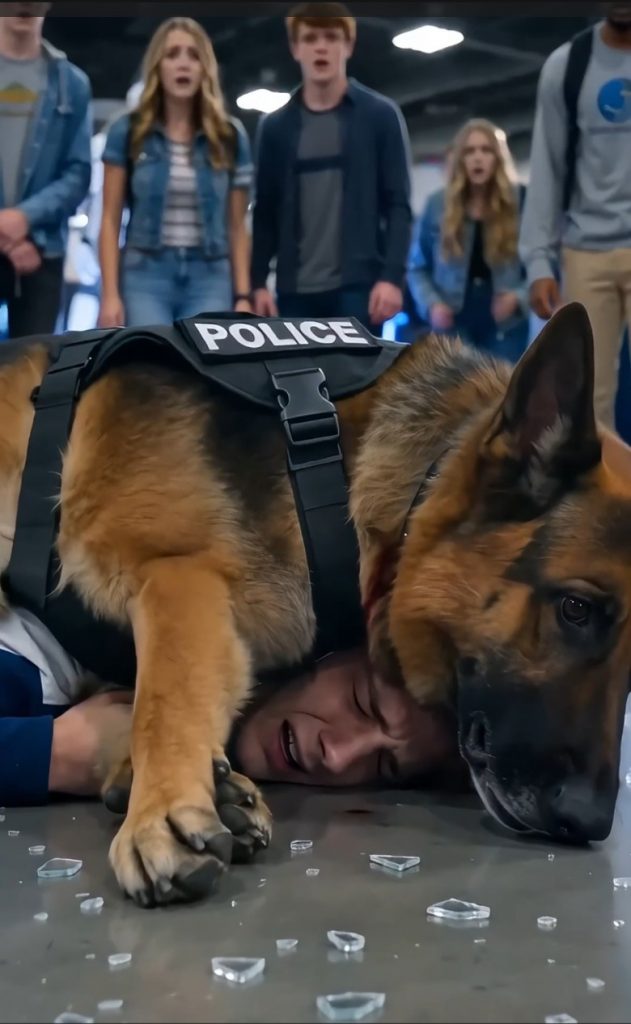
Lucas fell backward onto the polished concrete, the breath knocked from him as the dog planted itself over his body.
“Get off!” Lucas yelled, pushing at the black vest. “Get off me!”
The crowd gasped.
A girl in a denim jacket covered her mouth. A group of students backed away from the booth. Someone screamed that the dog had attacked him.
But the dog was not looking at Lucas.
His ears were pinned forward.
His dark eyes kept snapping upward.
Above them, a suspended monitor trembled on its chains.
No one noticed.
Not yet.
The German Shepherd barked again, deeper this time, his whole body rigid over Lucas like a shield.
Then the metal gave way.
A chain snapped loose with a violent crack.
The flat-screen display lurched downward, tilted, and exploded apart against the floor where Lucas had been standing moments earlier.
Glass and metal scattered across the concrete.
The crowd went silent.
Lucas stopped struggling.
He lay frozen beneath the dog, staring at the wreckage only a few feet away.
The German Shepherd lowered himself over Lucas as fragments continued to fall. His vest caught the smaller pieces, but part of his back leg was exposed.
One final shard dropped.
The dog’s body tightened.
A pained whimper escaped him, but he did not move away.
Lucas looked toward the dog’s leg and went pale.
The animal had saved him.
And paid for it.
Then, through the stunned silence of the convention hall, someone whispered, “That screen was supposed to be secure.”
Lucas looked at the broken chains.
Then at the booth behind him.
And his fear turned into something colder.
Because he had warned them that morning.
And they had told him to stop asking questions.
Act II
Lucas Avery had not wanted to come to the FutureFront Expo.
His professor insisted.
“You built the stabilizing model,” Dr. Chen told him. “You should be there when they unveil it.”
Lucas almost laughed at that.
He had built the original model, yes. A safer mounting system for suspended convention displays, meant to predict stress points before public installations failed.
But TechCore Dynamics had taken the software, renamed it, stripped his name from the presentation, and invited him only after Dr. Chen threatened to make noise.
So Lucas came.
Not because he wanted applause.
Because his father would have told him to stand in the room where people tried to erase him.
His father, Mark Avery, had worked construction for twenty-seven years. He trusted bolts, measurements, and people who checked their own work twice. When Lucas was a kid, Mark used to say, “Gravity doesn’t care how expensive your suit is.”
Two years earlier, Mark died after a temporary stage rig collapsed at a corporate event.
The official report called it an accident.
Lucas never believed that word again.
After his father’s death, he changed majors from mechanical design to structural safety systems. He built programs that could detect overloaded supports, hidden metal fatigue, bad angles, rushed installations.
He wanted to make sure no one else stood under something that rich men had decided was “probably fine.”
That was why he noticed the chains.
At FutureFront, the displays hung above the main walkway, suspended from black steel rigging between booths. Most were stable. One was not.
The monitor above the robotics booth moved wrong.
Not swinging naturally from air conditioning.
Twitching.
Pulling.
Straining at one corner.
Lucas reported it to a TechCore representative in a silver badge.
The man smiled without looking up from his tablet.
“It passed inspection.”
Lucas pointed upward. “That chain is carrying uneven load.”
“It passed inspection.”
“You need to clear the area.”
That was when the man finally looked at him.
His smile disappeared.
“You’re the student, right? Avery?”
Lucas said nothing.
The man stepped closer. “Enjoy the expo. Don’t embarrass yourself.”
An hour later, Lucas saw a police K9 unit near the entrance.
The German Shepherd’s name was Atlas. His handler, Officer Mara Quinn, was working security after a string of theft threats at the expo. Atlas was supposed to detect suspicious packages, not falling monitors.
But dogs notice the world differently.
Atlas heard stress before humans heard failure.
He heard metal shift.
He smelled hot wiring.
He saw people standing under a threat nobody else respected.
And when the chain began to fail, the dog did the only thing he had time to do.
He ran.
By the time Officer Quinn shouted his name, Atlas had already reached Lucas.
The crowd saw a dog attack.
Atlas saw a life about to be crushed beneath a falling screen.
And somewhere in the wreckage, the truth TechCore wanted buried was beginning to break open.
Act III
Officer Quinn reached Atlas on her knees.
“Easy, boy,” she whispered, her hands moving with trained care over his vest, his side, his injured leg. “Stay with me.”
Atlas panted hard, but his eyes remained on Lucas.
Lucas sat up slowly, shaking.
“I’m okay,” he said, though nobody had asked him yet.
Then he looked at Atlas.
“No,” he whispered. “No, no, no.”
The dog’s back leg trembled.
Officer Quinn pressed a clean cloth against the injury without panic, but Lucas saw the tension in her jaw.
“Call the emergency vet team,” she shouted. “Now!”
People who had been screaming minutes earlier now stood silent with guilt written across their faces.
The girl in the denim jacket began to cry.
“I thought he was hurting him,” she whispered.
Lucas crawled closer, stopping when Officer Quinn lifted a hand.
“Give him space.”
Lucas nodded, tears burning his eyes. “He saved me.”
Officer Quinn looked at him.
“Yes,” she said. “He did.”
Then Lucas saw something near the fallen monitor.
A broken mounting bracket lay beside the debris. One edge was cleanly sheared, but another had a groove in it.
Not stress damage.
A tool mark.
Lucas stood too quickly and nearly lost balance.
“That wasn’t an accident.”
A TechCore executive pushed through the crowd. His suit was dark, his smile polished, his expression already arranging itself for cameras.
“Everyone, please remain calm,” he announced. “This was an isolated equipment failure.”
Lucas turned on him.
“No, it wasn’t.”
The executive blinked. “Excuse me?”
“I warned your staff about that chain this morning.”
The man’s face tightened. “This is not the time.”
“It is exactly the time.”
Officer Quinn looked from Lucas to the broken bracket.
“What do you mean?”
Lucas pointed toward the support.
“That mounting plate was cut. Not snapped. Cut.”
The executive’s voice sharpened. “You are a student. You are not qualified to make that claim.”
Lucas stepped over a piece of glass, his hands trembling.
“My father died under a rig people like you called inspected.”
That silenced him.
For a moment.
Then a security guard moved toward Lucas.
Officer Quinn stood.
“Back up,” she said.
The guard stopped.
Atlas lifted his head weakly and gave one low bark.
Everyone heard it.
The executive glanced at the dog, and something ugly moved across his face.
Fear.
Not for Atlas.
For what Atlas had revealed.
That was when Lucas knew.
The monitor had not simply fallen.
It had been meant to fall while he stood beneath it.
Act IV
The expo floor became a crime scene before the emergency vet team finished loading Atlas onto the stretcher.
Lucas walked beside him until Officer Quinn stopped him gently.
“He has a pulse. He’s fighting.”
Lucas swallowed. “Can I come?”
“Later,” she said. “Right now, I need you to tell me everything.”
So he did.
He told her about the stolen software. About the warning. About the TechCore representative who knew his name before Lucas gave it. About the executive trying to call the collapse isolated before anyone inspected the bracket.
Within thirty minutes, convention security footage was pulled.
Within an hour, the truth began to take shape.
At 9:14 a.m., a man in a TechCore maintenance jacket entered the rigging area above the robotics booth.
At 9:22, he left with a tool bag.
At 10:03, Lucas reported the unstable monitor.
At 10:17, an internal message from a TechCore manager was sent.
Keep Avery away from the press walk-through. He’s becoming a problem.
Officer Quinn read the message twice.
Lucas stared at the screen, sickened.
“They were afraid I’d talk.”
Dr. Chen arrived soon after, breathless and furious. She hugged Lucas so hard he winced, then turned on the TechCore team with the coldest voice he had ever heard from her.
“My student almost died because your company was more afraid of embarrassment than gravity.”
The executive tried to leave.
He made it six steps.
Officer Quinn stopped him.
“Sir, you need to remain available for questioning.”
“This is absurd.”
“No,” she said. “Absurd was watching a police dog do a better safety assessment than your entire installation team.”
The crowd heard that.
Someone started clapping.
Not loud.
Just one person.
Then another.
Then silence again, because Atlas was not there to hear it.
That hurt Lucas more than he expected.
The emergency vet clinic was only twelve minutes away, but the wait felt endless. Lucas sat in the lobby with his elbows on his knees, still wearing the blue-and-white hoodie streaked with dust from the convention floor.
Officer Quinn sat across from him.
Her hands were clasped too tightly.
“He’s done this before,” she said quietly.
Lucas looked up.
“Saved someone?”
“Many times.”
Her voice softened.
“But never like that.”
Lucas stared at the floor.
“I thought he was attacking me.”
“So did everyone.”
“I pushed him.”
“He knew you didn’t understand.”
Lucas looked toward the treatment doors.
“How could he know?”
Officer Quinn gave a tired, sad smile.
“Atlas has always known what people need before they do.”
The doors opened.
A veterinarian stepped out.
Lucas and Quinn stood at the same time.
The vet’s expression was serious, but not broken.
“He’s stable.”
Officer Quinn covered her mouth.
Lucas closed his eyes.
The breath that left him felt like it had been trapped since the monitor fell.
“He’ll need rest,” the vet said. “But he protected that young man very well.”
Officer Quinn looked at Lucas.
Lucas could barely speak.
“I know.”
The next morning, the headline was everywhere.
Police Dog Saves Student From Falling Convention Display.
By afternoon, a second headline replaced it.
TechCore Under Investigation After Sabotage Evidence Found at Expo.
But Lucas did not care about headlines.
He cared about the dog in the recovery room, breathing softly under a blanket, one ear twitching when Lucas whispered his name.
“Hey, Atlas,” Lucas said. “It’s me.”
The dog opened his eyes.
And gently thumped his tail once.
Act V
TechCore tried to control the story.
They failed.
Too many people had recorded the fall. Too many witnesses had heard Lucas say he warned them. Too many cameras had caught Atlas staring upward before the screen came down.
Most of all, too many people had watched a dog get blamed for aggression when he was the only one in the room paying attention.
The investigation uncovered forged inspection documents, deleted maintenance reports, and internal pressure to rush the expo installation before investor tours. The cut bracket led police to a contractor who admitted he had been told to “make the problem disappear” and assumed it meant removing evidence of instability.
When asked why the monitor fell exactly during Lucas’s scheduled booth appearance, he asked for a lawyer.
That answer was loud enough.
Lucas testified at the public safety hearing six weeks later.
He wore his father’s old work watch.
It was scratched, heavy, and too loose on his wrist, but he needed it there.
Across the room sat TechCore executives who had once spoken about innovation as if safety were an obstacle to profit. This time, they did not smile.
Lucas unfolded his statement.
“My father died because someone decided a warning was inconvenient,” he began. “I almost died for the same reason.”
His voice shook, then steadied.
“A police dog saved me because he reacted faster than the people responsible for the structure above my head. That should shame everyone involved.”
No one interrupted him.
He looked toward the committee.
“Technology is not progress if it makes people easier to ignore.”
The hearing led to charges, resignations, lawsuits, and new safety regulations for suspended displays at public events. Dr. Chen helped Lucas publish the original stabilizing model under his own name, open-source, so no company could hide it behind proprietary silence again.
But the real ceremony happened much later, in a smaller room.
Atlas returned to duty after months of recovery, though Officer Quinn retired him from high-risk crowd assignments. His leg healed, but everyone agreed he had earned easier days.
The city held a commendation ceremony at the police department.
Reporters came.
So did students from the expo.
So did Lucas.
Atlas walked in beside Officer Quinn wearing his black POLICE vest, slower than before but proud, ears high, eyes bright.
The room stood.
Lucas did not clap at first.
He could not.
His throat had closed the moment he saw the dog.
When Atlas reached him, he sat down directly in front of Lucas as if they had arranged it.
Lucas crouched.
“Hi, hero,” he whispered.
Atlas leaned forward and pressed his muzzle into Lucas’s chest.
That was when Lucas broke.
He wrapped both arms around the dog carefully, mindful of the healed injury, and cried in front of cameras, police officers, professors, and strangers.
No one laughed.
Officer Quinn looked away, blinking hard.
After the ceremony, Lucas was allowed to walk Atlas in the courtyard behind the station. The dog moved slowly, sniffing every patch of grass like retirement might be full of important discoveries.
Lucas sat on a bench while Atlas rested his head on his knee.
“You know,” Lucas said softly, “I spent two years trying to make sure what happened to my dad didn’t happen to anyone else.”
Atlas looked up at him.
“And then you made sure it didn’t happen to me.”
The dog sighed.
Lucas smiled through the ache in his chest.
A month later, Lucas founded the Avery Safety Lab at his university, funded partly by the lawsuit settlement and partly by donations that poured in after Atlas’s story spread. The lab trained engineering students to investigate failures before they became tragedies.
On the front wall, Lucas hung two photographs.
One of his father in a hard hat, grinning from the top of a scaffold.
One of Atlas standing over him on the convention floor, fierce and unmovable beneath a ceiling about to fall.
Under them, he placed a sentence his father used to say:
Gravity does not forgive arrogance.
And below that, Lucas added his own:
Neither should we.
Years later, people still asked him what he remembered most from that day.
The crash?
The glass?
The terror?
Lucas always shook his head.
He remembered the moment before.
The impossible second when a dog everyone misunderstood chose to be hated for long enough to save a life.
Atlas did not wait to be believed.
He did not wait for applause.
He saw danger.
He moved.
And sometimes, Lucas thought, that was what courage really was.
Not being understood.
Not being thanked.
Just throwing yourself between someone vulnerable and the thing falling from above, even when the whole room thinks you are the threat.