Act I
The first insult came wrapped in a smile.
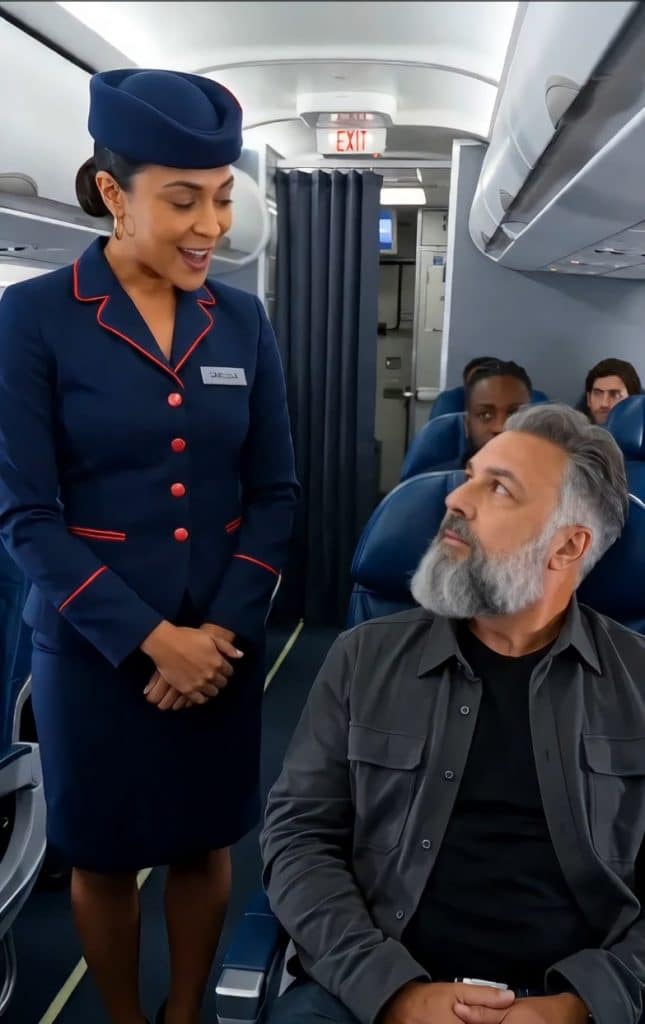
Sarissa stood in the business class aisle with her hands folded neatly over her navy uniform, her red-trimmed hat perfectly angled, her name tag shining beneath the cabin lights.
“Sir,” she said, looking down at the man in 14A, “I think you’re in the wrong seat.”
The man looked up calmly.
He had salt-and-pepper hair, a thick gray beard, and a dark casual jacket that looked too ordinary for the polished blue leather seat around him. No expensive watch. No laptop open. No tailored suit hanging from the hook beside him.
Just a middle-aged man sitting quietly beside the window while the aircraft hummed steadily around him.
“This is my seat,” he said.
His voice was low. Not defensive. Not embarrassed.
Certain.
Sarissa’s smile tightened.
Nearby passengers pretended not to listen, which meant everyone was listening.
She glanced over his jacket and black T-shirt, then gave a small gesture toward the curtain behind her.
“Business class is not for everyone,” she said. “Economy is that way.”
A man across the aisle looked down at his phone. A woman two rows back shifted uncomfortably. No one spoke.
The passenger reached into his jacket and raised his boarding pass.
Seat 14A was printed clearly in a red box.
Sarissa looked at it.
For one second, her face flickered.
Then she returned the pass without apology.
The service cart rattled into the aisle a moment later, stocked with orange juice, fruit, and polished glasses. Sarissa stopped beside him again, one hand gripping the cart handle.
“Oh,” she said, her voice sharp beneath the fake sweetness. “Sorry. Still here?”
The man only looked up.
“It’s okay,” he said.
That seemed to offend her more than anger would have.
She leaned closer, her perfume mixing with the metallic scent of cabin air and citrus from the cart.
“I told you to move.”
The words were loud enough for three rows to hear.
The cart jolted as she shoved it forward, glasses clinking hard. She walked away with her shoulders rigid, leaving the man in 14A seated in the bright silence of public humiliation.
He did not chase her.
He did not raise his voice.
He simply stared forward, his jaw tightening once.
Then his hand moved slowly toward the call button.
But he was not asking for orange juice anymore.
Act II
His name was Samuel Whitaker, though most people on that aircraft would not have known it.
Not from his clothes.
Not from his seat.
Not from the quiet way he boarded early, placed one small leather bag in the overhead bin, and thanked the gate agent by name.
Samuel had spent most of his life being underestimated by people who mistook polish for importance.
He grew up in a trailer outside Dayton, raised by a mother who cleaned offices at night and a grandfather who repaired aircraft parts in a cold garage behind the house. By fourteen, Samuel knew how to rebuild an engine valve before he knew how to tie a formal tie.
At nineteen, he joined a regional maintenance crew.
At twenty-seven, he designed a safety modification that saved an airline millions.
At forty-three, he became the kind of man executives called when they wanted an impossible problem solved quietly.
By fifty-six, he sat on the board of the very airline whose business class cabin Sarissa had just tried to remove him from.
He hated that part of his life.
The titles. The meetings. The careful suits. The rooms where men spoke about service while rarely looking at the people who gave it.
His late wife, Elena, had been a flight attendant for thirty-two years. She believed airplanes revealed character faster than almost anything else.
“People show you who they are when they think they’re above someone,” she used to say.
Samuel had heard that sentence a hundred times.
He was hearing it now.
He was on this flight because of Elena.
A year after her death, the airline had created a service scholarship in her name for crew members who showed exceptional compassion. Samuel was flying to New York to present the first award.
He had chosen to travel quietly.
No entourage. No executive escort. No announcement to the crew.
Just seat 14A, the seat Elena always requested when she flew as a passenger because she liked the window and said the wing made her feel safe.
But there was another reason he kept quiet.
For months, complaints had been reaching the board. Not about delays or lost bags. About humiliation. Passengers judged by clothing, accent, age, disability, race, weight, and money. People moved, ignored, mocked, or treated like mistakes in seats they had paid for.
Samuel had argued that numbers would never tell the whole story.
So he flew anonymously whenever he could.
Most crews passed with grace.
Some did not.
Sarissa had not failed because she made a mistake.
A mistake was asking to see a boarding pass.
She failed when the proof was in her hand and she chose arrogance anyway.
Samuel looked at the call button.
Then he looked at the blue curtain moving gently with the airflow.
He thought of Elena serving coffee to frightened first-time flyers. Kneeling to help elderly passengers with their shoes. Sneaking extra cookies to children whose parents looked exhausted. Saying, after every long flight, “Dignity is free. That’s why nobody has an excuse not to give it.”
Samuel pressed the button.
A soft chime sounded above his seat.
Three heads turned.
Then the lead purser stepped through the curtain.
And Sarissa came with her.
Act III
The lead purser’s name was Margaret Vale.
Samuel recognized her from the crew manifest, though she clearly did not recognize him yet. She was older than Sarissa, with calm eyes and the kind of posture that came from years of handling turbulence in both the sky and human behavior.
“Is everything all right here?” Margaret asked.
Before Samuel could answer, Sarissa spoke.
“This passenger is refusing crew instruction.”
The words were polished.
Prepared.
Samuel looked at her.
Margaret turned slightly. “What instruction?”
“I asked him to return to his assigned cabin,” Sarissa said. “He became difficult.”
A murmur passed through the nearby seats.
Samuel felt it then, not as anger, but as something heavier.
A lie in a confined space has nowhere to disappear.
He raised the boarding pass again.
“My assigned seat is 14A,” he said.
Margaret took the pass, read it, and paused.
Sarissa crossed her arms. “There may have been a boarding error.”
Margaret’s eyes moved to the seat number above the row. Then to the pass. Then back to Sarissa.
“There doesn’t appear to be one.”
Sarissa’s cheeks colored.
“He didn’t look like—”
She stopped herself too late.
The silence sharpened.
Samuel watched Margaret’s face change. Not dramatically. Not enough for passengers to see everything. But enough for someone trained in restraint to understand.
Margaret knew.
Sarissa had said the quiet part almost out loud.
Samuel leaned back.
“I was told business class was not for everyone,” he said. “Then I showed my boarding pass. Then I was told to move anyway.”
Sarissa’s eyes flashed.
“That is not what happened.”
A man across the aisle lifted his phone slightly.
“It is,” he said.
His voice shook, but he kept going.
“She said economy was that way.”
Another passenger nodded.
“She did.”
The woman two rows back added softly, “She pushed the cart and shouted at him.”
Margaret turned toward Sarissa.
“Step to the galley.”
Sarissa stiffened. “Margaret—”
“Now.”
For the first time, Sarissa looked uncertain.
Samuel expected her to argue. Instead, her eyes moved to the boarding pass still in Margaret’s hand.
Margaret had flipped it over.
On the back, beneath the printed itinerary, was a small notation only senior crew would recognize.
BOARD OBSERVER — ELENA WHITAKER SERVICE TRUST
Margaret looked up slowly.
“Mr. Whitaker?”
Sarissa’s face drained.
The passengers did not understand the name yet.
But Sarissa did.
Everyone who had attended annual training knew the Whitaker name. It was on the service modules. On the employee ethics videos. On the scholarship announcement posted in crew lounges across the country.
Samuel Whitaker.
Board member.
Widower of Elena Whitaker.
The man whose signature sat at the bottom of the airline’s new passenger dignity policy.
And Sarissa had just told him he did not belong.
Act IV
Margaret closed the curtain to the galley.
The cabin remained quiet behind it.
Sarissa stood beside the service cart, hands clenched, no longer wearing the easy authority she had carried down the aisle.
“I didn’t know who he was,” she said.
Margaret’s voice was cold.
“That is the problem.”
Sarissa swallowed. “I thought—”
“You thought what?”
No answer came.
Because the honest answer would have ruined her.
She thought casual meant poor.
She thought quiet meant powerless.
She thought a man without a suit could be embarrassed into obedience.
Margaret looked toward the closed curtain.
“You will not serve that cabin for the remainder of the flight.”
Sarissa’s eyes widened. “You can’t do that.”
“I can, and I am.”
“He’s going to ruin me.”
Margaret stepped closer.
“No, Sarissa. You did this in front of witnesses. Do not make him responsible for your choices.”
In seat 14A, Samuel stared out the window.
Clouds stretched beneath the aircraft like white fields. The world looked peaceful from that height, which had always struck him as strange. Up here, people could forget how much pain moved on the ground below.
The man across the aisle leaned toward him.
“I’m sorry nobody spoke sooner.”
Samuel turned.
The man looked ashamed.
“We all heard it.”
Samuel nodded.
“Sometimes people freeze.”
“I did.”
“We all have.”
The man lowered his eyes.
Margaret returned alone.
“Mr. Whitaker,” she said quietly, “I owe you an apology on behalf of the crew.”
Samuel looked up at her.
“You owe one to the cabin.”
Margaret understood immediately.
She stood in the aisle, facing the passengers who had watched the confrontation unfold.
“Ladies and gentlemen,” she said, voice steady, “a passenger in this cabin was treated with disrespect. His boarding pass was valid. His seat was correct. The way he was spoken to does not meet our standard, and it should not have happened.”
No one moved.
Samuel felt the cabin absorb the words.
Public harm deserved public correction.
Margaret turned back to him.
“I’m sorry, sir.”
Samuel’s face softened.
“Thank you.”
She hesitated. “May I offer you something to drink?”
A faint, sad smile touched his mouth.
“Orange juice would be fine.”
Margaret nodded, but before she stepped away, Samuel added, “And please serve the gentleman in 15C first. He looked like he was trying to disappear when this started.”
The man in 15C looked startled.
Samuel glanced around the cabin.
“People shouldn’t have to be powerful to be treated gently.”
Margaret’s eyes shone.
“No,” she said. “They shouldn’t.”
Behind the curtain, Sarissa heard every word.
And for the first time since boarding, she looked less angry than afraid.
Act V
The captain came out after the aircraft landed.
Not during the flight. Samuel respected that. In the air, emotions had to wait behind safety.
But once they reached the gate, once the seatbelt sign turned off and passengers began standing in the aisle, Captain Daniel Roe stepped into business class and asked Samuel if he could speak with him privately.
Sarissa stood near the forward galley, pale and silent.
She had removed her hat.
That made her look younger.
Not innocent.
Just young enough for shame to still have a chance to become change instead of bitterness.
Samuel followed the captain into the small forward space near the door.
Captain Roe lowered his voice.
“Mr. Whitaker, I reviewed the lead purser’s report. I’m sorry this happened on my aircraft.”
Samuel looked past him to the cabin.
“It happened because she thought no one important was watching.”
The captain nodded once.
“That will be addressed.”
Samuel’s gaze moved to Sarissa.
She stared at the floor.
“May I speak with her?” he asked.
The captain hesitated.
“Of course.”
Sarissa looked up when Samuel approached. Her face tightened as if she expected punishment to have a sound.
“I’m sorry,” she said quickly. “I was wrong.”
Samuel studied her.
“Are you sorry because I’m Samuel Whitaker?”
Her lips parted.
No answer.
He nodded slowly.
“That’s what you need to think about.”
Her eyes filled, but he did not soften the truth for her.
“You saw my clothes and decided I was a problem. You saw my boarding pass and decided proof mattered less than your judgment. You lied when someone asked what happened. Those are not service mistakes. Those are character choices.”
A tear slipped down her cheek.
“I know.”
“I hope you do someday.”
The words were not cruel.
That made them harder.
Sarissa whispered, “Am I losing my job?”
Samuel looked toward Margaret, then the captain.
“That decision is not mine alone.”
Then he turned back to her.
“But if it were, I would not start by asking whether you deserve to be punished. I would ask whether you are willing to become someone who never does this again to a person who cannot hurt your career.”
Sarissa covered her mouth.
Samuel stepped back.
The passengers began leaving the aircraft.
Several nodded to him as they passed. The man from across the aisle stopped and shook his hand. The woman two rows back touched Samuel’s arm lightly and said, “Your wife would be proud.”
Samuel froze.
She smiled sadly. “I saw the trust name on the pass when the purser held it. I knew Elena. She trained my daughter.”
For a moment, the airport noise disappeared.
Samuel’s eyes filled.
“What’s your daughter’s name?”
“Grace Vale.”
Samuel turned toward Margaret.
The lead purser, standing near the galley, looked down with a small, emotional smile.
Of course.
The world had a strange way of folding stories into each other at thirty thousand feet.
Samuel left the aircraft last.
In the jet bridge, he stopped once and looked back at seat 14A.
Elena’s seat.
The one Sarissa had tried to turn into a place of shame.
Instead, it had become a witness.
The investigation lasted two weeks.
Sarissa was suspended from passenger service, then assigned to retraining, supervised community outreach, and a formal review. Many people online would have wanted a cleaner ending. Fired. Humiliated. Gone.
Samuel did not argue for that.
He argued for something harder.
A full cabin service reform.
Every crew member would be trained not only in policy, but in dignity under pressure. Passenger complaints about discrimination would be reviewed by real people, not buried in automated replies. New hires would hear Elena Whitaker’s story in orientation.
And Sarissa, if she returned, would have to stand in front of trainees and tell the truth about what she had done.
Six months later, Samuel attended that training.
He sat in the back of a conference room at headquarters, again wearing a dark jacket and plain black T-shirt.
No one noticed him at first.
Sarissa stood at the front in uniform, hands clasped tightly.
Her voice shook when she began.
“I thought I was protecting business class standards,” she said. “But what I was really protecting was my own prejudice.”
The room was silent.
She continued.
“A passenger showed me proof he belonged. I ignored it because I had already decided he didn’t. Then I lied. The worst part is not that he turned out to be important. The worst part is that I would have treated him that way if he wasn’t.”
Samuel lowered his eyes.
That was the sentence he had been waiting for.
Not an apology to power.
An apology to truth.
After the session, Sarissa approached him.
“I don’t expect forgiveness,” she said.
Samuel looked at her for a long moment.
“Good,” he said. “Expecting forgiveness is just another way of making someone serve you.”
She absorbed that.
Then he added, “But I do believe people can change if they stop defending who they were.”
Her eyes filled again.
“I’m trying.”
“I can see that.”
That was all he gave her.
It was enough.
Years later, Samuel still flew in 14A whenever he could.
He watched crews more closely than passengers knew. He noticed who bent down to speak to children at eye level. Who helped nervous travelers without making them feel foolish. Who treated the man in a hoodie with the same warmth as the woman in pearls.
And sometimes, when the flight leveled above the clouds and the cabin softened into quiet, he heard Elena’s voice again.
Dignity is free.
That was the truth Sarissa had missed.
Business class was never about leather seats or orange juice in glass cups. It was never about polished shoes, tailored jackets, or the ability to look expensive under fluorescent cabin lights.
A seat could be purchased.
Status could be hidden.
Power could sit quietly by a window in a black T-shirt and say nothing until it had to.
But dignity was different.
Dignity was owed before the boarding pass.
Before the name.
Before the reveal.
Before anyone knew whether the person in 14A could ruin them.
The tragedy was how often people waited for proof of importance before offering basic respect.
The lesson, Samuel knew, was simpler than that.
Treat people well before you know who they are.
Because by the time you discover it, you may have already shown them who you are.