Act I
The motorcycles arrived before sunrise.
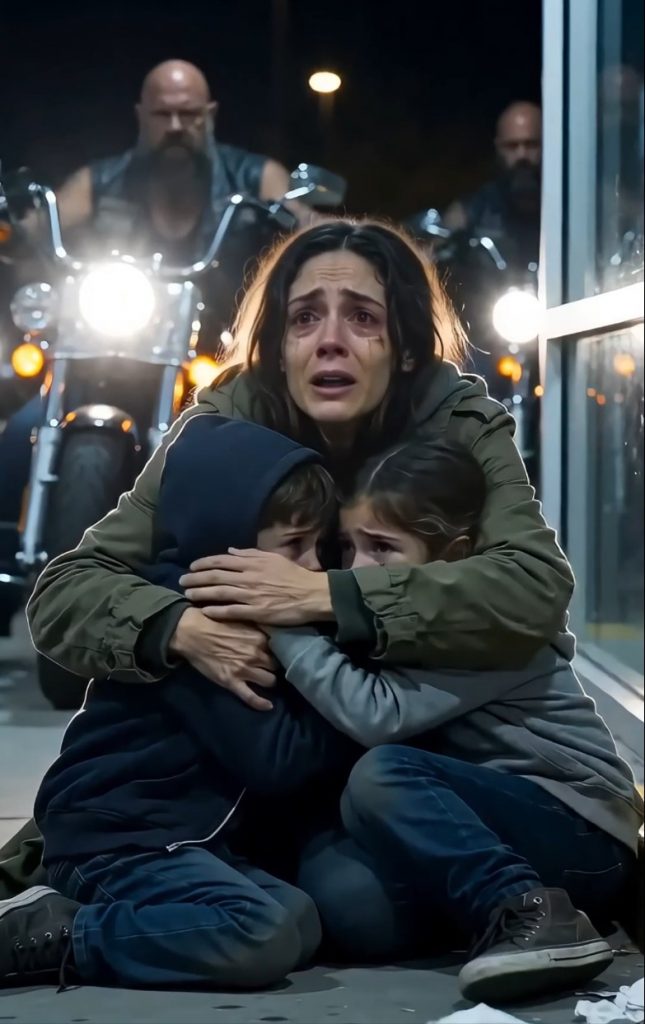
Their headlights cut through the empty bus station like searchlights, sweeping over crushed cans, torn wrappers, and a yellow curb stained by rain and old oil. The glass doors reflected the bikes as they rolled in one by one, engines growling low beneath the cold fluorescent lights.
At the edge of the terminal, a woman pulled two children tighter against her chest.
Her name was Leah.
Her green parka was too thin for the hour, her dark hair tangled from a sleepless night, and tear tracks had dried on her cheeks in uneven lines. Her son, Caleb, clutched her sleeve with both hands. Her younger daughter, Emma, hid her face under Leah’s arm, shivering inside a hoodie that smelled faintly of smoke and laundromat soap.
It was 5:03 in the morning.
They had no tickets.
No food.
No place to go until the shelter opened its doors.
Then the bikers stopped in front of them.
The leader swung one heavy boot down onto the concrete and dismounted slowly. He was older, broad-shouldered, with gray facial hair and a U.S. flag bandana tied around his head. Silver chains flashed against his black leather vest. A patch on his chest read SPIDHEL, stitched in rough white letters.
Leah’s heart thudded.
She had learned the hard way that when men arrived in groups, women with children did not assume kindness.
“Please, sir,” she said, voice trembling. “We don’t want any trouble.”
The biker leader stared down at her.
“Trouble?” His voice was gravelly and low. “Why are you out here this late?”
Leah swallowed.
“We lost everything. We were just trying to get to the shelter.”
Caleb pressed his face into her sleeve.
“Mom,” he whispered, so small it broke something inside her, “I’m so hungry. Are we sleeping outside again?”
Leah could not answer.
The bald biker beside the leader leaned forward, his thick arms bare beneath a leather vest.
“No food, no home, no bus ticket?” he said. “That’s rough.”
Leah’s fear sharpened.
She pulled the children into her chest, turning her shoulder like a shield.
“Please don’t scare my kids.”
The leader did not speak.
He only stared.
His expression was unreadable under the harsh station lights, his jaw locked, his eyes moving from Leah’s face to the children, then to Caleb’s hands.
That was when he saw it.
A dark bruise circled the boy’s wrist.
Not from falling.
Not from playing.
From being grabbed.
The leader’s face changed.
Barely.
But Leah saw it.
And suddenly the growl of the motorcycles did not sound like a threat anymore.
It sounded like a warning meant for someone else.
Act II
Leah had left with twenty-seven dollars, two backpacks, and the children’s birth certificates tucked inside her boot.
She had not planned it beautifully.
People in movies always packed bags in neat silence and left while danger slept upstairs. Real life was uglier. Real life was Caleb spilling cereal because his hands were shaking. Emma crying because she could not find her stuffed rabbit. Leah trying to turn the deadbolt without making noise while her husband’s truck still sat in the driveway.
His name was Darren.
To neighbors, he was unlucky. A man who lost jobs because bosses were unfair. A man who drank because pressure was heavy. A man who apologized loudly enough for people to hear through thin trailer walls.
To Leah, he was weather.
You learned to read him before he broke.
That night, the storm came early.
Darren found the shelter pamphlet in Leah’s purse.
He did not shout at first.
That was worse.
He held the paper between two fingers and asked, “Planning a trip?”
Leah said nothing.
Caleb stepped in front of Emma.
Darren grabbed his wrist and pulled him aside hard enough to make the boy cry out.
That sound made Leah move.
Not think.
Move.
She shoved Darren’s arm away, grabbed the children, and ran through the back door while he cursed behind them.
They crossed two streets barefoot before Leah realized Emma had no coat.
They hid behind a closed diner until dawn threatened the sky.
Then they walked to the bus station because Leah had once heard a woman at the food pantry say the shelter van picked people up there before morning intake.
But no van came.
The first bus would not arrive for another hour.
Her phone was dead.
Her cash was not enough.
And the only people who came were bikers.
Leah had seen clubs like that on the road. Big engines, patches, leather, men who laughed too loud at gas stations and made everyone move around them. She did not know what kind these were.
She only knew she had children against her chest and nowhere left to retreat.
The biker leader crouched slowly in front of Caleb.
The boy shrank back.
The man stopped immediately.
“I’m not going to touch you,” he said.
Caleb looked at him through wet lashes.
“What’s your name, son?”
Caleb did not answer.
Leah did. “Caleb.”
The biker nodded once. “I’m Ray.”
The bald biker snorted softly. “Most folks call him Preacher.”
Leah stared.
The name did not fit the leather.
Ray’s eyes stayed on Caleb’s wrist.
“Who did that?”
Leah’s body went cold.
“No one.”
Ray looked at her.
Not accusingly.
Sadly.
“Ma’am,” he said quietly, “that answer sounds like fear talking.”
Leah’s eyes filled.
Before she could speak, Emma lifted her head from under Leah’s arm.
“Daddy was mad,” she whispered.
The whole biker line went silent.
The engines still idled, but the men did not move.
Ray’s jaw tightened.
Then he stood.
“Turn the bikes off.”
One by one, the engines died.
The sudden silence made Leah’s breath catch.
Ray looked toward the dark road.
“Boys,” he said, “we’re not leaving them here.”
Act III
Leah did not trust kindness quickly.
Not anymore.
When Ray pulled a folded blanket from one of the motorcycle saddlebags, she stiffened. When the bald biker brought over a paper sack with breakfast sandwiches, she hesitated. When one of the younger bikers offered Emma a sealed carton of orange juice, Leah checked the cap before letting her daughter take it.
None of them mocked her.
That frightened her in a different way.
Caleb ate too fast, then looked ashamed. Ray sat on the curb several feet away, giving him space.
“Hunger makes everybody eat like that,” he said. “No shame in it.”
Caleb slowed.
Emma fell asleep against Leah’s lap halfway through the sandwich, one hand still wrapped around the juice box.
The sky lightened by degrees.
Gray turned to blue. The station became uglier in daylight: gum stains, cracked concrete, a poster peeling from the glass wall. But the bikers had formed a loose wall around Leah and the children, their bodies facing outward, not in.
The bald biker, whose name was Tank, made a call.
Not loud.
Not dramatic.
Just one hand over his phone and a voice rough with purpose.
“Yeah. It’s Tank. I need Rosie at the shelter awake now. Woman and two kids. Domestic situation. No, not later. Now.”
Leah looked at Ray.
“You know the shelter?”
Ray’s eyes softened.
“My wife started it.”
The words landed quietly.
Leah glanced at the patch on his vest again, then at the chains, the boots, the hard face.
“Your wife?”
“Marisol.” Ray’s voice changed around the name. “She used to run intake out of a church basement. Said nobody should have to wait until business hours to be safe.”
Leah looked down at Emma sleeping against her.
“Where is she now?”
Ray’s silence answered before he did.
“Gone six years.”
“I’m sorry.”
“So am I.”
A bus pulled into the far lane and hissed to a stop, though no one boarded. The driver looked at the bikers, then at the family, and wisely kept his doors closed.
Ray stood and walked toward the glass entrance.
Leah panicked.
“Where are you going?”
“To check if they’ve got a working outlet for your phone.”
She almost laughed from exhaustion.
“My phone?”
“You need to call someone?”
Leah shook her head.
“Anyone safe?”
Her mouth opened.
No name came out.
That was the worst part. Not the hunger. Not the cold. The silence where a safe name should have been.
Ray seemed to understand.
He nodded without pity.
“Then we make the first call.”
“To who?”
“Police. Shelter. Legal advocate. In that order.”
Leah’s stomach twisted.
“No police.”
Ray turned back.
“Why?”
“Because he always talks his way out.”
Ray looked toward Caleb’s bruised wrist.
“Not this time.”
Leah’s voice broke. “You don’t know him.”
Ray stepped closer, but not too close.
“No,” he said. “But I know men who scare women into thinking nobody can stand beside them.”
Leah looked at the line of bikers.
For the first time, she noticed details she had missed.
One had a faded ribbon pinned to his vest.
One had a child’s drawing tucked under the clear cover of his bike bag.
Tank had scars on his knuckles and tears in his eyes when Emma whimpered in her sleep.
Ray followed her gaze.
“We ride every first Saturday,” he said. “Marisol’s run. We check stations, underpasses, motel lots. Places people get stuck before help opens.”
Leah’s lips trembled.
“So you were looking?”
Ray nodded.
“For exactly you.”
Before she could answer, a truck engine growled down the road.
Leah’s whole body went rigid.
Caleb dropped his sandwich.
Ray saw her face and turned.
A dented red pickup rolled toward the bus station.
Leah whispered, “That’s him.”
Act IV
The pickup stopped hard near the curb.
Darren jumped out before the engine died.
He wore the same flannel shirt from the night before, hair wild, face flushed with anger dressed up as concern.
“There you are,” he shouted. “Leah, get the kids in the truck.”
Caleb scrambled behind Ray.
Emma woke and began to cry.
Darren’s eyes swept across the bikers, then narrowed.
“What is this? You got my family hanging around trash now?”
Tank stepped forward.
Ray lifted one hand, stopping him.
Leah stood slowly, Emma in her arms.
“We’re not going with you.”
Darren laughed.
It was the laugh he used in front of neighbors.
Tired husband. Difficult wife.
“Baby, you’re exhausted. You’re not thinking straight.”
Ray’s voice cut in.
“She said no.”
Darren looked him up and down.
“This is family business.”
Ray’s face did not move.
“Not when children are scared.”
Darren’s expression hardened.
Leah saw the shift and instinctively stepped back.
Ray saw that too.
Darren pointed at Caleb. “Boy, get over here.”
Caleb shook his head.
Darren took one step forward.
Every biker moved at once.
Not attacking.
Standing.
A wall of leather and boots between Darren and the children.
Darren stopped.
His eyes flicked from face to face, searching for weakness and finding none.
“You don’t know what she’s like,” he said loudly. “She’s unstable. Took my kids in the middle of the night. I’ve got rights.”
Ray nodded slowly.
“You probably do.”
Darren blinked, thrown off.
Ray continued, “And now you can explain those rights to the officers on their way.”
Darren’s jaw tightened.
Leah looked at Ray.
“You called already?”
Ray did not look away from Darren.
“Before I turned the bikes off.”
Sirens sounded faintly in the distance.
Darren’s anger cracked into panic.
He turned toward Leah. “You stupid—”
Tank stepped forward this time, voice low.
“Choose your next word like it matters.”
Darren’s mouth shut.
The patrol car arrived two minutes later, followed by a white van marked with the shelter’s logo. A woman with gray curls and a purple coat stepped out of the van and hurried toward Leah.
“Leah?” she asked gently. “I’m Rosie. You and the kids can come with me.”
Leah could not move.
She had imagined help so many times that when it finally stood in front of her, she did not trust her legs.
Rosie touched her own chest, not Leah’s arm.
“You’re safe to say no. You’re safe to ask questions. You’re safe to breathe.”
That sentence undid her.
Leah began to cry.
Not the silent kind.
The kind she had held back all night.
Caleb wrapped his arms around her waist. Emma cried because Leah cried. Rosie stood there with tissues and patience while the police spoke to Darren.
At first, Darren performed.
He was worried. He was misunderstood. His wife was emotional. He wanted his children home.
Then an officer gently asked Caleb about his wrist.
The boy looked at Ray.
Ray nodded once.
Caleb whispered the truth.
Darren stopped performing after that.
When they found Leah’s birth certificates tucked inside her boot, the shelter pamphlet in Darren’s truck, and Caleb’s bruise photographed under station lights, the story no longer belonged only to Darren’s mouth.
It had evidence now.
Darren was told to leave the property.
He refused.
Then he reached toward Leah.
Ray did not touch him.
He did not need to.
The officers stepped in first.
As Darren was escorted back toward the truck, he looked at Leah with a promise in his eyes.
Ray saw it.
So did Rosie.
So did the officer.
For once, Leah was not the only witness to the threat.
Act V
The shelter smelled like coffee, laundry soap, and pancakes.
Leah cried again when she saw the pancakes.
She hated that.
She hated how small kindness made her feel at first. Hated the way her children stared at the plates like food might disappear if they looked away. Hated that Caleb asked if he was allowed to have seconds.
Rosie said, “In this kitchen, seconds are a rule.”
Emma smiled for the first time that morning.
It was tiny.
It was enough.
Ray and the bikers did not come inside right away. They waited outside by the bikes while Leah met the intake worker, while the children were given clean socks, while a nurse checked Caleb’s wrist and Emma’s temperature.
Later, Leah found Ray standing near the shelter gate, helmet in one hand.
She walked toward him wrapped in a donated sweater.
“I don’t know how to thank you.”
Ray looked uncomfortable with gratitude.
“Stay alive,” he said. “That’s thanks enough.”
Leah wiped her face.
“Do you always do this?”
He looked toward the shelter sign.
“Marisol did. We just kept riding.”
Tank appeared behind him carrying two grocery bags.
“Snacks for the kids,” he muttered, like he was annoyed at the concept of tenderness.
Leah took the bags with shaking hands.
Inside were granola bars, juice boxes, crackers, coloring books, and a small stuffed bear with a biker bandana tied around its neck.
Emma named it Thunder.
By the end of the week, Leah had a protective order, a caseworker, and a bed in a family room with blue curtains. None of it was easy. Safety did not erase fear. It gave fear a place to finally sit down.
Caleb still woke at night.
Emma still asked if Daddy knew where they were.
Leah still flinched when trucks passed outside.
But every Saturday morning, motorcycles rolled by the shelter gate.
Not loud enough to scare the children.
Just loud enough for them to know.
The first time Caleb heard them, he ran to the window.
“Mom,” he said, “the helpers are here.”
Leah stood beside him.
Outside, Ray lifted one hand from the handlebar.
Caleb waved back.
Months later, Leah found work in the shelter kitchen. She started by washing dishes, then helping with breakfast, then sitting with new mothers who arrived at dawn wearing the same hollow-eyed terror she recognized too well.
She never told them it would be easy.
She told them they had made it through the door.
Sometimes that was the first miracle.
One cold morning, almost a year after the bus station, a young woman came in with a baby and a split lip, apologizing before anyone accused her of anything.
Leah knelt in front of her, just as Ray had once lowered his voice in front of Caleb.
“You don’t have to apologize for needing help.”
The woman broke down.
Leah held her hand until Rosie arrived.
That afternoon, Ray stopped by with a box of donated coats. Caleb and Emma ran to him like he was family, which, in the strange way life rebuilds itself after disaster, he had become.
Ray looked at Leah across the shelter lobby.
“You’re different now,” he said.
She smiled.
“No. I’m just not running.”
He nodded, understanding.
On the anniversary of that 5 a.m. morning, Leah took the children back to the bus station.
Not because she wanted to remember the fear.
Because she wanted them to see the distance between where they had been and where they were now.
The concrete was still cracked. The glass still reflected the fluorescent lights. The yellow curb was still chipped. But the trash had been cleared, and a new poster had been taped beside the entrance.
Need shelter before sunrise? Call this number. Someone will come.
At the bottom was the shelter logo.
And beside it, a small motorcycle icon.
Emma held Thunder the stuffed bear against her chest.
“Were we really sleeping here?”
Leah nodded.
“For a little while.”
Caleb looked at the curb.
“Was I scared?”
Leah brushed hair from his forehead.
“Yes.”
“Was Ray scary?”
She smiled softly.
“At first.”
Caleb thought about that.
“Sometimes people look scary but they’re safe.”
Leah looked down the empty road where the motorcycles had appeared out of the dark.
“Sometimes,” she said, “people arrive loud because quiet people have been ignored too long.”
A low rumble sounded in the distance.
Emma brightened.
The bikes came around the corner in a slow, respectful line, headlights warm in the early morning gray.
Ray stopped at the curb and took off his helmet.
This time, Leah did not pull her children back.
They ran forward.
And the biker leader who had once looked unreadable under harsh station lights crouched down on the concrete and let two laughing children throw their arms around his neck.
Leah watched with tears in her eyes.
The bus station had been the place where she thought the world had finally emptied.
Instead, it became the place where help arrived on chrome and leather, where a stranger saw a bruise and refused to look away, where engines that sounded like danger became the first sound of safety.
And for the rest of her life, whenever Leah heard motorcycles in the distance before dawn, she did not think of fear.
She thought of the morning her children were hungry, cold, and shaking.
And a line of bikers turned off their engines so they could hear them cry.