Act I
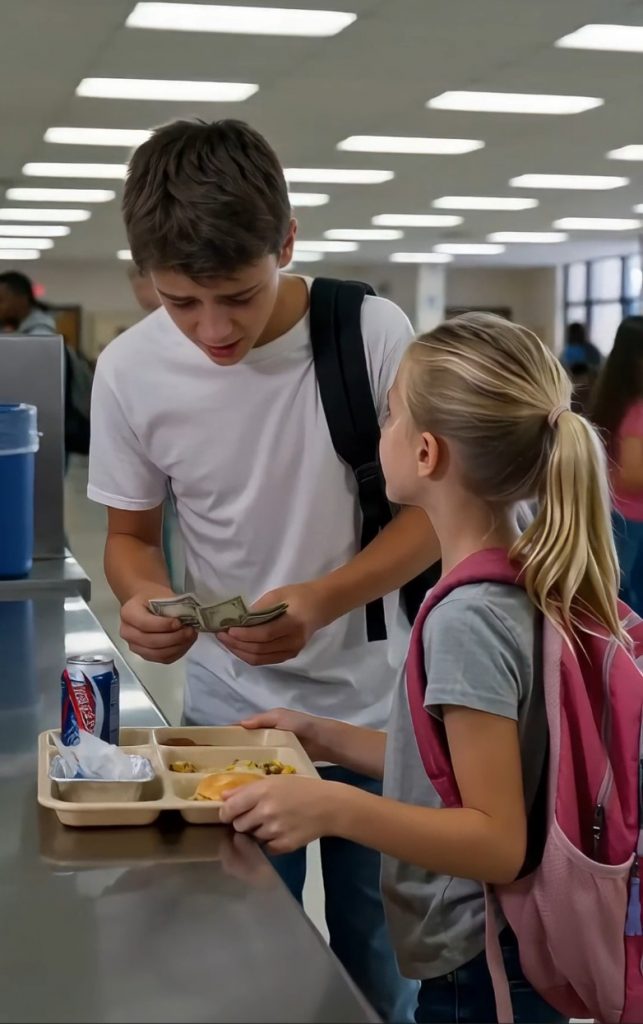
The boy counted the money three times because the answer hurt too much the first two.
A one-dollar bill. Three quarters. Two dimes. A nickel.
His little sister stood beside him with both hands wrapped around a lunch tray, trying not to stare at the sandwich, the apple slices, and the carton of milk like they were something precious.
The cafeteria roared around them.
Students laughed. Trays slid across counters. Sneakers squeaked against the tile floor. Somewhere behind them, someone shouted across a lunch table, and a group of boys burst into laughter.
But at the payment counter, everything felt painfully quiet.
“Lemme see,” the teenage boy whispered, pushing the coins around in his palm. “I got enough for one.”
His sister looked up at him.
She was maybe seven, blonde ponytail falling loose at the edges, pink backpack hanging from one shoulder. Her eyes moved from the tray to his face.
“I can share, bubby,” she said.
The boy’s jaw tightened.
He was trying to be brave in that specific way older siblings learn too early. Shoulders squared. Voice low. Face still. Like if he looked calm enough, hunger would become less real.
The cashier looked at the point-of-sale screen and sighed.
The terminal beeped.
“One meal only,” she said. “I can’t give out extras.”
The boy leaned closer, holding the cash in both hands.
“Please,” he said. “She’s been hungry since last night.”
The words landed harder than he meant them to.
The girl looked embarrassed immediately, as if being hungry was a mistake she had made in public.
Students nearby began to turn.
The boy noticed and lowered his voice.
“I’m not asking for free,” he said. “I’ll pay tomorrow. I swear. I can work. I can clean tables. Anything.”
The cashier’s mouth pressed into a thin line.
“Rules are rules.”
The little girl looked at her brother with tears gathering fast.
“You can eat mine too,” she whispered.
He shook his head before she finished.
“Nah,” he said softly. “You eat, okay?”
She clutched the tray tighter. The milk carton trembled.
That was when a deep voice cut through the cafeteria.
“Hold up.”
The room did not go silent all at once.
It rippled.
Heads turned first near the hallway, then at the lunch tables, then at the counter.
An older biker stood beside the beige lockers, broad-shouldered and weathered, with a gray mustache, a U.S. flag bandana, and a black leather vest covered in patches. A silver chain rested against his shirt. His boots looked too heavy for a school cafeteria.
He walked toward the counter slowly.
No one blocked him.
The boy’s face tightened with uncertainty. The little girl stepped closer to her brother.
The biker reached into his vest, pulled out a worn tan leather wallet, and placed it on the counter with a firm thud.
The cashier blinked.
The biker looked down at the tray.
Then at the boy.
Then at the girl.
“How many kids in this school are eating less than they should?”
And suddenly the lunch line was no longer about one sandwich.
Act II
His name was Mason Reed, and he had not planned to beg.
He had planned everything else.
He had planned to wake up early, get his sister Emma dressed, braid her hair badly enough that she laughed, and tell her they were going to have a “normal day.” He had planned to walk her to school before his own first bell, then go to class, take notes, stay invisible, and figure out dinner later.
That was how life had been for three months.
Figure it out later.
After their mother got sick, every day became a list of things Mason was not old enough to handle and too old to ignore. Medicine bottles on the kitchen counter. Past-due notices tucked under magnets on the fridge. Emma’s shoes splitting at the side. Their mother apologizing from the bedroom, voice weak, as if illness were bad manners.
Their father had died four years earlier in a highway accident outside Tulsa.
Before that, he had been the loudest person in every room. A mechanic. A weekend drummer. A man who called Mason “captain” and Emma “sunshine.” When he died, the house did not only lose an income.
It lost sound.
Their mother, Claire, fought to keep them afloat. She took shifts at a laundry service. Then at a motel. Then cleaning offices at night. She came home smelling like bleach and peppermint gum, kissed both kids on the forehead, and told them they were almost through the hard part.
Then her lungs got bad.
Then the hard part got teeth.
Mason started working wherever people would let a sixteen-year-old work quietly. Stocking shelves for a corner store. Carrying boxes for a neighbor who sold antiques online. Fixing bikes for kids whose parents paid in cash.
But hunger is faster than pride.
That morning, the last bread in the house had gone to Emma’s breakfast.
Mason told her he ate earlier.
She believed him because she wanted to.
At school, he waited until the lunch line was shorter before taking her through. He thought if he stayed calm, if he counted the cash carefully, if he explained like an adult, the cashier might understand.
But schools are full of systems that can hear a beep faster than a child’s stomach.
The woman at the register, Mrs. Harlan, was not cruel in the way villains are cruel. She was tired. Rule-bound. Afraid of losing her job. Her own name badge was scratched, her eyes shadowed, her voice dry from saying no too many times.
But to Emma, no was still no.
And to Mason, forty cents short might as well have been a locked door.
The biker saw all of it.
He had come to the school for a maintenance meeting, or so the front office thought. His name was Frank Maddox, though the patches on his vest called him Bear. He ran a motorcycle repair shop on the edge of town and belonged to a veterans’ riding club that sponsored school supply drives, coat donations, and toy runs every Christmas.
To most students, he looked like someone from a warning poster.
To the kids who had ever needed help, he looked like someone who showed up with batteries, blankets, and no questions.
He had been standing near the hallway, waiting for the assistant principal, when he heard Emma say, “I can share, bubby.”
That word stopped him.
Bubby.
His own sister used to call him that before their mother disappeared for weeks at a time, before school lunches became the only steady meal he could count on, before he learned that shame could taste like powdered milk and government cheese.
Frank did not move at first.
He watched Mason refuse the food.
Watched the boy choose hunger with a gentleness that made the old man’s chest ache.
Then he heard the cashier say, “Rules are rules.”
And something in him, buried but not dead, stood up.
Act III
Frank opened the wallet slowly.
Mrs. Harlan stared at it like it might bite.
“How much?” he asked.
“For the second meal?” she said.
“No.”
The cashier frowned.
Frank looked at the payment terminal.
“How much does he owe?”
Mason’s face flushed.
“Sir, you don’t have to—”
Frank did not look away from the cashier.
“How much?”
Mrs. Harlan hesitated.
The line behind them had gone silent enough that the hum of the fluorescent lights became noticeable.
She tapped the screen.
“Mason Reed,” she read, then glanced at the boy with discomfort. “Negative balance is eighty-three dollars and forty cents.”
Mason closed his eyes.
Emma looked up at him.
“Bubby?”
“It’s okay,” he whispered, though his voice broke on the second word.
Frank’s jaw tightened.
“And hers?”
Mrs. Harlan tapped again.
“Emma Reed. Thirty-six dollars.”
Frank placed a hundred-dollar bill on the counter.
Then another.
“And the rest of the school?”
The cashier stopped breathing for a second.
“Excuse me?”
Frank leaned one hand on the counter.
“You heard me.”
Behind them, a teacher shifted nervously. “Sir, that’s not necessary.”
Frank turned his head slightly.
“No hungry child has ever been necessary.”
The words sank into the room.
Mrs. Harlan swallowed and tapped through another screen.
“I don’t think I’m allowed to disclose—”
Frank pulled a business card from his wallet and slid it beside the cash.
“Then call the principal. Call the district. Call whoever needs calling. I’ll wait.”
The card read Maddox Auto & Cycle beneath his name.
But under that was something Mason did not expect.
Founder, Open Road Children’s Fund.
Mrs. Harlan looked from the card to Frank.
“You’re that Maddox?”
Frank’s eyes stayed steady.
“I’m the one asking how much.”
A murmur moved through the cafeteria.
Mason did not understand what was happening. Emma still held the tray. Her sandwich sat untouched. Her eyes bounced between the biker, the cashier, and her brother.
The assistant principal, Mr. Dobbins, hurried in from the hallway with a walkie-talkie clipped to his belt.
“What’s going on here?”
Frank did not raise his voice.
“A boy tried to buy lunch for his little sister and couldn’t afford both meals. Your cashier followed a rule. I’m asking how expensive that rule is.”
Mr. Dobbins paled slightly.
“This is a school matter.”
Frank nodded.
“That’s why I’m in a school.”
Mason wished the floor would open beneath him. Every eye in the cafeteria felt like a hand pointing at his empty pockets.
“I can pay it back,” he said quickly. “I don’t want charity.”
Frank finally turned to him.
His expression softened.
“Son, this isn’t charity.”
Mason’s eyes stung.
“Then what is it?”
Frank looked at Emma’s shaking tray.
“It’s lunch.”
Act IV
The principal arrived five minutes later with a folder full of policies and a face full of panic.
By then, Frank had moved Mason and Emma to a side table away from the staring crowd. He told Emma to eat while the food was warm. She looked to Mason for permission.
Mason nodded.
Only then did she take a bite.
Frank noticed how quickly she tried not to eat quickly.
That hurt most.
Hungry kids learn manners like armor. Small bites. Quiet chewing. Eyes down. Never look desperate, even when desperation is the only thing on your plate.
Mason did not touch the second meal Mrs. Harlan had finally placed in front of him.
Frank sat across from him.
“You should eat.”
“I’m not hungry.”
Frank gave him a look.
Mason picked up the sandwich.
The principal, Mrs. Carver, approached with Mr. Dobbins and Mrs. Harlan behind her. Her smile was tight and public.
“Mr. Maddox, we appreciate your concern, but district lunch accounts are handled through formal channels.”
Frank leaned back.
“Good. Use one.”
“It isn’t that simple.”
“It never is when a child is hungry.”
Mrs. Carver’s expression hardened.
“There are procedures.”
Frank’s eyes moved to Mason, then Emma, then back to the principal.
“I grew up with procedures,” he said. “They told my sister she couldn’t eat because our mother forgot to sign a form. They told me I didn’t qualify because my uncle’s address was on file, even though I hadn’t slept there in months. They told us to wait. You know what hungry children hear when adults say wait?”
No one answered.
Frank’s voice dropped.
“They hear nobody is coming.”
Mrs. Harlan looked down.
For the first time, Mason saw her strictness crack into something like shame.
“I didn’t make the rule,” she said quietly.
Frank nodded once.
“I know.”
The sentence surprised her.
Then he added, “But every adult in this building decides how loudly that rule speaks.”
Mrs. Carver tried to regain control.
“Mr. Maddox, we cannot have public scenes in the cafeteria.”
Frank looked around at the students pretending not to listen.
“Then feed them before it becomes one.”
The principal lowered her voice.
“Do you understand how much unpaid lunch debt this school has?”
Frank held her gaze.
“Tell me.”
She hesitated.
He waited.
Finally, she said, “Nine thousand, six hundred and twelve dollars.”
The number moved through the cafeteria like weather.
Mason stared at the table.
Nine thousand dollars of children standing in lines, holding trays, hoping a machine said yes.
Frank opened his wallet again, but this time he did not pull out cash.
He pulled out a checkbook.
Mrs. Carver’s eyes widened.
“You can’t be serious.”
Frank removed a pen from inside his vest.
“I’m very tired of people saying that when kids need food.”
He wrote the check slowly.
Not because he was showing off.
Because his hand shook.
When he tore it free, the sound was small but final.
He placed it on the table.
“Clear it.”
Mrs. Carver stared.
“All of it?” she asked.
Frank’s voice was flat.
“All of it.”
Emma stopped chewing.
Mason looked up, stunned.
Frank pointed the pen gently toward the principal.
“And after you clear it, you’re going to help me set up an emergency meal fund that doesn’t make children perform poverty at a cash register.”
Mrs. Carver did not speak.
Frank stood.
The room seemed to stand with him.
“Because I came here today to talk about fixing a bus engine,” he said. “But apparently something else is more broken.”
Act V
The story should have ended there.
A biker writes a check. Children eat. Adults feel embarrassed. The school promises change.
But real change never ends at the dramatic moment.
It begins there.
Frank did not leave after the check cleared.
He asked for data. Asked for names. Asked why families were falling through programs meant to catch them. Asked how many students had parents working irregular hours, how many had guardians who could not complete online forms, how many were too proud or too afraid to ask for free lunch support.
Mrs. Carver resisted for three days.
Then the local paper called.
Then the district office called.
Then parents started calling too, not angry at the donation, but angry that they had not known how many children were quietly going hungry in the same cafeteria where their own kids threw away half-eaten apples.
By the next month, the Open Road Lunch Fund was official.
No child in the district would be denied a meal because of debt.
No sibling would be forced to choose.
No cashier would be placed in the position of weighing hunger against policy with a line of students watching.
Mrs. Harlan stayed.
At first, Mason hated seeing her. Then one morning, she stopped him before first period and handed him a brown paper bag.
“Extra breakfast sandwich,” she said gruffly. “Kitchen made too many.”
Mason looked at her.
She looked away.
“Don’t make it weird.”
He almost smiled.
“I won’t.”
Emma forgave her faster.
Children often do, when adults finally stop hurting them.
The bigger problem was Mason.
He did not know how to accept help without feeling like he had failed.
Frank understood that better than anyone.
Two days after the cafeteria incident, he showed up at the Reed apartment with a toolbox, a grocery card, and a lie.
“Heard you fix bikes,” he said.
Mason looked suspicious. “Sometimes.”
“My shop has too many busted ones and not enough patient hands. I pay hourly.”
“I have school.”
“After school.”
“I have to take care of my mom.”
Frank glanced past him into the small apartment, where Claire Reed slept under a knitted blanket, medicine bottles lined on the side table.
“Then we’ll schedule around that.”
Mason folded his arms.
“I don’t want pity.”
Frank’s face did not change.
“Good. I don’t hire people I pity.”
That was how Mason started working at Maddox Auto & Cycle three afternoons a week.
He learned to patch tires, clean chains, rebuild brake cables, and swear quietly when old bolts refused to move. Frank never asked too many questions, but food appeared in the break room every shift. Sandwiches. soup, fruit, leftovers from a diner near the shop.
Mason pretended not to notice that Frank always made too much.
Frank pretended to believe him.
Emma came by sometimes after school and sat on a stool doing homework while old bikers with names like Tank and Preacher helped her spell vocabulary words. She called Frank “Mr. Bear” because someone told her the nickname once and nobody had the courage to correct her.
Claire improved slowly.
Not magically. Not like stories sometimes pretend. Medicine helped. Rest helped. The district social worker Frank connected her with helped most of all. She got enrolled in assistance programs she had never known how to access and found part-time remote work through a community nonprofit.
One evening, Claire came into the shop to thank Frank.
She was thin, tired, and embarrassed.
Frank wiped his hands on a rag and listened while she tried to explain that she would pay him back someday.
When she finished, he shook his head.
“Ma’am, years ago somebody fed me when I couldn’t pay.”
Claire’s eyes filled.
“I’m still paying them back.”
Months later, the cafeteria looked different.
Not physically. Same beige walls. Same long tables. Same fluorescent lights buzzing overhead. Same payment terminal at the counter.
But the line moved differently.
Kids no longer held their breath at the register.
Mrs. Harlan no longer announced debt in front of everyone. A small sign sat near the terminal:
IF YOU NEED A MEAL, TAKE A MEAL.
WE’LL HANDLE THE REST.
Emma read it every day for a week.
Then she asked if she could draw flowers around the words.
Mrs. Harlan handed her markers.
On the last day of school, Mason walked Emma through the lunch line. He had money now. Not much, but enough. Enough to pay. Enough to feel the old fear loosen its grip.
Emma put a milk carton on her tray, then picked up a second one.
Mason raised an eyebrow.
“For you,” she said.
He smiled.
This time, he did not say no.
Frank was standing near the hallway again, talking to the principal about summer meal deliveries. His bandana was the same. His vest was the same. His wallet, worn and tan, sat half-visible in his pocket.
Emma spotted him and waved.
“Mr. Bear!”
The whole cafeteria turned.
Frank looked deeply uncomfortable.
Mason laughed for the first time in that room without trying to hide it.
Later, when the lunch period ended and the students spilled into the hallway, Mason stayed behind.
Frank was near the counter, signing a stack of forms.
Mason walked up beside him.
“I never said thank you right,” he said.
Frank capped the pen.
“You said it by showing up to work on time.”
“I mean for Emma.”
Frank looked toward the cafeteria tables.
“She remind you of anyone?” Mason asked.
For a moment, the biker’s face changed.
“My sister,” he said.
“Where is she now?”
Frank was quiet.
“Gone a long time.”
Mason nodded, understanding more than he wanted to.
Frank placed one heavy hand on his shoulder.
“That day at the counter,” he said, “you did what a good brother does. You made sure she ate first.”
Mason’s throat tightened.
“I was scared.”
“Good brothers usually are.”
Across the cafeteria, Emma stood on tiptoe to hand Mrs. Harlan a drawing. It showed a lunch tray, a smiling sun, and a giant man in a leather vest holding a wallet like a superhero shield.
Mrs. Harlan laughed until she cried.
Mason watched, eyes burning.
The memory of that first day would never disappear completely.
The coins in his hand.
The beep of the terminal.
His sister offering him the food she needed.
The cashier’s refusal.
The biker’s voice cutting through the room.
But the ending had changed.
That mattered.
Not because a stranger paid one bill.
Because he saw what everyone else had been trained not to see.
A hungry child is not a balance.
A meal is not a reward.
And dignity should never depend on whether a teenager has enough coins in his palm.
Sometimes rescue does not come with sirens.
Sometimes it comes in heavy boots across a cafeteria floor.
Sometimes it wears a leather vest, carries an old tan wallet, and says two words just loud enough to stop the whole room.
Hold up.
And sometimes, that is all it takes for the rules to finally meet someone stronger than shame.