Act I
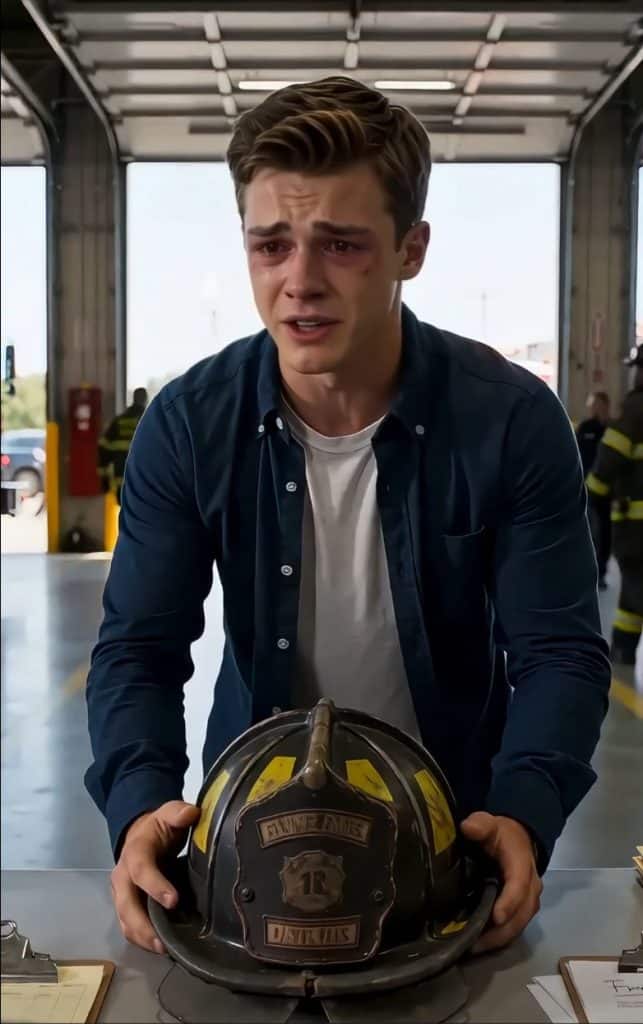
The young man placed the helmet on the table like he was laying down a piece of his heart.
It was old, scratched, and heavy. Yellow paint had faded into dull amber beneath blackened streaks. The edges were worn smooth from years of hands gripping it in smoke, rain, and panic. It did not look valuable to anyone passing by the donation table inside the fire station garage.
But to Ethan Reyes, it was everything.
His fingers stayed on the helmet even after he set it down.
Across the folding table, Officer Martin Kustin looked from the helmet to the young man’s tear-streaked face.
“I need medicine for my mom,” Ethan said, voice cracking. “What can you give me for this?”
Around them, the fire station bay was alive with noise. Boots on polished concrete. Radios chirping. Volunteers sorting paperwork. A red-and-white engine marked 18 sat behind them under the bright overhead lights.
Kustin reached into the cash box and pulled out two twenty-dollar bills.
He placed them beside the helmet.
“Best I can do is forty.”
Ethan stared at the money.
Forty dollars.
His mother’s medicine cost two hundred and eighty-seven.
For a moment, he looked like he might take the helmet back and run. Then he swallowed hard, touched the scratched brim with trembling fingers, and whispered, “Forty? Man… this was my dad’s helmet. He wore this his whole life.”
Kustin’s expression softened.
“I’m sorry,” he said. “Old gear doesn’t sell for much.”
Ethan nodded like he understood, but understanding did not make it hurt less.
He had already sold his watch. His tools. His father’s old radio. The framed badge from the hallway. The leather recliner where his mother used to sit beside his father after long shifts.
This helmet was the last thing.
The last piece of Captain Gabriel Reyes that still smelled faintly of smoke and garage dust.
Kustin lowered his eyes toward it again.
Then he stopped.
His hand hovered above the helmet.
There was a mark near the back rim, almost hidden beneath soot and chipped paint. Not a manufacturer’s mark. Not a station number.
A hand-carved notch.
Three lines crossed by a diagonal slash.
Kustin’s face changed.
The noise of the fire station seemed to fall away.
He leaned closer, turned the helmet slightly, and found the old brass shield beneath the grime.
Station 18.
But under the edge of the shield, scratched so faintly it almost vanished, was another name.
Not Reyes.
Kustin placed his hand firmly on the helmet.
His voice dropped.
“Where did you get this helmet?”
Ethan froze.
And for the first time that day, the old helmet looked less like a memory and more like evidence.
Act II
Ethan had not wanted to come.
His mother, Marisol, would have begged him not to if she had known. She would have told him no medicine was worth selling his father’s helmet. She would have tried to stand from her bed, weak lungs fighting every breath, and taken it from his hands.
So he waited until she fell asleep.
Then he wrapped the helmet in one of his father’s old station shirts and took the bus across town to the emergency-service fundraiser.
The event had been advertised as a public intake day. Old gear, collectibles, badges, uniforms, and memorabilia could be appraised, donated, or bought for charity. Ethan saw the poster in a pharmacy window while counting coins for antibiotics he still could not afford.
He hated himself for considering it.
Then his mother coughed so hard that night she gripped the bedsheet and whispered his father’s name.
By morning, Ethan had made his decision.
The helmet had sat for years on the top shelf of their hallway closet.
His father never let anyone treat it like decoration. It was not polished. Not displayed under glass. Not used for nostalgia when old firehouse friends came over and told stories.
Gabriel Reyes kept it wrapped in cloth.
When Ethan was little, he once asked why.
His father had taken the helmet down, held it in both hands, and said, “Some things survive what people don’t. You respect that.”
Ethan did not understand then.
He only knew his father’s face always changed when he touched it.
Gabriel Reyes had been a firefighter for thirty-one years. Not famous. Not decorated in newspapers. Not the kind of man who gave speeches in uniform or smiled for cameras.
He was the one who fixed the station sink. The one who remembered birthdays. The one who visited families after the flames were gone because he said smoke could leave a house faster than grief.
He died quietly.
Not in a burning building.
Not under falling beams.
Not in a heroic photograph.
A heart attack in the grocery store parking lot, one month before Ethan graduated college, one year before Marisol’s diagnosis swallowed the family’s savings.
At the funeral, men from Station 18 stood shoulder to shoulder. They called Gabriel brave. Loyal. The best of them.
But when Ethan asked about the helmet, they went quiet.
One older firefighter, Captain Bell, touched the cloth-wrapped brim and said, “Your dad carried more than his own story in that thing.”
Then he walked away before explaining.
Ethan had meant to ask again someday.
Someday became bills.
Bills became medicine.
Medicine became forty dollars on a folding table.
Now Officer Kustin was staring at him like the helmet had just spoken.
“It was my father’s,” Ethan said carefully.
Kustin’s eyes remained fixed on the hidden name. “Your father was Gabriel Reyes?”
“Yes.”
“Station 18?”
“His whole career.”
Kustin’s jaw tightened.
“That isn’t Gabriel’s original helmet.”
Ethan felt something cold move through him.
“What?”
Kustin turned the helmet so Ethan could see the scratched name beneath the shield.
The letters were old and uneven, but readable.
D. KUSTIN.
Ethan looked up slowly.
Officer Kustin’s face had gone pale.
“That was my brother’s helmet,” he said.
Act III
The fire station garage went still in a way Ethan could feel before he understood it.
Officer Kustin did not shout. He did not accuse. That made it worse.
He only stared at the helmet like it had climbed out of a grave.
“My brother’s name was David Kustin,” he said. “He was a firefighter with Engine 18.”
Ethan shook his head. “No. My dad wore this. I saw pictures.”
“I’m not saying he stole it.”
The words landed hard.
Kustin drew in a breath, then called over his shoulder, “Chief Bell.”
The older man at the far end of the bay turned.
Ethan recognized him immediately from the funeral. Captain Bell, though apparently now the chief, moved slower than before, but his eyes were still sharp. When he saw the helmet on the table, his expression emptied.
“Kustin,” he said quietly. “Where did that come from?”
“Gabriel Reyes’ son brought it in.”
Chief Bell closed his eyes.
For a moment, Ethan thought he might collapse.
Then the chief pulled out the folding chair and sat across from him.
“Ethan,” he said, voice low, “your father never told you about the Elridge warehouse fire?”
Ethan’s throat tightened.
“No.”
The chief looked at Officer Kustin.
Martin Kustin nodded once, but his face was rigid.
Chief Bell placed one hand beside the helmet, not touching it.
“Twenty-six years ago, Engine 18 responded to a warehouse fire outside the old rail district. Officially, it was ruled accidental. Bad wiring. Unstable structure. Two firefighters trapped inside. One survived. One didn’t.”
“David,” Ethan whispered.
Kustin looked away.
“My brother.”
Chief Bell continued. “Your father was the one who came out alive.”
The words struck Ethan like guilt, though he had no reason to feel it.
He had grown up hearing fragments about a fire that changed his father. A nightmare. A bad call. A name his mother never said at dinner.
But never this.
“Dad survived,” Ethan said. “Your brother didn’t.”
Kustin’s voice was quiet. “That’s what we were told.”
Chief Bell looked at the helmet.
“Gabriel came out wearing David’s helmet.”
Ethan frowned. “Why?”
“Because David put it on him.”
Silence spread.
Chief Bell’s voice grew rough.
“The ceiling came down. Gabriel’s helmet cracked. David found him disoriented and bleeding, gave him his own helmet, and shoved him toward the exit. Gabriel tried to go back. The second collapse stopped him.”
Ethan looked at the scarred helmet.
Suddenly it was not just old gear.
It was a last act.
A man’s final decision.
Kustin’s hand closed into a fist on the table.
“Then why did my family never get it back?”
Chief Bell looked pained.
“Because your brother’s death was not the only thing hidden that night.”
Ethan stopped breathing.
Kustin leaned forward.
“What does that mean?”
Chief Bell hesitated.
Then he turned the helmet upside down.
Inside, beneath the old liner, was a metal plate Ethan had never noticed. Chief Bell pressed two fingers against it, shifted it, and the liner loosened.
Something fell onto the table.
A folded piece of blackened paper sealed inside a brittle plastic pouch.
Chief Bell’s voice dropped to a whisper.
“Gabriel said he would tell the truth when he could prove who set the fire.”
Act IV
The paper had survived because David Kustin had hidden it in his own helmet.
It was not a confession. Not exactly.
It was a delivery log from the Elridge warehouse, marked with false inventory codes and signed by a city inspector who later became wealthy enough to retire at forty-five. The warehouse had not been empty, as the report claimed. It had been used to store illegal chemical drums for a private contractor with ties to city officials.
The fire had not started from wiring.
It had started because someone wanted those records destroyed.
David had found the log during the call.
He hid it in his helmet because firefighters learn quickly that pockets tear, jackets burn, and hands need to stay free.
Then he gave that helmet to Gabriel Reyes.
And died before he could tell anyone.
Ethan stared at the fragile paper under the station lights.
“My dad knew?”
Chief Bell nodded.
“He suspected. But after the fire, Gabriel was badly hurt. The investigation closed fast. Too fast. Witnesses changed statements. Evidence disappeared. He tried for years to reopen it.”
Kustin’s face hardened. “No one told us.”
“Your family was grieving,” Chief Bell said. “And Gabriel was threatened.”
Ethan looked up.
“What?”
The chief’s eyes filled with shame.
“He had a wife. A baby. Men came to his house and told him that if he kept digging, David’s name would be dragged through the mud. They said they’d blame both men for mishandling the scene. They said Gabriel would lose his job, his pension, everything.”
Ethan felt sick.
“My dad kept the helmet.”
“Yes,” Chief Bell said. “Because he promised David he would not let the truth die.”
Kustin stood so abruptly the chair scraped back.
“My mother died thinking my brother made a mistake in that fire.”
“No,” Chief Bell said, voice breaking. “David saved Gabriel. And Gabriel spent the rest of his life trying to save David’s name.”
Kustin turned away, hand over his mouth.
Ethan looked down at the forty dollars still lying beside the helmet.
The shame hit him all at once.
He had brought this here to sell.
To trade a dead man’s final act for medicine money.
He reached for the bills and pushed them back.
“I can’t sell it,” he said.
Kustin turned.
“I didn’t know what it was,” Ethan said, tears rising again. “I just needed help. My mom can’t breathe without her medication, and I didn’t know what else to do.”
Kustin’s expression changed.
All the anger in his face broke apart.
Chief Bell looked from Ethan to the helmet, then to the papers on the table.
The busy fundraiser around them had gone silent. Firefighters, volunteers, and officers stood watching from a respectful distance, understanding only pieces but feeling the weight of all of it.
Kustin picked up the two twenty-dollar bills.
Then he opened his wallet and placed every bill he had beside them.
Chief Bell did the same.
Then a firefighter stepped forward.
Then another.
A paramedic.
A dispatcher.
A volunteer.
Money began landing on the table, not with the cold slap of appraisal, but with the quiet rhythm of people answering a call.
Ethan stared as the pile grew.
“No,” he whispered. “I can’t—”
Kustin placed a hand on his shoulder.
“You came here trying to save your mother,” he said. “Your father would understand that.”
Ethan broke down then.
Not because the money solved everything.
Because for the first time since his father died, he did not feel alone inside the sacrifice.
Act V
Marisol Reyes received her medicine before sunset.
Kustin drove Ethan himself.
He did not turn on the siren, though Ethan suspected he wanted to. They stopped at the pharmacy first, then at the small duplex where Marisol lay in a bedroom full of old photographs, folded blankets, and the quiet evidence of a family that had been slowly selling itself piece by piece to survive.
When Ethan walked in with the bag of medicine, she began to cry.
When she saw Officer Kustin behind him carrying the helmet, she covered her mouth.
“You found out,” she whispered.
Ethan stopped.
“You knew?”
Marisol’s eyes moved to the helmet.
“I knew some. Not all.”
She reached for it with trembling hands, and Kustin gave it to her gently.
“Gabriel made me promise not to tell Ethan until he was old enough,” she said. “Then your father got sick. Then he died. And every time I tried, I didn’t know how to explain that the helmet in our closet belonged to both the man who raised you and the man who saved him.”
Kustin sat beside her bed.
“My brother’s name was David.”
Marisol nodded, tears spilling.
“Gabriel said it every year on the anniversary. Alone in the garage. He thought I didn’t hear.”
Kustin’s face crumpled.
For the first time, Ethan saw the officer not as a badge, not as a man behind a table, but as a little brother who had spent half his life missing someone without the whole truth.
The investigation reopened within forty-eight hours.
The hidden delivery log led to archived files, old signatures, property transfers, and men who had spent decades believing the past was too buried to burn them. Some were dead. Some were not. The city called it a historical inquiry.
Kustin called it unfinished business.
Ethan called it his father’s last alarm.
The local paper ran the story two weeks later.
Not as a scandal.
As a correction.
David Kustin was officially recognized for saving Gabriel Reyes during the Elridge warehouse fire. Gabriel Reyes was recognized for preserving evidence and attempting, despite intimidation, to expose the truth.
At Station 18, they held a ceremony.
Ethan stood beside his mother in the front row. Marisol wore a blue coat and leaned on his arm, breathing better now, her cheeks carrying color again.
Kustin stood beside Chief Bell.
Between them, on a wooden stand, rested the helmet.
Not cleaned.
Not repainted.
Not restored into something pretty.
Its scratches remained. Its soot remained. Its worn brim and chipped shield remained exactly as time had left them.
Because the damage was part of the testimony.
Chief Bell spoke first.
He told the crowd about fire. About duty. About silence. About the cost of letting powerful men write reports that grieving families were too exhausted to question.
Then Kustin stepped forward.
He touched the helmet once.
“My brother died a hero,” he said, voice steady until the final word. “Gabriel Reyes lived with that truth when others tried to bury it. Today, both men come home.”
Ethan felt his mother’s hand tighten around his.
After the ceremony, Kustin approached him.
“I want you to keep it,” he said.
Ethan looked at him in surprise.
“It’s your brother’s.”
“And your father’s,” Kustin said. “David gave it to Gabriel. Gabriel carried it for both of them. It belongs with the family that kept it safe.”
Ethan looked down.
“I almost sold it for forty dollars.”
Kustin gave a sad smile.
“No. You brought it back to where it could speak.”
The helmet returned to the Reyes home, but not to the hallway closet.
Ethan built a shelf in the living room with a small brass plaque beneath it.
DAVID KUSTIN
GABRIEL REYES
ENGINE 18
BROTHERS IN FIRE
Marisol placed fresh flowers beside it every Sunday.
Sometimes Kustin came by for dinner. The first time, he stood awkwardly in the doorway with a pie from the grocery store and no idea what to do with his hands. Marisol hugged him before he could speak.
After that, he came often.
Not as a guest.
As family that had been delayed by twenty-six years.
The donations from the station did not stop at one day. Chief Bell helped Ethan apply for survivor assistance funds that Gabriel had never claimed. Kustin connected Marisol with a medical foundation for first responder families. The fire station organized a fundraiser that paid off six months of her treatment in one weekend.
Ethan went back to school part-time.
At night, he worked at Station 18 as a civilian logistics aide, filing records, maintaining equipment, learning the rhythm of the place that had shaped his father.
He passed the firefighter entrance exam the following spring.
When he told his mother, she cried.
When he told Kustin, the officer stared at him for a long moment and said, “Your dad would be proud.”
Ethan nodded.
Then Kustin added, “David too.”
On Ethan’s first day at the academy, he stopped by the living room shelf before sunrise.
The old helmet sat in the dim morning light.
For years, he had thought of it as his father’s past. Then as another family’s loss. Then as evidence. Then as history.
Now he understood it differently.
It was a burden two men had carried together.
A promise passed through smoke.
A truth hidden long enough to survive.
He did not touch it.
He only stood before it and whispered, “I’ll do my best.”
Behind him, his mother’s voice answered from the hallway.
“That’s all your father ever did.”
Ethan turned.
Marisol smiled, frail but steady.
Outside, dawn broke over the rooftops.
Across town, Station 18 was already awake. Engines checked. Coffee burning. Radios murmuring. Another day beginning for people who ran toward what everyone else fled.
The helmet remained on the shelf.
Not sold.
Not forgotten.
Not buried in a closet.
And never again mistaken for old gear worth forty dollars.
Because some things are not valuable because of what they can bring at a table.
Some things are valuable because of what they carried through fire.
A man’s final sacrifice.
Another man’s lifelong promise.
A son’s desperate love for his mother.
And the truth, waiting under soot and scratches, until the right person finally looked close enough to see the name hidden inside.