Act I
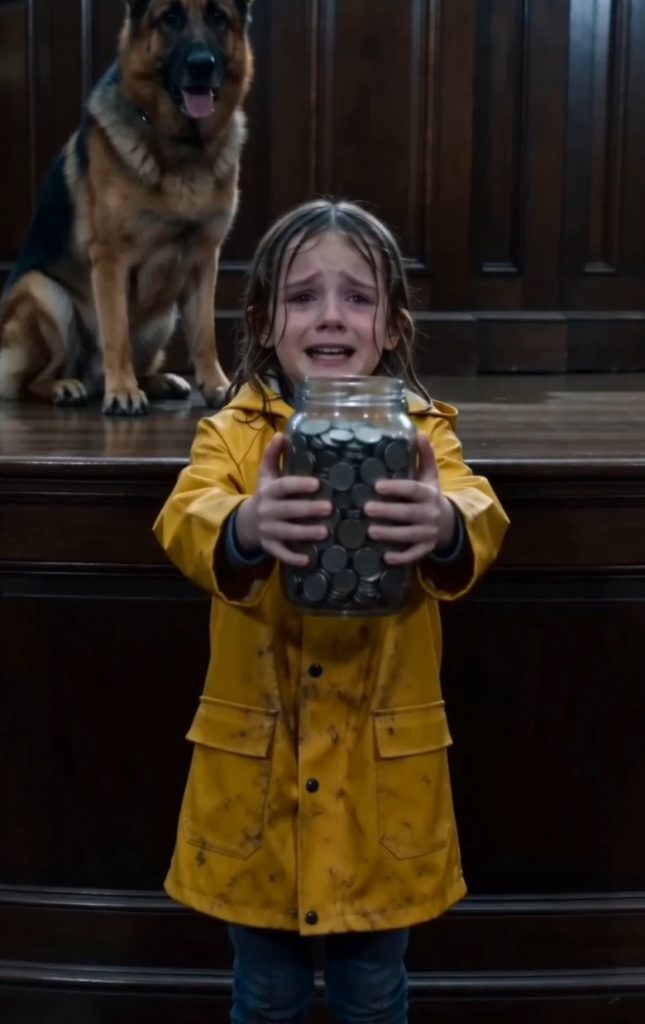
The little girl was soaked from the rain before she ever reached the stage.
Her yellow raincoat dripped onto the polished floor of the auction hall. Mud clung to her rubber boots. Wet brown hair stuck to her cheeks, and tears made bright lines down her face as she held a heavy glass jar against her chest with both arms.
Inside the jar were coins, folded bills, and one handwritten label taped crookedly to the glass.
For Tango.
The audience turned as she stepped into the aisle.
Men in dark suits lowered their numbered paddles. Women in pearls whispered behind gloved hands. Above them, chandeliers glowed against the high ceiling, and the dark wood walls made every sound feel official, final, impossible to undo.
On the raised stage, a German Shepherd sat beside the podium.
Tango.
His ears lifted the moment he saw the girl.
The auctioneer, an older man with silver hair and a careful voice, looked down from behind the microphone.
The girl raised the jar with trembling arms.
“I want to buy Tango! I have 82 euros and 47 cents.”
A few people in the room softened.
Not enough.
The auctioneer glanced at the paperwork in front of him.
“The price is 500 euros, little one.”
The girl’s face crumpled.
She hugged the jar tighter, as if the coins might multiply if she loved hard enough.
Before she could speak again, a woman rose sharply from the front row.
Beatrice Moreau moved like a blade.
Her hair was pinned in a perfect formal bun. Her dark blazer was tailored, her jewelry expensive, her expression cold with humiliation. She crossed the aisle and seized the little girl by the shoulder.
“You insolent little girl!”
The child twisted away, protecting the jar.
“Please, Aunt Beatrice!”
The word aunt rippled through the room.
Beatrice’s face hardened.
“You have embarrassed this family enough.”
She tried to turn the girl away from the stage, but Tango stood.
A low sound came from his chest.
Not an attack.
A warning.
The auctioneer stiffened.
The girl looked up at the dog through tears.
“Tango,” she whispered.
Beatrice turned toward the audience, her voice rising.
“This dog is a coward! He abandoned my sister to die!”
The girl froze.
The words struck her harder than any hand could have.
On stage, Tango’s ears flattened.
Beatrice lifted one jeweled finger toward a man seated two rows back.
“Mr. Dubois, buy him!”
A broad man with a smooth smile raised paddle number two.
“600 euros.”
The auctioneer swallowed.
The room had become very quiet.
The little girl clutched her jar until her knuckles went white.
“You’re lying,” she whispered.
Beatrice leaned down, close enough that only the front rows could hear.
“No, child. I am selling the last thing your mother loved before it ruins us all.”
But Tango was already looking past Beatrice.
Not at the bidders.
Not at the auctioneer.
At a weathered leather satchel sitting among the estate lots near the back of the stage.
And inside that satchel was the truth Beatrice had spent eight months trying to bury.
Act II
Her name was Lila Moreau.
She was seven years old, and for most of her life, she had believed three things with complete certainty.
Her mother was brave.
Tango was family.
And Aunt Beatrice never came to the house unless something bad was about to happen.
Lila’s mother, Claire Moreau, had owned a small estate outside Lyon. It was not grand in the way Beatrice liked grand things. The roof needed work. The garden grew wild in summer. The old stables had been converted into a rescue center for working dogs that had been retired, injured, or simply unwanted.
Claire loved the place because it had scars.
She said scarred things understood gentleness better.
Tango had arrived when Lila was four. He had once worked in search and rescue, and though he was older now, he still moved with quiet discipline. Claire trained him with hand signals, soft commands, and trust.
To Lila, he was not a rescue dog.
He was the creature who slept outside her door during thunderstorms. The one who walked beside her when she was afraid of the dark hallway. The one who could find her no matter where she hid.
“Because Tango knows your heart,” Claire would say, laughing.
Then came the night of the storm.
Lila remembered only pieces.
Rain against the windows. Her mother’s voice somewhere downstairs. Tango barking in a way she had never heard before. The smell of smoke from the old west wing, where Claire kept estate papers, rescue records, and files Lila was too young to understand.
Tango burst into Lila’s room before anyone else came.
He pulled at her blanket. Then at her sleeve. Then he barked until she climbed out of bed, crying and confused.
He led her through the back stairs to the garden path.
Then he ran back.
That was the part Beatrice used later.
The dog ran back.
By morning, Claire was gone.
Adults said soft things around Lila after that. Accident. Smoke. Too late. Terrible loss.
Beatrice said something different.
“Tango left her.”
She said it to neighbors. To lawyers. To the probate court. To anyone who might object when she took control of the estate as Lila’s temporary guardian.
The story was useful.
If Tango was a coward, then he was not a witness.
If Tango was dangerous, then he could be sold.
If Tango was gone, there would be nothing left in the house that still knew the path Claire had taken that night.
Lila did not believe her aunt.
She remembered Tango saving her.
She remembered her mother’s voice from below, faint but clear, giving one command.
“Find Lila.”
For eight months, Lila told people.
No one listened.
Children are often believed when they are cute, but rarely when they are inconvenient.
Beatrice moved into the estate. She locked Claire’s office. She dismissed the rescue staff. She spoke to Mr. Dubois in closed rooms and called the land “wasted potential.”
Mr. Dubois owned luxury developments along the countryside. He smiled at Lila with too many teeth and told her the estate would become “something beautiful.”
But Lila knew beauty did not need people to whisper.
When the auction notice arrived, she saw Tango listed as Lot 17.
Working dog, trained. Starting price: 500 euros.
So she took the jar from under her bed.
Every coin from lost teeth. Every birthday bill. Every euro Claire had given her for watering the lavender. She counted three times.
82 euros and 47 cents.
Then, on the morning of the auction, she put on her yellow raincoat and walked through the storm alone.
Because no one else was coming to save Tango.
And she still believed Tango had saved her.
Act III
The auctioneer lifted his gavel.
“Bid stands at 600 euros.”
Mr. Dubois smiled faintly.
Beatrice exhaled, as if the worst of the nuisance had passed.
But Tango did not sit.
He stepped to the edge of the stage and stared at the girl in the muddy yellow raincoat. His body was still, but his eyes were bright and locked on hers.
Lila knew that look.
It was the look he gave before obeying a command.
She wiped her face with the sleeve of her coat.
“Tango,” she said, her voice small but steady. “Cherche.”
Search.
The word moved through the room like a struck match.
Tango leapt down from the stage.
Several guests gasped. One woman lifted her feet from the floor. The auctioneer stepped back from the podium.
But Tango did not run toward Beatrice.
He ran past her.
Straight to the row of estate items waiting to be sold: old paintings, silver candlesticks, a writing desk, boxes of books, and a weathered leather satchel listed as miscellaneous personal effects.
Tango stopped in front of it and barked once.
Lila ran to him.
Beatrice’s face changed.
“Do not touch that.”
The auctioneer frowned. “Madame Moreau?”
Beatrice moved quickly, but Lila was faster.
She dropped to her knees beside the satchel and pulled it toward her. Tango placed one paw on it, holding it down.
The audience began to murmur.
Mr. Dubois stood.
“This is absurd,” he said. “Control the animal.”
Lila opened the satchel.
Inside were old training gloves, a scarf that still smelled faintly of lavender, and a sealed waterproof pouch hidden beneath the torn lining.
The auctioneer came down from the podium.
Beatrice reached for it.
Tango barked again.
She stopped.
Lila held the pouch against her raincoat.
“It was Mama’s,” she said.
The auctioneer looked at Beatrice.
“What is in it?”
“Nothing relevant,” Beatrice snapped. “This is a sale proceeding, not a circus.”
A voice rose from the back of the hall.
“Then you won’t mind if I open it.”
An elderly man stepped into the aisle.
His name was Henri Marchand, and the moment Beatrice saw him, the confidence left her eyes.
He had been Claire’s notary for twelve years.
Beatrice had told everyone he was retired, confused, and no longer involved.
But he walked steadily forward now, rain darkening the shoulders of his coat, a leather briefcase in one hand.
The auctioneer seemed relieved to see him.
“Monsieur Marchand.”
Henri nodded to the child.
“Lila, may I?”
She hesitated.
Then she looked at Tango.
The dog sat beside her.
So she handed the pouch to the notary.
Henri opened it carefully.
Inside was a flash drive, a folded document, and a small notebook with Claire Moreau’s handwriting across the front.
If anything happens, trust Tango.
The room seemed to stop breathing.
Beatrice whispered, “That is private.”
Henri looked up.
“No,” he said. “It is evidence.”
Mr. Dubois lowered his paddle.
But everyone had already seen him do it too late.
Act IV
The first page was not emotional.
That made it worse.
It was a legal amendment, signed by Claire Moreau and witnessed two weeks before the storm. It revoked Beatrice’s authority over the estate in the event of Claire’s death and named Henri Marchand as independent trustee until Lila came of age.
Beatrice’s lips parted.
“That document was never filed.”
Henri’s eyes were cold.
“It was never filed because my office was broken into the night after Claire died.”
The audience erupted.
The auctioneer raised both hands for order, but the hall had already changed. The bidders were no longer watching a poor child beg for a dog.
They were watching a crime unravel.
Henri opened the notebook.
Claire’s handwriting filled the pages in careful blue ink.
Beatrice is pressuring me to sell. Dubois has offered her a private commission. I refused. If they try to use my absence to control Lila, the land, or the rescue center, Tango knows the satchel. He was trained to find it. He will return to it if given the command.
Lila pressed both hands over her mouth.
Her mother had known.
Not everything.
But enough.
Henri continued reading.
Tango is not to be sold. He is Lila’s guardian companion and remains part of the trust.
Beatrice’s composure cracked.
“You are letting a child’s pet trick decide an estate?”
“No,” Henri said. “Claire decided. We are simply catching up.”
Mr. Dubois began edging toward the side aisle.
The auctioneer noticed.
So did the bailiff standing near the chamber doors.
Henri inserted the flash drive into a laptop at the clerk’s desk. A video file appeared on the large screen normally used to display auction lots.
The footage was grainy, taken from a security camera near the estate’s west corridor.
Rain blurred part of the image.
But the scene was clear enough.
Claire stood in the hallway holding the leather satchel. Beatrice stood across from her. Mr. Dubois was visible near the door.
There was no sound, but there did not need to be.
Claire tried to walk past them.
Dubois blocked the doorway.
Beatrice reached for the satchel.
The clip ended before the storm worsened, but the room understood.
Lila looked at her aunt with a child’s stunned clarity.
“You said Tango left her.”
Beatrice’s face flushed.
“He did.”
Henri removed one final page.
“Tango’s collar contained GPS records from that night. He left Claire only after she sent him upstairs. He went to Lila’s bedroom, led her out through the garden, then returned to the west wing three separate times before emergency responders arrived.”
Lila began to cry silently.
Not from fear now.
From grief finding its missing shape.
Tango had not abandoned her mother.
He had obeyed her.
He had saved her daughter first because Claire told him to.
Beatrice looked around the hall, searching for sympathy and finding none.
“You don’t understand,” she said. “Claire was going to waste everything. That estate could have been worth millions. A dog rescue? A child? Sentimental nonsense.”
Henri closed the notebook.
“And that is why she did not trust you.”
The bailiff stepped toward Beatrice.
Mr. Dubois tried to speak, but the auctioneer cut him off.
“This sale is suspended.”
The gavel came down once.
Not as a sale.
As an ending.
Beatrice turned toward Lila with a bitterness so raw it stripped away every trace of polish.
“You think he belongs to you because you brought a jar of coins?”
Lila looked down at the jar.
82 euros and 47 cents.
All she had.
Then she lifted her chin.
“No,” she said. “He belongs with me because Mama said so.”
Tango moved closer until his shoulder pressed against her yellow raincoat.
And in front of the entire hall, the dog chose his place.
Act V
By evening, the rain had stopped.
The auction hall emptied slowly, not with the excitement of wealthy people leaving after a sale, but with the uneasy silence of witnesses who knew they had nearly participated in something cruel.
Beatrice Moreau was escorted into a side office to give a statement. Mr. Dubois was stopped before he reached his car. His paddle, his contracts, and his private correspondence with Beatrice would become part of a much larger investigation.
The auctioneer found Lila sitting on the stage steps with Tango’s head in her lap.
Her jar of coins sat beside her boots.
He looked ashamed.
“I’m sorry,” he said gently. “I should have stopped sooner.”
Lila stroked Tango’s ears.
“Grown-ups don’t listen when you’re small.”
The auctioneer had no answer for that.
Henri Marchand knelt carefully in front of her.
“Lila, your mother made sure you would be protected. You will not be sent back with Beatrice.”
The girl looked at him, frightened by hope.
“Where will I go?”
“For now, with Madame Renard from the rescue center. You remember her?”
Lila nodded.
Madame Renard had taught her how to brush Tango’s coat and how to stand still when nervous dogs approached.
“And Tango?”
Henri smiled.
“Tango goes where you go.”
The dog lifted his head at his name.
For the first time all day, Lila smiled.
Not much.
But enough.
Weeks passed before the whole truth settled into official language.
Fraud.
Coercion.
Concealment of estate documents.
Improper sale proceedings.
A suspicious development agreement.
Adults gave the nightmare names that fit inside folders.
Lila had simpler words for it.
Aunt Beatrice lied.
Mr. Dubois wanted the house.
Tango told the truth.
The Moreau estate did not become a resort.
The locked office was reopened. Claire’s rescue files were restored. Dogs returned to the stables, not as property, but as lives with names and histories. Volunteers came back. So did the old trainer. So did Madame Renard, who moved into the caretaker’s cottage with Lila while the trust was arranged.
Henri visited every Thursday.
He brought legal papers, pastries, and once, a new jar.
Lila refused it.
She kept the old one.
The glass was scratched. The label was wrinkled from rain. Inside remained the same 82 euros and 47 cents, untouched.
She placed it on the shelf beside Tango’s old collar and her mother’s notebook.
Henri asked why she did not want to spend the money.
Lila thought about it carefully.
“Because that’s what I had when I thought no one would help,” she said.
Henri looked away for a moment.
The old notary had read wills, contracts, and death certificates for most of his life. He had seen families fight over silver spoons and vineyards, over paintings and houses, over things that had value only because someone else wanted them.
But nothing in his briefcase had ever weighed as much as that little jar.
On the first anniversary of Claire’s passing, Lila and Tango walked to the hill behind the rescue center where lavender grew wild. The sky was clear. The grass was wet from morning dew. Madame Renard waited at a distance, close enough to protect, far enough to give the child privacy.
Lila sat beneath the old chestnut tree.
Tango lay beside her.
For a while, she said nothing.
Then she pulled Claire’s lavender scarf from her pocket and tied it loosely around Tango’s collar.
“Mama knew you were good,” she whispered.
Tango rested his head on her knee.
Lila looked toward the house.
For months after the auction, people had told her she was brave. She did not feel brave. She had been scared the whole time. Scared walking through the rain. Scared holding up the jar. Scared when Aunt Beatrice called Tango a coward.
But maybe bravery was not a feeling.
Maybe bravery was loving someone enough to stand in front of people who could say no.
The story traveled through town, of course.
People repeated the dramatic parts first. The muddy girl. The jar of coins. The rich aunt. The dog finding the hidden satchel. Mr. Dubois lowering his paddle too late.
But at the rescue center, the story was told differently.
It was told every time a frightened child visited and Tango sat gently at their side.
It was told every time someone tried to dismiss a small voice and Madame Renard said, “Listen anyway.”
It was told by the jar on the shelf.
82 euros.
47 cents.
Not enough to buy a dog at auction.
More than enough to expose a lie.
Years later, when Lila was old enough to understand all the documents, she read her mother’s notebook from beginning to end. She cried over the pages. She laughed once at a recipe tucked between legal notes. She pressed her fingers to the words If anything happens, trust Tango until the ink seemed to warm beneath her hand.
By then, Tango was older.
His muzzle had gone white. His steps were slower. But every night, he still slept outside Lila’s door.
Not because he had to.
Because he always knew where he belonged.
And whenever storms rolled over the estate, Lila no longer hid beneath the blankets.
She opened her bedroom door.
Tango lifted his head.
She would sit beside him on the floor, listening to the rain, remembering the auction hall, the gavel, the woman who lied, the man who bid, and the moment everyone finally saw what she had known all along.
Tango had never been a coward.
He was the last promise her mother kept.