Act I
The dog was not supposed to be in the examination room.
Everyone knew that.
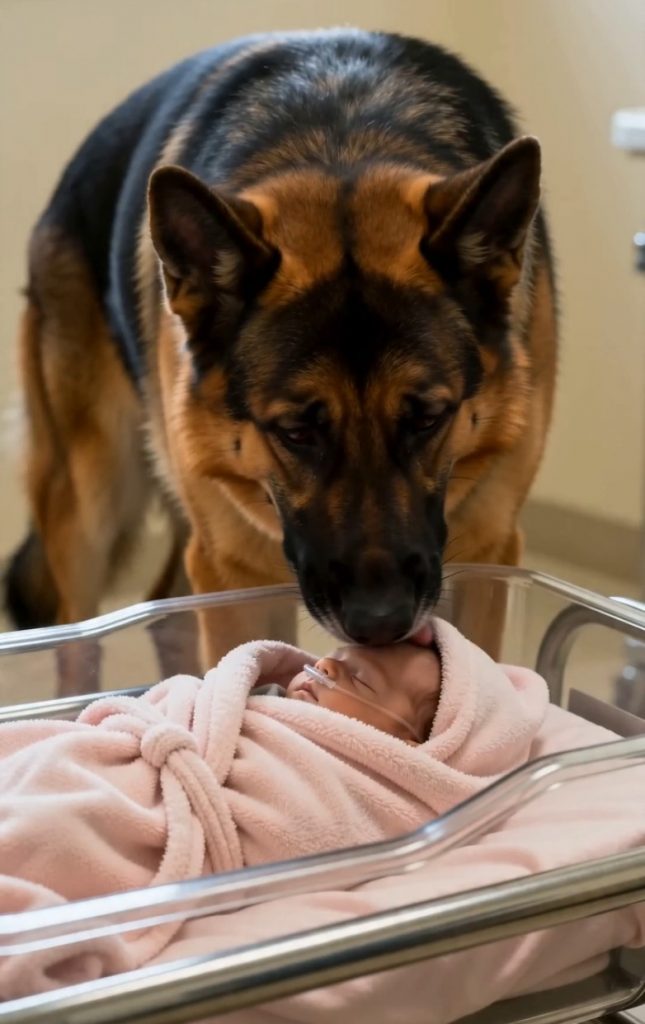
Not beside the stainless steel table. Not near the wires. Not near the newborn wrapped in a pink blanket with a tiny cannula resting beneath her nose.
But no one could make him leave.
He was a German Shepherd, large and steady, with black-and-tan markings, sharp ears, and dark eyes that never left the baby’s face. Snow still clung to the fur along his back. His paws had left damp prints across the hospital floor, a trail from the emergency entrance to the room where the infant had been laid under bright clinical lights.
The baby slept through everything.
Through the nurses whispering.
Through the doctor giving orders.
Through the security guard standing at the door with one hand on his radio.
Through the dog lowering his head and gently licking the top of her pink beanie.
A nurse gasped. “Someone pull him back.”
But the dog did not bare his teeth.
He did not growl.
He touched the baby with a tenderness so careful it silenced the room.
His tongue brushed her forehead, then her cheek, light as breath. The baby remained still, swaddled tightly, her tiny face pale but peaceful beneath the hospital light.
Dr. Helen Morris stood at the foot of the table, frozen with her clipboard pressed against her chest.
She had seen fear before.
She had seen grief, shock, rage, and denial.
But she had never seen an animal look at a child like that.
The dog placed one front paw gently on the edge of the pink blanket, not pressing down, only resting there as if he were making a promise. His ears tilted forward. His eyes softened.
Then something impossible happened.
A single tear rolled from the dog’s left eye.
It slipped through the dark fur beneath his eye and hung there, bright under the fluorescent light.
No one spoke.
The security guard lowered his radio.
The nurse who had wanted him removed covered her mouth.
Dr. Morris took one slow step closer.
The dog did not look at her. He kept staring at the newborn as if he had carried her across the edge of the world and could finally allow himself to break.
That was when the baby’s hand moved.
One tiny fist slipped free from the blanket and brushed against the dog’s paw.
The German Shepherd closed his eyes.
And somewhere deep in his collar, beneath wet fur and a strip of torn leather, something began to beep.
Act II
They had found the baby twenty-six minutes earlier outside the ambulance bay.
A janitor named Carl heard the dog first.
Not barking.
Whining.
A low, broken sound coming from the alley beside the loading dock, where snow had piled against the wall and the hospital vents blew warm air into the freezing morning.
At first, Carl thought the animal was hurt.
Then he saw the bundle between the dog’s front legs.
The German Shepherd was curled around the newborn like a wall, his body shielding her from the wind. His fur was dusted white. His muzzle rested inches from her face. Each time snow blew toward the bundle, he shifted his body to block it.
The baby was wrapped in a pink blanket.
No note.
No bag.
No mother.
Only the dog.
When Carl called for help, the shepherd lifted his head and growled—not with aggression, but warning. He did not trust the men rushing toward him. He did not understand uniforms. He did not understand hospital protocol.
He understood only that the baby was his to protect.
It took Dr. Morris herself to calm him.
She walked into the alley without gloves, despite the cold, and crouched several feet away.
“I’m not taking her from you,” she said quietly. “I’m taking her inside.”
The dog stared at her.
Snow gathered on his ears.
The baby made one faint sound beneath the blanket.
The dog looked down.
That was the moment he moved.
Not away.
Aside.
Just enough.
Dr. Morris slid her hands under the newborn and lifted her into her coat. The dog rose immediately and followed so close that his shoulder brushed her leg with every step.
No one could stop him.
Security tried at the emergency doors.
The dog showed his teeth once.
Dr. Morris said, “Let him through.”
So the shepherd entered St. Mercy Hospital as if he had been sent there.
Inside, the baby was rushed to the exam room. Her temperature was low, her breathing shallow, but steady. Nurses worked around her with practiced urgency. Dr. Morris checked her heart, her lungs, her tiny fingers, searching for signs of how long she had been outside.
The dog stood against the wall.
Silent.
Watchful.
Every time someone touched the baby too quickly, his ears twitched.
Every time the newborn made a sound, he stepped forward.
The nurses began calling him Shadow because he would not leave the baby’s side.
But the dog already had a name.
It was engraved on a scratched metal tag tucked beneath his collar.
Atlas.
The tag also carried an address on the north side of town.
A house that had burned six months earlier.
And when the police officer arrived with that information, Dr. Morris felt the first chill of recognition.
She knew that house.
Everyone in town did.
It had belonged to Leah Bennett, a young search-and-rescue volunteer who had disappeared after the fire and was presumed dead by most of the county.
Leah had owned a German Shepherd.
A trained rescue dog.
His name had been Atlas.
The officer looked through the glass at the dog standing beside the newborn.
“That can’t be him,” he said.
Dr. Morris did not answer.
Because Atlas had just stepped forward, lowered his head, and begun licking the baby’s face like he had been waiting months to find her.
And if the dog was Atlas, then the child on the table was not just abandoned.
She was connected to a woman everyone had stopped looking for.
Act III
Leah Bennett had been the kind of person people called when hope was almost gone.
Lost hikers.
Missing children.
Elderly people who wandered from nursing homes.
Flood rescues.
Winter searches.
If there was mud, darkness, danger, or a family waiting by the road with shaking hands, Leah went.
Atlas went with her.
She had found him as a half-starved puppy behind an abandoned farmhouse, too frightened to approach anyone and too stubborn to die. Leah sat in the grass for three hours until he crawled into her lap.
After that, the two were rarely apart.
People said Atlas could read her thoughts.
Leah laughed and said he only read her heart.
Six months before the baby was found, Leah’s house caught fire during a storm.
The report called it accidental.
An electrical fault in the kitchen.
Neighbors said the flames rose fast. Too fast. By the time firefighters arrived, the back of the house was already collapsing. Leah’s car was in the driveway. Her phone was found melted near the porch.
But no body was recovered.
People wanted that to mean she had escaped.
Then weeks passed.
Then months.
Hope became discomfort.
Discomfort became silence.
Her fiancé, Mark Ellison, held a memorial service in September. He stood in front of a photograph of Leah and Atlas and told the town she had been the love of his life. He cried beautifully. People believed him because grief, when performed well, can look almost holy.
Atlas was never found.
Mark said the dog must have run into the woods and died.
No one questioned it.
Almost no one.
Dr. Morris remembered Leah because Leah had once brought an injured child into St. Mercy after a campground accident. She had been muddy, exhausted, and bleeding from one hand, but she refused treatment until the boy was seen first.
“Search dogs are stubborn,” Dr. Morris had said.
Leah smiled and looked at Atlas.
“No,” she said. “They just know who matters.”
Now, in the examination room, Atlas stood over a newborn child and wept.
Dr. Morris ordered the collar removed gently.
Atlas resisted at first, then allowed it when the nurse moved slowly and kept the baby in sight. Beneath the scratched tag, hidden under a strip of reinforced leather, was a small emergency locator device.
The beeping had started when hospital equipment interfered with its damaged battery.
A nurse turned the collar over.
There was something sewn into the inside lining.
Not much.
Just a folded strip of waterproof paper, worn soft and stained by weather.
The officer cut the stitch.
Dr. Morris unfolded the note.
Her face changed before she read it aloud.
Because the handwriting was Leah’s.
If Atlas brings her to help, believe him. Her name is Grace. Mark cannot know she lived.
The room went cold.
The officer swore under his breath.
Dr. Morris read the note again, slower this time, as if the words might rearrange themselves into something less terrible.
Her name is Grace.
Mark cannot know she lived.
The baby slept beneath the pink blanket, unaware that her existence had just reopened a grave.
Atlas pressed his nose to the child’s hand.
Dr. Morris looked at the officer.
“Find Mark Ellison.”
But Mark had already found them.
He arrived twenty minutes later in a black coat, snow melting on his shoulders, his face arranged into panic. He told the front desk he had heard about an abandoned baby on the police scanner. He said he was there to help. He said Leah would have wanted him to help.
Then he saw Atlas through the examination room window.
His face lost every trace of grief.
For one raw second, Mark looked afraid.
Atlas saw him.
The dog’s whole body changed.
His ears flattened. His lips lifted. A deep growl rolled out of him, low and ancient, filling the sterile room with warning.
The baby stirred.
Mark stepped back.
Dr. Morris saw it.
So did the officer.
A man can pretend many things.
But a guilty man rarely knows what to do when the dead send back a witness.
Act IV
Mark tried to smile.
It was his second mistake.
His first had been coming to the hospital at all.
“Atlas,” he said softly, raising one hand as if greeting an old friend.
The dog lunged so hard the security guard jumped.
Dr. Morris stepped between them before Atlas could hit the end of his restraint.
“Do not come closer,” she said.
Mark’s eyes flicked to the baby.
Too quick.
Too hungry.
Not fatherly.
Calculating.
“Where did that child come from?” he asked.
The officer moved beside him. “We were hoping you could answer that.”
Mark gave a weak laugh. “Me?”
Dr. Morris held up the note.
The smile died.
His lawyer would later say it proved nothing. A note in a dog collar. A missing woman’s handwriting. A baby no one had yet connected by blood. But in that room, before the legal language arrived, truth had already entered.
Atlas knew him.
Atlas hated him.
And Mark knew why.
The police detained him for questioning within the hour.
By evening, detectives were searching the ruins of Leah’s old house again. This time, they looked beyond the fire report. They found traces of accelerant near the back porch. They found the remains of a locked chain on the cellar door. They found, buried beneath the collapsed pantry wall, a metal storage box that had survived the blaze.
Inside were Leah’s journals.
Not all of them.
Enough.
She had discovered Mark was not the man he pretended to be. He had gambling debts, forged checks, and a life built on lies that became dangerous when Leah became pregnant. He wanted her savings. Her house. Her insurance. He did not want a child tying him to the truth.
Leah had planned to leave.
The last entry was dated two days before the fire.
Atlas won’t let Mark near me anymore. I thought he was jealous at first. He isn’t. He knows.
The detectives found the rest because Atlas showed them.
At dawn, they brought him back to Leah’s property with Dr. Morris standing nearby and baby Grace safe in neonatal care. Atlas moved through the charred remains slowly, nose low, body tense.
He stopped near the old storm cellar behind the house.
It had been hidden under fallen branches and snow.
Inside, they found blankets, empty water bottles, medical supplies, and a pink baby hat matching the one Grace wore.
Leah had survived the fire.
Pregnant, injured, and hunted by the man everyone believed was mourning her.
She had hidden in the cellar for weeks, helped by one person: Nora Pike, an elderly neighbor who lived at the edge of the woods and trusted dogs more than police reports.
Nora told detectives everything.
Leah had crawled to her porch the night of the fire with Atlas at her side. She was terrified, exhausted, and certain Mark would kill her if he found out she was alive. Nora wanted to call the police, but Leah begged her not to.
“His cousin works dispatch,” Leah said. “He’ll know before I’m safe.”
So Nora hid her.
For months, Leah lived between the cellar and Nora’s house while winter closed in. She documented everything she could. She prepared the note. She trained Atlas with one final command.
Find help.
Not home.
Not Mark.
Help.
Grace was born during a snowstorm in Nora’s back room.
Leah held her daughter for less than two days.
Then infection and exhaustion took what fear and fire had not.
Nora tried to get Grace to the hospital herself, but the roads were blocked and her truck would not start. So she wrapped the baby in Leah’s pink blanket, fastened the note inside Atlas’s collar, and opened the door.
“Find help,” she whispered.
Atlas stepped into the snow carrying the last command Leah ever gave him.
He guided Nora part of the way, then refused to wait when she fell on the icy road and could not get up. He continued alone, circling back only once to lick her face before taking the baby’s scent toward the hospital vents where warmth cut through the storm.
By the time Carl found him at the ambulance bay, Atlas had been standing guard for nearly an hour.
No one ever again called him just a dog.
Act V
Grace survived.
That was the sentence everyone repeated first because it was the one that mattered most.
Her breathing strengthened. Her color warmed. The cannula came off after several days. Nurses who had handled thousands of newborns found reasons to pass her room and check on her anyway.
Atlas was allowed into the hospital under special permission.
No one argued after the story broke.
He lay beside Grace’s crib with his head on his paws, opening one eye whenever anyone entered. The staff learned to announce themselves to him before touching the baby.
“Morning, Atlas.”
“Just checking her temperature, Atlas.”
“Fresh blanket, Atlas.”
He accepted them.
Barely.
Dr. Morris became Grace’s temporary medical guardian while social services worked through the storm of legal questions. Leah had no living parents. Mark was in custody. Nora Pike, the old neighbor, was recovering from exposure and a fractured wrist, furious that anyone thought that made her weak.
When Nora was finally wheeled into Grace’s room, Atlas rose for the first time all morning and pressed his head into her lap.
The old woman sobbed into his fur.
“You did it,” she whispered. “You found help.”
Grace slept through the reunion, one tiny hand curled near her cheek.
The investigation moved quickly after that.
Mark’s careful grief collapsed under evidence. His financial records told one story. Leah’s journals told another. The fire report was reopened. The cousin in dispatch was suspended, then charged for leaking information. People who had repeated Mark’s version of events began claiming they had always suspected something.
Dr. Morris hated that part.
The way truth made cowards pretend they had been brave quietly.
At Leah’s memorial, the church overflowed.
This time, there was no empty performance at the front.
There were search-and-rescue volunteers in uniform. Nurses from St. Mercy. Neighbors. Families of people Leah had once found in the woods, in floods, in the dark. Nora sat in the first row holding Grace, who wore a soft pink hat and slept against her shoulder.
Atlas lay at Nora’s feet.
When the pastor spoke Leah’s name, the dog lifted his head.
The whole church broke.
Not because he understood the words.
Because everyone understood him.
Afterward, they buried Leah beneath a white oak near the rescue station. Her headstone was simple, by Nora’s request.
Leah Bennett
She brought the lost home.
Beneath it, smaller:
Mother of Grace.
Handler of Atlas.
For a while, no one knew what would happen next.
Then Leah’s lawyer appeared with a sealed envelope.
Leah had written it before the fire, before the storm, before everything. She had updated her emergency papers when she first suspected Mark might become dangerous. Inside was a guardianship request.
If anything happens to me, I ask Nora Pike to protect my child if she is able. If Nora cannot, I ask Dr. Helen Morris of St. Mercy Hospital. She once listened when no one else did. That is what children need most.
Dr. Morris read the sentence three times.
She had met Leah only twice.
But kindness, she learned, could leave tracks long after the moment passed.
Nora became Grace’s guardian with Dr. Morris as co-guardian and medical advocate. It was unusual. Complicated. Imperfect.
It was also exactly what Grace needed.
They moved into Nora’s old house together after repairs were made, with Atlas claiming the rug beside the crib before anyone else could decide where he belonged. Dr. Morris visited every evening after shifts, at first for medical checks, then because Grace had begun smiling at the sound of her voice.
The house changed slowly.
The back room where Grace was born became a nursery with pale curtains and a mobile of little wooden birds. Leah’s journals were stored in a locked box until Grace was old enough to read them. Her search-and-rescue jacket hung by the door, not as a shrine, but as a promise.
Atlas grew gray around the muzzle.
He followed Grace everywhere.
When she learned to crawl, he moved behind her like a patient shadow. When she took her first steps, she used his fur for balance. When she cried at night, he reached the crib before Nora did.
On Grace’s first birthday, they held a small party in the yard.
No chandeliers. No spectacle.
Just a picnic table, a homemade cake, rescue volunteers, hospital staff, Nora in a wool sweater, Dr. Morris with flour on one sleeve, and Atlas sitting proudly beside the high chair.
Grace smashed frosting into both hands and laughed.
Atlas watched her with solemn devotion.
Nora leaned toward Dr. Morris and whispered, “Leah would’ve liked this.”
Dr. Morris looked at the child, then at the dog.
“No,” she said softly. “She would’ve loved it.”
That evening, after everyone left, Nora carried Grace to Leah’s grave beneath the white oak. Dr. Morris walked beside her. Atlas followed slowly, his paws pressing into the spring grass.
Nora set a small pink flower near the stone.
Grace reached down and patted the engraved letters with her tiny hand.
Atlas lay beside the grave.
For a long time, he was still.
Then he rested his head gently against Grace’s blanket, the same way he had in the hospital examination room when a tear rolled from his eye and made an entire room understand that love does not always speak in words.
Sometimes it crosses snow.
Sometimes it guards the helpless.
Sometimes it carries the last wish of the dead all the way to the living.
And sometimes, when everyone else has given up searching, it finds the way home.