Act I
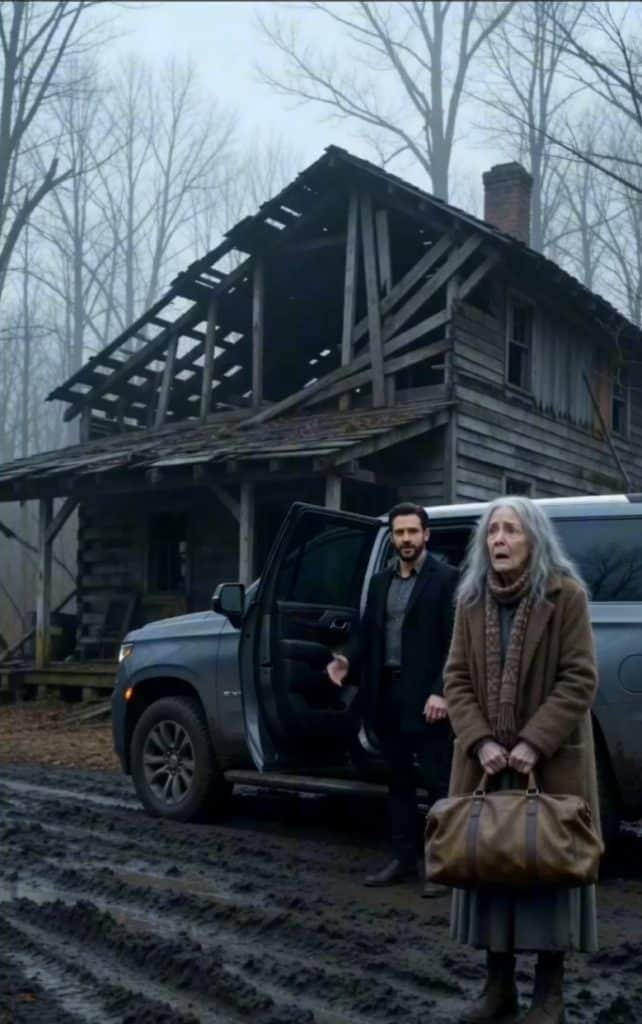
The SUV stopped where the road ended.
Beyond it, there was only mud, leafless trees, and a shack that looked as if one strong wind could finish what time had started. Its roof sagged in the middle. One window was broken. The boards along the porch had gone dark with rot.
Martha Whitaker stood in the tire ruts with both hands wrapped around the handle of her brown leather duffel bag.
Her silver hair whipped across her face.
She did not understand at first.
Not because she was confused the way they claimed she was. Not because she had lost her mind, as Clara liked to whisper to neighbors when Martha entered the room.
She did not understand because cruelty still surprised her.
Even after all these years.
Elias stepped out of the dark grey SUV in his black suit jacket and polished shoes, careful not to let the mud touch his cuffs. He gestured toward the collapsing shack like a real estate agent showing off a lake house.
“So here it is,” he said with a smirk. “Your new home.”
Martha stared at him.
Her grandson.
The boy she had raised after his mother died. The boy whose fevers she had cooled with wet towels. The boy who used to sleep on her kitchen floor beside the old radiator because he said the sound helped him dream.
“Elias,” she whispered.
He looked away.
That hurt more than the words.
Clara stood by the open SUV door, elegant in her beige trench coat, smiling as if the whole scene had been arranged for her private amusement. She looked at Martha’s worn coat, her grey skirt, her shaking hands.
“You’ll feel right at home here,” Clara said sweetly.
Then she climbed into the SUV beside Elias and pulled the door shut.
The engine roared.
The tires spun, spraying dirty water across the mud. The vehicle lurched forward, then disappeared into the misty woods, its red taillights fading between the trees.
Martha remained still long after the sound was gone.
The forest closed around her.
No houses. No road signs. No phone signal. Just the shack, the wet ground, the cold air, and the terrible knowledge that the people who brought her here had not looked back.
Her chin trembled.
“Oh,” she breathed. “My God.”
She clutched the duffel bag tighter.
Because inside it was the one thing Elias and Clara had forgotten to search.
And by abandoning her on that land, they had made their first mistake.
Act II
Martha had spent her life being underestimated.
At twenty, she was a waitress at a roadside diner off Route 19, pouring coffee for truckers who called her honey and never looked at her face. At twenty-five, she married Samuel Whitaker, a quiet carpenter with rough hands and a laugh that made even bad winters feel survivable.
Together, they bought twelve acres of forest no one wanted.
People laughed at them.
The land was too far from town. Too muddy in spring. Too cold in winter. Too full of old trees and stones and narrow tracks that swallowed tires after rain.
Samuel built the shack first.
Not as a home.
As a promise.
He built it with salvaged timber, crooked nails, and the kind of pride poor men put into things no one else values. Martha cooked beans over a camp stove while he worked. At night, they sat on the unfinished porch and imagined a real house down the hill, a garden, a swing, children running through the trees.
Then life came.
Not gently.
Their only daughter, Ruth, married young and died young, leaving behind a five-year-old boy with dark eyes and a fear of being left alone.
Elias.
Martha and Samuel raised him as their own.
Samuel taught him how to carve whistles from willow branches. Martha packed his lunches, signed his field trip slips, sat through his school concerts, and worked double shifts after Samuel’s heart began failing.
When Samuel died, Elias was sixteen.
He cried at the funeral like a child, then changed by inches. Grief hardened him. Ambition polished him. By the time he left for college, he spoke of the old house as if it embarrassed him.
Martha forgave that.
Young people often run from the places that saved them.
She waited for him to come back.
For a while, he did.
At Christmas. On birthdays. When he needed money. When his first business failed. When his second one needed a loan. When he met Clara, a woman with sharp eyes and softer hands than her heart deserved.
Clara saw Martha clearly from the beginning.
Not as family.
As an obstacle.
The old house still belonged to Martha. So did the forest. So did the small savings Samuel had left, carefully invested through a local attorney who had been more loyal than Elias ever guessed.
Clara wanted all of it.
She started with concern.
“Martha shouldn’t live alone.”
Then pity.
“She forgets little things.”
Then alarm.
“She left the stove on.”
Martha had not.
But Clara had learned that repeating a lie in a gentle voice made people lean in instead of push back.
Elias began taking over bills. Then appointments. Then bank visits. He told Martha it was easier if he handled things. She let him, at first, because she wanted to believe being needed was the same as being loved.
Then he asked her to sign papers.
Power of attorney.
Property management.
Medical proxy.
“Just in case,” Elias said.
Martha signed nothing.
That was when his kindness ended.
He stopped bringing groceries. Stopped answering calls. Clara began calling her confused in front of guests. Elias told neighbors Martha was “declining.” A doctor she had seen only once wrote a note saying she required supervision.
The next week, Clara arrived with a suitcase.
Not Martha’s suitcase.
A stranger’s.
“You’re moving somewhere safer,” Clara said.
They drove for nearly an hour.
Martha thought they were taking her to the care home Elias had mentioned in town.
Then the road turned to gravel.
Then dirt.
Then mud.
Then the shack appeared.
Samuel’s old shack.
Martha had not seen it in thirty years.
Elias thought he was dumping her in a forgotten ruin.
But Samuel had built that shack on the first parcel they ever bought.
And Martha, quiet old Martha with the shaking hands, still owned every acre around it.
In her duffel bag lay a folder from her attorney, a small recorder, and the original deed Elias had never found.
The forest was not her prison.
It was her witness.
And someone was already coming.
Act III
Martha waited until the sound of the SUV was completely gone before she moved.
Her knees ached as she stepped through the mud toward the shack. The door hung crooked, but it opened when she pushed. The smell inside was damp wood, mice, and old smoke, but beneath it was something else.
Memory.
Samuel’s hands on the beams.
Samuel’s pencil marks near the window.
Samuel laughing when the first rain leaked through the roof and Martha placed three pots under the drips, declaring it “indoor plumbing.”
Her eyes filled.
“Oh, Sam,” she whispered. “Look what he’s become.”
The floorboards groaned beneath her. She set the duffel bag on a rough wooden table and opened it with trembling fingers.
Inside were not clothes.
Not medicine.
Not food.
Elias had assumed the bag held the useless belongings of an old woman.
It held his ruin.
Martha removed the recorder first.
She had turned it on in the SUV.
Every word was there.
Elias telling her she was “too stubborn to die quietly.” Clara laughing about the property once Martha was “out of the way.” The fake care home story. The plan to report her missing only after enough time had passed to claim she wandered off.
Martha’s hands shook as she listened to the first few seconds.
Then she turned it off.
She could not bear more.
The folder came next.
Her attorney, Miriam Hale, had prepared it three days earlier after Martha arrived at her office wearing the same brown coat and asking a question no grandmother should have to ask.
“What happens if my grandson tries to make me disappear?”
Miriam had not laughed.
She had not softened the answer.
She gave Martha copies of every deed, every bank record, every rejected power of attorney form, every note Clara had forged to claim Martha was mentally unfit.
Most importantly, Miriam gave Martha a small emergency transmitter.
“Press it if they take you anywhere against your will,” Miriam said. “It will send your location to my office and the sheriff.”
Martha had pressed it under her scarf the moment the SUV turned off the main road.
Now she stood inside the shack, staring at the little black device in her palm.
A faint green light blinked.
Still working.
Outside, the forest wind moved through bare branches.
Then Martha heard something.
An engine.
Not the SUV.
This one was heavier. Slower. Coming up the muddy track.
For one wild second, fear seized her. Maybe Elias had returned. Maybe Clara had realized the duffel mattered. Maybe they had come back to finish the cruelty they had started.
Martha grabbed the recorder and backed toward the wall.
Headlights swept across the broken window.
A truck stopped outside.
A door opened.
“Martha?” a woman called. “It’s Miriam Hale. Sheriff’s with me.”
Martha’s legs weakened.
She opened the shack door and saw Miriam standing in the mud in a navy coat, silver hair pinned beneath a rain hood. Beside her were two deputies and a tall man in a brown sheriff’s jacket.
For the first time that day, Martha let the duffel bag slip from her hands.
Miriam hurried forward and caught her before she fell.
“You’re safe,” she said.
Martha shook her head, tears spilling down her weathered cheeks.
“No,” she whispered. “Not yet.”
Then she looked toward the muddy road where Elias and Clara had vanished.
“Not until he hears what he said.”
Act IV
Elias returned to Martha’s house that evening feeling victorious.
He poured bourbon in Samuel’s old study and stood by the fireplace as Clara walked through the rooms making plans.
“This wallpaper has to go,” she said. “The dining room too. We’ll open the wall, make it modern. The old furniture is depressing.”
Elias loosened his collar.
“She’ll be found in a day or two.”
Clara turned.
“Found?”
He looked annoyed.
“Reported. Whatever.”
“Be careful with words, darling.”
That was Clara’s gift.
She could turn murder into vocabulary.
Elias looked out the window toward the garden Martha had kept alive for forty years.
For one second, something moved in him.
Not guilt exactly.
A memory.
Martha holding his small hand at his mother’s funeral. Martha whispering, “You are not alone.” Martha sleeping in a chair beside his bed when he had pneumonia. Martha selling Samuel’s truck to pay his first semester tuition.
Then Clara touched his shoulder.
The memory died.
“She would have ruined us,” Clara said softly. “You know that.”
Elias nodded.
The doorbell rang.
Clara frowned.
“Are you expecting someone?”
Elias crossed the hall and opened the door.
Sheriff Tom Whitaker stood on the porch.
No relation to Martha, though people in town liked to joke about the name. Behind him stood Miriam Hale, two deputies, and Martha.
Alive.
Wrapped in a deputy’s coat.
Holding the duffel bag.
Elias’s face went slack.
Clara appeared behind him and stopped dead.
For a few seconds, no one spoke.
Martha looked smaller than she ever had in that doorway. Wet hair around her face. Mud on her skirt. Eyes red from crying.
But she was not weak.
Not anymore.
The sheriff removed his hat.
“Elias Whitaker?”
Elias recovered poorly.
“Sheriff, thank God. She’s confused. We were just about to call—”
Martha lifted the recorder.
Elias stopped.
Miriam’s voice was calm.
“Mrs. Whitaker activated an emergency locator shortly after you drove her into the north forest parcel and abandoned her near the old shack.”
Clara laughed once.
“That is ridiculous. We were taking her to a retreat property.”
Martha looked at her.
“You called it my new home.”
Clara’s face hardened.
The sheriff held out his hand.
“Recorder, please.”
Martha gave it to him.
He pressed play.
Elias’s voice filled the porch.
So here it is… your new home.
Then Clara.
You’ll feel right at home here.
The recording continued.
Not just the public cruelty.
The private cruelty.
The conversation in the car before they stopped. Clara asking how long an elderly woman could survive in weather like this. Elias saying Martha had made her choice by refusing to sign. Clara reminding him that once Martha was declared missing and unstable, the court would look more kindly on guardianship.
Elias stared at the recorder as if it had betrayed him.
But it had only repeated him.
The deputies moved forward.
Clara stepped back.
“You can’t arrest us based on that.”
Miriam opened the folder from the duffel bag.
“No,” she said. “But it supports an elder endangerment charge, attempted fraud, coercion, and conspiracy to obtain property through false medical claims. The forged letters to the bank help too.”
Clara looked at Elias.
For the first time, she did not look superior.
She looked furious that he had failed to control an old woman.
Elias turned to Martha.
“Grandma,” he said, voice cracking suddenly. “Please. This got out of hand.”
Martha flinched at the word Grandma.
He had not used it in years.
“You left me in the mud,” she whispered.
His eyes filled, but she could not tell whether it was sorrow or fear.
Maybe he could not either.
“I wasn’t thinking.”
“Yes,” Martha said. “You were. That was the worst part.”
The sheriff nodded to his deputies.
Clara tried to argue as they took her wrist. Elias did not resist. He only looked at Martha with the stunned expression of a man who had finally seen the person he betrayed as someone real.
But Martha had one more truth to give him.
“The house was never the inheritance,” she said.
Elias frowned through his panic.
Martha’s voice trembled.
“It was the test.”
Act V
The town heard by morning.
Not everything.
Small towns never receive whole truths at once. They gather pieces and assemble them at church doors, diners, gas pumps, and grocery aisles.
Elias and Clara had abandoned Martha in the forest.
Martha had recorded them.
The sheriff found her.
The old shack was on her land.
The house was never in Elias’s name.
By noon, people who had avoided Martha for months began remembering how much they had always cared.
Miriam protected her from most of them.
“You do not owe anyone your pain for their curiosity,” she said.
Martha stayed in a guest room at Miriam’s house for three nights. She slept poorly. She woke calling Samuel’s name. She cried when a kettle whistled because it sounded, for half a second, like the wind in the shack.
On the fourth day, she returned home.
Not because it was easy.
Because it was hers.
The house looked different when she walked in. Clara’s coat was gone from the hall. Elias’s bourbon glass had been removed from the study. The dining room wallpaper still bloomed with faded roses Clara had hated.
Martha touched it with two fingers.
“I like old things,” she whispered.
Miriam stood behind her.
“I know.”
The legal process moved slowly, as it often does when people with nice clothes commit ugly crimes. Clara hired a sharp attorney who described the event as a misunderstanding. Elias’s lawyer tried to claim emotional distress and family conflict.
Then the recording played in court.
The room went quiet.
Cruelty sounds different when it cannot hide behind facial expressions or excuses.
Martha testified once.
She wore her brown coat because she wanted the judge to see the same woman they had left in the forest. Her voice shook at first. Then steadied.
“I raised him,” she said. “That does not mean he owns me. Loving someone does not give them the right to throw you away when you become inconvenient.”
Elias cried at the defense table.
Martha did not look at him.
Not because she felt nothing.
Because she felt too much.
That was the problem with betrayal by family. It did not cut one clean wound. It broke open every memory and poisoned it, forcing you to ask whether love had ever been real or only useful until it stopped paying.
The judge ruled firmly.
Protective orders. Fraud investigation. Frozen access to Martha’s accounts. Mandatory review of all documents Elias and Clara had attempted to file. Criminal charges continued.
Elias wrote Martha a letter from jail.
She did not open it for two weeks.
When she finally did, the first line read:
Grandma, I don’t know when I stopped seeing you as the person who saved me.
Martha folded the letter and placed it in Samuel’s desk.
She did not forgive him that day.
Forgiveness, she decided, was not a coin cruel people could demand because regret had finally become uncomfortable.
But she did not throw the letter away either.
Spring came late that year.
The forest thawed slowly. Mud softened. Bare branches sprouted pale green. One morning, Martha asked Miriam to drive her back to the shack.
Miriam hesitated.
“Are you sure?”
“No,” Martha said. “But I’m going.”
They parked at the same muddy clearing.
The shack still leaned. The window was still broken. The roof still sagged beneath years of neglect. But in daylight, with birds calling from the trees and new moss bright along the stones, it looked less like a grave and more like something waiting.
Martha stood where Elias had abandoned her.
The memory hit hard.
His gesture toward the shack.
Clara’s smile.
The SUV disappearing.
Her own voice whispering, Oh my God.
Miriam came beside her.
“We can have it torn down.”
Martha shook her head.
“Samuel built this.”
“It’s barely standing.”
“So was I.”
Miriam said nothing.
That summer, Martha hired local carpenters to restore the shack.
Not into a home for herself.
Into a shelter.
A warm, simple place for elders in crisis to stay when family became dangerous and the law needed time to catch up. Miriam helped set up the trust. The sheriff donated security equipment. A church group brought quilts. A retired nurse volunteered weekends.
Martha named it Samuel’s Porch.
At the entrance, she placed a small wooden sign.
No one who arrives here is unwanted.
The first woman came in September.
Eighty-one. Dropped at a hospital by a nephew who never returned.
Martha made tea.
She did not ask too many questions.
She simply sat with her on the restored porch while rain tapped the new roof and said, “You can rest now.”
Years passed.
The story changed shape, as stories do.
Some told it as revenge. The old woman who caught her greedy grandson. The wife in the beige coat who lost everything. The abandoned grandmother who owned the land all along.
But Martha never liked those versions.
They made the ending too easy.
The truth was that love and grief could live in the same body. She could miss the little boy Elias had been and still testify against the man he became. She could remember feeding him soup and still refuse to let him steal her life.
One winter evening, long after the court cases ended, Martha sat in Samuel’s Porch watching snow fall over the repaired clearing.
Miriam brought her a letter.
No return address, but Martha knew the handwriting.
Elias.
This time, she opened it right away.
He wrote that he was working in the prison library. That he had started remembering things honestly. That he did not expect forgiveness. That Clara had left him the moment his money froze. That he finally understood she had not made him cruel; she had only encouraged what he had allowed to grow.
At the end, he wrote:
You told me the house was the test. I failed it. But I think the real test was whether I could lose everything and become human again. I don’t know if I will pass. I am trying.
Martha read the last line twice.
Then she folded the letter and placed it in her coat pocket.
Outside, the forest was quiet.
Not empty.
Quiet.
There was a difference.
The shack that had once been meant as her punishment now glowed warmly against the dark, filled with lamplight, blankets, soup, and the soft murmur of people learning they had not been discarded after all.
Martha looked toward the muddy track where the SUV had vanished that day.
She no longer saw only abandonment.
She saw the moment the truth found the open air.
Elias and Clara had driven her into the woods believing they were leaving behind an old woman with nothing.
They were wrong.
They left her on her own land.
With her own name.
With proof in her bag.
And with a heart that, though broken, still knew how to build shelter from ruins.