Act I
“Trash. Stop waving paper at people who matter.”
The insult rang out beneath the bright lights of an upscale American supermarket, just as thirteen-year-old Ethan Miller stumbled backward and hit the floor.
Raffle tickets scattered across the polished entrance tiles. A small cardboard collection box toppled from the folding table, spilling a handful of dollar bills and loose change beneath the shopping carts.
Ethan landed hard beside it, his worn brown hoodie twisting beneath him. A thin streak of blood appeared on his elbow, but the first thing he looked at was not his injury.
It was the money.
He had spent three Saturdays earning those donations.
The man standing over him barely glanced at the fallen tickets. Richard Caldwell, forty-five, wore a tailored charcoal suit, polished black shoes, and a silver watch that cost more than Ethan’s family spent on groceries in a month. His leather briefcase hung from one hand, and his expression suggested that the entire world had been wasting his time since the moment he woke up.
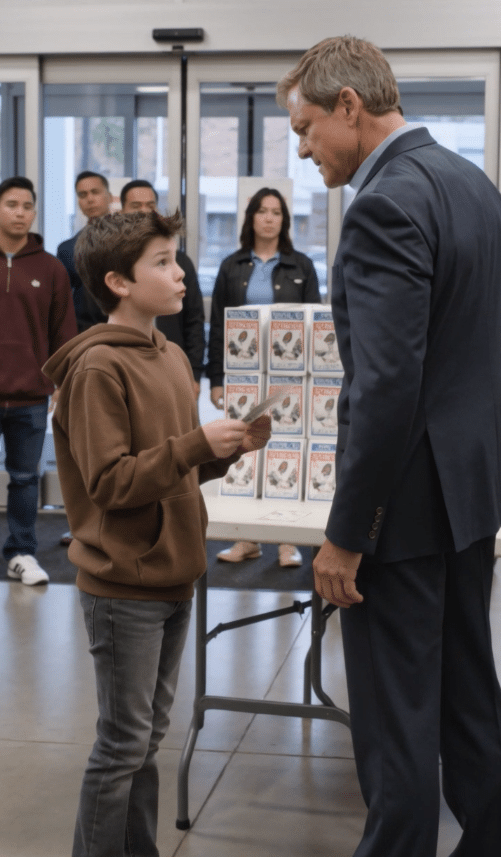
Only seconds earlier, Ethan had been standing beside a small fundraising table near the supermarket’s sliding glass doors.
His school was trying to save its after-school arts program, which had lost funding after a budget shortfall. The raffle offered grocery gift cards and a donated bicycle, and the students had been asked to help sell tickets over the weekend.
Ethan had volunteered immediately.
His mother, Rachel, worked long shifts at a nursing home, and money had been tight since their rent increased. Ethan knew what it felt like when adults whispered about bills after they thought children were asleep. If selling raffle tickets could help keep the art room open, he was willing to stand outside a supermarket for as long as necessary.
Richard had approached the table while checking his phone.
Ethan smiled, lifted a ticket, and asked whether he would like to support the fundraiser. The paper had come slightly too close to Richard’s hand as the man reached for his briefcase.
Richard stopped.
He looked at the ticket as if Ethan had tried to force him into a transaction.
“Sir, it is for the school fundraiser,” Ethan explained.
Richard’s face hardened.
“Trash. Stop waving paper at people who matter.”
Ethan lowered the ticket.
“I’m sorry, sir. I didn’t mean to—”
Richard kicked him in the chest.
The impact sent Ethan down beside the table. Several tickets slid beneath a shopping cart, and a small tin of coins spun across the floor before coming to rest against a polished shoe.
A woman emerging from the automatic doors gasped. A father pulled his young daughter closer. Two shoppers froze with their hands on their carts, staring at the scene as though their minds could not reconcile what they had just witnessed.
Ethan tried to sit up.
Richard stepped over the fallen tickets and kicked him again, then delivered another forceful blow to his back and side.
Ethan cried out and curled protectively around himself.
The crowd recoiled.
“Sell your little scam in the parking lot,” Richard said.
His voice carried easily through the entrance.
Ethan pressed one hand against the floor, trying to gather enough strength to move. His elbow stung, his chest hurt, and the room seemed to blur at the edges.
But he could still see the raffle tickets beneath the shopping carts.
He had promised his teacher that he would bring back every unsold ticket and every dollar collected. It was a small promise, but it mattered to him.
He had no idea why a grown man could look at a child trying to help his school and see something deserving of punishment.
Then the sliding glass doors opened again.
A tall man in a tailored navy suit stepped out of the supermarket, followed by two employees who stopped abruptly when they saw the crowd. The man moved past them without hesitation, his dark overcoat swinging behind him.
He crossed the entrance in seconds.
Richard barely had time to turn before the stranger struck him once across the face, sending him stumbling backward.
The man immediately positioned himself between Richard and the boy.
His expression was furious, but his voice remained controlled.
“That ticket just closed every door you thought money could open.”
Richard touched his cheek, staring at the stranger as if he had never encountered anyone who dared to challenge him.
“Every door?”
The man said nothing more.
He did not need to.
His name was Daniel Mercer, and he owned the supermarket chain where Richard had just committed the most expensive mistake of his life.
But Richard knew nothing about the man standing in front of him.
And he had absolutely no idea what was printed on the back of the raffle ticket lying near his shoe.
Act II
Ethan Miller had never thought of himself as a particularly brave person.
He disliked arguments. He hated being the center of attention, and he had a habit of apologizing even when someone else bumped into him. At school, he was the quiet boy who stayed late to clean paintbrushes and helped teachers carry boxes without being asked.
He was also the student who worried most when the after-school arts program was threatened.
Art had become his refuge two years earlier, when his father left and the house seemed to shrink around the silence he had created.
Ethan’s mother, Rachel, did everything she could to keep life stable. She worked long shifts at a nursing home, often coming home with aching feet and the smell of disinfectant clinging to her clothes. She never spoke badly about Ethan’s father, even when bills arrived faster than she could pay them.
But Ethan heard the quiet conversations.
He knew the electricity bill had been delayed. He knew his mother had stopped buying coffee on the way to work. He knew she sometimes told him she had already eaten when there was only enough food left for one proper dinner.
He also knew she would never ask him to help pay the bills.
So he looked for ways to contribute without making her feel she had failed him.
He helped a neighbor carry groceries. He shoveled snow for an elderly couple during winter. When the school announced the raffle, he volunteered before anyone else raised a hand.
The fundraiser was meant to be simple.
Each student would sell tickets for a modest price, and the proceeds would help preserve the school’s after-school arts program. The program wasn’t just about painting or music. It gave students a safe place to stay until their parents finished work, and it offered a quiet corner to children who struggled to find their place elsewhere.
Ethan knew several of those children.
There was Marcus, who drew elaborate comic-book heroes in the margins of his math worksheets. There was Olivia, who could play piano beautifully but rarely spoke in class. And there was a younger student named Ben who had recently lost his father and spent most afternoons painting the same blue house over and over.
The art room was the one place where none of them had to explain themselves.
When the principal announced that the program might close, Ethan felt something tighten inside him.
He couldn’t donate much money. His family didn’t have much to spare.
But he could stand outside a store and ask strangers for a few dollars.
He could do that.
For three weekends, he sat beside the folding table with a handwritten sign, a ticket box, and a stack of raffle slips. Some people donated generously. Others smiled and declined. A few complained that students should not be asking shoppers for money.
Ethan thanked every person who stopped, whether they bought a ticket or not.
He was beginning to believe the fundraiser might succeed.
On the morning Richard attacked him, Ethan had already sold more than half the tickets assigned to his class. His teacher had texted the volunteers to thank them, and he had reread the message twice during his break.
He was proud.
Not because he expected anyone to praise him, but because the work was making a difference.
Richard Caldwell could not have understood any of that from the boy’s appearance.
To him, Ethan was a child in a worn hoodie standing near a supermarket entrance. The fundraising table looked cheap. The handwritten sign was crooked. The raffle tickets were ordinary slips of paper.
Richard saw inconvenience where Ethan saw opportunity.
That difference had shaped Richard’s life for years.
He had built a successful career in commercial real estate and eventually founded a property investment company. He was accustomed to negotiating with executives, developers, bankers, and politicians. His time was expensive, or so he often told people, and he had little patience for anyone who did not seem to be moving toward a measurable goal.
He donated to a few high-profile charities every year, usually when his company could be named in the annual report. He liked causes that came with polished brochures, elegant dinners, and photographs that could be placed in corporate newsletters.
A child selling raffle tickets outside a supermarket did not fit that image.
Richard had spent years confusing wealth with importance.
He believed that people who mattered did not need to ask strangers for help. They hired professionals, bought influence, and arranged for problems to disappear before anyone noticed them.
Ethan’s little table irritated him because it suggested another way of moving through the world: one in which people gave what they could simply because someone else needed it.
Richard had never learned to respect that kind of effort.
Now, as security officers moved into the entrance and shoppers began describing what they had witnessed, he tried to recover the confidence he had lost when Daniel Mercer struck him.
He straightened his jacket.
“You people have no idea who I am,” he announced.
Daniel looked at him without blinking.
“That,” he replied, “is not the problem.”
Richard opened his mouth, but Daniel turned away to check on Ethan.
And the wealthy man discovered something he found even more offensive than being challenged.
The supermarket owner was more concerned about the boy on the floor than about the expensive suit he had just damaged.
Act III
Daniel Mercer had not planned to spend his Saturday morning at that particular store.
He had been visiting several locations in the region, checking on a renovation project and meeting employees before the afternoon rush. Unlike the corporate executives who preferred to remain in headquarters, Daniel occasionally visited stores without a formal schedule.
He believed that a company could not understand its customers by studying spreadsheets alone.
You had to see the entrance when it rained. You had to hear the complaints at the service desk. You had to notice when an elderly shopper struggled to reach a shelf or when a tired cashier quietly paid for a child’s missing lunch.
Daniel had built his supermarket chain around that philosophy.
It had not made him universally popular among investors. Some wanted higher margins and fewer community programs. Daniel insisted that a successful business should be part of the neighborhood rather than merely occupy its land.
The school fundraiser had been approved through a community partnership program. The store allowed local schools and registered nonprofit groups to reserve designated spaces near the entrance, subject to safety rules and proper authorization.
Daniel knew about the program.
He did not know Ethan personally.
When he stepped through the automatic doors, however, he recognized the fundraising table. He had seen similar setups outside several stores, often staffed by students who were nervous about approaching strangers.
Then he saw Richard kick the boy.
Daniel moved before he had time to think through the consequences.
The punch was a mistake he would have to answer for. He knew that even as he stood between Richard and Ethan. Anger did not make him immune to the rules, and his position did not give him the right to deliver his own punishment.
But he could not undo the moment.
What he could do was make sure Ethan received help and that the evidence was preserved.
Daniel signaled to a nearby employee to call emergency services and asked the store’s security manager to secure the entrance footage. Another employee moved the shopping carts aside, clearing space around the fallen boy.
Daniel crouched near Ethan without touching him.
“Can you hear me?”
Ethan nodded, breathing carefully.
“Don’t try to get up yet. Help is coming.”
Ethan’s eyes moved toward the raffle table.
“My tickets,” he whispered.
Daniel followed his gaze.
The paper slips were scattered across the floor, some beneath carts and others caught near the edge of the automatic doors. A store employee began collecting them carefully, separating the ones that were bent from those that remained intact.
“Your tickets are safe,” Daniel told him.
Ethan looked relieved.
It was such a small expression, almost invisible beneath the pain, that Daniel felt a fresh wave of anger. The boy had been assaulted in front of dozens of people, and he was still worried about a school fundraiser.
Richard, meanwhile, was speaking loudly to the security manager.
“I want the police here now. This man attacked me.”
“They’ve been called,” the manager replied.
“Good. And I want every camera recording preserved.”
Daniel stood.
“They will be.”
Richard turned toward him.
“You think you can hit me and then act like the hero?”
“No,” Daniel said. “I think I made a decision in anger, and I’ll answer for it. You will answer for yours.”
Richard appeared momentarily confused.
He had expected Daniel to deny the punch, threaten him with corporate power, or try to make the entire matter disappear. Instead, the supermarket owner acknowledged his own action while refusing to excuse Richard’s.
The distinction left Richard with little room to maneuver.
Police arrived and began taking statements. Witnesses described the sequence of events independently, and the security team preserved footage from the entrance cameras. The recordings showed Ethan offering the ticket, Richard reacting aggressively, and the assault that followed.
They also showed Daniel’s intervention.
Both actions would be reviewed.
Daniel cooperated fully and instructed his staff not to edit, delete, or selectively share the recordings. He did not want the company using the footage for publicity, and he refused a suggestion that the store release a dramatic statement before the facts had been reviewed.
“This is a child who was hurt,” he told his communications director. “He is not a campaign.”
That afternoon, Ethan was taken for medical evaluation while his mother hurried to meet him. The injuries were not life-threatening, but he was badly shaken and needed time to recover.
Rachel arrived at the hospital with her coat still buttoned incorrectly and her work bag hanging from one shoulder.
When she saw her son, she held him carefully and asked the same question several times.
“Are you sure you’re okay?”
Ethan nodded, though his eyes filled with tears.
“I didn’t mean to bother him.”
Rachel pulled back just enough to look at him.
“You didn’t do anything wrong by asking someone to help your school.”
“But he was angry.”
“That’s his responsibility,” she said. “Not yours.”
Daniel visited later that evening, after first giving his statement to the police. He apologized for the punch he had delivered and told Rachel that he would cooperate with any review of his conduct.
Rachel listened quietly.
She was grateful that someone had intervened, but she did not confuse gratitude with permission to ignore what had happened. She wanted the man who attacked her son held accountable, and she expected Daniel to answer for his own actions, too.
Daniel respected that.
Before he left, he asked Ethan about the fundraiser.
The boy explained the threatened arts program, the raffle prizes, and the children who depended on the after-school room.
Daniel listened without interrupting.
Then he asked to see the raffle ticket Ethan had been holding when Richard attacked him.
A staff member had recovered it from the floor and placed it in a clear evidence sleeve. On the front was the school’s name, the drawing date, and a simple illustration of a paintbrush.
Daniel turned it over.
On the back was a small printed message:
Every ticket helps keep the doors of the arts room open.
He read the sentence twice.
Then he looked at Ethan.
“Do you know who wrote that?”
“Our art teacher,” Ethan said. “She wanted people to understand what the money was for.”
Daniel handed the ticket back to the employee.
For years, he had supported schools through grants and corporate donations. He knew the numbers behind arts education, the reports showing how extracurricular programs helped students build confidence and remain engaged in school.
But the ticket reminded him of something no spreadsheet could measure.
A door did not matter only because it opened into a room.
It mattered because of the people waiting on the other side.
Daniel left the hospital with the image of that little ticket in his mind.
And by Monday morning, he had begun asking questions that would change the future of the school—and expose why Richard’s money had never given him the power he imagined he possessed.
Act IV
Richard Caldwell expected the incident to fade.
He had dealt with complaints before. In his world, disputes were handled by attorneys, statements were carefully worded, and reputations were managed through a mixture of negotiation and silence.
He assumed the supermarket would prefer a quiet settlement over a public confrontation. He expected the boy’s family to be overwhelmed by the attention and grateful for any offer that made the problem disappear.
He was wrong on both counts.
The police continued their investigation based on the witness accounts and preserved footage. Richard’s conduct was referred through the appropriate legal process, and his employer began reviewing the incident after receiving formal notice.
Daniel’s punch was also investigated.
Daniel did not attempt to use his position to influence either process. He gave a statement, made himself available for questions, and accepted that his decision to strike Richard would be judged separately from the assault on Ethan.
The supermarket’s board was concerned about the incident, but Daniel refused to let the discussion become a public-relations exercise.
He asked for an independent review of the security response, including why so many witnesses had remained frozen and how staff could respond more quickly when a customer was in danger.
He also asked the community partnerships team to review the rules governing school fundraisers.
The goal was not to ban public fundraising or to turn every entrance into a security checkpoint. It was to make sure children participating in approved activities were clearly identified, properly supervised, and never left to manage aggressive adults on their own.
The store introduced a more visible volunteer check-in process and designated staff contacts for school groups. Managers received updated instructions for responding to threatening behavior and preserving evidence without escalating confrontations.
Those measures mattered.
But Daniel knew the larger question remained: what could be done for the school Ethan had been trying to help?
He contacted the principal, not to offer an extravagant gift in exchange for publicity, but to understand the actual funding gap. The principal explained that the arts program needed enough money to cover supplies, instructor hours, and a safe after-school space for the rest of the academic year.
It was a manageable amount.
The school had already raised part of it through the raffle and several small donations. What remained was enough to make the difference between keeping the program open and cutting its hours.
Daniel arranged for the supermarket’s community foundation to review the request under its existing grant process. The foundation evaluated the school’s budget, confirmed the program’s costs, and approved a transparent grant covering the remaining shortfall.
There would be no naming rights attached to the art room.
There would be no demand that Ethan appear in advertisements.
The grant would be reported publicly, with the school’s permission, as part of the foundation’s regular community support.
Daniel also asked the principal whether the school needed anything beyond money.
She told him that the art room had old tables, worn storage cabinets, and several broken easels. Students often shared brushes because there were not enough supplies for everyone.
The foundation expanded the grant to include basic equipment, using the school’s itemized list and the same approval process.
When the principal told the students that the program would remain open, several of them cheered. Marcus immediately began planning a new comic-book mural. Olivia asked whether the piano could be tuned. Ben quietly returned to his blue house painting and added a second window.
Ethan was not there to hear the announcement.
He was still recovering at home, trying to understand how a routine Saturday had become something people at school were discussing in hushed voices.
He disliked being called a hero.
He had not intended to change the world. He had wanted to sell raffle tickets, help his teacher, and make life a little easier for his mother.
When Rachel told him that the arts program had received enough support to remain open, he sat very still.
“Did they do it because of me?”
“They did it because the school needed help,” she replied. “You helped people understand why it mattered.”
Ethan looked down at his hands.
He was happy for the other students, but he felt uneasy about the attention. He worried that people would treat him differently, or that the story would become a contest between the wealthy man who had hurt him and the wealthy man who had intervened.
Rachel seemed to understand.
“You don’t have to become anyone’s symbol,” she told him. “You can just be Ethan.”
Meanwhile, Richard’s confidence began to unravel.
The video had not been released by the supermarket, but the police had the footage and witnesses had described what they saw. News of the incident spread through local conversations, and Richard’s employer could not ignore the formal investigation.
His company reviewed its conduct policies and placed him on administrative leave while it assessed the consequences. Several business partners asked questions about the incident, and a planned speaking engagement was postponed.
No single decision destroyed Richard’s career overnight.
Instead, he encountered something he had rarely experienced: people who wanted facts before agreeing to help him.
His money could pay for legal representation. It could not make the footage disappear, and it could not force witnesses to change their statements.
He had spent years believing that wealth opened every door.
Now he was discovering that some doors required trust, and trust could not be purchased on demand.
The final blow to his arrogance came when he learned that Daniel had not offered to make the investigation go away.
Richard demanded a meeting.
Daniel agreed, but only through the formal process arranged by the company’s legal team. He would not discuss the evidence privately, and he would not offer Richard a deal.
During the meeting, Richard sat stiffly across from him, his expensive suit immaculate.
“You could have handled this differently,” Richard said.
Daniel’s expression remained neutral.
“So could you.”
“You have no idea what this is doing to my business.”
Daniel looked at him for a long moment.
“Ethan was trying to keep a school program open. You kicked him because he offered you a raffle ticket.”
Richard’s jaw tightened.
“You’re making me sound like a monster.”
“I’m describing what happened.”
Richard had no answer.
Daniel continued, carefully separating the investigation from the supermarket’s business decisions.
“You’ll have the opportunity to respond to the evidence. I won’t decide the legal outcome, and I won’t pretend my own actions don’t deserve scrutiny. But I will not use this company’s power to shield you from accountability.”
Richard looked away.
For the first time, he seemed to understand that Daniel’s warning at the entrance had not been a theatrical threat.
The doors he had believed money could open were closing because the people on the other side no longer trusted him.
And the boy he had called trash had never needed to possess any of those doors to matter.
Act V
The first day Ethan returned to school, he found a new box of raffle tickets on his desk.
His teacher had placed it beside a handwritten card from the art club. The message was simple: Thank you for helping us keep the room open.
Ethan read it twice before slipping it into his backpack.
He still felt nervous walking through crowded spaces. A sudden movement behind him could make his shoulders tense, and he sometimes remembered the supermarket floor when he heard the sharp chime of automatic doors.
Recovery was not a dramatic moment in which fear vanished.
It was a series of ordinary mornings when he got out of bed, went to school, and gradually remembered that most people were not Richard Caldwell.
His mother encouraged him to take his time.
She did not insist that he return to fundraising, and she never told him he had to be brave for the sake of the other students. If he wanted to step away from the table, she would support him.
Ethan thought about it for several days.
Then he asked his teacher whether he could help with the art room instead.
The answer was yes.
He spent his first afternoon back organizing brushes, sorting colored paper, and helping Marcus plan the mural. Olivia played a short piece on the piano while Ben painted a bright yellow sun above the blue house he had been working on for weeks.
For the first time in months, the room felt less like a place under threat and more like a place where something could grow.
The supermarket’s grant covered the remaining costs for the year, and the school published a clear account of how the money would be used. The raffle proceeds remained part of the fundraising total, credited to the students who had sold tickets and the community members who had purchased them.
Ethan’s work was not erased by the larger donation.
It was part of the reason the community had come together.
A few weeks later, Daniel Mercer visited the school at the principal’s invitation. He did not arrive with cameras or a group of executives. He came with a representative from the community foundation and a list of the equipment purchased through the grant.
Ethan met him in the art room.
Daniel greeted the students, listened to their questions, and asked what they planned to create with the new supplies. Marcus described the mural. Olivia asked whether the program might eventually include music lessons. Ben showed him the painting of the blue house.
Daniel gave each student the same attention.
When he reached Ethan, he paused.
“How are you doing?”
“Better,” Ethan said.
“Good.”
There was a moment of silence.
Ethan looked at the man who had stepped between him and Richard. He was grateful that Daniel had intervened, but he remembered the punch, too, and the way the adults had later explained that everyone had to answer for their actions.
“Did you get in trouble for hitting him?” Ethan asked.
Daniel did not look away.
“My actions were reviewed, and I had to answer for them. I should have focused on stopping him and getting help without striking him.”
Ethan considered that answer.
“Would you still have stopped him?”
“Yes,” Daniel said. “Absolutely.”
He let the distinction stand on its own.
“Protecting someone matters. So does how you do it.”
Ethan nodded slowly.
The answer made sense to him. It did not turn the day into a perfect story, and it did not require him to pretend that violence became harmless when used by someone with good intentions.
It meant that doing the right thing could still require accountability.
Before leaving, Daniel looked around the room.
“Your teacher tells me you helped organize the supplies.”
Ethan shrugged.
“Someone had to.”
Daniel smiled.
“That sounds like the beginning of good leadership.”
Ethan blushed and returned to arranging the brushes.
He was not interested in becoming famous. He did not want strangers to recognize him in the supermarket or ask him to recount the assault. He wanted to draw, help his mother, and make sure his friends had somewhere to go after school.
That was enough.
Richard’s situation continued to unfold through the legal and professional processes set in motion by the incident. The evidence remained available to investigators, and the consequences were determined through those processes rather than through a private agreement with Daniel. Richard’s employer completed its review and made its own decisions about his future.
Daniel, too, had to live with the result of his impulsive punch. He cooperated with the review and accepted that being the owner of a major company did not place him above the rules.
Neither man was permitted to write his own version of the story without challenge.
That mattered to Ethan more than he realized.
For years, he had assumed that adults with money always got the final word. The incident had shown him something different: people could document what happened, tell the truth, and insist that responsibility applied regardless of status.
One Saturday morning, Ethan returned to the supermarket with his mother.
He did not stand at the old table. The raffle had ended, and the arts program was secure for the year. Instead, he helped Rachel carry groceries toward the car while shoppers moved through the sliding doors.
Near the entrance, a little girl dropped a sheet of colorful drawings. The papers scattered across the floor, and she looked close to tears.
Ethan set down the grocery bag.
“It’s okay,” he told her. “I’ll help you.”
Together, they collected the pages. He handed each one back carefully, smoothing a folded corner before returning the last drawing to her.
Her mother thanked him.
Ethan smiled and rejoined Rachel.
No one applauded. No one announced that a powerful man had arrived. No one needed to threaten a bully or promise that the future would punish every cruel person.
It was simply a small act of kindness in a busy place.
As they reached the car, Rachel glanced at her son.
“You know you didn’t have to go back there,” she said.
“I know.”
“Are you glad you did?”
Ethan thought about the question.
He remembered the raffle tickets scattered across the tiles. He remembered Richard’s polished shoes, the frozen faces in the crowd, and the pain of trying to get back up. He remembered Daniel standing between them, angry enough to strike, and the difficult conversations that followed.
Then he remembered the art room, filled with new supplies and children who no longer had to wonder whether it would close.
“Yeah,” he said. “I think I am.”
Rachel put an arm around his shoulders.
Ethan had once believed that helping people meant doing whatever he could, no matter how small he felt. Now he understood that kindness also meant knowing when to ask for help, when to step back, and when to let other people share the responsibility.
He had not been powerful enough to stop Richard on his own.
He had not needed to be.
The raffle ticket had never been a scam. It had never been worthless paper. It had represented a classroom full of children, a teacher trying to keep a promise, and a boy who wanted to do something useful with the little he had.
Richard had looked at that ticket and seen a nuisance.
Daniel had looked at it and recognized an open door.
But the deepest truth was simpler than either man’s reaction.
Ethan’s worth had never depended on the money raised, the attention he received, or the identity of the person who stepped in to help him.
He had mattered before the first ticket was sold.
He had mattered while he lay hurt on the supermarket floor.
And he mattered long after the doors slid shut behind him.
Because money might open the doors to a boardroom, a private club, or a luxury apartment.
It could not buy the right to humiliate a child.
And it could never make kindness less valuable than wealth.