Act I
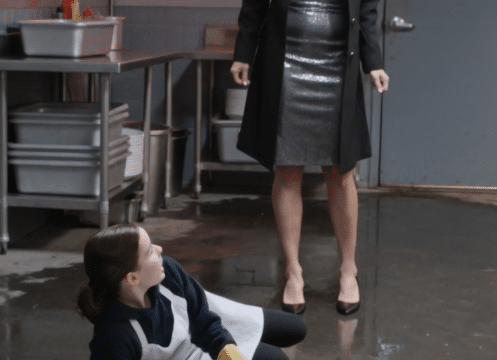
The girl was still holding her snow shovel when the woman kicked her to the ground.
Fourteen-year-old Emily Carter landed beside the porch steps, her old gray coat disappearing against the white snow. Her red knit hat slipped over one ear, and the handle of her shovel skidded across the driveway. When she tried to push herself up, a thin streak of blood appeared on her palm.
The woman standing above her barely looked down.
Victoria Ashford wore a cream winter coat, expensive white boots, and diamond earrings that caught the pale morning light. Behind her, two luxury cars sat beneath a heated carport, their windshields perfectly clear while fresh snow covered every neighboring roof.
A few loose snowflakes had slid across Victoria’s spotless steps.
That was all it had taken.
“I am sorry. I will sweep that off,” Emily said, her voice trembling.
Victoria stared at the girl as though the apology itself were an insult.
“Trash. Street workers do not touch my steps.”
Emily swallowed. She had been clearing the driveway for nearly an hour, pushing heavy snow toward the edge of the pavement so Victoria could leave without slipping. The snow had been deep enough to reach the girl’s ankles, and her patched gloves were already soaked through.
She had not expected a thank-you.
She had expected to be paid the amount they had agreed upon.
Instead, Victoria stepped forward and drove her boot into Emily’s chest.
The shovel clattered away as Emily fell. For a moment, she could only stare at the gray winter sky, struggling to understand what had happened. The cold pressed through her coat, and pain tightened her breathing.
From a neighboring porch, a man lowered his coffee cup.
A woman standing beside a parked SUV covered her mouth.
Nobody moved.
Emily tried to reach for the shovel. She wanted to get up, finish the driveway, and leave before the woman became even angrier.
Victoria took another step.
Then another.
Two more kicks landed against Emily’s back and side, forcing her to curl inward in the snow. She raised an arm over her head, trying to protect herself while keeping her face turned away from the icy ground.
“Crawl through the snow and clean it right,” Victoria ordered.
The words carried across the quiet street.
Emily blinked back tears. Her palm stung, her ribs hurt, and she could feel the damp cold seeping through her jeans. Yet even then, she glanced toward the driveway, where the snow shovel lay several feet away.
She needed the money.
Her mother had left a note on the kitchen table that morning reminding her to buy groceries after work. The heating bill was overdue, and the envelope from the landlord had arrived two days earlier.
Emily had promised herself she would bring home enough money to help.
Now she lay in the snow while the woman who owed her payment looked down at her with contempt.
A dark city vehicle came around the corner.
Its brakes caught sharply at the curb, and the driver’s door swung open. A woman in a navy coat stepped out, saw Emily on the ground, and hurried across the snow-covered pavement.
She reached Victoria just as the wealthy homeowner turned toward the approaching footsteps.
The woman delivered one sharp slap across Victoria’s face.
Victoria staggered half a step, one hand flying to her cheek.
Before she could recover, the stranger moved between her and the girl, shielding Emily from view.
Her expression was cold, controlled, and unmistakably furious.
“She cleared your street before the city cleared your name.”
Victoria stared at her.
The neighbors fell silent. Even the wind seemed to fade beneath the weight of the accusation.
Victoria’s lips parted, but no answer came.
Then, slowly, she recognized the official badge clipped to the stranger’s coat.
The woman’s name was Margaret Ellis.
And Victoria Ashford had spent the past six months trying to make sure Margaret never discovered what had happened on that very street.
“My name?” Victoria whispered.
For the first time that morning, the wealthy homeowner looked genuinely afraid.
Because the girl in the snow was not the only person whose life Victoria had tried to push out of sight.
And the secret Margaret had uncovered was far more serious than a few snowflakes on a porch.
Act II
Emily Carter had learned to work before she learned how to ask for help.
Her mother, Denise, worked as a home-care aide, driving between clients across the city and picking up extra shifts whenever someone called in sick. She was the kind of woman who kept spare gloves in her car for clients who forgot theirs and bought groceries for an elderly neighbor when she learned his pension had been delayed.
She was also the kind of woman who rarely admitted when she was exhausted.
Emily noticed anyway.
She noticed the way her mother rubbed her wrists after long shifts. She noticed how carefully Denise counted the money in her purse before going to the grocery store. She noticed that, when the temperature dropped, their apartment heater made a rattling sound and her mother quietly placed a towel along the bottom of the window to keep the draft out.
Denise had never asked Emily to work.
In fact, she had repeatedly told her daughter that school came first. But Emily hated feeling helpless when she could see the strain her mother carried.
So she began shoveling snow for neighbors.
At first, it was simple work. She cleared a short walkway for an elderly couple on the next block and earned enough to buy milk, bread, and a few cans of soup. When the weather grew worse, more residents began asking for help.
Emily kept a small notebook with names, addresses, and agreed prices.
She was careful. She arrived when she said she would, finished the work, and never asked for extra money afterward. If a neighbor could not afford the full amount, she sometimes accepted less, though she made sure her mother never knew when she did.
She was not trying to become a hero.
She was trying to keep their lives from becoming more difficult than they already were.
Victoria Ashford had hired Emily through a neighborhood message board after seeing an advertisement for snow removal. Her driveway was unusually wide, and the steps leading to her front door had to remain clear for a scheduled visit from a property manager.
Victoria had insisted on a fixed price.
Emily had agreed.
When she arrived that morning, Victoria barely opened the door far enough to hand her a shovel. She pointed toward the driveway and told the girl to make sure no snow remained on the steps.
Emily worked steadily.
The snow was heavy, and the wind kept blowing it back across the pavement. She cleared the path once, then returned to the edges to make sure there was room for a car to turn safely.
A few flakes slid toward Victoria’s white boots.
The woman reacted as if Emily had deliberately ruined something precious.
The attack that followed was not the result of a misunderstanding. Emily apologized immediately, offered to clean the snow again, and made no threat. Victoria simply believed that a girl who worked for cash outdoors could be treated however she pleased.
That belief had shaped much of Victoria’s life.
She owned several rental properties, sat on the board of a local charitable foundation, and regularly attended events where photographs of her donations appeared in glossy brochures. She spoke often about neighborhood standards, civic pride, and the importance of personal responsibility.
She also had a habit of confusing respectability with innocence.
When residents complained about broken sidewalks outside her rental properties, Victoria blamed contractors. When a tenant reported a dangerous patch of ice that had remained untreated for days, she insisted the tenant had exaggerated. When inspectors asked questions, she sent letters through her attorney.
She had learned that if she spoke confidently enough, many people would stop asking questions.
But the neighborhood’s winter problems had become impossible to ignore.
After several severe storms, residents had complained about uncleared sidewalks, icy bus stops, and elderly people struggling to reach medical appointments. The city had launched a winter-relief initiative to identify dangerous routes and coordinate emergency assistance for residents who could not clear their own walkways.
Margaret Ellis, the city’s winter-relief commissioner, was responsible for overseeing the program.
She had spent years working in municipal emergency coordination. She knew that a blocked sidewalk was not merely an inconvenience for someone using a wheelchair or a walker. It could mean a missed medical appointment, a fall on black ice, or a parent forced to push a stroller into traffic.
She also knew that the city could not be everywhere at once.
That was why the program partnered with local organizations and volunteer networks, including residents who helped clear paths during severe weather.
Margaret had been visiting the neighborhood that morning after receiving reports that several priority sidewalks remained blocked. Her driver was taking her toward the next inspection point when she saw the dark shape of a girl on the ground.
At first, she thought Emily had slipped.
Then she saw Victoria standing over her.
Margaret stopped the vehicle.
What she witnessed next would change the course of an investigation that had already begun to threaten Victoria’s reputation.
Because Margaret recognized the street.
And she remembered the name attached to the reports.
Act III
Six months earlier, the city had received a series of complaints about winter maintenance in the same neighborhood.
At first, the reports appeared routine. Several sidewalks had not been cleared after snowfall. A ramp leading to a bus stop had been left icy. One elderly resident had fallen near a corner where snow had been piled across the curb cut.
The complaints were assigned to the winter-relief office.
But when inspectors returned to the locations, they discovered that some of the maintenance records did not match what residents described. Work had been marked complete even when the sidewalks remained obstructed, and several contractors appeared to have received payment for tasks that had not been properly performed.
Margaret ordered a broader review.
The problem was not simply that snow had been left on the ground. In a city where winter weather could turn a short walk into a serious hazard, inaccurate records meant the people responsible for addressing dangerous conditions might never be sent back.
The review examined contractor invoices, inspection logs, and reports from neighborhood assistance programs. It also looked at complaints that had been closed without a documented site visit.
One property management company appeared repeatedly in the records.
It was connected to several buildings owned by Victoria Ashford.
Victoria was not personally responsible for every sidewalk in the neighborhood, and the records alone did not establish that she had committed a crime. But her company had approved payments to a contractor whose work had been questioned, and some of the disputed maintenance certificates bore authorization linked to her property office.
When city officials requested supporting documentation, Victoria’s representatives supplied partial files.
Several records were missing.
Others appeared to have been amended after the dates listed on the original complaints.
Margaret referred the discrepancies for an independent audit and requested that the relevant records be preserved. She also asked that the city suspend disputed payments until the work could be verified.
Victoria responded with a polished letter accusing the city of unfairly targeting successful property owners.
She claimed that the complaints had been exaggerated by residents who disliked her developments. She argued that weather conditions made perfect documentation impossible and insisted that her company had acted in good faith.
Her attorney demanded that the city withdraw any suggestion of wrongdoing.
The review continued.
Then, three weeks before the assault, a new report arrived.
An elderly resident had missed a medical appointment after finding the sidewalk outside her building blocked by a ridge of frozen snow. A volunteer had eventually cleared a path, but the contractor’s records showed the area had supposedly been inspected and made safe the previous day.
The report included a photograph.
In the background stood a sign bearing the name of Victoria’s property management company.
Margaret requested the original inspection logs.
That request triggered a second review of the company’s winter maintenance records.
And that was why Margaret was driving through the neighborhood when she saw Emily lying in Victoria’s driveway.
The girl had been clearing snow from a private property, not performing official city work. Margaret did not know her name, and she had never met her before.
But she recognized the street as one of the locations flagged by the audit.
When Margaret stepped between Victoria and Emily, her words had been deliberate.
“She cleared your street before the city cleared your name.”
She was not claiming that Emily had personally completed the city’s contracted work. She was pointing to something more revealing: a child working in the cold to earn a little money had done honest labor in a neighborhood where adults had been paid to maintain safe walkways—and some of those records were now under investigation.
Victoria’s anger had been visible before the attack.
Her fear appeared only after she recognized Margaret.
“You have no right to come onto my property and threaten me,” Victoria said, attempting to recover her composure.
Margaret ignored the accusation for the moment and looked toward Emily.
The girl remained on the ground, shivering and holding one hand against her coat. Her shovel lay several feet away, partly buried in fresh snow.
Margaret called for emergency assistance and asked the neighbors to preserve any photographs or recordings they might have taken. One resident finally stepped forward to retrieve a blanket from her porch, while another called the police.
Victoria did not move to help.
Instead, she straightened the collar of her coat and looked toward the city vehicle.
“This is a private dispute,” she insisted. “The girl was careless. She damaged my property.”
Margaret turned back.
“What property?”
Victoria gestured toward the porch steps.
“There is snow on them.”
For several seconds, Margaret said nothing.
The steps were white with fresh snowfall. A few scattered flakes had blown toward the edge of the path, but there was no meaningful damage to point to. Emily’s shovel had not struck the porch, and nothing had been broken.
Margaret looked at the girl again.
Then she faced Victoria.
“You can explain your complaint to the responding officers,” she said. “You can also explain why you thought an apology justified violence.”
Victoria’s cheeks flushed.
“You don’t understand who you’re dealing with.”
Margaret’s expression did not change.
“I understand exactly what I saw.”
By the time the police arrived, several neighbors had begun to speak. Their accounts differed in small details, but they agreed on the central sequence: Emily had been shoveling, Victoria had confronted her over a small amount of snow, and the assault had followed.
A doorbell camera had captured part of the incident.
Another neighbor had recorded the aftermath from a window.
The evidence would be reviewed through the appropriate legal process.
Margaret did not tell the officers how to handle the case. She provided her own account and identified the city records already under review. She also made clear that the assault investigation and the municipal audit were separate matters, even though they had converged at the same address.
Victoria had spent months trying to keep the two issues apart.
Now both were moving forward.
And when the city auditor compared the disputed maintenance records with the photographs and inspection logs, the gaps became much harder to dismiss.
Act IV
Emily spent the afternoon at a medical clinic with her mother beside her.
Denise had arrived from work after receiving the call, still wearing her nursing uniform beneath an old winter jacket. When she saw Emily’s injured hand and the way her daughter winced while moving, her face drained of color.
She wanted to know why no one had stopped the attack sooner.
Emily had no answer.
She remembered the faces on the porches, the woman standing by the SUV, and the brief silence after she fell. She did not hate the neighbors, but she could not understand how so many people could watch a child being hurt and remain behind their doors.
Denise held her hand carefully.
“You don’t have to explain why she did it,” she told her daughter. “There is no excuse for what happened.”
Emily began to cry then, not loudly, but with the exhausted relief of someone who had spent the entire morning trying not to fall apart.
Her mother stayed beside her until the tears passed.
Over the next several days, Emily’s injuries were assessed and her recovery monitored. She was sore, frightened, and reluctant to go back to the neighborhood where she had been attacked. Denise did not pressure her to return to work.
The money from Victoria’s job had never been worth her daughter’s safety.
Meanwhile, the police continued gathering evidence. The recordings and witness statements were preserved, and Victoria was required to respond to the allegations through the proper process.
Margaret also filed her official report about what she had witnessed. Her slap was documented as part of the same sequence, and she cooperated with the review of her own conduct. She did not claim that her position gave her the right to strike someone, even someone she had seen assault a child.
The city commissioner’s role was to protect the public and ensure that the appropriate authorities had the information they needed.
She could not replace the police, the courts, or the independent auditors.
And she would not pretend otherwise.
But the encounter forced a new urgency into the municipal review.
The auditor obtained additional contractor invoices and compared them with property maintenance logs. Several payments had been approved for work that could not be substantiated by photographs or inspection records. In some cases, the listed completion times conflicted with reports submitted by residents.
The findings did not automatically prove who had knowingly falsified the records. They did, however, establish enough discrepancies to justify further investigation and the suspension of disputed payments.
Victoria’s company was required to provide additional documentation.
Its representatives asked for more time.
The city granted reasonable deadlines but refused to close the review simply because the company objected. Officials also arranged fresh inspections of the affected sidewalks and entrances, prioritizing locations used by older residents and people with mobility limitations.
In the meantime, the winter-relief office coordinated with verified community volunteers to clear the most urgent routes.
Emily’s name appeared in none of the contractor records.
She had been paid privately to shovel one driveway, and she had done the work she was hired to do. Yet the image of the girl clearing snow while an adult stood over her became a painful reminder of how easily essential labor could be overlooked when the person performing it had little money or influence.
Margaret began asking a different set of questions.
How many residents were relying on informal arrangements because sidewalks and driveways were not being cleared reliably? How many elderly people had stopped leaving home because the paths outside were unsafe? How many children were taking on paid work in the cold because their families needed the money?
The answers were complicated.
No single program could solve every problem, and the city did not have unlimited resources. But the review identified gaps in the way assistance was coordinated and made it clear that reported hazards needed faster follow-up.
The winter-relief office introduced a more transparent system for confirming completed work on priority public routes. It also expanded outreach to local organizations that could connect residents with legitimate assistance, while making clear that children should not be expected to substitute for contractors responsible for public infrastructure.
Margaret did not use Emily’s injury as a publicity opportunity.
She asked Denise for permission before mentioning the incident in any internal discussion, and she kept Emily’s personal details out of public communications. The goal was to improve the system, not turn a frightened teenager into a symbol without her consent.
Victoria, meanwhile, discovered that her social standing could not insulate her from every consequence.
Her company’s disputed payments remained under review. Business partners requested clarification, and a local charitable board temporarily suspended her participation in financial oversight while the relevant facts were assessed.
Those decisions were not made because Margaret disliked her.
They were made because the records required examination and the assault had raised serious questions about her judgment.
Victoria tried to argue that the two matters were unrelated.
Her attorneys insisted that a personal confrontation should not influence the review of a business.
On that point, the principle was correct: the evidence had to be evaluated on its own merits.
But the principle did not mean Victoria could avoid scrutiny altogether.
The assault had brought public attention to a street already connected to disputed maintenance records. Investigators were entitled to examine those records, and Victoria was entitled to respond. Neither side could simply declare the matter settled.
Weeks later, a preliminary audit confirmed that several maintenance payments could not be adequately supported by the documentation provided. The city referred the findings for further review and pursued recovery of payments for work that had not been verified.
The investigation into the assault proceeded separately.
Victoria’s polished public image began to fracture, not because one official had uttered a dramatic sentence in the snow, but because independent evidence continued to accumulate.
Her name, once used to open doors, now appeared on requests for records, audit correspondence, and formal notices requiring answers.
The city did not need to destroy her reputation.
It needed to establish the truth.
And for the first time, Victoria could not control how quickly that truth emerged.
Act V
By the time the snow began to melt, Emily had returned to school.
She walked more slowly than before and kept her injured hand tucked into the pocket of her coat when the wind grew sharp. Her mother had insisted she take a break from shoveling, and Emily had agreed, though she still worried about the bills waiting at home.
She was not suddenly free from financial pressure.
The heating bill still had to be paid. Denise still worked long shifts. Their apartment still needed repairs, and Emily still understood the difference between wanting something and being able to afford it.
But she had stopped believing that every problem had to be solved by enduring whatever someone stronger demanded of her.
A teacher helped Denise find information about a local family assistance program. A community organization connected them with short-term winter support, and Emily agreed to focus on school while she recovered.
She was uncomfortable with the attention surrounding the incident.
Some classmates wanted to know whether Victoria had been arrested. Others asked whether Margaret had really slapped the woman. Emily answered only what she felt comfortable answering, and her teacher made sure the school did not turn the assault into a spectacle.
For a while, Emily avoided talking about the driveway altogether.
Then one afternoon, her class was asked to write about a time they had learned something important about themselves.
Emily stared at the blank page for a long time.
She did not want to write about being a victim. She did not want to describe the snow or the kicks or the terrible silence of the neighbors. She certainly did not want to turn her pain into an inspirational story for other people.
Finally, she wrote about work.
She wrote that she had once believed hard work could protect a person from being mistreated. If she arrived on time, did a good job, kept her promises, and apologized when something went wrong, she thought people would have no reason to be cruel.
Now she understood that being responsible did not guarantee that other people would behave responsibly.
That was not a reason to stop working hard.
It was a reason to stop blaming herself when someone chose to be cruel.
Her teacher read the page and returned it without making a speech. At the bottom, she had written one sentence:
You deserved respect before you ever picked up the shovel.
Emily kept the paper in her backpack.
The city’s investigation continued into the spring. The audit findings led to further examination of the contractor’s records, and disputed payments were addressed through formal procedures. Victoria’s company had to provide additional documentation and respond to the findings, while the assault case followed its own course.
Margaret remained involved in the winter-relief reforms but avoided discussing the case publicly beyond confirming her cooperation with investigators.
She did not call Emily to offer a dramatic apology for the city.
Instead, she arranged for a community liaison to contact Denise and provide information about available assistance, leaving the family free to accept or decline it. She also made sure that the revised winter response plan included clear channels for residents to report unsafe walkways and receive follow-up.
The changes were not glamorous.
They involved better records, more reliable inspections, and clearer responsibility for the work that kept people safe during winter.
But those changes mattered to people who had never attended a charity dinner or met a city commissioner.
They mattered to the elderly man who needed a clear route to the pharmacy. They mattered to the parent pushing a stroller toward the bus stop. They mattered to anyone who had ever stepped outside after a storm and wondered whether the sidewalk would be safe.
One afternoon, Margaret returned to the neighborhood to review the new procedures.
The snow had mostly melted, leaving wet pavement and small gray piles beside the curb. She stopped near Victoria’s driveway, where the porch steps were now clean and dry.
A few houses away, Emily was walking home from school with Denise.
Margaret approached only after Denise noticed her and gave a small nod.
She did not reach for Emily’s hand or ask the girl to recount what had happened. She simply told Denise that the city had completed another stage of the review and that the family could contact the liaison if they needed help navigating the available resources.
Denise thanked her.
Emily looked at Margaret for a moment.
“Did you find out why they said the work was finished when it wasn’t?”
Margaret answered carefully.
“The review found records that didn’t match the work that could be verified. The people responsible have to answer for those records. We have to make sure the system catches problems sooner.”
Emily considered this.
“So it wasn’t just the snow.”
“No,” Margaret said. “It was also whether people did what they promised, and whether anyone checked.”
Emily nodded.
That answer was more useful to her than a promise that every dishonest person would eventually get what they deserved.
The world did not work that neatly.
Some people avoided consequences for too long. Some problems required months of paperwork and patient investigation. Sometimes the person who did the right thing was never thanked, and sometimes the people who should have stepped forward remained silent.
But evidence could be preserved.
Records could be checked.
People could be held accountable through a process that did not depend on who owned the largest house on the street.
Before Margaret left, Emily glanced toward the driveway.
“I thought if I just cleaned it again, she would stop being angry.”
Denise put a hand on her daughter’s shoulder.
Margaret answered softly.
“You were hired to clear snow. You weren’t hired to accept being hurt.”
Emily looked down at the patched gloves she had carried in her coat pocket for weeks.
For the first time, she understood that distinction without feeling she had failed someone.
She had done the work.
She had apologized for the snow.
She had tried to make things right even when the mistake was tiny and the reaction was cruel.
Nothing she had done made the assault her fault.
As Denise and Emily continued down the street, Margaret watched them go before returning to her vehicle.
The winter had left its marks on the neighborhood: damaged curbs, cracked pavement, and patches of grass flattened beneath months of snow. Some repairs would take time, and the city’s work was far from finished.
But the street was safer than it had been.
The records were being examined.
The people responsible for the disputed work had been required to answer questions.
And a fourteen-year-old girl who had once believed she had to endure mistreatment to earn a few dollars was beginning to understand that her dignity was not part of the price.
Victoria Ashford had asked Emily to crawl through the snow and clean her steps.
She had mistaken poverty for permission.
She had mistaken a child’s apology for weakness, a worn coat for worthlessness, and a powerful address for immunity.
But the snow melted, the records remained, and the truth did not disappear simply because someone wealthy wished it would.
In the end, the most important thing Margaret revealed was not that Victoria’s name had become part of an investigation.
It was that a person’s name could not make cruelty respectable.
And a girl with patched gloves, a borrowed shovel, and almost nothing in her pockets could still possess something no expensive coat could buy.
The right to be treated like a human being.
Even in the snow.
Especially there.