Act I
The first jolt hit Natalie Carter just as she was starting to drift off.
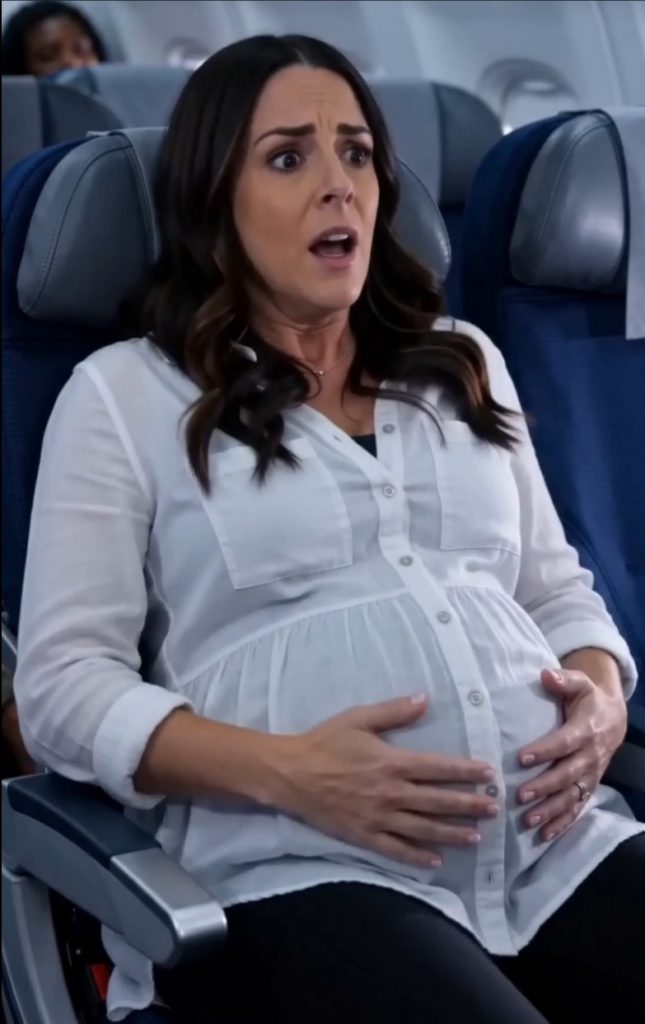
Her seat lurched forward with a dull thud. Her eyes flew open, and both hands went straight to her stomach.
The baby kicked once, as if startled too.
Natalie breathed through her nose and pressed her head back against the navy-blue airplane seat. The cabin was dim and cool, filled with the constant engine hum and the soft rustle of passengers opening snack bags, turning pages, adjusting blankets.
She was thirty-four weeks pregnant.
Her back ached. Her ankles were swollen. She had been awake since 4:00 a.m., standing in airport lines while strangers bumped her carry-on and pretended not to notice.
Then it happened again.
Thud.
The back of her seat jerked.
Natalie closed her eyes.
Please, not this.
She turned over her shoulder, trying to keep her voice calm.
“Excuse me,” she said, her patience already thinning. “Could you please stop tapping the seat? It’s a bit uncomfortable for me.”
The young man behind her did not answer right away.
She saw only part of him. Buzz cut. Tan combat boots. Camouflage uniform. A name tag across his chest.
HIGGINS.
His face was turned down, focused on something near his knees.
Natalie turned forward again with a heavy sigh, rubbing the top of her belly.
She had always been polite.
Too polite, her sister said.
But exhaustion has a way of sanding down grace.
Another thud struck the seat.
This one sharper.
Natalie’s body lurched, and pain tightened across her lower back. Tears sprang to her eyes, hot and humiliating.
That was enough.
She pushed herself up with both hands on the armrests, awkwardly shifting into the aisle. A flight attendant looked over from three rows ahead, but Natalie was already turning.
“Sir, I asked you—”
The words died in her mouth.
Officer Higgins was not kicking her seat.
Not on purpose.
He was hunched forward, jaw tight, both hands gripping the lower part of his left leg.
Except it was not a leg.
It was a prosthetic device, metal and carbon fiber fitted beneath his uniform pants. The tan boot attached to it had been striking the seat frame because the cramped space gave him nowhere to position it. He was trying, silently and stubbornly, to adjust it without bothering anyone.
The clicking sound came again.
Metal against plastic.
Boot against seat.
Not rudeness.
Pain.
Natalie’s hand flew to her mouth.
“Oh my God,” she whispered.
Higgins looked up at her then.
His face was young, younger than she expected, with tired eyes and the careful blankness of someone used to people seeing the prosthetic before they saw him.
“I’m sorry, ma’am,” he said quietly. “I’m trying to keep it still.”
Natalie felt shame rush through her so fast she could not speak.
Behind her, a baby she had not yet met shifted beneath her hand.
In front of her sat a soldier who had already given part of himself to a country that now couldn’t give him enough legroom in economy.
And in that frozen aisle, with strangers watching, Natalie realized her anger had landed on the wrong wound.
But the worst part was still coming.
Because when Higgins glanced at the necklace around her throat, his face changed.
Act II
The necklace was the last thing Natalie’s husband had given her before deployment.
A small silver dog tag, not official issue, engraved with three words on one side.
Come back stubborn.
Daniel Carter had pressed it into her palm the night before he left, smiling like he always did when he was trying to make fear look smaller.
“You wear it until I get home,” he told her.
“And what do you wear?”
He tapped his chest.
“You.”
Natalie had rolled her eyes, but she slept with the necklace under her pillow that night.
Three months later, she found out she was pregnant.
Two weeks after that, Daniel’s letters stopped.
The official call came on a rainy Tuesday.
There had been an explosion during a convoy mission overseas. Daniel had not survived. The military liaison used careful words. Heroism. Sacrifice. Immediate loss.
Natalie remembered almost none of them.
She remembered the kitchen tile under her knees.
She remembered the phone slipping from her hand.
She remembered touching her stomach and whispering, “No, no, no,” because Daniel had died before she could tell him he was going to be a father.
After the funeral, grief became a room she lived inside.
People visited. People brought casseroles. People said Daniel would have been proud. People said the baby was a blessing, as if blessings did not sometimes arrive wrapped in unbearable absence.
Natalie tried to be strong.
She attended doctor appointments alone. She packed away Daniel’s boots and then unpacked them the same night because the closet felt too empty. She wrote him letters she never mailed, filling pages with things like:
She kicked today.
I think it’s a girl.
I hate you for leaving, but I know you didn’t choose it.
When the Army invited her to a memorial ceremony in Washington, she almost refused.
Then a package arrived.
Inside was Daniel’s field notebook, recovered with his belongings. Most of the pages were damaged by water and dirt, but one line remained clear.
If anything happens, tell Nat I tried to keep my promise.
Natalie bought the plane ticket that evening.
She was flying to the ceremony not because she was ready, but because the baby deserved to hear her father’s name spoken by people who knew what he had done.
Now, standing in the aisle of a crowded airplane, Natalie saw Officer Higgins staring at the necklace.
Not casually.
As if it had struck him.
His eyes moved from the dog tag to her face, then down to her stomach, then back up again.
“Carter,” he said.
Natalie froze.
“What?”
His voice was barely audible.
“Your necklace. Was your husband Sergeant Daniel Carter?”
The cabin noise seemed to disappear.
Natalie’s hand tightened around the seat.
“Yes.”
Higgins’s face went pale.
He looked down at his prosthetic, then back at her.
For a moment, he seemed to be deciding whether the truth would hurt more spoken or swallowed.
Then he said, “Ma’am, your husband saved my life.”
Natalie stared at him.
The plane moved through the clouds.
The baby shifted again beneath her palm.
And all the air left Natalie’s lungs.
Act III
The flight attendant moved them to the rear galley after that.
There was no empty row, but there was enough space near the service area for Higgins to straighten his prosthetic and for Natalie to sit on a fold-down jumpseat with a cup of water trembling in her hands.
“I didn’t know,” she said.
Higgins shook his head.
“You didn’t do anything wrong.”
“I snapped at you.”
“You were uncomfortable.”
“I was cruel.”
He looked at her then, gently but firmly.
“No, ma’am. Cruel is different. I’ve seen cruel.”
Natalie looked away.
The word ma’am made her feel older than him, though grief had aged her more than years ever could.
“What happened?” she asked.
Higgins stared at the floor for a long moment.
“You sure you want to hear it?”
No.
Yes.
She nodded.
He spoke carefully, not like a man telling a war story, but like someone handing over a fragile object.
Their convoy had been hit outside a rural checkpoint. There was smoke, confusion, shouting through radios. Higgins had been pinned and unable to move. Daniel Carter was already clear.
“He could’ve stayed back,” Higgins said. “He didn’t.”
Natalie pressed both hands around the paper cup.
Higgins swallowed.
“He came for me. Got me out. Kept talking the whole time. Said if I passed out, he’d tell everyone I owed him twenty bucks.”
A sound escaped Natalie that was almost a laugh and almost a sob.
“That sounds like him.”
“He asked if I had family,” Higgins continued. “I told him my mom. My little brother. He told me he had a wife back home who made the best blueberry pancakes in Virginia.”
Natalie covered her mouth.
Daniel hated blueberries.
He only said that because Natalie loved making pancakes and he loved stealing the burned ones before she could throw them away.
Higgins reached into the pocket of his uniform jacket.
“There’s something else.”
He pulled out a folded envelope, worn soft at the corners.
Natalie stared at it.
“I was going to give this to you at the ceremony,” he said. “I didn’t know you’d be on this flight. I didn’t even know what you looked like until I saw the tag.”
The envelope had her name written across it.
Natalie.
Daniel’s handwriting.
Her vision blurred instantly.
Higgins held it out, but she did not take it at first.
For months, she had begged the universe for one more message from Daniel.
Now that it was in front of her, she was terrified to open it.
“He gave it to me before the mission,” Higgins said. “Told me if he got too busy being dramatic, I should make sure it reached you.”
Natalie laughed through tears.
“That idiot.”
Higgins smiled faintly.
“He also told me not to let anyone read it unless they could prove they made the pancakes.”
This time, Natalie cried fully.
Quietly, but without fighting it.
The flight attendant turned away, pretending to arrange cups.
Natalie finally took the letter.
Her fingers traced Daniel’s handwriting like touch could bring back warmth.
“I’m scared,” she whispered.
Higgins nodded.
“I was too.”
She looked up.
“When?”
“When I woke up and realized he’d saved me, but he wasn’t there.”
The honesty between them settled heavily.
Natalie opened the envelope.
Inside was one folded page.
And an ultrasound picture she had never sent him.
She went completely still.
Daniel had known.
Act IV
Natalie unfolded the letter with shaking hands.
Nat,
If you’re reading this, I already hate this letter. I hate that it had to exist. I hate that I’m not there to say all of this badly in person while you tell me I’m rambling.
First, I know.
Natalie stopped.
Her breath caught so sharply Higgins looked up.
She kept reading.
Your sister told me. Don’t be mad at her. I bullied it out of her because she sounded weird on the phone, and you know I am professionally annoying.
We’re having a baby.
Our baby.
I have read that sentence twenty times and still don’t know how to be worthy of it.
Natalie pressed the page to her chest.
Her sister had known for one day before the call came. Natalie had begged her not to tell Daniel until she could do it herself over video.
But Daniel had always been impossible to fool.
She forced herself to continue.
If I make it home, I’m going to pretend to be shocked when you tell me, because I want you to have that moment. If I don’t, please don’t think I left without knowing the best thing that ever happened to me.
Tell our kid I loved them before I knew their name.
Tell them I was scared sometimes, but I tried to be brave anyway.
Tell them their mom was the bravest person I ever met.
Natalie bent over the letter, crying so hard the baby shifted as if responding to the sound.
Higgins sat quietly beside her.
No advice.
No empty comfort.
Just presence.
That was more than most people had given her.
Then Natalie read the final lines.
And if Higgins makes it home, please tell him he does not owe me anything. Not his guilt. Not his life. Just pancakes someday, if he wants them.
He’s a good man. Don’t let him argue.
Natalie looked at Higgins.
His face had broken open.
Not dramatically. Not loudly. Just enough to reveal the grief he had been carrying under his uniform, under his silence, under every clack of the prosthetic he tried to hide.
“He wrote about you,” Natalie whispered.
Higgins looked down.
“I don’t feel like a good man.”
“Daniel said you were.”
“He died pulling me out.”
“He chose to help you.”
Higgins closed his eyes.
“That doesn’t make it easier.”
“No,” Natalie said softly. “It makes it mean something.”
The plane dipped slightly, and the seatbelt sign chimed.
The flight attendant came over, concerned. “Mrs. Carter, we need you seated.”
Natalie nodded, wiping her face.
But before she returned to her row, she looked at Higgins’s cramped seat.
“There has to be a better place for you.”
He gave a tired half-smile.
“Not on this plane.”
Natalie turned to the flight attendant.
“He needs space.”
The attendant hesitated. “The flight is full.”
Natalie looked down the aisle.
For once, she did not care about being polite.
“This man is injured, in pain, and trying not to bother anyone. There is a first-class cabin with bigger seats.”
A few passengers looked up.
The attendant lowered her voice. “Those seats are assigned.”
“Then assign one to him.”
Higgins shook his head. “Mrs. Carter, it’s fine.”
Natalie turned on him with the full force of a pregnant widow who had just read her husband’s last letter.
“Daniel said not to let you argue.”
Higgins went silent.
The flight attendant blinked, then disappeared toward the front.
A minute later, an older man in a first-class aisle seat stood and walked back.
He had heard enough.
“Soldier can take mine,” he said gruffly. “I’ll sit wherever.”
Then a woman across from him offered to switch with Natalie too.
“Mom-to-be needs room,” she said.
Within minutes, the cabin rearranged itself in the awkward, beautiful way people do when shame finally turns into action.
Higgins tried to protest twice.
Natalie raised an eyebrow both times.
He stopped.
As he settled into the larger seat, his prosthetic finally positioned without striking anything, he exhaled so deeply that Natalie understood how long he had been holding pain inside his body.
Then he looked at her.
“Thank you.”
Natalie touched Daniel’s letter.
“No,” she said. “Thank you for bringing him back to me.”
Outside the window, sunlight broke through the clouds.
For the first time in months, Natalie felt Daniel not as absence, but as something still moving through the world.
Through a letter.
Through a saved life.
Through the stranger behind her seat.
Act V
The memorial ceremony was held the next morning under a cold, bright sky.
Natalie stood in the front row wearing a black dress, Daniel’s dog tag, and a coat that no longer closed over her stomach. Higgins stood beside her in uniform, steady on his prosthetic, his face solemn.
When Daniel’s name was read, Natalie did not collapse.
She thought she might.
Instead, she placed one hand over the baby and one hand around the folded letter in her pocket.
Sergeant Daniel Carter.
Husband.
Father.
Soldier.
Friend.
The word father nearly took her down.
Higgins felt her sway and offered his arm.
She took it.
No one looking at them would have understood the strange bond formed between seat rows at thirty thousand feet. A widow who had mistaken pain for rudeness. A soldier who had mistaken survival for debt. A letter that released them both from stories they had been telling themselves alone.
After the ceremony, Higgins asked if he could tell her one more thing.
They sat on a bench near the memorial wall, away from the crowd.
“Daniel talked about home all the time,” he said.
Natalie smiled faintly.
“He loved home.”
“He said if he had a daughter, he wanted her to know how to change a tire.”
Natalie laughed.
“And if it was a son?”
“How to make blueberry pancakes.”
“He hated blueberries.”
“I know,” Higgins said. “He said that too.”
They both laughed then.
Not because anything was fixed.
Because grief had allowed one small absurd thing to survive.
Three weeks later, Natalie gave birth to a girl.
She named her Grace Daniel Carter.
Higgins visited the hospital two days later with flowers, a stuffed bear in Army camouflage, and a box of pancake mix he looked deeply embarrassed to be holding.
Natalie placed Grace in his arms.
He froze.
“I don’t know how to hold a baby.”
“You’ll learn.”
“She’s tiny.”
“She’s new.”
Grace opened her eyes for half a second, then closed them again, unimpressed by everyone.
Higgins looked down at her like he had been trusted with something too precious for human hands.
“She has his nose,” he whispered.
Natalie smiled through sudden tears.
“She does.”
Months passed.
Higgins became Uncle Aaron, though he protested that he had not earned a title so quickly. Natalie ignored him. Daniel’s letter had given instructions, and she had become very good at following the ones that mattered.
Every Sunday morning, when schedules allowed, Higgins came over for pancakes.
The first batch was terrible.
The second was worse.
By the third month, he learned not to burn them.
Grace grew.
She learned to grab his dog tags when he leaned too close. She learned to laugh whenever his prosthetic made a soft mechanical click. The first time it happened, Higgins flinched, embarrassed.
Natalie shook her head.
“Don’t hide it from her.”
He looked uncertain.
“Why?”
“Because someday she’s going to ask what happened. And I want her to learn that people carry pain in different ways. Some scars show. Some don’t. None of them make a person less whole.”
Higgins looked down at Grace, who was trying very seriously to chew on his sleeve.
“I still don’t always feel whole.”
Natalie’s voice softened.
“Me neither.”
That was the truth that stayed between them.
Not a perfect healing.
Not a neat ending.
Just two people connected by the same man, learning to live with what he saved and what he left behind.
Years later, Grace would know the story.
Not all at once.
First, she would know that her father loved pancakes and wrote terrible jokes. Then that he was brave. Then that bravery was not the same as fearlessness. Then that a man named Aaron Higgins came home because Daniel refused to leave him behind.
And someday, when she was old enough, Natalie would show her the letter.
Tell our kid I loved them before I knew their name.
But for now, Grace only knew Sunday mornings.
Warm kitchen.
Blueberry batter.
A soldier with a gentle voice.
A mother who sometimes cried while smiling.
And a silver dog tag that caught the light when Natalie lifted her from the high chair.
One rainy afternoon, Natalie found the old boarding pass tucked inside Daniel’s letter.
The flight number had faded slightly.
She remembered that day with a sharp ache: the seat jolting, her anger rising, the awful moment she saw the prosthetic, the guilt that burned through her, the name Higgins spoken like a door opening.
She had thought she was turning around to confront a stranger.
Instead, she had turned around and found the last person who had heard her husband’s voice.
Life could be cruel that way.
It could also be merciful.
Natalie placed the boarding pass back in the envelope and looked across the living room.
Higgins sat on the carpet while Grace tried to stack wooden blocks on his knee. His prosthetic rested visible beneath his jeans. Grace tapped it once, heard the soft click, and giggled.
Higgins smiled.
Not politely.
Not painfully.
Fully.
Natalie touched the dog tag at her throat.
For the first time, the words engraved there no longer felt like a broken promise.
Come back stubborn.
Daniel had not come back the way she begged him to.
But he had come back in a letter.
In a story.
In the life he saved.
In the daughter who would grow up surrounded by proof that love does not always end where loss begins.
And all of it started with a sound she had mistaken for carelessness.
A boot against a seat.
A hidden pain.
A soldier trying not to be a burden.
A woman turning around just in time to see the truth.