Act I
Maya had chosen the end of the table because it was the only place no one had to pretend they wanted her there.
The cafeteria roared around her.
Trays slammed down. Chairs scraped against pale tile. Students shouted across long wooden tables while fries disappeared, gossip traveled, and laughter bounced off the off-white walls. Near the double red doors, two sophomores argued over a phone charger. At the far side of the room, the varsity table had claimed its usual territory like a throne room.
Maya sat alone with a burger in both hands.
She took small bites, careful not to look hungry. Careful not to look scared. Careful not to look like the new girl everyone had already decided was strange because she did not laugh at the right jokes or wear the right shoes or know where to stand.
Behind her, Blake Carson smiled.
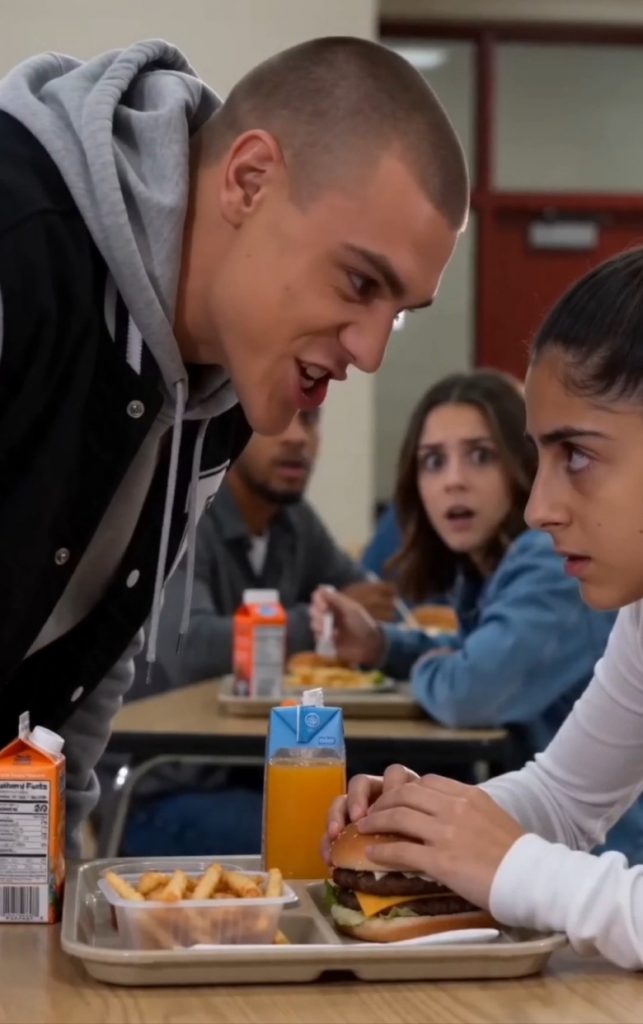
He was tall, athletic, and loud in the way popular boys can be when they learn early that volume feels like power. His gray-and-black varsity jacket hung perfectly over his hoodie. His buzz cut made his face look sharper, meaner. He checked the nearby table of girls to make sure they were watching.
They were.
That was all he needed.
He circled Maya’s table with a slow, swaggering walk.
“Still eating alone?” he called, loud enough for three rows to hear. “Even the chairs don’t want you.”
A few people laughed.
Not everyone.
But enough.
Maya stopped chewing.
She lowered the burger onto her tray and stared down at the orange juice carton beside it. Her shoulders curled inward. Her hands folded in her lap. From a distance, she looked small.
That pleased Blake.
He leaned closer, lowering his face near hers.
“Honestly,” he whispered, sharp and poisonous, “if shame had a face, it would be yours.”
Two students walking past with trays stopped. Their eyes widened, but their feet did not move.
Maya closed her eyes.
Blake glanced around again.
The room had begun to notice.
That was the real meal for him.
Then he bent over Maya’s tray and spat onto the top of her burger.
The cafeteria noise seemed to collapse all at once.
A fork froze halfway to someone’s mouth. A girl near the drink station covered her lips. The two students behind Blake stepped backward, horrified.
Maya did not scream.
She did not cry.
She did not shove the tray away.
She placed both hands flat on the table and slowly lifted her head.
When she looked at Blake, something in the room shifted.
Her eyes were not pleading anymore.
They were wide, unblinking, and cold with a fury so still it felt almost frightening. Not wild. Not reckless. Focused.
Blake’s grin flickered.
“What?” he said. “You gonna cry?”
Maya stood.
The silence spread farther, table by table, until even the varsity section stopped moving.
Then Maya said five words Blake would remember for the rest of his life.
“Did everyone see it now?”
Act II
Maya Alvarez had been at Westbridge High for eleven days.
Long enough to learn which bathroom stalls had broken locks. Long enough to know the cafeteria divided people faster than any schedule ever could. Long enough to understand that Blake Carson was not merely popular.
He was protected.
His father owned three car dealerships, sponsored the football scoreboard, and sat beside the principal at every booster dinner. His mother chaired the gala committee. His older brother had been a state champion quarterback whose framed jersey hung near the gym entrance like a family crest.
Blake moved through school with inherited permission.
Teachers smiled tightly when he interrupted. Coaches called him intense. Guidance counselors called him complicated. Students called him untouchable, though never within earshot.
Maya had known his name before she arrived.
Not from gossip.
From her brother.
Two years earlier, Jonah Alvarez had been a sophomore at Westbridge. Quiet. Brilliant with computers. Terrible at eye contact unless he was explaining something he loved. He built tiny robots from old toothbrush motors and kept a notebook full of sketches for machines that could help people with limited mobility.
Jonah did not fit.
Blake noticed.
At first, it was small. A backpack kicked under a bus seat. A nickname whispered in hallways. A lunch tray moved just out of reach. Then came edited photos, fake messages, group chats, and the kind of laughter that follows a person until they start changing routes through their own school.
Jonah reported it once.
The complaint disappeared into “conflict resolution.”
He reported it twice.
The school called it “peer adjustment.”
The third time, Jonah finally yelled back in the hallway after Blake grabbed his project notebook and tossed it into a trash can. A teacher saw only the yelling. Blake said Jonah threatened him. Three boys backed Blake’s version.
Jonah was suspended.
Blake played Friday night.
After that, Jonah transferred.
He finished school online, but something in him dimmed. He stopped building robots. Stopped eating lunch at the kitchen table. Stopped believing adults meant anything when they said the word safe.
Maya watched her brother disappear by inches.
Her mother fought the school until she had no more money for lawyers. Her father wrote emails that received careful replies full of policies and concern and no action. The family moved districts the following year, but Maya never forgot Westbridge.
Then her father got a job back in town.
And Maya, who could have begged to enroll anywhere else, chose Westbridge.
Her parents thought she wanted closure.
That was only partly true.
Maya wanted to know if the school had changed.
It had not.
By her third day, she saw Blake shove a freshman’s books off a table and call it a joke. By her fifth, she saw a girl crying behind the music building while three others deleted comments from her social media. By her eighth, a cafeteria worker quietly told Maya, “Keep your head down around that Carson boy.”
Maya did not keep her head down.
Not exactly.
She listened.
She wrote things down.
She joined the school paper and asked about the missing anti-bullying committee that appeared on the school website but never met. She found the old complaint forms in a district archive. She learned that Jonah had not been the only one.
There were names.
So many names.
Students who transferred. Students who quit teams. Students who changed lunch periods. Students who learned to laugh at cruelty before cruelty chose them next.
Maya carried those names in a blue folder in her backpack.
Not for revenge.
For proof.
But proof was a strange thing in high school. Everyone wanted it until it stood in front of them. Then they wanted context. Then they wanted patience. Then they wanted the victim to be calmer, softer, easier to defend.
That was why Maya sat alone on the eleventh day.
Because she knew Blake would come.
Because bullies are drawn to silence the way smoke is drawn to a crack under a door.
And because that morning, she had received an email from the district investigator assigned to reopen Jonah’s file.
We need a current incident with witnesses.
Maya had closed her laptop and gone to lunch.
She had not expected Blake to go that far.
But when he did, when the whole room watched him ruin her food and laugh, the cold terror in her chest turned into something clean.
This time, there were witnesses.
This time, everyone saw.
And Blake had no idea the girl he thought was alone had entered that cafeteria carrying the weight of every student he had ever made feel invisible.
Act III
Blake blinked at her.
“What did you say?”
Maya’s voice stayed calm.
“I asked if everyone saw it now.”
A murmur moved through the cafeteria.
Blake looked around, suddenly aware that the silence was not the same as attention. Attention had always fed him. This felt different. He was not performing anymore.
He was being observed.
Maya reached for her tray, but not the burger. She picked up the white napkin beside it and covered the ruined food without looking away from him.
That small gesture made something twist in Blake’s face.
“Don’t act dramatic,” he said. “It was a joke.”
Maya nodded once.
“A joke.”
The word traveled through the room.
A girl at the next table whispered, “That wasn’t a joke.”
Blake turned sharply.
“What?”
The girl looked down, frightened by her own courage.
Maya saw her.
So did half the cafeteria.
That mattered.
Blake leaned closer to Maya again, trying to shrink the world back to just the two of them.
“You think people care?” he said under his breath. “You think anyone’s going to risk anything for you?”
Maya’s eyes did not move.
“No,” she said. “I think they’re tired of risking themselves for you.”
The double red doors opened.
Assistant Principal Grant came in first, already wearing the expression adults use when they plan to solve the appearance of a problem rather than the problem itself. Behind him came Ms. Rivera, the school counselor, moving faster, her face pale with concern.
“What is going on?” Grant demanded.
No one answered immediately.
That was how fear works. It keeps a room full of witnesses silent even when the truth is sitting in the open.
Blake recovered quickly.
“She freaked out,” he said, pointing at Maya. “I was just messing around, and she made it weird.”
Ms. Rivera looked at Maya’s tray.
Then at Blake.
Then at the students standing nearby.
“Is that what happened?” she asked.
The room held its breath.
A boy near the drink machine raised his hand halfway.
Blake stared at him.
The hand dropped.
Maya’s face softened with a grief older than the moment.
Of course.
Then a chair scraped.
A freshman stood from the end of a nearby table. He was small, with braces and a red hoodie two sizes too big.
“He spit on her food,” the freshman said.
Blake’s face went hard.
“Shut up, Tyler.”
The freshman flinched, but this time he did not sit.
“He did,” Tyler said, voice shaking. “I saw it.”
Another voice came from the varsity table.
“He said she was shame.”
A third student stood near the red doors.
“He does this all the time.”
Blake turned in a slow circle, suddenly surrounded not by enemies, but by witnesses who had finally discovered one another.
Maya reached into her backpack and removed the blue folder.
Assistant Principal Grant’s eyes narrowed.
“Maya, what is that?”
She placed it on the table.
“Names.”
Grant stiffened.
Ms. Rivera stepped closer.
Maya opened the folder. Inside were printed screenshots, written statements, dates, reports, and old complaint copies. At the top was Jonah’s suspension notice, marked in red pen.
Blake saw the name.
His sneer vanished.
“Alvarez?” he whispered.
Maya looked at him.
“Yes.”
The room seemed to tilt around that single word.
Blake remembered then. Not everything, perhaps. Boys like him rarely preserved the pain they caused with the same clarity as the people who carried it. But he remembered enough.
The notebook in the trash.
The hallway.
The suspension.
Jonah’s name becoming a joke and then disappearing.
Maya watched recognition enter his face.
There it was.
Not regret.
Fear.
Assistant Principal Grant reached for the folder.
“Maya, this is not the appropriate place—”
Ms. Rivera blocked his hand.
“No,” she said quietly. “I think this is exactly the appropriate place.”
Grant stared at her.
The cafeteria stared at both of them.
And for the first time in years, the adult who usually softened the truth had been stopped by one who was done softening it.
Act IV
The principal arrived three minutes later.
So did the school resource officer.
So did Coach Landry, who looked first at Blake, then at the covered burger, then at the blue folder on the table, and seemed to understand that his winning season had just become very small.
Principal Whitmore tried to move everyone to the office.
Maya refused to touch the folder until Ms. Rivera promised, in front of the cafeteria, that it would be copied, logged, and sent to the district investigator before the end of the day.
“Not summarized,” Maya said.
The principal’s mouth tightened.
Ms. Rivera nodded.
“Not summarized.”
Blake laughed, but it came out thin.
“This is insane. My dad’s going to destroy this.”
A silence followed.
Not because the threat was surprising.
Because everyone recognized it.
The freshman in the red hoodie spoke again.
“He said that to me too.”
Then the stories came.
Not all at once. Not neatly. Not like a courtroom scene where truth lines up and waits its turn.
Messily.
A girl from choir said Blake filmed her crying after practice and sent it to a group chat. A junior from the baseball team said he quit because Blake and two others kept locking his gear in the supply closet. A senior admitted he had lied about Jonah because Blake told him he would be “dead socially” if he did not.
The senior’s voice cracked when he said Jonah’s name.
“I’m sorry,” he whispered, though Jonah was not there to hear it.
Maya closed her eyes.
For a moment, she was back in her kitchen two years earlier, watching her brother stare at his ruined notebook, saying, “It doesn’t matter. They already decided.”
But it had mattered.
It all mattered.
Blake backed away from the table.
“You’re all pathetic,” he snapped. “You’re acting like I ruined your lives because I made some jokes.”
Maya looked at him then, and the cold intensity returned.
“No,” she said. “You ruined your own life because you thought no one else’s mattered.”
That sentence landed harder than shouting.
Coach Landry removed Blake’s varsity jacket from the back of his chair.
Blake stared.
“Coach?”
The coach’s face was gray.
“You’re done for now.”
“My dad funds the team.”
“And maybe that’s been part of the problem,” Coach Landry said.
The room went still again.
Principal Whitmore looked furious, but not at Blake. At the loss of control. At the fact that this was happening in public, where it could not be folded into a private meeting and polished until the edges disappeared.
A phone buzzed on Grant’s belt.
Then another.
Then the principal’s.
Someone had already sent the district office a video.
Not Maya.
She had not needed to.
For once, the room itself had become the record.
Blake’s father arrived less than an hour later, storming through the office wing in a tailored suit, demanding names, threatening lawsuits, calling the incident “teenage nonsense.”
Maya sat in the counselor’s office with Ms. Rivera beside her and heard every word through the wall.
Then the district investigator walked in.
Mrs. Callahan was small, silver-haired, and carried a laptop bag that looked older than most students. She did not raise her voice. She did not need to.
She played the cafeteria video once.
Blake’s father stopped talking.
Then she opened Maya’s blue folder.
And the thing that had lived in whispers for years finally began to breathe in daylight.
Act V
Blake Carson did not return to school the next day.
At first, students said he was suspended.
Then they said he had transferred.
Then they said his father was fighting everything.
Rumors moved faster than facts, as they always do in high school.
The facts came slowly.
The district opened a formal investigation into Westbridge’s handling of bullying reports. Assistant Principal Grant was placed on administrative leave. The school board scheduled a public hearing. Coach Landry suspended three players from the team pending review, then resigned from the booster committee when Blake’s father tried to pressure him privately.
Principal Whitmore called an assembly.
Students expected the usual speech.
Kindness. Community. Moving forward. Empty words arranged like cafeteria chairs after a fight.
But Ms. Rivera stepped to the microphone instead.
She looked tired.
She also looked done.
“For years,” she said, “students in this school have been asked to be resilient when what they needed was protection. That is not resilience. That is abandonment with better branding.”
No one clapped.
They were too stunned.
Maya sat near the back, not alone this time. Tyler sat beside her in his red hoodie. On her other side was the girl from choir, who kept twisting her sleeve around her fingers but had shown up anyway.
Ms. Rivera continued.
“If you were hurt and not believed, I am sorry. If you reported something and nothing changed, I am sorry. If you learned to laugh along because silence felt safer, I am sorry for the culture that taught you that.”
Maya stared at the floor.
Sorry did not fix Jonah.
It did not erase the online classes, the lost friendships, the way he still avoided cafeterias even at community college.
But it was the first time an adult at Westbridge had said the truth out loud without asking the students to make it smaller.
That mattered.
After the assembly, Maya called Jonah from the stairwell.
He answered on the fourth ring.
“You okay?” he asked immediately.
She almost lied.
Then she remembered the cafeteria.
The silence.
The witnesses standing.
“No,” she said. “But I think something finally happened.”
She told him everything.
Not dramatically. Not neatly.
When she got to the part where the senior apologized, Jonah went quiet.
For a long time, Maya thought the call had dropped.
Then he said, “Did he look like he meant it?”
Maya leaned her head against the wall.
“Yeah.”
Jonah breathed out slowly.
“Good.”
It was not forgiveness.
But maybe it was one less stone in his pocket.
Weeks later, the cafeteria changed in small ways that would have seemed laughable before.
A new staff monitor stood near the far tables, not scrolling on her phone but watching. Complaint forms moved from hidden office links to a visible student portal. The anti-bullying committee actually met, and half the students on it were the ones who had once been told to stop being dramatic.
Maya did not become popular.
That was not how real life worked.
Some students admired her. Some avoided her because courage makes people uncomfortable when it reminds them of their own silence. Some whispered that she had gone too far. That Blake had been cruel, sure, but did his whole future have to suffer?
Maya heard those whispers.
They hurt less than she expected.
Because her future had suffered too.
So had Jonah’s.
So had Tyler’s.
So had every student who learned to scan a room before sitting down.
One Friday, Maya returned to the same end of the long cafeteria table.
She placed her tray down.
A burger. Fries. Orange juice.
For a second, the memory hit her so hard her fingers tightened around the carton.
Then Tyler sat across from her.
The girl from choir sat beside him.
Then two others.
No big speech. No movie moment. No sudden crown passed from one table to another.
Just chairs filling.
Maya looked down so no one would see her eyes.
Tyler unwrapped his sandwich and said, “So, are we calling this the unpopular table or the witness protection table?”
Maya laughed.
It surprised her.
The sound came out small, but real.
By spring, Jonah visited Westbridge for the public hearing.
He wore a blue button-down and stood beside his sister while the district board reviewed the findings. Blake’s father sat in the front row, jaw tight, no longer shouting. Blake was not there.
Maya wished he had been.
Not because she wanted to see him humiliated.
Because she wanted him to understand the difference between shame and accountability.
Shame says you are beyond repair.
Accountability says you are not allowed to keep breaking people while calling it a personality.
Jonah spoke for three minutes.
His voice shook at first. Then steadied.
“I don’t want anyone punished because people are angry,” he said. “I want the school to stop waiting until damage becomes public before it decides damage is real.”
Maya cried then.
Quietly.
Her brother had come back into the building that failed him and left his voice there for someone else to use.
Months later, on the last day of school, Maya found a note taped inside her locker.
No name.
Just one sentence.
You made it easier to tell.
She folded it carefully and placed it inside the blue folder, now thicker than ever but no longer hidden.
That afternoon, she sat outside near the red doors after lunch, watching students spill into the hallway.
She thought about the moment Blake leaned over her tray, certain that his cruelty would become entertainment and nothing more.
He had mistaken silence for permission.
Everyone had.
Even Maya, for a while.
But silence is not always surrender. Sometimes it is the breath before a room decides it has seen enough.
Maya never forgot the cafeteria going quiet.
Not because it felt powerful.
Because for one terrible, beautiful second, every person in that room had to choose what kind of witness they were going to be.
And that was the day Westbridge changed.
Not because a bully spat on a burger.
Because the girl he thought was alone lifted her head, looked him in the eye, and made the whole school admit what it had seen.